


What is the Macro Photogrammetry Software Market Size and Growth Rate?
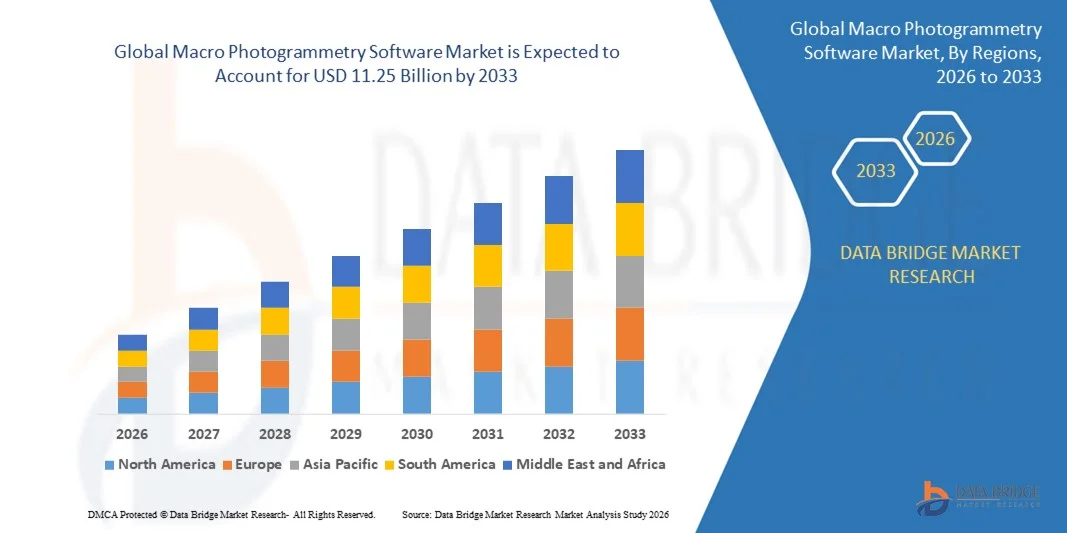
- As per Data Bridge Market Research analysis, the global macro photogrammetry software market size was valued at USD 3.57 billion in 2025 and is expected to reach USD 11.25 billion by 2033, at a CAGR of 15.40% during the forecast period
- The market growth is largely fuelled by the increasing demand for high-precision 3D mapping and modeling solutions across industries such as surveying, construction, mining, and heritage conservation
- Growing adoption of drone-based imaging systems and advancements in AI and machine learning for automated image processing are further driving market expansion
Market Size & Forecast
- Global Market Value (2025): USD 3.57 billion
- Expected Market Value (2033): USD 11.25 billion
- Forecast CAGR (2026-2033): 15.40%
What are the Major Takeaways of the Macro Photogrammetry Software Market?
- The market is witnessing significant innovation in software features, including automated point cloud generation, real-time data processing, and enhanced 3D modeling capabilities, improving efficiency and accuracy for end users
- Increasing use of macro photogrammetry in industrial inspections, agriculture, and environmental monitoring is expanding application areas, while decreasing hardware costs and improved accessibility are facilitating adoption across small and medium enterprises
- North America dominated the macro photogrammetry software market with the largest revenue share of 38.50% in 2025, driven by widespread adoption of UAVs, advanced surveying technologies, and strong demand for accurate 3D mapping across construction, mining, and infrastructure industries
- Asia-Pacific region is expected to witness the highest growth rate in the global macro photogrammetry software market, driven by expanding infrastructure development, rising industrial applications, increasing investments in UAV-based surveys, and growing awareness of advanced 3D mapping solutions across multiple sectors
- The Multi-Camera Photogrammetry segment held the largest market revenue share in 2025, driven by its ability to capture highly accurate 3D data, create detailed models, and reduce blind spots during scanning. Multi-camera setups are widely adopted in industrial inspections, construction projects, and heritage documentation for their precision and comprehensive coverage. The systems allow simultaneous capture from multiple angles, reducing post-processing time and increasing overall efficiency. As industries demand higher accuracy for complex projects, multi-camera photogrammetry continues to gain preference over simpler methods
Report Scope and Macro Photogrammetry Software Market Segmentation
|
Attributes |
Macro Photogrammetry Software Key Market Insights |
|
Segments Covered |
|
|
Countries Covered |
North America
Europe
Asia-Pacific
Middle East and Africa
South America
|
|
Key Market Players |
|
|
Market Opportunities |
|
|
Value Added Data Infosets |
In addition to the market insights such as market value, growth rate, market segments, geographical coverage, market players, and market scenario, the market report curated by the Data Bridge Market Research team includes in-depth expert analysis, import/export analysis, pricing analysis, production consumption analysis, and pestle analysis. |
What is the Key Trend in the Macro Photogrammetry Software Market?
Rising Demand for High-Precision 3D Mapping and Modeling
- The growing focus on accurate and efficient spatial data acquisition is significantly shaping the macro photogrammetry software market, as industries increasingly seek solutions that provide high-resolution 3D models, precise measurements, and reliable point cloud generation. Macro photogrammetry software is gaining traction due to its ability to streamline 3D mapping workflows, improve modeling accuracy, and integrate with existing GIS and CAD systems without extensive manual intervention
- Increasing adoption of drone-based imaging systems, UAV surveys, and aerial photogrammetry has accelerated demand across construction, mining, surveying, agriculture, and heritage conservation applications. Organizations are actively seeking software that can process large datasets efficiently, prompting vendors to develop solutions with enhanced automation, AI-assisted feature extraction, and real-time data processing capabilities
- Advanced data visualization, seamless integration with CAD/GIS platforms, and automated reporting features are influencing purchasing decisions, as users increasingly prioritize tools that enhance operational efficiency and reduce project timelines. Software providers are leveraging marketing campaigns and industry partnerships to highlight these benefits and differentiate products in a competitive market
- For instance, in 2024, Pix4D in Switzerland and Agisoft in Russia expanded their software portfolios with enhanced macro photogrammetry features for industrial inspections and heritage conservation projects. These launches were introduced in response to rising demand for high-resolution 3D mapping and modeling, with distribution across enterprise, educational, and online platforms
- While adoption of macro photogrammetry software is growing, sustained market expansion depends on continuous R&D, cost optimization, and improving processing speed and accuracy. Vendors are also focusing on cloud integration, scalability, and user-friendly interfaces to balance performance, cost, and accessibility for broader adoption
Macro Photogrammetry Software Market Dynamics
Driver
Increasing Adoption of Drone-Based Imaging and 3D Mapping
- Rising demand for high-precision 3D models is a major driver for the macro photogrammetry software market. Organizations are increasingly replacing manual surveying and legacy photogrammetry methods with advanced software to improve accuracy, reduce errors, and accelerate project completion. This trend is also pushing research into automated feature extraction, point cloud optimization, and AI-assisted image processing, supporting software innovation
- Expanding applications in construction, mining, surveying, agriculture, environmental monitoring, and heritage preservation are influencing market growth. Macro photogrammetry software helps enhance modeling precision, visualization quality, and data reliability, enabling organizations to meet operational requirements and improve decision-making. The increasing adoption of UAVs for data acquisition further reinforces this trend
- Software providers are actively promoting macro photogrammetry solutions through product innovation, marketing campaigns, and integration with drones, CAD, and GIS platforms. These efforts are supported by the growing need for high-quality spatial data, efficiency in large-scale mapping projects, and cost-effective data processing, encouraging partnerships with drone manufacturers and industry users
- For instance, in 2023, Pix4D in Switzerland and DroneDeploy in the U.S. reported increased adoption of macro photogrammetry software in construction and mining applications. This expansion followed higher demand for automated 3D mapping, improved point cloud processing, and enhanced visualization tools, driving repeat usage and solution differentiation
- Although rising drone adoption and 3D modeling trends support growth, wider adoption depends on hardware compatibility, processing speed, and software cost. Investment in cloud computing, AI-assisted processing, and advanced visualization features will be critical for meeting global demand and maintaining competitive advantage
Restraint/Challenge
High Cost and Complexity Compared to Traditional Surveying Methods
- The relatively higher cost of macro photogrammetry software compared to conventional surveying techniques remains a key challenge, limiting adoption among small and medium-sized enterprises. High licensing fees, training requirements, and the need for advanced computing hardware contribute to elevated operational costs
- User awareness and technical expertise remain uneven, particularly in emerging markets where drone usage and 3D mapping adoption are still limited. Limited understanding of software capabilities restricts adoption across certain industries and leads to slower uptake in regions with minimal educational initiatives or professional training
- Integration and data processing challenges also impact market growth, as macro photogrammetry software often requires compatibility with drones, CAD/GIS systems, and cloud platforms. Processing large datasets can be time-consuming and resource-intensive, increasing operational complexity
- For instance, in 2024, construction firms in India and Brazil reported slower uptake due to high software costs, technical complexity, and limited in-house expertise. Hardware requirements and cloud integration challenges were additional barriers. These factors also prompted some organizations to continue using traditional surveying methods, affecting software adoption
- Overcoming these challenges will require cost-efficient solutions, enhanced user training, and simplified software interfaces. Collaboration with hardware providers, training institutions, and cloud service providers can help unlock the long-term growth potential of the global macro photogrammetry software market. Furthermore, improving processing efficiency and reducing software complexity will be essential for widespread adoption
How is the Macro Photogrammetry Software Market Segmented?
The market is segmented on the basis of photogrammetry style, application, and end user.
- By Photogrammetry Style
On the basis of photogrammetry style, the global macro photogrammetry software market is segmented into Point-and-Shoot Photogrammetry, Multi-Camera Photogrammetry, and Video-to-Photogrammetry. The Multi-Camera Photogrammetry segment held the largest market revenue share in 2025, driven by its ability to capture highly accurate 3D data, create detailed models, and reduce blind spots during scanning. Multi-camera setups are widely adopted in industrial inspections, construction projects, and heritage documentation for their precision and comprehensive coverage. The systems allow simultaneous capture from multiple angles, reducing post-processing time and increasing overall efficiency. As industries demand higher accuracy for complex projects, multi-camera photogrammetry continues to gain preference over simpler methods.
The Point-and-Shoot Photogrammetry segment is expected to witness the fastest growth rate from 2026 to 2033, driven by its ease of use, lower cost, and compatibility with consumer-grade cameras. Point-and-shoot solutions are particularly popular among small businesses, educational institutions, and drone operators, providing a quick and reliable way to generate 3D models and spatial data with minimal setup. The simplicity of the workflow and reduced training requirements make it appealing for rapid deployment. Moreover, technological improvements in camera sensors and image processing are enhancing output quality, expanding its applicability across more sectors.
- By Application
On the basis of application, the market is segmented into Culture Heritage and Museum, Films and Games, Topographic Maps, Traffic Management System, 3D Printing, Drones and Robots, and Others. The Drones and Robots segment held the largest revenue share in 2025, owing to the increasing use of unmanned aerial systems for large-scale mapping, inspection, and monitoring tasks, which require efficient and accurate photogrammetry software. Drones enable cost-effective data collection in hazardous or inaccessible areas. Combined with macro photogrammetry software, they provide high-resolution 3D models for urban planning, agriculture, and mining operations. The growing integration with AI-driven analytics further enhances decision-making capabilities in real-time scenarios.
The Films and Games segment is expected to witness the fastest growth from 2026 to 2033, driven by rising demand for high-fidelity 3D assets in animation, visual effects, and virtual reality experiences. Content creators increasingly rely on macro photogrammetry software to digitize real-world objects and environments with precision. The software allows for realistic texturing and modeling, improving the immersive quality of media content. Expansion of gaming and entertainment industries worldwide is fueling investments in photogrammetry technology, further accelerating adoption. In addition, reduced processing times and improved automation are making it easier for studios of all sizes to incorporate 3D assets.
- By End User
On the basis of end user, the market is segmented into Building and Construction, Automotive, Energy, Oil and Gas, Ship Building, and Others. The Building and Construction segment held the largest market revenue share in 2025, driven by the need for accurate site surveys, progress monitoring, and structural inspections using photogrammetry solutions. Accurate 3D models help architects and engineers improve design precision and reduce project errors. Integration with BIM and CAD systems allows seamless planning and execution. Growing construction activities globally, along with increasing adoption of smart infrastructure technologies, continue to fuel demand.
The Automotive segment is expected to witness the fastest growth from 2026 to 2033, fueled by the increasing adoption of 3D modeling and inspection technologies in vehicle design, prototyping, and quality assurance processes, where high-precision macro photogrammetry provides faster and more accurate measurements. It helps manufacturers detect defects, analyze aerodynamics, and optimize component assembly. The technology also supports the production of detailed digital twins, enabling virtual testing and simulation. Rising consumer expectations for vehicle safety, performance, and aesthetics are driving broader adoption of photogrammetry solutions in this industry.
Which Region Holds the Largest Share of the Macro Photogrammetry Software Market?
- North America dominated the macro photogrammetry software market with the largest revenue share of 38.50% in 2025, driven by widespread adoption of UAVs, advanced surveying technologies, and strong demand for accurate 3D mapping across construction, mining, and infrastructure industries
- Organizations in the region highly value high-resolution 3D models, automated point cloud generation, and seamless integration with GIS and CAD systems for improved efficiency and decision-making
- This widespread adoption is further supported by robust R&D investments, technological infrastructure, and increasing demand for digital twins and smart city projects, establishing macro photogrammetry software as a critical tool for industrial and commercial applications
U.S. Macro Photogrammetry Software Market Insight
The U.S. macro photogrammetry software market captured the largest revenue share in 2025 within North America, fueled by the rapid integration of drones, UAV-based surveys, and AI-assisted photogrammetry solutions. Companies are increasingly prioritizing automated 3D modeling, accurate topographic mapping, and enhanced visualization for construction, mining, and heritage documentation. The demand for cloud-based processing, real-time analysis, and seamless GIS integration is further propelling market growth. Moreover, the expansion of industrial inspection and infrastructure monitoring applications is significantly contributing to software adoption.
Europe Macro Photogrammetry Software Market Insight
The Europe macro photogrammetry software market is expected to witness the fastest growth rate from 2026 to 2033, primarily driven by increasing demand for digital mapping, urban planning, and infrastructure monitoring. The adoption of UAVs and AI-enabled photogrammetry software is rising across construction, cultural heritage, and environmental projects. European organizations are emphasizing accuracy, efficiency, and data integration, which is fostering market expansion. The growing trend of smart city initiatives and government-backed mapping projects is further accelerating adoption across both public and private sectors.
U.K. Macro Photogrammetry Software Market Insight
The U.K. macro photogrammetry software market is expected to witness the fastest growth rate from 2026 to 2033, driven by the need for precise 3D modeling in construction, surveying, and industrial inspection projects. Increasing awareness of advanced mapping technologies and the integration of AI and cloud computing in photogrammetry solutions are boosting adoption. Furthermore, the U.K.’s focus on heritage preservation, urban development, and environmental monitoring is contributing to growing demand for high-resolution 3D mapping software.
Germany Macro Photogrammetry Software Market Insight
The Germany macro photogrammetry software market is expected to witness the fastest growth rate from 2026 to 2033, fueled by rising demand for industrial automation, precision surveying, and infrastructure inspection. Germany’s focus on digitalization, technological innovation, and sustainable urban planning encourages adoption of advanced photogrammetry solutions. Integration with UAVs, drones, and AI-assisted 3D modeling software is increasingly prevalent, supporting enhanced workflow efficiency and accurate data capture across construction and industrial sectors.
Asia-Pacific Macro Photogrammetry Software Market Insight
The Asia-Pacific macro photogrammetry software market is expected to witness the fastest growth rate from 2026 to 2033, driven by rapid urbanization, industrial expansion, and government initiatives promoting smart city and infrastructure projects. Increasing adoption of drones, UAV surveys, and AI-assisted photogrammetry software in countries such as China, Japan, and India is accelerating market growth. The region’s emphasis on cost-effective, high-precision mapping solutions and growing investment in construction, mining, and agriculture further supports software adoption.
Japan Macro Photogrammetry Software Market Insight
The Japan macro photogrammetry software market is expected to witness the fastest growth rate from 2026 to 2033 due to the country’s technologically advanced landscape, growing reliance on UAVs, and demand for precise 3D modeling in urban planning and construction. Japanese enterprises prioritize accuracy, automation, and AI-enabled data processing, which is driving software adoption. In addition, the increasing number of infrastructure projects and industrial inspections is boosting demand for efficient photogrammetry solutions.
China Macro Photogrammetry Software Market Insight
The China macro photogrammetry software market accounted for the largest market revenue share in Asia-Pacific in 2025, attributed to rapid urbanization, large-scale infrastructure projects, and high adoption of drone-based surveys. China’s push towards smart city development and digitization of industrial and construction processes is fueling demand for advanced photogrammetry software. Affordable solutions, local software providers, and strong government support for mapping and monitoring initiatives are key factors driving market growth in China.
Which are the Top Companies in the Macro Photogrammetry Software Market?
The Macro Photogrammetry Software industry is primarily led by well-established companies, including:
- Pix4D SA (Switzerland)
- 3Dflow SR (Italy)
- Agisoft (Russia)
- Capturing Reality s.r.o. (Slovakia)
- NUBIGON Inc. (Canada)
- Linearis3D GmbH & Co.KG (Germany)
- Menci software SRL (Italy)
- Photometrix Photogrammetry Software (Australia)
- Skyline Software Systems Inc. (U.S.)
- Racurs (Russia)
- SimActive Inc. (Canada)
- ICAROS (Italy)
- Magnasoft (Germany)
- DroneDeploy (U.S.)
- PhotoModeler Technologies (Canada)
- Esri International LLC (U.S.)
- Autodesk, Inc. (U.S.)
- Trimble Inc. (U.S.)
- Hexagon AB (Sweden)
- Vexcel Imaging GmbH (Austria)
- nFrames (Germany)
- REDcatch GmbH (Germany)

- Interactive Data Analysis Dashboard
- Company Analysis Dashboard for high growth potential opportunities
- Research Analyst Access for customization & queries
- Competitor Analysis with Interactive dashboard
- Latest News, Updates & Trend analysis
- Harness the Power of Benchmark Analysis for Comprehensive Competitor Tracking
Data collection and base year analysis are done using data collection modules with large sample sizes. The stage includes obtaining market information or related data through various sources and strategies. It includes examining and planning all the data acquired from the past in advance. It likewise envelops the examination of information inconsistencies seen across different information sources. The market data is analysed and estimated using market statistical and coherent models. Also, market share analysis and key trend analysis are the major success factors in the market report. To know more, please request an analyst call or drop down your inquiry.
The key research methodology used by DBMR research team is data triangulation which involves data mining, analysis of the impact of data variables on the market and primary (industry expert) validation. Data models include Vendor Positioning Grid, Market Time Line Analysis, Market Overview and Guide, Company Positioning Grid, Patent Analysis, Pricing Analysis, Company Market Share Analysis, Standards of Measurement, Global versus Regional and Vendor Share Analysis. To know more about the research methodology, drop in an inquiry to speak to our industry experts.
Data Bridge Market Research is a leader in advanced formative research. We take pride in servicing our existing and new customers with data and analysis that match and suits their goal. The report can be customized to include price trend analysis of target brands understanding the market for additional countries (ask for the list of countries), clinical trial results data, literature review, refurbished market and product base analysis. Market analysis of target competitors can be analyzed from technology-based analysis to market portfolio strategies. We can add as many competitors that you require data about in the format and data style you are looking for. Our team of analysts can also provide you data in crude raw excel files pivot tables (Fact book) or can assist you in creating presentations from the data sets available in the report.













