


What is the Macroencapsulation Market Size and Growth Rate?
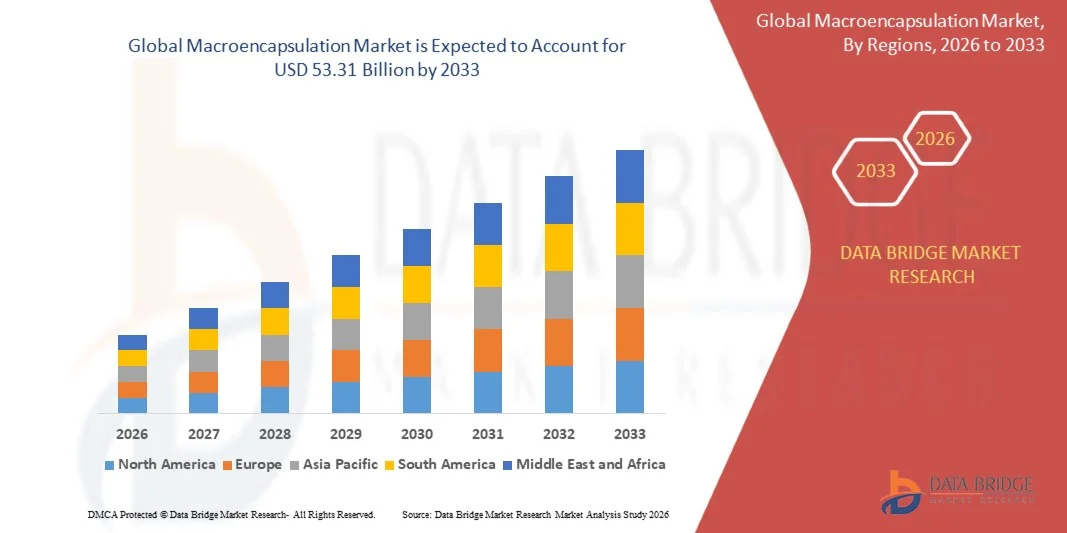
- As per Data Bridge Market Research analysis, the macroencapsulation market was valued at USD 18.30 billion in 2025 and is projected to reach USD 53.31 billion by 2033, growing at a CAGR of 14.3% from 2026 to 2033.
- The market is experiencing steady growth driven by the rising demand for phase change material encapsulation in thermal energy storage and building applications, growing adoption of controlled-release agrochemical formulations, and expanding use of macroencapsulated additives across construction, energy, and industrial materials.
- The growing global emphasis on energy efficiency and decarbonization, combined with increasing government incentives for thermal energy storage and sustainable construction materials, is compelling manufacturers to scale macroencapsulation capacity for phase change materials used in building insulation, HVAC systems, and cold-chain packaging. Rising adoption of macroencapsulated slow-release fertilizers and pesticides in precision agriculture is further supporting demand for durable, larger-format encapsulation formats that withstand mechanical handling and environmental exposure.
- Increasing integration of macroencapsulation technology in battery thermal management and self-healing construction materials is opening new application avenues, as manufacturers seek to combine protective isolation with functional release characteristics in a single engineered particle or panel format.
- Continued advancement of large-format encapsulation formats capable of withstanding harsh mechanical handling and repeated environmental exposure cycles is expanding the addressable use cases for macroencapsulation beyond traditional agrochemical and pharmaceutical applications into structural and infrastructure-grade materials.
Market Size & Forecast
- Global Market Value (2025): USD 18.30 Billion
- Expected Market Value (2033): USD 53.31 Billion
- Forecast CAGR (2026–2033): 14.3%
- Leading Region in 2025: Europe
- Fastest Growing Region: Asia-Pacific
What are the Major Takeaways of the Macroencapsulation Market?
- Europe dominated the global macroencapsulation market with the largest revenue share of 34.72% in 2025, supported by strong regulatory push for energy-efficient buildings and well-established phase change material manufacturing capabilities.
- Asia-Pacific is expected to be the fastest-growing region at a CAGR of 16.8% from 2026 to 2033, fueled by rapid construction activity, expanding agricultural modernization, and increasing chemical manufacturing capacity in China and India.
- The polymer-based material type segment led the market with a 48.63% share in 2025, driven by its versatility, cost-effectiveness, and compatibility with diverse core materials across construction and agricultural applications.
- The phase change materials core material segment is the fastest-growing category, projected to register a CAGR of 17.2%, reflecting rising demand for thermal energy storage solutions in buildings, cold-chain logistics, and battery systems.
- The building & construction materials application segment dominated the application category with a 38.94% revenue share in 2025, led by growing integration of macroencapsulated PCM into insulation panels, wallboards, and concrete formulations.
- The direct sales distribution channel accounted for 63.28% of the market share in 2025, preferred for its close technical collaboration between manufacturers and large-scale industrial and construction customers.
- The self-healing function segment is the fastest-growing functional category, with a CAGR of 18.1%, driven by rising adoption of macroencapsulated healing agents in infrastructure and coating applications.
Report Scope and Macroencapsulation Market Segmentation
|
Attributes |
Macroencapsulation Key Market Insights |
|
Segments Covered |
|
|
Countries Covered |
North America
Europe
Asia-Pacific
Middle East and Africa
South America
|
|
Key Market Players |
|
|
Market Opportunities |
|
|
Value Added Data Infosets |
In addition to the insights on market scenarios such as market value, growth rate, segmentation, geographical coverage, and major players, the market reports curated by the Data Bridge Market Research also include in-depth expert analysis, geographically represented company-wise production and capacity, network layouts of distributors and partners, detailed and updated price trend analysis and deficit analysis of supply chain and demand. |
What is the Key Trend in the Macroencapsulation Market?
- Building material manufacturers are increasingly integrating macroencapsulated phase change materials into wallboards, insulation panels, and concrete formulations to improve thermal regulation and reduce building energy consumption.
- For instance, in April 2025, BASF SE expanded its Micronal-branded macroencapsulated PCM product line for the European construction sector, offering enhanced thermal storage capacity for passive building temperature regulation.
- Rising adoption of macroencapsulated slow-release fertilizer granules is enabling precision agriculture operations to reduce nutrient runoff and application frequency while improving crop yield consistency.
- Manufacturers are increasingly investing in self-healing macroencapsulation technology for infrastructure coatings and concrete, where rupture of embedded capsules releases healing agents that automatically seal microcracks and extend structural service life.
- For instance, in January 2025, Sika AG introduced an expanded self-healing concrete additive line incorporating macroencapsulated healing agents, targeting infrastructure and civil engineering applications requiring extended durability.
- As industries continue to prioritize energy efficiency, sustainability, and functional material innovation, the adoption of macroencapsulation technology is expected to accelerate, reinforcing its role as a foundational technology across construction, agriculture, and energy storage applications.
What are the Key Drivers of the Macroencapsulation Market?
- The rising global emphasis on building energy efficiency and thermal management has significantly increased demand for macroencapsulated phase change materials capable of reducing heating and cooling loads across residential and commercial structures.
- For instance, in March 2025, Rubitherm Technologies expanded its macroencapsulated PCM production capacity in Europe to meet rising demand from construction and cold-chain logistics customers.
- Agricultural producers and agrochemical manufacturers are increasingly incorporating macroencapsulated controlled-release fertilizers and pesticides into precision farming programs to reduce environmental runoff, improve nutrient-use efficiency, and lower overall input costs.
- For instance, in October 2024, Syngenta AG announced an investment in additional macroencapsulation manufacturing capacity to support rising orders for controlled-release agrochemical formulations across North America and Asia-Pacific.
- With industries increasingly relying on functional materials to improve energy efficiency, agricultural productivity, and infrastructure durability, macroencapsulation technology will remain indispensable across construction, agriculture, and energy storage applications.
- For instance, in June 2024, DuPont de Nemours expanded its macroencapsulated battery thermal management materials portfolio, supporting growing demand from electric vehicle and energy storage system manufacturers.
- With growing adoption of functional materials across energy-efficient buildings, precision agriculture, cold-chain logistics, and energy storage, macroencapsulation technology is expected to remain an important enabler of improved thermal management, controlled release, resource efficiency, and product performance across diverse end-use industries.
Which Factors are Challenging the Growth of the Macroencapsulation Market?
- Macroencapsulation processes require significant capital investment in specialized coating, extrusion, and fluidized-bed equipment, along with material-specific formulation development, which increases the overall cost of establishing new production capacity.
- These high capital and formulation-development costs limit adoption among smaller manufacturers and constrain the entry of new players into price-sensitive agricultural and construction material markets.
- For instance, in September 2024, Euro Panel Products Ltd. invested in an advanced coating line to expand its manufacturing capabilities, illustrating the substantial capital expenditure associated with installing specialized coating infrastructure and scaling advanced material-processing operations.
- The high capital investment and formulation-development lead times associated with macroencapsulation continue to restrict adoption, particularly among small and medium-sized manufacturers in emerging markets. This cost and lead-time barrier slows market penetration in price-sensitive regions, limiting the widespread deployment of advanced macroencapsulation technologies despite growing demand across construction and agricultural applications.
How is the Macroencapsulation Market Segmented?
The macroencapsulation market is segmented on the basis of material type, core material, technique, capsule size, application, end-use industry, form, function, distribution channel and end user.
- By Material Type
On the basis of material type, the global macroencapsulation market is segmented into polymer-based, metal-based, ceramic-based, and others. The polymer-based segment dominated the market with a 48.63% share in 2025, owing to its versatility, cost-effectiveness, and compatibility with diverse core materials across construction and agricultural applications. These shell materials deliver flexible mechanical properties and tunable permeability, making them the preferred choice for phase change material and agrochemical encapsulation applications.
The ceramic-based segment is projected to register the fastest growth at a CAGR of 16.4% from 2026 to 2033, driven by rising demand for high-temperature-resistant shell materials in battery thermal management and industrial process applications. Advances in ceramic shell formulations, combined with growing adoption in energy storage systems, are accelerating segment expansion.
- By Core Material
On the basis of core material, the global macroencapsulation market is segmented into phase change materials, agrochemicals & fertilizers, catalysts & enzymes, active pharmaceutical/nutraceutical ingredients, and others. The agrochemicals & fertilizers segment led the market with a 36.92% share in 2025, supported by extensive use of macroencapsulated slow-release formulations in precision agriculture and turf management applications.
The phase change materials segment is expected to experience the fastest growth at a CAGR of 17.2% from 2026 to 2033, driven by increasing demand for thermal energy storage solutions in buildings, cold-chain logistics, and battery systems.
- By Technique
On the basis of technique, the global macroencapsulation market is segmented into coating/pan coating, extrusion, fluidized bed coating, spray drying, and others. The fluidized bed coating segment dominated the market with a share of 33.75% in 2025 due to its widespread adoption in producing uniform, mechanically durable shell coatings for agrochemical and construction material applications, increasing demand for scalable batch-processing capabilities, and growing integration with automated quality-inspection systems. Additionally, rising focus on process consistency and yield optimization further supports the strong adoption of fluidized bed coating technology.
The extrusion segment is anticipated to witness the fastest CAGR of 16.9% from 2026 to 2033, driven by the increasing need for continuous, high-throughput production of macrocapsules with consistent shell thickness for phase change material and building material applications. Manufacturers are adopting extrusion-based platforms to conduct cost-effective, scalable, and repeatable macrocapsule production. Additionally, the integration of extrusion technology with in-line quality-monitoring systems is enhancing the accuracy and efficiency of macroencapsulation manufacturing, further driving segment growth.
- By Capsule Size
On the basis of capsule size, the global macroencapsulation market is segmented into small macrocapsules (1-5 mm), medium macrocapsules (5-20 mm), and large macrocapsules (>20 mm). The small macrocapsules segment dominated the market with a share of 45.28% in 2025 due to its critical role in providing balanced payload capacity and mechanical durability for agrochemical and phase change material applications. The widespread adoption of small-format macrocapsules across granular fertilizer and building insulation applications is driving strong demand for this capsule-size category.
The large macrocapsules segment is expected to witness the fastest CAGR of 15.8% from 2026 to 2033, driven by the rising need for high-payload thermal energy storage panels and self-healing construction elements requiring larger encapsulated volumes. Manufacturers are increasingly integrating large-format macrocapsules into structural and infrastructure applications. Additionally, the growing emphasis on large-scale thermal energy storage deployment is further accelerating adoption of this capsule-size category.
- By Application
On the basis of application, the global macroencapsulation market is segmented into thermal energy storage, agriculture & fertilizers, building & construction materials, batteries & energy storage, textiles, and others. The building & construction materials segment dominated the market with a share of 38.94% in 2025 due to its critical role in enabling passive thermal regulation, energy-efficient insulation, and self-healing structural elements across residential and commercial construction. High adoption is driven by the increasing need for energy-efficient building solutions, integration with green-building certification programs, and enhanced construction-material performance. Additionally, growing investment by construction material manufacturers and government energy-efficiency programs is reinforcing the leading position of this segment in the market.
The batteries & energy storage segment is expected to witness the fastest CAGR of 18.6% from 2026 to 2033. This growth is driven by increasing demand for macroencapsulated thermal management materials that protect battery cells from thermal runaway and improve energy storage system safety. Growing adoption of electric vehicles and grid-scale energy storage installations is further accelerating market expansion in this segment.
- By End-Use Industry
On the basis of end-use industry, the global macroencapsulation market is segmented into construction, agriculture, energy & power, textile, chemicals & industrial, and others. The construction segment dominated the market with a share of 41.37% in 2025 due to its widespread use in energy-efficient building materials, insulation systems, and self-healing structural elements. Rising adoption of macroencapsulated phase change materials and healing agents in green-building projects is enabling construction companies to enhance building performance, reduce energy consumption, and meet sustainability certification requirements. Additionally, increasing investment by construction material manufacturers and government building-efficiency mandates is accelerating adoption and reinforcing this segment's leading position in the market.
The energy & power segment is expected to witness the fastest CAGR of 17.9% from 2026 to 2033, driven by the increasing integration of macroencapsulated phase change materials and thermal management components in battery systems, grid-scale energy storage, and renewable energy infrastructure. These materials enhance thermal stability, improve system safety, and allow more efficient energy storage and release cycles, making macroencapsulation technology more accessible, scalable, and valuable for the energy transition.
- By Form
On the basis of form, the global macroencapsulation market is segmented into capsules/beads, granules & pellets, and sheets & panels. The granules & pellets segment dominated the market with a share of 44.16% in 2025 due to its critical role in providing scalable, easy-to-handle formats for agrochemical and industrial applications requiring bulk distribution and mechanized application. Additionally, established partnerships with agricultural distributors, fertilizer producers, and industrial chemical suppliers are expanding reach, improving accessibility, and reinforcing the adoption of granular macroencapsulation formats across global markets.
The sheets & panels segment is expected to witness the fastest CAGR of 17.1% from 2026 to 2033. This growth is primarily driven by the increasing demand for prefabricated thermal energy storage panels and insulation boards used in building and construction applications. Manufacturers are leveraging advanced macroencapsulation techniques to enhance panel durability, enable consistent thermal performance, and support modular construction methods, thereby accelerating adoption across residential and commercial building applications.
- By Function
On the basis of function, the global macroencapsulation market is segmented into controlled release, thermal regulation, protection & isolation, and self-healing. The controlled release segment dominated the market with a share of 39.62% in 2025 due to its widespread use in agrochemical and nutraceutical applications requiring precise, time-released delivery of active ingredients. High adoption is supported by agricultural producers, fertilizer manufacturers, and industrial chemical suppliers that rely on controlled-release macroencapsulation to ensure consistency, efficiency, and measurable application outcomes. Additionally, increasing integration with precision agriculture and smart-farming technologies enhances application accuracy and reinforces the dominance of the controlled release function segment.
The self-healing segment is expected to witness the fastest CAGR of 18.1% from 2026 to 2033, driven by the increasing demand for durable, low-maintenance infrastructure and coating solutions that automatically repair microcracks and extend service life. By offering embedded healing-agent release upon damage, this function enhances structural durability, reduces maintenance costs, and extends asset lifecycles, making self-healing macroencapsulation highly attractive for infrastructure, coatings, and construction applications.
- By Distribution Channel
On the basis of distribution channel, the global macroencapsulation market is segmented into direct sales and distributors. The direct sales segment dominated the market with a share of 63.28% in 2025 due to its preference among large-scale construction material manufacturers, agrochemical producers, and industrial customers that require close collaboration on formulation design, shell-material selection, and quality validation for critical applications. Additionally, established long-term supply agreements, regional production facilities, and integrated technical support are facilitating faster product qualification and adoption of direct-sourced macroencapsulation solutions, while strong technical support networks are improving accessibility, reliability, and trust, further reinforcing this segment's leading market position.
The distributors segment is expected to witness the fastest CAGR of 13.6% from 2026 to 2033. This growth is primarily driven by the increasing demand from small and medium-sized agricultural and construction material buyers for standardized, readily available macroencapsulated products across multiple industries. Distributors offer scalable, cost-effective sourcing solutions for construction, agriculture, and industrial applications, while providing regional inventory support, technical guidance, and seamless integration with buyers' procurement systems, enhancing overall sourcing efficiency and flexibility.
- By End User
On the basis of end user, the global macroencapsulation market is segmented into industrial manufacturers, construction companies, agricultural producers, and energy companies. The industrial manufacturers segment dominated the market with a share of 37.84% in 2025 due to its widespread role in integrating macroencapsulated materials into finished chemical, textile, and consumer products requiring functional performance characteristics. Additionally, established manufacturing infrastructure, broad supplier familiarity, and extensive formulation-development history are facilitating continued adoption of macroencapsulation among industrial manufacturers, while strong supplier support networks are improving accessibility, reliability, and trust, further reinforcing this segment's leading market position.
The energy companies segment is expected to witness the fastest CAGR of 18.3% from 2026 to 2033, driven by the increasing adoption of macroencapsulated phase change materials and thermal management solutions in grid-scale energy storage, battery systems, and renewable energy infrastructure. These solutions enhance thermal stability, improve system safety, and allow more efficient energy storage and release cycles, making macroencapsulation technology increasingly valuable for the global energy transition.
Which Region Holds the Largest Share of the Macroencapsulation Market?
- Europe dominated the macroencapsulation market and accounted for the largest revenue share of 34.72% in 2025, supported by strong regulatory push for energy-efficient buildings, well-established phase change material manufacturing capabilities, and the presence of established chemical and materials producers.
- The region also benefits from strong government incentives for sustainable construction and thermal energy storage, high adoption of self-healing infrastructure materials, and growing use of macroencapsulation across building, agriculture, and energy storage applications. Increasing focus on decarbonization and circular-economy manufacturing continues to strengthen Europe's leadership position in the global market.
Germany Macroencapsulation Market Insight
The Germany macroencapsulation market is growing steadily, driven by the country's strong chemical manufacturing base, stringent building energy-efficiency regulations, and rising adoption of macroencapsulated phase change materials in construction and industrial applications. Growing adoption of self-healing concrete additives and thermal energy storage panels across commercial and residential construction is significantly boosting market demand. In addition, rising investments in domestic materials-science research and development, increasing export-oriented chemical production, and rapid technological advancements are positioning Germany as a leading market for macroencapsulation in Europe.
France Macroencapsulation Market Insight
The France macroencapsulation market is witnessing steady growth due to the country's strong chemical and materials manufacturing base, stringent building energy-performance regulations, and continued adoption of macroencapsulated phase change materials in construction applications. Chemical companies, construction material manufacturers, and research institutes are increasingly utilizing macroencapsulation technologies for thermal regulation and self-healing infrastructure applications. Continuous advancements in shell-material formulations, process automation, and sustainability certification frameworks are further driving market growth in France.
Asia-Pacific Macroencapsulation Market Insight
The Asia-Pacific macroencapsulation market is expected to witness rapid growth, driven by heavy building work, modern farming, and larger chemical plants in China and India. Macroencapsulation is a process where larger amounts of core materials or active substances are enclosed within a protective shell or matrix. This technology protects harsh chemicals, controls the release of agrochemicals, and adds durability to construction materials.
China Macroencapsulation Market Insight
The China macroencapsulation market is expanding rapidly, supported by large-scale construction activity, growing agricultural modernization initiatives, and increasing domestic chemical manufacturing capacity. Manufacturers and agricultural producers are increasingly utilizing macroencapsulated controlled-release fertilizers and phase change materials for both agricultural and construction applications. Continuous expansion of chemical production infrastructure, government energy-efficiency mandates, and rising domestic demand for sustainable building materials are further driving market growth in China.
Japan Macroencapsulation Market Insight
The Japan macroencapsulation market is witnessing consistent growth due to rising investments in advanced materials technologies, precision manufacturing innovation, and strong domestic focus on energy-efficient building and battery thermal management solutions. Chemical manufacturers, construction companies, and research institutes are increasingly adopting high-precision macroencapsulation technologies for phase change material and energy storage applications. Moreover, increasing integration of macroencapsulated materials into electric vehicle battery systems and the country's focus on quality and reliability are further contributing to market growth.
Which are the Top Companies in Macroencapsulation Market?
The macroencapsulation industry is primarily led by well-established companies, including:
- BASF SE (Germany)
- Rubitherm Technologies GmbH (Germany)
- Croda International Plc (U.K.)
- Microtek Laboratories, Inc. (U.S.)
- PCM Products Ltd. (U.K.)
- Climator Sweden AB (Sweden)
- Entropy Solutions LLC (U.S.)
- Encapsys, LLC (Sensient Technologies) (U.S.)
- Sasol Limited (South Africa)
- DuPont de Nemours, Inc. (U.S.)
- Honeywell International Inc. (U.S.)
- Cabot Corporation (U.S.)
- Arkema S.A. (France)
- Cargill, Incorporated (U.S.)
- Syngenta AG (Switzerland)
- UPL Limited (India)
- Koppert B.V. (Netherlands)
- Balchem Corporation (U.S.)
- The Lubrizol Corporation (U.S.)
- Evonik Industries AG (Germany)
- Wacker Chemie AG (Germany)
- SGL Carbon SE (Germany)
- Saint-Gobain S.A. (France)
- Knauf Insulation (Germany)
- Sika AG (Switzerland)
- Autonomic Materials, Inc. (U.S.)
- PLUSS Advanced Technologies Pvt. Ltd. (India)
- Advansix Inc. (U.S.)
- Rockwool A/S (Denmark)
- Beijing Guanghe New Materials Co., Ltd. (China)
What are Latest Developments in Macroencapsulation Market?
- In September 2025, BASF SE launched an expanded macroencapsulated phase change material product line for cold-chain packaging and building insulation applications, strengthening its position in the European sustainable materials market.
- In February 2025, Rubitherm Technologies expanded its PCM macroencapsulation manufacturing capacity in Germany to support growing demand for thermal energy storage solutions from construction and logistics customers.
- In November 2025, Sika AG introduced an upgraded self-healing macroencapsulation technology for infrastructure coatings, improving crack-sealing performance and extending maintenance intervals for bridge and tunnel applications. This development strengthens Sika's position in the durable construction materials market by enabling infrastructure operators to reduce long-term maintenance costs.
- In October 2024, Syngenta AG expanded its controlled-release agrochemical manufacturing capacity in North America to include additional macroencapsulated fertilizer formulations, improving supply continuity for precision agriculture customers.
- In June 2023, DuPont de Nemours partnered with a battery systems manufacturer to co-develop macroencapsulated thermal management materials for electric vehicle battery packs, combining its materials science expertise with the partner's battery systems integration capabilities to support improved thermal safety and performance.
- In March 2023, Microtek Laboratories received manufacturing certification for an expanded macroencapsulated PCM production line targeting cold-chain packaging applications, enabling the company to serve growing demand from pharmaceutical and food-logistics customers requiring temperature-stable shipping solutions.

- Interactive Data Analysis Dashboard
- Company Analysis Dashboard for high growth potential opportunities
- Research Analyst Access for customization & queries
- Competitor Analysis with Interactive dashboard
- Latest News, Updates & Trend analysis
- Harness the Power of Benchmark Analysis for Comprehensive Competitor Tracking
Global Macroencapsulation Market, Supply Chain Analysis and Ecosystem Framework
To support market growth and help clients navigate the impact of geopolitical shifts, DBMR has integrated in-depth supply chain analysis into its Global Macroencapsulation Market research reports. This addition empowers clients to respond effectively to global changes affecting their industries. The supply chain analysis section includes detailed insights such as Global Macroencapsulation Market consumption and production by country, price trend analysis, the impact of tariffs and geopolitical developments, and import and export trends by country and HSN code. It also highlights major suppliers with data on production capacity and company profiles, as well as key importers and exporters. In addition to research, DBMR offers specialized supply chain consulting services backed by over a decade of experience, providing solutions like supplier discovery, supplier risk assessment, price trend analysis, impact evaluation of inflation and trade route changes, and comprehensive market trend analysis.
Data collection and base year analysis are done using data collection modules with large sample sizes. The stage includes obtaining market information or related data through various sources and strategies. It includes examining and planning all the data acquired from the past in advance. It likewise envelops the examination of information inconsistencies seen across different information sources. The market data is analysed and estimated using market statistical and coherent models. Also, market share analysis and key trend analysis are the major success factors in the market report. To know more, please request an analyst call or drop down your inquiry.
The key research methodology used by DBMR research team is data triangulation which involves data mining, analysis of the impact of data variables on the market and primary (industry expert) validation. Data models include Vendor Positioning Grid, Market Time Line Analysis, Market Overview and Guide, Company Positioning Grid, Patent Analysis, Pricing Analysis, Company Market Share Analysis, Standards of Measurement, Global versus Regional and Vendor Share Analysis. To know more about the research methodology, drop in an inquiry to speak to our industry experts.
Data Bridge Market Research is a leader in advanced formative research. We take pride in servicing our existing and new customers with data and analysis that match and suits their goal. The report can be customized to include price trend analysis of target brands understanding the market for additional countries (ask for the list of countries), clinical trial results data, literature review, refurbished market and product base analysis. Market analysis of target competitors can be analyzed from technology-based analysis to market portfolio strategies. We can add as many competitors that you require data about in the format and data style you are looking for. Our team of analysts can also provide you data in crude raw excel files pivot tables (Fact book) or can assist you in creating presentations from the data sets available in the report.













