


What is the Magnetic Materials Market Size and Growth Rate?
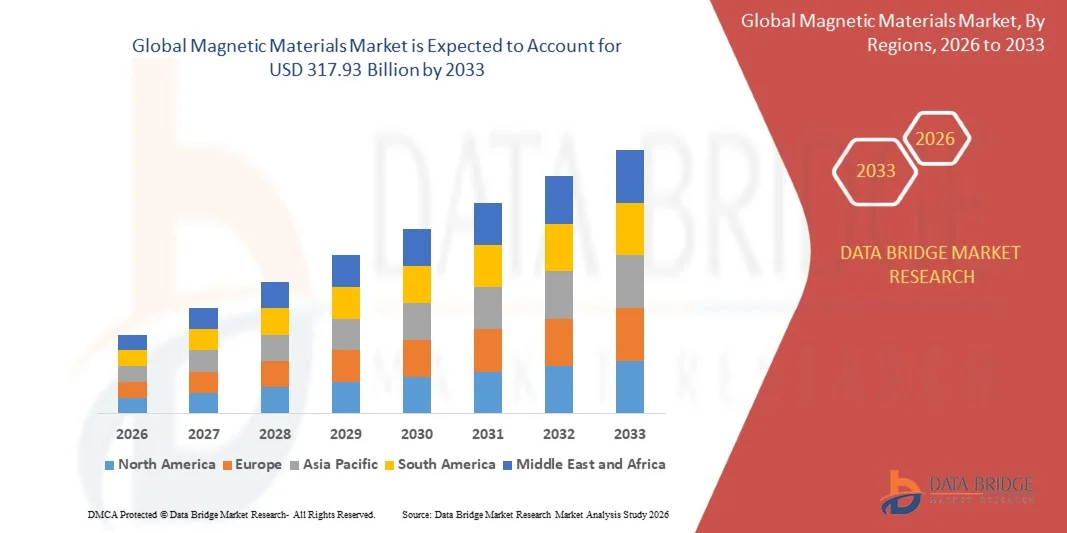
- As per Data Bridge Market Research analysis, the magnetic materials market was valued at USD 152.15 billion in 2025 and is projected to reach USD 317.93 billion by 2033, growing at a CAGR of 9.65% from 2026 to 2033.
- The market is experiencing rapid growth driven by accelerating electrification of transport, expanding renewable energy and power grid investment, and increasing adoption of high-efficiency motors, transformers, and power electronics across industrial, automotive, and consumer applications.
- The increasing shift toward high-efficiency electric drivetrains and low-loss grid equipment, combined with growing adoption of high-performance neodymium-iron-boron magnets and advanced amorphous and nanocrystalline soft magnetic alloys, is supporting market adoption. Magnetic materials are being applied across traction motors, wind generators, and distribution transformers, sensors and actuators, and data storage devices, offering higher efficiency, compact design, and lower energy losses for end users.
Market Size & Forecast
- Global Market Value (2025): USD 152.15 Billion
- Expected Market Value (2033): USD 317.93 Billion
- Forecast CAGR (2026–2033): 9.65%
- Leading Region in 2025: Asia-Pacific
- Fastest Growing Region: North America
What are the Major Takeaways of the Magnetic Materials Market?
- Asia-Pacific dominated the magnetic materials market with the largest revenue share of 58.60% in 2025, supported by the region's dominant rare earth processing and magnet manufacturing base, large electrical steel capacity, and strong EV, wind, and electronics production.
- North America is expected to be the fastest-growing region at a CAGR of 11.45% from 2026 to 2033, fueled by government-backed reshoring of rare earth magnet supply chains, expanding EV and defense demand, and new magnet manufacturing capacity.
- The electrical steel segment led the market with a 41.35% share in 2025, driven by its indispensable role in transformer cores, motors, and generators across power and industrial applications.
- Neodymium iron boron is the fastest-growing material, projected to register a CAGR of 12.05%, reflecting the surge in demand for high-energy-density magnets in EV traction motors, wind turbines, and robotics.
- The soft magnetic materials segment dominated the type category with a 58.40% revenue share in 2025, led by extensive use in transformers, inductors, and electric motor laminations.
- Motors & generators accounted for 44.80% of the market share in 2025, preferred by increasing use of magnetic materials in industrial drives, vehicle traction systems, and power generation equipment.
- The sensors & actuators segment is the fastest-growing application category, with a CAGR of 11.20%, driven by increasing deployment of robotics, advanced driver-assistance systems, and industrial automation.
Report Scope and Magnetic Materials Market Segmentation
|
Attributes |
Magnetic Materials Key Market Insights |
|
Segments Covered |
|
|
Countries Covered |
North America
Europe
Asia-Pacific
Middle East and Africa
South America
|
|
Key Market Players |
|
|
Market Opportunities |
|
|
Value Added Data Infosets |
In addition to the insights on market scenarios such as market value, growth rate, segmentation, geographical coverage, and major players, the market reports curated by the Data Bridge Market Research also include import export analysis, production capacity overview, production consumption analysis, price trend analysis, climate change scenario, supply chain analysis, value chain analysis, raw material/consumables overview, vendor selection criteria, PESTLE Analysis, Porter Analysis, and regulatory framework. |
What is the Key Trend in the Magnetic Materials Market?
- The magnetic materials industry is steadily moving toward diversified, regionally secure supply chains, with producers building integrated oxide-to-magnet capacity outside China, expanding recycling, and developing magnets that reduce or eliminate dependence on heavy rare earth elements.
- For instance, in September 2025, according to Neo Performance Materials, the company officially opened its sintered neodymium iron boron magnet plant in Narva, Estonia, with initial capacity of 2,000 tonnes per year and a Phase 1 design capacity of 5,000 tonnes per year; in September 2026, the plant began shipping commercial volumes to a tier-one supplier of electric vehicle motors, highlighting the emergence of non-Chinese magnet capacity.
- Rare-earth-free permanent magnets based on iron nitride and other chemistries are moving from pilot scale toward commercial production, as motor designers seek performance alternatives that are insulated from rare earth price and export-control volatility.
- Demand is also shifting toward high-efficiency soft magnetic materials, including thinner-gauge electrical steel and amorphous and nanocrystalline alloys, as utilities, data centers, and EV charging operators seek lower core losses in transformers, inductors, and power electronics.
- For instance, in September 2026, according to Niron Magnetics, the company marked the steel-raising milestone at its Sartell, Minnesota plant, which is designed to produce up to 1,500 tons of rare-earth-free iron nitride magnets annually and will be operational in 2027, following a conditional commitment of up to USD 150 million from the U.S. Department of War’s Office of Strategic Capital in August 2026, illustrating growing investment in rare-earth-free magnet technologies.
- As electrification, supply-chain localization, and efficiency requirements continue to advance, magnetic materials are expected to evolve from a commodity input into a strategically managed, application-engineered material across mobility, energy, and industrial systems.
What are the Key Drivers of the Magnetic Materials Market?
- Accelerating electrification of transport, renewable power generation, and industrial automation is increasing demand for magnetic materials, which enable efficient motors, generators, transformers, sensors, and power conversion equipment.
- For instance, in May 2026, according to the International Energy Agency (IEA) Global EV Outlook 2026, global electric car sales grew by 20% to exceed 20 million units in 2025, accounting for one in four new cars sold, with sales projected to reach 23 million in 2026, highlighting the scale of demand for traction motor magnets and electrical steel.
- Wind turbine generators, EV traction motors, industrial drives, and grid transformers rely on high-performance permanent magnets and low-loss soft magnetic cores to achieve higher power density, efficiency, and reliability, encouraging manufacturers to secure long-term material supply.
- For instance, in April 2026, according to the Global Wind Energy Council (GWEC), global wind installations reached a record 165 GW in 2025, up 40% from the previous record year, bringing cumulative capacity to 1,299 GW, with 969 GW of new capacity projected between 2026 and 2030, demonstrating sustained demand from wind power generation.
- With EV adoption, wind and grid buildout, and industrial and robotics automation continuing to expand across regions, magnetic materials are expected to remain essential to efficient and compact electromechanical and power systems.
What Factors Are Challenging the Growth of the Magnetic Materials Market?
- Concentration of rare earth processing and magnet manufacturing in a single country exposes magnet users to export controls, licensing delays, and supply interruptions, creating procurement and production planning uncertainty for automotive, industrial, and defense customers.
- For instance, in April 2025, according to the IEA, China introduced export controls on seven heavy rare earth elements and all related compounds, metals, and magnets, after which many carmakers in the United States, Europe, and elsewhere struggled to obtain permanent magnets and some cut utilization rates or temporarily shut down factories; for the full year, China exported 57,392 tons of rare earth magnets, a 1.3% decline, with shipments to the U.S. falling 20.3% to 5,933 tons, according to Chinese customs data.
- Volatility in the prices of neodymium, praseodymium, dysprosium, and terbium, together with the price gap between Chinese and non-Chinese supply, raises the cost of building and operating magnet capacity outside China and complicates long-term contracting.
- Lengthy automotive and industrial qualification cycles, limited recycling infrastructure, and the technical difficulty of substituting heavy rare earths without sacrificing high-temperature performance can further slow the ramp-up of new suppliers and alternative materials.
- For instance, in October 2025, according to the IEA, China announced further export controls that would require foreign companies to obtain licenses for parts, components, and assemblies containing Chinese-sourced rare earth materials or produced using Chinese rare earth technologies; the controls were later eased, with magnet exports rising 13% in November 2025, according to the Center for Strategic and International Studies (CSIS), illustrating how quickly policy shifts can alter supply availability.
- The combination of export-control risk, raw material price volatility, long qualification timelines, and high capital costs for new capacity can constrain adoption and profitability, particularly for manufacturers outside China and in price-sensitive end-use segments.
How is the Magnetic Materials Market Segmented?
The magnetic materials market is segmented on the basis of material, type, application, and end-use industry.
- By Material
On the basis of material, the magnetic materials market is segmented into electrical steel, neodymium iron boron, ferrite, samarium cobalt, alnico, amorphous & nanocrystalline alloys, and others. The electrical steel segment dominated the market with 41.35% share in 2025, supported by its indispensable role in transformer cores, motor laminations, and generator stators across power and industrial applications. Grain-oriented and non-oriented grades deliver low core loss and high permeability at competitive cost, making them the default choice for large-volume magnetic circuits. Grid expansion, equipment replacement, and rising electric motor production continue to sustain demand. Established steel capacity and long-standing supplier relationships with transformer and motor makers support reliable supply. Tightening efficiency regulations for transformers and motors further reinforce its leading position.
The neodymium iron boron segment is projected to register the fastest growth at a CAGR of 12.05% from 2026 to 2033, driven by increasing demand for high-energy-density magnets in EV traction motors, wind turbines, industrial servo drives, and robotics. These magnets allow smaller, lighter, and more efficient motors compared with ferrite or wound-field designs. Automakers and turbine makers are securing multi-year supply agreements, and new sintered magnet plants are being commissioned in North America, Europe, and Asia. Efforts to reduce heavy rare earth content through grain boundary diffusion and alloy design are improving thermal performance. Growth in electric mobility and clean power installations is expected to sustain segment momentum.
- By Type
On the basis of type, the magnetic materials market is segmented into soft magnetic materials, permanent magnetic materials, and semi-hard magnetic materials. The soft magnetic materials segment dominated the market with 58.40% share in 2025, supported by extensive use in transformers, inductors, chokes, and electric motor laminations. These materials magnetize and demagnetize easily, delivering low hysteresis loss in alternating-current applications. Continuous investment in power grids, renewable interconnections, and industrial motors supports steady volume growth. The broad availability of electrical steel and soft ferrite grades keeps costs competitive. Growing emphasis on energy efficiency continues to strengthen the segment's leading position.
The permanent magnetic materials segment is projected to register the fastest growth at a CAGR of 11.30% from 2026 to 2033, driven by rising adoption of permanent magnet synchronous motors and generators in vehicles, wind turbines, and industrial equipment. These materials provide a persistent magnetic field without external power, supporting compact and efficient designs. Government support for domestic magnet manufacturing is adding new capacity in several regions. Demand from robotics, drones, and consumer electronics is broadening the customer base. Ongoing development of rare-earth-free and reduced-rare-earth grades is expected to widen the addressable market.
- By Application
On the basis of application, the magnetic materials market is segmented into motors & generators, transformers & inductors, sensors & actuators, data storage & electronics, audio & acoustic devices, and others. The motors & generators segment dominated the application category with 44.80% share in 2025, supported by extensive use of electrical steel laminations and permanent magnets in industrial drives, vehicle traction systems, appliances, and power generation equipment. Efficiency standards for electric motors are pushing adoption of premium-efficiency designs. Electrification of transport and the buildout of wind and hydro capacity contribute additional volume. Large installed bases in industrial and commercial equipment create steady replacement demand. Its breadth across sectors continues to reinforce its leading position.
The sensors & actuators segment is projected to register the fastest growth at a CAGR of 11.20% from 2026 to 2033, driven by increasing deployment of robotics, advanced driver-assistance systems, industrial automation, and precision motion control. Compact magnets enable position sensing, haptic feedback, and high-torque micro-actuators in space-constrained designs. Growth in electric vehicles is increasing the number of magnet-based sensors per vehicle. Factory automation and collaborative robots are expanding demand for servo and frameless motors. Medical devices and consumer electronics are creating additional use cases. Continuous miniaturization is expected to sustain segment expansion.
- By End-Use Industry
On the basis of end-use industry, the magnetic materials market is segmented into energy & power, automotive & transportation, industrial machinery & automation, consumer electronics, aerospace & defense, and healthcare. The energy & power segment dominated the end-use category with 33.40% share in 2025, supported by large requirements for transformer cores, generators, and switchgear across power transmission, distribution, and renewable generation. Grid modernization and capacity expansion in emerging economies continue to underpin demand. Wind turbine installations add high-value permanent magnet and electrical steel content. Utilities are increasingly specifying low-loss cores to reduce lifetime energy costs. Growing electricity demand from data centers and electrification further strengthens the segment.
The automotive & transportation segment is projected to register the fastest growth at a CAGR of 11.60% from 2026 to 2033, driven by rising production of electric and hybrid vehicles that use high-performance magnets and premium electrical steel in traction motors. Each electric vehicle also uses magnetic components in power electronics, on-board chargers, sensors, and actuators. Automakers are securing magnet supply through long-term agreements and co-development programs. Localization of vehicle and motor production is increasing regional demand. Electrification of buses, trucks, and rail is creating additional volume. Continued improvements in motor efficiency are expected to sustain segment growth.
Which Region Holds the Largest Share of the Magnetic Materials Market?
- Asia-Pacific dominated the magnetic materials market with the largest revenue share of 58.60% in 2025, supported by the region's dominant rare earth processing and magnet manufacturing base, large electrical steel capacity, and strong EV, wind, and electronics production.
- The region also benefits from integrated supply chains spanning rare earth refining, alloy making, magnet fabrication, and motor assembly, and from the presence of leading producers in China and Japan. According to the IEA, China holds an estimated 90% of the rare earth permanent magnet market, and Chinese automakers supplied around 60% of global electric car sales in 2025, reinforcing the region's leadership in magnetic material consumption.
China Magnetic Materials Market Insight
The China magnetic materials market is evolving toward higher-value grades, supported by large-scale magnet production, the world's largest EV and wind equipment industries, and extensive electrical steel capacity. According to Chinese customs data, China exported 57,392 tons of rare earth magnets in 2025, a 1.3% decline from the prior year, as licensing requirements shaped export flows. In addition, China installed more than 120 GW of wind capacity in 2025, according to GWEC, sustaining domestic demand for generator magnets and grid equipment.
Japan Magnetic Materials Market Insight
The Japan magnetic materials market is witnessing consistent growth due to demand for high-performance magnets, ferrites, and soft magnetic components from the automotive, electronics, and industrial equipment sectors. Domestic producers such as TDK, Shin-Etsu Chemical, Proterial, and Daido Steel continue to refine heat-resistant and low-heavy-rare-earth magnet grades. Furthermore, Chinese magnet shipments to Japan reached 280 tons in December 2025, up 31.4% from a year earlier, according to Chinese customs data, while a July 2026 supply agreement between Niron Magnetics and ASPINA is supporting exploration of rare-earth-free motor solutions.
India Magnetic Materials Market Insight
The India magnetic materials market is witnessing rapid growth due to expanding EV adoption, record wind installations, and rising industrial and electronics manufacturing. In November 2025, India's Union Cabinet approved a scheme with an outlay of INR 7,280 crore to establish 6,000 metric tonnes per annum of integrated sintered rare earth permanent magnet capacity, with up to five beneficiaries each eligible for up to 1,200 tonnes per annum. Moreover, India nearly doubled its annual wind installations to a record 6.3 GW in 2025, according to GWEC, supporting demand for generators and transformers.
U.S. Magnetic Materials Market Insight
The U.S. magnetic materials market is witnessing rapid growth due to government-backed reshoring of magnet supply chains, expanding defense and EV demand, and new domestic capacity. In July 2025, MP Materials announced a partnership with the Department of Defense that includes a 10-year NdPr price floor of USD 110 per kilogram and a new 10X magnet facility targeting 10,000 metric tons of annual capacity. In addition, USA Rare Earth commissioned Phase 1a of its Stillwater, Oklahoma magnet line in the first quarter of 2026, with total capacity expected to reach 1,200 tonnes per annum by the first quarter of 2027.
Germany Magnetic Materials Market Insight
The Germany magnetic materials market is expanding steadily due to the country's strong automotive, machinery, and electrical equipment base and its role as a hub for advanced magnet manufacturing in Europe. VACUUMSCHMELZE's plant in Hanau is one of only two operational rare earth permanent magnet plants in Europe, according to Benchmark Mineral Intelligence. Moreover, Neo Performance Materials signed a multi-year memorandum of understanding with Robert Bosch to reserve magnet materials produced at its Narva plant, reflecting growing efforts by German industry to secure European supply.
Which are the Top Companies in Magnetic Materials Market?
The magnetic materials industry is primarily led by well-established companies, including:
- TDK Corporation (Japan)
- Shin-Etsu Chemical Co., Ltd. (Japan)
- Proterial, Ltd. (Japan)
- Daido Steel Co., Ltd. (Japan)
- VACUUMSCHMELZE GmbH & Co. KG (Germany)
- MP Materials Corp. (U.S.)
- Neo Performance Materials Inc. (Canada)
- Arnold Magnetic Technologies Corp. (U.S.)
- JL MAG Rare-Earth Co., Ltd. (China)
- Ningbo Yunsheng Co., Ltd. (China)
- Zhong Ke San Huan Hi-Tech Co., Ltd. (China)
- Yantai Zhenghai Magnetic Material Co., Ltd. (China)
- China Northern Rare Earth (Group) High-Tech Co., Ltd. (China)
- Nippon Steel Corporation (Japan)
- POSCO Holdings Inc. (South Korea)
- China Baowu Steel Group Corporation Limited (China)
- Lynas Rare Earths Limited (Australia)
- Noveon Magnetics Inc. (U.S.)
- Niron Magnetics, Inc. (U.S.)
- Electron Energy Corporation (U.S.)
What are Latest Developments in Magnetic Materials Market?
- In September 2026, Neo Performance Materials announced that its Narva magnet facility in Estonia entered commercial production with approximately 2,000 metric tons of annual nameplate capacity and began shipping commercial volumes of rare earth permanent magnets to a tier-one supplier of electric vehicle motors. The company also reported multiple magnet programs awarded by three tier-one motor manufacturers, with qualification samples delivered for each program.
- In September 2026, Niron Magnetics celebrated the steel-raising milestone at its Sartell, Minnesota manufacturing plant and announced an investment from Honda Motor Co., Ltd. The plant, designed to produce up to 1,500 tons of rare-earth-free iron nitride magnets annually, is scheduled to be operational in 2027 and is supported by a conditional loan commitment of up to USD 150 million from the U.S. Department of War’s Office of Strategic Capital.
- In November 2025, India's Union Cabinet approved the Scheme to Promote Manufacturing of Sintered Rare Earth Permanent Magnets with a financial outlay of INR 7,280 crore, comprising INR 6,450 crore of sales-linked incentives over five years and INR 750 crore of capital subsidy. The scheme aims to establish 6,000 metric tonnes per annum of integrated capacity across five beneficiaries selected through global competitive bidding.
- In July 2025, MP Materials announced a public-private partnership with the U.S. Department of Defense that includes a USD 400 million investment in convertible preferred equity, a USD 150 million loan for heavy rare earth separation, a 10-year NdPr price floor of USD 110 per kilogram, and a 10-year offtake agreement for magnets from a new 10X facility. The 10X facility is expected to begin commissioning in 2028 and would bring the company's total U.S. magnet manufacturing capacity to an estimated 10,000 metric tons.

- Interactive Data Analysis Dashboard
- Company Analysis Dashboard for high growth potential opportunities
- Research Analyst Access for customization & queries
- Competitor Analysis with Interactive dashboard
- Latest News, Updates & Trend analysis
- Harness the Power of Benchmark Analysis for Comprehensive Competitor Tracking
Global Magnetic Materials Market, Supply Chain Analysis and Ecosystem Framework
To support market growth and help clients navigate the impact of geopolitical shifts, DBMR has integrated in-depth supply chain analysis into its Global Magnetic Materials Market research reports. This addition empowers clients to respond effectively to global changes affecting their industries. The supply chain analysis section includes detailed insights such as Global Magnetic Materials Market consumption and production by country, price trend analysis, the impact of tariffs and geopolitical developments, and import and export trends by country and HSN code. It also highlights major suppliers with data on production capacity and company profiles, as well as key importers and exporters. In addition to research, DBMR offers specialized supply chain consulting services backed by over a decade of experience, providing solutions like supplier discovery, supplier risk assessment, price trend analysis, impact evaluation of inflation and trade route changes, and comprehensive market trend analysis.
Data collection and base year analysis are done using data collection modules with large sample sizes. The stage includes obtaining market information or related data through various sources and strategies. It includes examining and planning all the data acquired from the past in advance. It likewise envelops the examination of information inconsistencies seen across different information sources. The market data is analysed and estimated using market statistical and coherent models. Also, market share analysis and key trend analysis are the major success factors in the market report. To know more, please request an analyst call or drop down your inquiry.
The key research methodology used by DBMR research team is data triangulation which involves data mining, analysis of the impact of data variables on the market and primary (industry expert) validation. Data models include Vendor Positioning Grid, Market Time Line Analysis, Market Overview and Guide, Company Positioning Grid, Patent Analysis, Pricing Analysis, Company Market Share Analysis, Standards of Measurement, Global versus Regional and Vendor Share Analysis. To know more about the research methodology, drop in an inquiry to speak to our industry experts.
Data Bridge Market Research is a leader in advanced formative research. We take pride in servicing our existing and new customers with data and analysis that match and suits their goal. The report can be customized to include price trend analysis of target brands understanding the market for additional countries (ask for the list of countries), clinical trial results data, literature review, refurbished market and product base analysis. Market analysis of target competitors can be analyzed from technology-based analysis to market portfolio strategies. We can add as many competitors that you require data about in the format and data style you are looking for. Our team of analysts can also provide you data in crude raw excel files pivot tables (Fact book) or can assist you in creating presentations from the data sets available in the report.













