


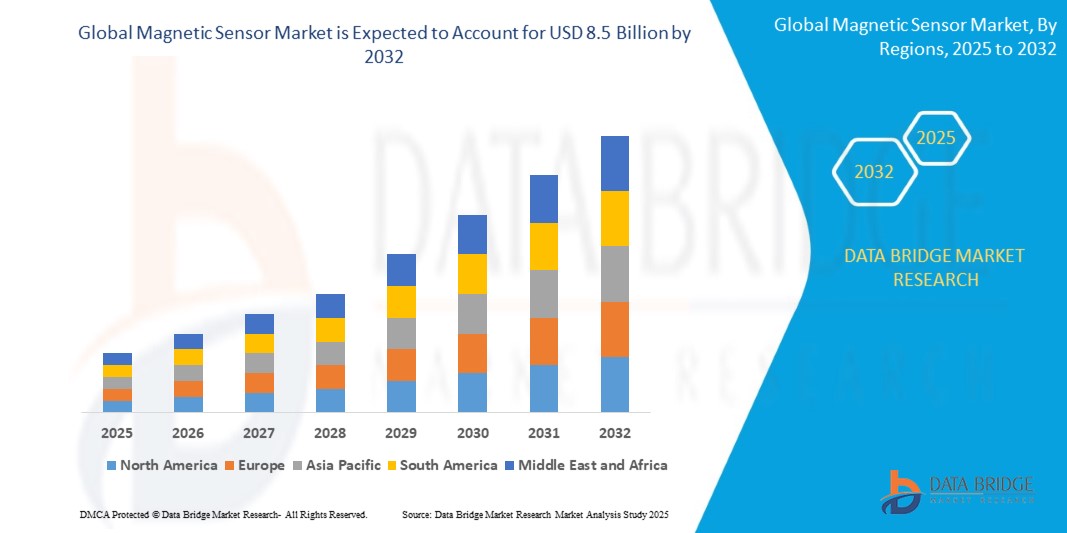
Magnetic Sensor Market Size
- The Global Magnetic Sensor Market Size was valued at USD 3.1 Billion in 2024 and is expected to reach USD 8.5 Billion by 2032, at a CAGR of 15.5% during the forecast period
- The Global Magnetic Sensor Market's growth is driven by increasing demand for advanced sensing technologies in automotive, consumer electronics, and industrial automation applications.
Magnetic Sensor Market Analysis
- The Global Magnetic Sensor Market is experiencing significant growth as industries across automotive, consumer electronics, industrial automation, healthcare, and aerospace & defense increasingly adopt magnetic sensing solutions for enhanced precision, efficiency, and safety. These sensors are vital for enabling functions such as position sensing, current measurement, speed detection, and navigation in a wide range of applications. The proliferation of smart devices, electric vehicles (EVs), industrial robotics, and medical diagnostics is further fueling demand for high-performance magnetic sensing technologies.
- One of the key drivers of this market is the ongoing advancement in magnetoresistive technologies, including Anisotropic Magnetoresistance (AMR), Giant Magnetoresistance (GMR), and Tunnel Magnetoresistance (TMR). These innovations offer higher sensitivity, lower power consumption, and miniaturized form factors, making them ideal for modern compact and power-efficient devices. Additionally, the rising adoption of Hall-effect sensors in automotive safety systems, brushless motors, and proximity sensing is reinforcing the market’s upward trajectory.
- The global push towards electrification and automation is reshaping end-user demands. In the automotive sector, increasing adoption of EVs and ADAS (Advanced Driver-Assistance Systems) is boosting the need for magnetic sensors in battery monitoring, throttle positioning, wheel speed detection, and powertrain systems. In consumer electronics, magnetic sensors are widely used in smartphones, tablets, and gaming devices to enable compass functionality, orientation detection, and user interaction. Industrial automation relies on these sensors for motor control, machinery feedback systems, and predictive maintenance, while the healthcare sector is leveraging them in non-invasive medical instruments and magnetic tracking systems.
- Despite the promising outlook, the magnetic sensor market faces several challenges. These include high design complexity, especially for integrating sensors into compact devices; sensitivity to external magnetic interference; and price competition among manufacturers. In addition, fluctuations in raw material costs and the need for specialized manufacturing capabilities can impact overall profitability. Regulatory and safety standards in automotive and medical applications also demand rigorous testing and compliance, which can increase time-to-market for new products.
- Nevertheless, the future of the Global Magnetic Sensor Market remains optimistic. The accelerating pace of digitalization, expanding applications in emerging technologies such as IoT and AI, and growing investments in automation and smart infrastructure are expected to drive robust demand. As sensor technologies continue to evolve with improved performance, smaller footprints, and better energy efficiency, the market is well-positioned for sustained expansion throughout the next decade.
Report Scope and Magnetic Sensor Market Segmentation
|
Attributes |
Magnetic Sensor Market Insights |
|
Segments Covered |
|
|
Countries Covered |
North America
Europe
Asia-Pacific
Middle East and Africa
South America
|
|
Key Market Players |
|
|
Market Opportunities |
|
|
Value Added Data Infosets |
In addition to the insights on market scenarios such as market value, growth rate, segmentation, geographical coverage, and major players, the market reports curated by the Data Bridge Market Research also include in-depth expert analysis, pricing analysis, brand share analysis, consumer survey, demography analysis, supply chain analysis, value chain analysis, raw material/consumables overview, vendor selection criteria, PESTLE Analysis, Porter Analysis, and regulatory framework. |
Magnetic Sensor Market Trends
Rising use in smartphones, tablets, and consumer electronics, particularly for orientation, navigation, and gesture functions
- The rising use of magnetic sensors in smartphones, tablets, and other consumer electronics is one of the most prominent trends in the global magnetic sensor market. These sensors play a critical role in enhancing user experience through features such as orientation detection, electronic compassing, and motion tracking. Their integration enables seamless interaction between users and devices by detecting the device's position and movement relative to the Earth's magnetic field.
- In smartphones and tablets, magnetic sensors are widely used for digital compass functionality, allowing applications like maps and augmented reality (AR) to offer accurate directional guidance. They also support gaming and immersive user interfaces by enabling real-time motion sensing and spatial awareness. As the demand for more interactive and intuitive mobile experiences increases, manufacturers are incorporating increasingly sensitive and compact magnetic sensors into mobile devices.
- Moreover, in wearables and smart devices, magnetic sensors enable gesture recognition and hands-free control, enhancing accessibility and convenience. These functions are especially valuable in fitness trackers, smartwatches, and AR/VR headsets, where natural interaction and real-time response are essential. The continuing trend toward miniaturization and multifunctional electronics is expected to drive even broader adoption of magnetic sensors in next-generation consumer technologies.
Magnetic Sensor Market Dynamics
Driver
Advancements in sensor technologies like TMR, GMR, and AMR for higher precision and sensitivity
- Advancements in magnetic sensor technologies particularly Tunneling Magnetoresistance (TMR), Giant Magnetoresistance (GMR), and Anisotropic Magnetoresistance (AMR)—have significantly enhanced the performance, precision, and sensitivity of magnetic sensors across various applications.
- TMR sensors offer exceptional sensitivity and low power consumption, making them ideal for applications requiring highly accurate magnetic field detection, such as in automotive position sensing, current monitoring, and consumer electronics. Their ability to operate effectively at low magnetic field levels while maintaining stability has driven their adoption in emerging technologies, especially in electric vehicles and advanced robotics.
- GMR sensors are valued for their ability to detect very small changes in magnetic fields, which is crucial in applications like hard disk drives, magnetic read heads, and precision instrumentation. Their compact size and high accuracy make them suitable for medical diagnostics, navigation systems, and industrial automation where space constraints and high-resolution feedback are critical.
- AMR sensors, being the most established among the three, continue to be widely used due to their cost-effectiveness, robustness, and good linear response. They are commonly used in automotive applications, consumer devices, and smart meters. Recent innovations have improved their reliability under harsh conditions, supporting broader industrial and defense sector applications.
- Collectively, the evolution of these sensor technologies has enabled manufacturers to meet the growing demand for miniaturized, high-performance, and energy-efficient magnetic sensing solutions, thereby driving market growth across multiple end-use industries.
Restraint/Challenge
Complexity and cost of advanced sensor design and fabrication
- The complexity and cost of advanced sensor design and fabrication is a significant restraint in the growth of the global magnetic sensor market. As the demand increases for more compact, high-precision, and multi-functional magnetic sensors, manufacturers are required to incorporate cutting-edge technologies like TMR, GMR, and AMR, which involve intricate design processes and highly controlled manufacturing environments.
- These advanced sensors require the use of specialized materials—such as thin-film magnetic layers, high-purity semiconductors, and rare-earth elements which are not only expensive but also difficult to process. The precision required in layering, patterning, and etching these materials makes the fabrication process technically demanding and capital intensive. Cleanroom facilities, high-end lithography equipment, and quality assurance systems are necessary to maintain consistency and performance, significantly driving up the initial investment and operational costs.
- Furthermore, as sensors become smaller to meet the demands of miniaturization in consumer electronics and medical devices, the engineering challenge intensifies. Designing sensors that remain sensitive and reliable at micro or nano scales without compromising power efficiency or durability involves extensive R&D, simulation, and prototyping.
- This level of complexity and cost makes it challenging for smaller firms to compete, limiting market entry and slowing down the rate at which new innovations can be scaled. It also results in longer lead times and higher prices for end-users, especially in price-sensitive industries. As a result, while the technological potential of magnetic sensors is high, these barriers can restrict their widespread commercial adoption.
Magnetic Sensor Market Scope
The market is segmented on the basis of Type, Technology and Application.
-
By Type
The Global Magnetic Sensor Market, segmented by type, includes Hall Effect Sensors, Magnetoresistive Sensors, and Fluxgate Sensors. Hall Effect Sensors account for the largest share due to their cost-effectiveness, durability, and widespread use in automotive systems, industrial automation, and consumer electronics. Magnetoresistive Sensors comprising AMR, GMR, and TMR technologies are rapidly gaining traction for their high sensitivity and precision, making them ideal for applications in ADAS, navigation, current sensing, and medical devices. Fluxgate Sensors, though more niche, offer extremely accurate magnetic field detection and are primarily used in aerospace, defense, geophysical studies, and scientific instrumentation. The unique strengths of each sensor type enable the market to address diverse performance and application demands across industries.
- By Technology
The Global Magnetic Sensor Market, by technology, is categorized into Anisotropic Magnetoresistance (AMR), Giant Magnetoresistance (GMR), Tunnel Magnetoresistance (TMR), and Hall Effect. AMR technology is widely adopted due to its maturity and cost-efficiency, commonly used in position and speed sensing across automotive and industrial applications. GMR sensors, with their enhanced sensitivity, are preferred in data storage, biosensing, and current detection applications. TMR technology is emerging rapidly due to its superior signal-to-noise ratio and lower power consumption, making it ideal for precision-demanding applications such as robotics, medical devices, and consumer electronics. Hall Effect technology remains dominant for general-purpose use due to its robustness, simplicity, and effectiveness in various environments, particularly in automotive and consumer electronic devices. This diverse range of technologies enables tailored magnetic sensing solutions across multiple sectors.
- By Application
The Global Magnetic Sensor Market, by application, encompasses Automotive, Consumer Electronics, Industrial, Healthcare, Aerospace and Defense, and Energy and Utilities. The automotive sector leads the market, driven by the growing integration of magnetic sensors in electric vehicles (EVs), advanced driver-assistance systems (ADAS), and powertrain systems for position, speed, and current sensing. In consumer electronics, magnetic sensors are increasingly used in smartphones, tablets, and wearables for functions like navigation, orientation, and gesture control. The industrial segment relies on these sensors for automation, robotics, and machinery monitoring, especially in harsh environments. In healthcare, magnetic sensors support advanced imaging systems, implantable devices, and patient monitoring technologies. Aerospace and defense applications require high-precision magnetic sensors for navigation, avionics, and detection systems in extreme conditions. The energy and utilities sector utilizes magnetic sensors for grid monitoring, smart metering, and renewable energy systems to ensure efficient power distribution and safety. This broad application base highlights the critical role of magnetic sensors in enhancing functionality, efficiency, and safety across industries.
Magnetic Sensor Market Regional Analysis
- North America holds a significant share of the global magnetic sensor market, driven by strong demand across the automotive, aerospace, and consumer electronics industries. The region benefits from the presence of major technology providers and early adopters of advanced sensor technologies, particularly in the United States. Investments in autonomous vehicles, electric mobility, and industrial automation are further fueling growth, while stringent safety regulations in sectors like healthcare and defense continue to support demand for high-performance magnetic sensors.
- Europe is a prominent market due to its strong automotive manufacturing base, especially in Germany, France, and Italy. The push toward electrification, ADAS integration, and energy-efficient vehicles is accelerating the use of magnetic sensors. Moreover, the region’s emphasis on industrial automation, renewable energy, and smart manufacturing under Industry 4.0 initiatives contributes significantly to market expansion. European R&D in sensor miniaturization and magnetic field accuracy also plays a key role in advancing technology adoption.
- Asia Pacific is the fastest-growing region in the global magnetic sensor market, led by countries like China, Japan, South Korea, and India. This growth is attributed to the region's large-scale electronics and semiconductor manufacturing, high adoption of consumer electronics, and the rapid expansion of automotive and industrial sectors. Government investments in smart infrastructure and IoT-based applications also boost sensor deployment. Additionally, the presence of numerous OEMs and low-cost production capabilities make the region a hub for magnetic sensor innovation and distribution.
- The magnetic sensor market in Latin America is gradually expanding, supported by growth in the automotive and industrial sectors, particularly in Brazil and Mexico. While adoption is still emerging compared to developed regions, increasing investments in smart manufacturing, healthcare infrastructure, and renewable energy systems are opening up new opportunities. Market growth is also influenced by the modernization of utility grids and the integration of sensors into consumer electronics.
- In the Middle East and Africa, the magnetic sensor market is in the early stages of development but shows promise due to growing investments in smart cities, energy management, and industrial automation. The adoption of advanced sensor technologies is being driven by initiatives in sectors such as oil & gas, utilities, and transportation. While limited infrastructure and high import dependence pose challenges, regional governments' focus on digital transformation is expected to gradually enhance market potential.
United States
The U.S. leads the magnetic sensor market in North America, supported by strong demand from the automotive, industrial, and consumer electronics sectors. Growth is driven by the increasing adoption of advanced driver assistance systems (ADAS), automation in manufacturing, and high-performance sensor integration in smartphones and wearable devices.
Germany
Germany drives the European market with significant utilization of magnetic sensors in automotive safety systems, precision manufacturing, and renewable energy applications. The country’s leadership in automotive innovation, along with growing demand for sensor-based automation and robotics, sustains market strength.
China
China dominates the Asia-Pacific market in both production and consumption of magnetic sensors. Rapid industrialization, mass electronics manufacturing, EV adoption, and smart infrastructure development—backed by government initiatives—are fueling strong domestic demand and export growth.
India
India is an emerging market with increasing demand for magnetic sensors in automotive, consumer electronics, and industrial automation. The country’s growing electronics manufacturing base, rising vehicle production, and government support for smart cities and IoT adoption are key drivers.
South Korea
South Korea’s market is driven by its advanced semiconductor and electronics ecosystem. Major companies are integrating high-sensitivity magnetic sensors into consumer devices, medical electronics, and automotive systems, with ongoing R&D in compact, power-efficient sensor technologies.
Magnetic Sensor Market Share
The Global Magnetic Sensor industry is primarily led by well-established companies, including:
- Allegro MicroSystems (Manchester, USA)
- TDK Corporation (Tokyo, Japan)
- Infineon Technologies AG (Neubiberg, Germany)
- NXP Semiconductors (Eindhoven, Netherlands)
- Honeywell International Inc. (Charlotte, USA)
- STMicroelectronics (Geneva, Switzerland)
- TE Connectivity (Schaffhausen, Switzerland)
- Texas Instruments (Dallas, USA)
- Asahi Kasei Microdevices (AKM) (Tokyo, Japan)
- Melexis (Ieper, Belgium)
- AMS-Osram (Premstätten, Austria)
Latest Developments in Global Magnetic Sensor Market
- In May 2025, TDK Corporation unveiled a new range of tunnel magnetoresistance (TMR) sensors aimed at enhancing precision in automotive steering and braking systems, supporting the growing demand for autonomous vehicle technologies.
- In April 2025, Allegro MicroSystems introduced its next-generation Hall-effect current sensors for solar inverters and industrial automation, focusing on improved accuracy, compact form factors, and energy efficiency.
- In March 2025, Melexis announced the opening of a dedicated R&D center in Singapore to develop advanced magnetic sensing solutions for electric vehicles, robotics, and smart devices, aiming to strengthen its footprint in the Asia-Pacific market.
- In February 2025, Infineon Technologies partnered with a major OEM to supply anisotropic magnetoresistive (AMR) sensors for smart grid and renewable energy applications, targeting increased precision in monitoring and control systems.
- In January 2025, NVE Corporation advanced its spintronic magnetic sensors to deliver higher sensitivity and lower power consumption for industrial automation and medical device integration.
- In November 2024, Honeywell launched a ruggedized line of magnetoresistive sensors for aerospace and defense applications, emphasizing their durability and accuracy in harsh environments.
- In September 2024, Asahi Kasei Microdevices (AKM) released compact GMR-based magnetic sensors designed for wearable devices and AR/VR controllers, supporting next-generation consumer electronics.

- Interactive Data Analysis Dashboard
- Company Analysis Dashboard for high growth potential opportunities
- Research Analyst Access for customization & queries
- Competitor Analysis with Interactive dashboard
- Latest News, Updates & Trend analysis
- Harness the Power of Benchmark Analysis for Comprehensive Competitor Tracking
Global Magnetic Sensor Market, Supply Chain Analysis and Ecosystem Framework
To support market growth and help clients navigate the impact of geopolitical shifts, DBMR has integrated in-depth supply chain analysis into its Global Magnetic Sensor Market research reports. This addition empowers clients to respond effectively to global changes affecting their industries. The supply chain analysis section includes detailed insights such as Global Magnetic Sensor Market consumption and production by country, price trend analysis, the impact of tariffs and geopolitical developments, and import and export trends by country and HSN code. It also highlights major suppliers with data on production capacity and company profiles, as well as key importers and exporters. In addition to research, DBMR offers specialized supply chain consulting services backed by over a decade of experience, providing solutions like supplier discovery, supplier risk assessment, price trend analysis, impact evaluation of inflation and trade route changes, and comprehensive market trend analysis.
Data collection and base year analysis are done using data collection modules with large sample sizes. The stage includes obtaining market information or related data through various sources and strategies. It includes examining and planning all the data acquired from the past in advance. It likewise envelops the examination of information inconsistencies seen across different information sources. The market data is analysed and estimated using market statistical and coherent models. Also, market share analysis and key trend analysis are the major success factors in the market report. To know more, please request an analyst call or drop down your inquiry.
The key research methodology used by DBMR research team is data triangulation which involves data mining, analysis of the impact of data variables on the market and primary (industry expert) validation. Data models include Vendor Positioning Grid, Market Time Line Analysis, Market Overview and Guide, Company Positioning Grid, Patent Analysis, Pricing Analysis, Company Market Share Analysis, Standards of Measurement, Global versus Regional and Vendor Share Analysis. To know more about the research methodology, drop in an inquiry to speak to our industry experts.
Data Bridge Market Research is a leader in advanced formative research. We take pride in servicing our existing and new customers with data and analysis that match and suits their goal. The report can be customized to include price trend analysis of target brands understanding the market for additional countries (ask for the list of countries), clinical trial results data, literature review, refurbished market and product base analysis. Market analysis of target competitors can be analyzed from technology-based analysis to market portfolio strategies. We can add as many competitors that you require data about in the format and data style you are looking for. Our team of analysts can also provide you data in crude raw excel files pivot tables (Fact book) or can assist you in creating presentations from the data sets available in the report.













