


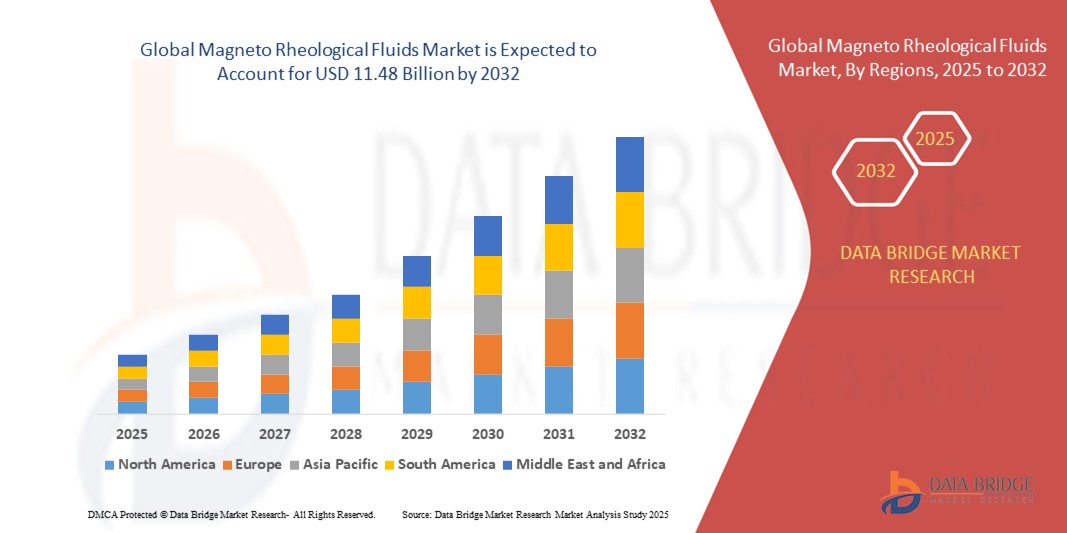
Magneto Rheological Fluids Market Size
- The global magneto rheological fluids market size was valued at USD 2.41 billion in 2024 and is expected to reach USD 11.48 billion by 2032, at a CAGR of 21.50% during the forecast period
- The market growth is largely fuelled by increasing adoption of MR fluids in automotive, aerospace, and industrial applications, where their unique ability to change viscosity under a magnetic field enhances performance and safety
- Growing investments in smart systems, adaptive suspension technologies, and precision machinery are further driving the demand for magneto rheological fluids
Magneto Rheological Fluids Market Analysis
- The market is witnessing significant growth due to the increasing integration of MR fluids in automotive dampers, vibration control systems, robotics, and prosthetic devices
- Technological advancements, including higher response rates, improved stability, and eco-friendly formulations, are expanding application opportunities across multiple sectors
- North America dominated the magneto rheological fluids market with the largest revenue share of 38.5% in 2024, driven by increasing adoption of MR fluid-based automotive suspension systems, robotics, and industrial vibration control solutions
- Asia-Pacific region is expected to witness the highest growth rate in the global magneto rheological fluids market, driven by increasing urbanization, technological advancements, and government initiatives supporting smart manufacturing and automation
- The Silicon Oil segment held the largest market revenue share in 2024, driven by its stable viscosity, wide operating temperature range, and superior magnetic responsiveness. Silicon oil-based MR fluids are widely preferred for precision applications such as automotive dampers and robotics, offering consistent performance under varying magnetic fields
Report Scope and Magneto Rheological Fluids Market Segmentation
|
Attributes |
Magneto Rheological Fluids Key Market Insights |
|
Segments Covered |
|
|
Countries Covered |
North America
Europe
Asia-Pacific
Middle East and Africa
South America
|
|
Key Market Players |
|
|
Market Opportunities |
• Growing Adoption Of Magneto Rheological Fluids In Automotive And Aerospace Applications |
|
Value Added Data Infosets |
In addition to the insights on market scenarios such as market value, growth rate, segmentation, geographical coverage, and major players, the market reports curated by the Data Bridge Market Research also include import export analysis, production capacity overview, production consumption analysis, price trend analysis, climate change scenario, supply chain analysis, value chain analysis, raw material/consumables overview, vendor selection criteria, PESTLE Analysis, Porter Analysis, and regulatory framework. |
Magneto Rheological Fluids Market Trends
Increasing Adoption of MR Fluids in Automotive and Industrial Applications
• The growing use of magneto rheological (MR) fluids in automotive suspension systems, braking systems, and clutches is transforming vehicle performance and safety standards. MR fluids enable real-time adaptability to driving conditions, improving ride comfort, handling, and overall operational efficiency. This trend is driving higher adoption among premium and commercial vehicle manufacturers
• High demand for MR fluids in industrial automation and robotics is accelerating the integration of smart damping and precision control systems. These fluids offer rapid response times and controllable viscosity, making them ideal for vibration control, prosthetics, and precision machinery applications. Their implementation reduces equipment wear and enhances operational reliability
• The affordability, stability, and ease of integration of modern MR fluid systems are making them increasingly attractive across sectors. Engineers and manufacturers can implement MR fluids in both new systems and retrofitting applications, leading to broader market penetration
• For instance, in 2023, leading automotive manufacturers in Germany and Japan incorporated MR fluids into active suspension systems, resulting in improved ride comfort, enhanced vehicle safety, and reduced maintenance costs
• While MR fluids are enabling adaptive control and smart system performance, their adoption depends on continued R&D, standardization, and cost-effective manufacturing solutions. Market players are focusing on developing high-performance fluids tailored for localized and industry-specific applications
Magneto Rheological Fluids Market Dynamics
Driver
Rising Demand for Adaptive and Smart Control Systems Across Industries
• The increasing need for adaptive control and real-time damping in automotive, aerospace, and industrial applications is pushing manufacturers to adopt MR fluids. These fluids provide precise control over mechanical systems, enhancing safety, stability, and operational efficiency. In addition, they reduce energy consumption and wear on mechanical components, further optimizing system performance
• Growing industrial automation and robotics deployment is driving demand for MR fluids in vibration control, prosthetics, and manufacturing machinery. Their ability to respond instantly to external forces helps maintain equipment performance and extend service life. Continuous technological advancements are also enabling more compact and efficient MR fluid systems, increasing their applicability across diverse industries
• Public and private sector initiatives focused on advanced vehicle safety and smart manufacturing technologies are accelerating MR fluid integration. Collaborative R&D programs are also contributing to technological improvements and cost optimization. Moreover, government grants and incentives for adopting smart materials are supporting wider adoption and commercial deployment of MR fluids
• For instance, in 2022, several European automotive OEMs implemented MR fluid-based adaptive suspension systems, boosting product differentiation, customer satisfaction, and overall market growth. These implementations also demonstrated tangible reductions in vehicle maintenance costs and enhanced passenger comfort, further validating the technology’s benefits
• While smart control requirements and industrial automation are propelling the market, consistent product innovation and regulatory compliance remain critical to ensure sustained adoption and performance optimization. Stakeholders are increasingly focusing on standardization and compatibility with existing systems to ease integration and reduce barriers to adoption
Restraint/Challenge
High Cost of Advanced MR Fluid Systems and Technical Complexity
• The high price of MR fluid systems, including the fluids and associated control hardware, limits adoption, particularly in cost-sensitive markets. Small and medium enterprises may face challenges in deploying these technologies on a large scale. In addition, long procurement cycles and expensive replacement parts add to operational costs, restricting adoption in emerging regions
• Technical complexity in designing, integrating, and maintaining MR fluid-based systems requires skilled personnel and specialized training. Lack of expertise can result in operational inefficiencies, suboptimal system performance, and maintenance delays. Moreover, integrating MR fluids with legacy machinery or diverse industrial setups can require significant customization, adding to implementation challenges
• Supply chain constraints, including availability of high-quality base fluids, additives, and control devices, can disrupt production schedules and increase lead times for end users. Consistent quality is crucial for ensuring reliable system performance. Global supply chain fluctuations, including shipping delays and raw material shortages, can further exacerbate availability issues and affect market growth
• For instance, in 2023, several industrial automation firms in Asia and North America reported delays in deploying MR fluid-based vibration control systems due to component shortages and integration challenges. These setbacks not only affected project timelines but also delayed potential cost savings and efficiency gains that MR fluid systems could deliver
• Addressing cost, technical complexity, and supply chain issues through modular designs, training programs, and localized sourcing strategies is essential for wider adoption and long-term market growth. Companies are increasingly investing in partnerships, automation of production, and localized manufacturing to ensure steady supply, reduce costs, and improve accessibility globally
Magneto Rheological Fluids Market Scope
The market is segmented on the basis of base oil, product, application, end use, and technology.
- By Base Oil
On the basis of base oil, the magneto rheological fluids market is segmented into Silicon Oil, Mineral Oil, Synthetic Hydrocarbon Oil, Paraffin Oil, Hydraulic Oil, Water, and Others. The Silicon Oil segment held the largest market revenue share in 2024, driven by its stable viscosity, wide operating temperature range, and superior magnetic responsiveness. Silicon oil-based MR fluids are widely preferred for precision applications such as automotive dampers and robotics, offering consistent performance under varying magnetic fields.
The Mineral Oil segment is expected to witness the fastest growth rate from 2025 to 2032, driven by its cost-effectiveness and compatibility with conventional sealing materials. Mineral oil-based MR fluids are particularly favored in industrial and construction applications due to their ease of formulation and reliable performance in high-load environments.
- By Product
On the basis of product, the market is segmented into Ready-to-use magnetorheological fluid, Semi-concentrated magnetorheological fluid, Concentrated magnetorheological fluid, and Others. The Ready-to-use MR fluid segment held the largest market revenue share in 2024, attributed to its convenience and immediate applicability in devices without the need for additional dilution or preparation.
The Semi-concentrated MR fluid segment is expected to witness the fastest growth rate from 2025 to 2032, owing to its flexibility in customization and ability to balance cost and performance for diverse industrial and automotive applications.
- By Application
On the basis of application, the market is segmented into Automotive, Aerospace, Building and Construction, Military and Defense, Optics, Electrical and Electronics, Medical and Prosthetics, Robotics, and Others. The Automotive segment held the largest market share in 2024, driven by increasing adoption of MR fluid-based suspension systems and adaptive dampers for enhanced vehicle ride comfort and safety.
The Robotics segment is expected to witness the fastest growth rate from 2025 to 2032, driven by rising automation and precision engineering requirements where MR fluids provide controllable resistance and high responsiveness in robotic actuators and prosthetic devices.
- By End Use
On the basis of end use, the market is segmented into OEMs, Aftermarket, and Industrial. The OEMs segment held the largest market revenue share in 2024, owing to the integration of MR fluid systems during manufacturing for vehicles, industrial machinery, and precision equipment.
The Industrial segment is expected to witness the fastest growth rate from 2025 to 2032, fueled by growing adoption of MR fluids in adaptive dampers, vibration control, and other manufacturing applications requiring precise motion control.
- By Technology
On the basis of technology, the market is segmented into Particle Size, Magnetic Field Strength, and Viscosity. The Magnetic Field Strength segment held the largest market share in 2024, driven by its direct impact on MR fluid performance and ability to provide controllable stiffness and damping in real-time applications.
The Particle Size segment is expected to witness the fastest growth rate from 2025 to 2032, owing to advancements in nano- and micro-particle engineering that enhance fluid response time, stability, and efficiency across automotive, aerospace, and robotics applications.
Magneto Rheological Fluids Market Regional Analysis
• North America dominated the magneto rheological fluids market with the largest revenue share of 38.5% in 2024, driven by increasing adoption of MR fluid-based automotive suspension systems, robotics, and industrial vibration control solutions
• Consumers and industries in the region highly value the precision control, rapid responsiveness, and reliability offered by MR fluid technology in automotive, aerospace, and industrial applications
• This widespread adoption is further supported by advanced manufacturing infrastructure, strong R&D initiatives, and increasing investment in adaptive and smart systems, establishing MR fluids as a preferred solution across multiple sectors
U.S. Magneto Rheological Fluids Market Insight
The U.S. MR fluids market captured the largest revenue share in 2024 within North America, fueled by rising demand for advanced vehicle suspension systems, industrial automation, and robotics applications. Manufacturers are increasingly focusing on enhancing performance and efficiency through MR fluid integration in dampers, clutches, and prosthetic devices. Growing investments in R&D and government support for smart manufacturing technologies are further propelling the MR fluids industry.
Europe Magneto Rheological Fluids Market Insight
The Europe MR fluids market is expected to witness the fastest growth rate from 2025 to 2032, primarily driven by stringent automotive and aerospace safety standards and increasing adoption of adaptive damping systems. Rising urbanization and demand for energy-efficient, responsive solutions are fostering market growth. European industries are increasingly implementing MR fluids in automotive, construction, and robotics applications, with emphasis on precision engineering and sustainability
U.K. Magneto Rheological Fluids Market Insight
The U.K. MR fluids market is expected to witness the fastest growth rate from 2025 to 2032, driven by the adoption of smart suspension systems, industrial automation, and robotics technology. The region’s focus on innovation, energy efficiency, and high-performance materials encourages widespread use of MR fluids across automotive and industrial sectors.
Germany Magneto Rheological Fluids Market Insight
The Germany MR fluids market is expected to witness the fastest growth rate from 2025 to 2032, fueled by the country’s advanced automotive industry, high awareness of adaptive technology, and emphasis on sustainability. Germany’s strong R&D ecosystem, combined with adoption of cutting-edge smart manufacturing solutions, is driving the integration of MR fluids in automotive dampers, robotics, and industrial machinery.
Asia-Pacific Magneto Rheological Fluids Market Insight
The Asia-Pacific MR fluids market is expected to witness the fastest growth rate from 2025 to 2032, driven by rapid industrialization, increasing automotive production, and rising investments in robotics and automation in countries such as China, Japan, and India. Government initiatives promoting smart manufacturing and digitalization are further accelerating MR fluid adoption.
Japan Magneto Rheological Fluids Market Insight
The Japan MR fluids market is expected to witness the fastest growth rate from 2025 to 2032 due to the country’s focus on high-precision automotive and robotics technologies. Rapid urbanization and a strong inclination toward automation are driving MR fluid adoption. Integration with adaptive vehicle suspension, robotics actuators, and prosthetic devices is fueling growth, supported by advanced R&D and innovative engineering solutions.
China Magneto Rheological Fluids Market Insight
The China MR fluids market accounted for the largest market revenue share in Asia-Pacific in 2024, attributed to rapid industrialization, growing automotive production, and increasing adoption of robotics and automation technologies. Domestic manufacturing capabilities, government support for smart manufacturing, and availability of cost-effective MR fluid solutions are key factors propelling market growth across automotive, industrial, and medical applications.
Magneto Rheological Fluids Market Share
The Magneto Rheological Fluids industry is primarily led by well-established companies, including:
- Lord Corporation (U.S.)
- Arus MR Tech (India)
- Liquids Research Limited (U.K.)
- QED Technologies (U.S.)
- KURIMOTO, Ltd. (Japan)
- Kolektor Group (Slovenia)
- Magnequench (U.S.)
- Lord Microstrain (U.S.)
- The Timken Company (U.S.)
- BASF SE (Germany)
- 3M Company (U.S.)
- Parker Hannifin Corporation (U.S.)
- SKF Group (Sweden)
- Freudenberg Group (Germany)
- Saint-Gobain (France)
- Honeywell International Inc. (U.S.)
- General Electric Company (U.S.)
- Bosch Rexroth AG (Germany)
- Thyssenkrupp AG (Germany)
- ZF Friedrichshafen AG (Germany)

- Interactive Data Analysis Dashboard
- Company Analysis Dashboard for high growth potential opportunities
- Research Analyst Access for customization & queries
- Competitor Analysis with Interactive dashboard
- Latest News, Updates & Trend analysis
- Harness the Power of Benchmark Analysis for Comprehensive Competitor Tracking
Global Magneto Rheological Fluids Market, Supply Chain Analysis and Ecosystem Framework
To support market growth and help clients navigate the impact of geopolitical shifts, DBMR has integrated in-depth supply chain analysis into its Global Magneto Rheological Fluids Market research reports. This addition empowers clients to respond effectively to global changes affecting their industries. The supply chain analysis section includes detailed insights such as Global Magneto Rheological Fluids Market consumption and production by country, price trend analysis, the impact of tariffs and geopolitical developments, and import and export trends by country and HSN code. It also highlights major suppliers with data on production capacity and company profiles, as well as key importers and exporters. In addition to research, DBMR offers specialized supply chain consulting services backed by over a decade of experience, providing solutions like supplier discovery, supplier risk assessment, price trend analysis, impact evaluation of inflation and trade route changes, and comprehensive market trend analysis.
Data collection and base year analysis are done using data collection modules with large sample sizes. The stage includes obtaining market information or related data through various sources and strategies. It includes examining and planning all the data acquired from the past in advance. It likewise envelops the examination of information inconsistencies seen across different information sources. The market data is analysed and estimated using market statistical and coherent models. Also, market share analysis and key trend analysis are the major success factors in the market report. To know more, please request an analyst call or drop down your inquiry.
The key research methodology used by DBMR research team is data triangulation which involves data mining, analysis of the impact of data variables on the market and primary (industry expert) validation. Data models include Vendor Positioning Grid, Market Time Line Analysis, Market Overview and Guide, Company Positioning Grid, Patent Analysis, Pricing Analysis, Company Market Share Analysis, Standards of Measurement, Global versus Regional and Vendor Share Analysis. To know more about the research methodology, drop in an inquiry to speak to our industry experts.
Data Bridge Market Research is a leader in advanced formative research. We take pride in servicing our existing and new customers with data and analysis that match and suits their goal. The report can be customized to include price trend analysis of target brands understanding the market for additional countries (ask for the list of countries), clinical trial results data, literature review, refurbished market and product base analysis. Market analysis of target competitors can be analyzed from technology-based analysis to market portfolio strategies. We can add as many competitors that you require data about in the format and data style you are looking for. Our team of analysts can also provide you data in crude raw excel files pivot tables (Fact book) or can assist you in creating presentations from the data sets available in the report.













