


What is the Magnetoencephalograph Market Size and Overview?
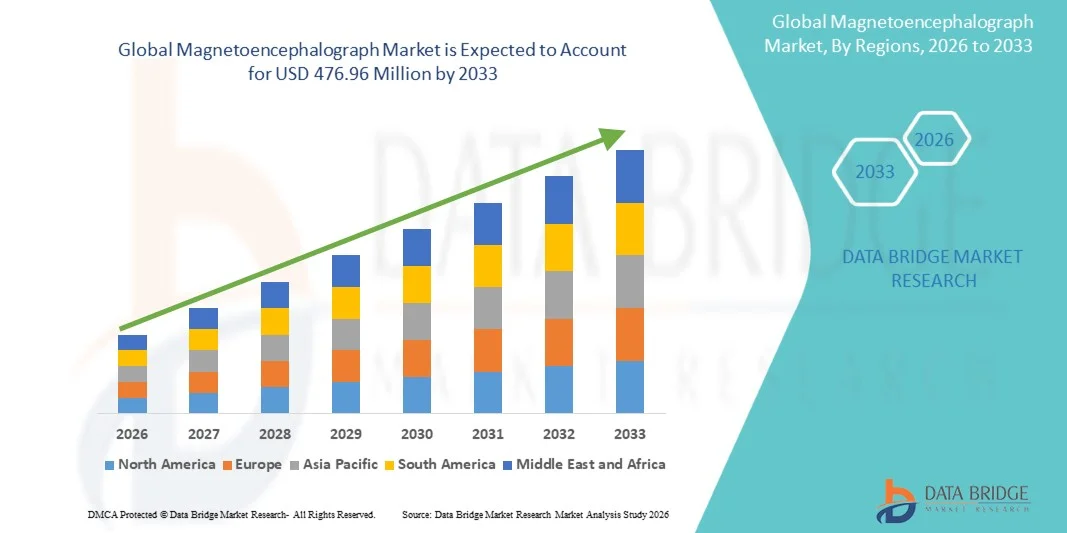
As per Data Bridge Market Research analysis, the Magnetoencephalograph Market was valued at USD 325.30 Million in 2025 and is projected to reach USD 476.96 Million by 2033, growing at a CAGR of 4.90% from 2026 to 2033. The market is experiencing consistent growth driven by increasing prevalence of neurological disorders, rising demand for advanced non-invasive brain imaging technologies, and growing investments in neuroscience research and precision diagnostics. Expanding adoption of magnetoencephalography systems in epilepsy diagnosis, cognitive neuroscience, and functional brain mapping applications is further supporting market expansion across hospitals, academic institutions, and specialized neurodiagnostic centers globally.
The increasing global focus on early neurological disorder detection and advanced brain function analysis, combined with continuous technological advancements in neuroimaging systems, is encouraging healthcare providers and research organizations to adopt high-precision MEG technologies. Magnetoencephalography systems are increasingly being utilized for accurate localization of epileptic activity, pre-surgical brain mapping, and real-time neural activity monitoring, helping clinicians improve diagnostic accuracy and treatment planning. Growing integration of artificial intelligence, wearable MEG technologies, and optically pumped magnetometers is further accelerating innovation and expanding clinical and research applications across the global market.
Market Size & Forecast
- Global Market Value (2025): USD 325.30 Million
- Expected Market Value (2033): USD 476.96 Million
- Forecast CAGR (2026–2033): 4.90%
- Leading Region in 2025: North America
- Fastest Growing Region: Asia-Pacific
Key Market Trends & Insights
- North America dominated the Magnetoencephalograph Market with the largest revenue share of 34.4% in 2025, supported by advanced healthcare infrastructure, strong adoption of neuroimaging technologies, and increasing prevalence of neurological disorders across the region
- The fixed devices segment led the market with a 68.4% share in 2025, driven by their widespread adoption across hospitals, neuroscience institutes, and advanced diagnostic centers for high-precision brain activity mapping
- Asia-Pacific is expected to be the fastest-growing region at a CAGR of 6.1% from 2026 to 2033, fueled by improving healthcare infrastructure, rising neurological disease burden, and increasing investments in advanced medical imaging technologies
- Portable devices are the fastest-growing modality type, projected to register a CAGR of 14.2% from 2026 to 2033, supported by rising demand for flexible and accessible neurodiagnostic solutions across outpatient and decentralized healthcare settings
- The clinical application segment dominated the application category with a 61.7% revenue share in 2025, led by increasing utilization of MEG systems for epilepsy diagnosis, pre-surgical brain mapping, and neurological disorder assessment
- Hospitals accounted for 49.3% of the market in 2025, preferred by rising patient inflow for neurological diagnostics and increasing establishment of specialized neuroscience departments
- The research application segment is the fastest-growing application category, with a CAGR of 13.5% from 2026 to 2033, driven by expanding neuroscience research activities focused on cognitive function, brain connectivity, and neurodegenerative disease analysis
Report Scope and Magnetoencephalograph Market Segmentation
|
Attributes |
Magnetoencephalograph Key Market Insights |
|
Segments Covered |
|
|
Countries Covered |
North America
Europe
Asia-Pacific
Middle East and Africa
South America
|
|
Key Market Players |
|
|
Market Opportunities |
|
|
Value Added Data Infosets |
In addition to the insights on market scenarios such as market value, growth rate, segmentation, geographical coverage, and major players, the market reports curated by the Data Bridge Market Research also include depth expert analysis, patient epidemiology, pipeline analysis, pricing analysis, and regulatory framework. |
What is the Key Trend in the Magnetoencephalograph Market?
Trend: Rising Adoption of Portable MEG Systems
Healthcare providers and neuroscience researchers are increasingly adopting portable and wearable magnetoencephalography systems to improve accessibility, patient comfort, and real-time brain activity monitoring. Traditional fixed MEG systems require large magnetically shielded rooms and high infrastructure investment, while portable technologies based on optically pumped magnetometers are enabling more flexible clinical and research applications. These systems are gaining strong interest for pediatric neurology, cognitive neuroscience, and mobile brain monitoring studies.
Companies such as Cerca Magnetics are actively commercializing wearable OPM-MEG systems, while in March 2024 the company installed an advanced OPM-MEG platform at the University of Zurich to support next-generation neuroscience and medical technology research initiatives.
Magnetoencephalograph Market Dynamics
Key Market Driver: Growing Demand for Early Neurological Diagnosis
The increasing prevalence of neurological disorders such as epilepsy, Alzheimer’s disease, Parkinson’s disease, and brain tumors is significantly driving demand for advanced neurodiagnostic technologies including magnetoencephalography systems. MEG enables highly accurate and non-invasive mapping of brain activity, supporting early diagnosis and improved surgical planning for complex neurological conditions. Hospitals and neuroscience centers are increasingly investing in advanced brain imaging technologies to improve diagnostic precision and patient outcomes.
According to the World Health Organization, neurological disorders affect more than one billion people globally, which is accelerating investments in advanced neuroimaging infrastructure. In November 2024, The University of Alabama at Birmingham and UAB Medicine introduced a new MEG system to strengthen epilepsy diagnosis and advanced brain function analysis capabilities across clinical and research operations.
Key Restraint/Challenge: High Cost of MEG Systems
A major challenge in the Magnetoencephalograph market is the high cost associated with system installation, maintenance, and operational infrastructure. MEG systems require superconducting sensors, cryogenic cooling technologies, magnetically shielded rooms, and highly specialized technical expertise, significantly increasing overall deployment costs for healthcare institutions. Smaller hospitals and emerging healthcare facilities often face financial limitations in adopting advanced MEG technologies despite growing neurological diagnostic demand.
Advanced systems can cost several million dollars depending on system configuration and infrastructure requirements, limiting widespread commercialization across developing markets. The February 2022 acquisition of the TRIUX neo system by the University of Nebraska Medical Center from MEGIN highlights the substantial investment required for deployment of next-generation magnetoencephalography platforms in specialized neuroscience institutions.
Key Market Opportunity: Expansion of MEG Applications in Brain-Computer Interface Research
The rapid expansion of brain-computer interface (BCI) research is creating significant growth opportunities for the Magnetoencephalograph market. MEG systems provide high temporal resolution and accurate neural signal detection, making them increasingly valuable for advanced BCI development, cognitive neuroscience, and neurotechnology applications. Researchers are actively utilizing MEG technologies to study neural connectivity, motor control, and real-time brain signal processing for communication and rehabilitation systems.
Academic institutions and medical technology companies are increasing investments in neurotechnology innovation and AI-assisted brain signal analysis platforms. Organizations such as University of Zurich and Cerca Magnetics are expanding research collaborations focused on wearable OPM-MEG systems, supporting the advancement of next-generation BCI and neural interface technologies across the global neuroscience market.
How is the Magnetoencephalograph Market Segmented?
The Magnetoencephalograph market is segmented on the basis of modality, application, and end user.
- By Modality
On the basis of modality, the Magnetoencephalograph Market is segmented into portable devices and fixed devices. The Fixed Devices segment dominated the market with the largest share of 68.4% in 2025, supported by their widespread adoption across hospitals, neuroscience institutes, and advanced diagnostic centers for high-precision brain activity mapping. Fixed systems provide superior signal sensitivity, advanced shielding capabilities, and comprehensive data acquisition, making them highly suitable for complex neurological evaluations. Growing prevalence of epilepsy, brain tumors, and neurodegenerative disorders is increasing demand for accurate non-invasive neuroimaging solutions. The segment further benefits from continuous investments in high-end healthcare infrastructure and increasing integration of MEG systems into clinical neuroscience programs. Strong preference for fixed installations in research-intensive institutions continues to reinforce segment dominance globally.
The Portable Devices segment is projected to register the fastest growth at a CAGR of 14.2% from 2026 to 2033, driven by rising demand for flexible and accessible neurodiagnostic solutions across outpatient and decentralized healthcare settings. Advancements in wearable sensors, optically pumped magnetometers, and compact MEG technologies are significantly improving portability and operational efficiency. Portable systems enable real-time neurological monitoring in environments where traditional fixed systems are difficult to deploy. Increasing focus on pediatric neurology and bedside brain monitoring applications is accelerating adoption across emerging healthcare facilities. Growing investments in next-generation mobile neuroimaging technologies are expected to further support rapid segment expansion during the forecast period.
- By Application
On the basis of application, the Magnetoencephalograph Market is segmented into clinical application and research application. The Clinical Application segment dominated the market with the largest share of 61.7% in 2025, driven by increasing utilization of MEG systems for epilepsy diagnosis, pre-surgical brain mapping, and neurological disorder assessment. Healthcare providers are increasingly adopting advanced neuroimaging technologies to improve diagnostic accuracy and treatment planning for complex brain conditions. Rising prevalence of neurological disorders and increasing awareness regarding early brain disease detection are supporting strong clinical demand. The segment also benefits from expanding reimbursement support and growing integration of MEG into multidisciplinary neuroscience centers. Continuous technological improvements in signal processing and imaging precision are further strengthening the segment’s leadership position.
The Research Application segment is projected to register the fastest growth at a CAGR of 13.5% from 2026 to 2033, driven by expanding neuroscience research activities focused on cognitive function, brain connectivity, and neurodegenerative disease analysis. Academic institutions and research laboratories are increasingly investing in advanced MEG technologies to study neural dynamics with high temporal resolution. Rising collaborations between universities, medical centers, and technology developers are accelerating innovation in brain mapping methodologies. Increasing government funding for neuroscience research programs and brain-computer interface development is further contributing to market growth. Growing exploration of MEG applications in psychiatric disorders and artificial intelligence-assisted neuroanalytics is expected to create strong future expansion opportunities.
- By End User
On the basis of end user, the Magnetoencephalograph Market is segmented into hospitals, imaging centers, and academic and research institutes. The Hospitals segment dominated the market with the largest share of 49.3% in 2025, supported by rising patient inflow for neurological diagnostics and increasing establishment of specialized neuroscience departments. Hospitals are adopting advanced MEG systems to improve clinical decision-making, surgical planning, and real-time monitoring of brain disorders. The availability of integrated diagnostic infrastructure and skilled healthcare professionals further supports large-scale deployment in hospital environments. Increasing investments in tertiary care facilities and growing emphasis on precision neurology are strengthening segment growth. Expansion of hospital-based neuroimaging programs across developed and emerging economies continues to reinforce market leadership.
The Academic and Research Institutes segment is projected to register the fastest growth at a CAGR of 13.8% from 2026 to 2033, driven by increasing global focus on neuroscience innovation and brain function research. Universities and research organizations are expanding investments in advanced neuroimaging laboratories to support cognitive science and neurological disorder studies. Growing collaborations between public research agencies and private medical technology companies are accelerating development of next-generation MEG platforms. Rising funding initiatives for brain mapping projects and neurotechnology research are further supporting segment expansion. Increasing demand for high-resolution neural activity analysis in experimental and translational research applications is expected to drive long-term growth across the segment.
Which Region Holds the Largest Share of the Magnetoencephalograph Market?
North America dominated the Magnetoencephalograph market and accounted for the largest revenue share of 34.4% in 2025, driven by advanced healthcare infrastructure, strong adoption of neuroimaging technologies, and increasing prevalence of neurological disorders across the region. The market benefits from significant investments in neuroscience research, widespread availability of specialized diagnostic centers, and strong integration of advanced brain mapping technologies in clinical practice. Hospitals and research institutions across the region are increasingly utilizing magnetoencephalography systems for epilepsy diagnosis, pre-surgical planning, and cognitive neuroscience studies. In addition, the presence of major medical device manufacturers and continuous technological advancements in non-invasive neurodiagnostic systems continue to reinforce North America’s leadership position in the global market.
U.S. Magnetoencephalograph Market Insight
The U.S. Magnetoencephalograph market is experiencing strong growth driven by increasing incidence of neurological disorders, rising adoption of precision neurodiagnostics, and expanding investments in brain research initiatives. Healthcare institutions are actively integrating advanced MEG systems for epilepsy localization, functional brain mapping, and neurodegenerative disease analysis. The country’s strong healthcare spending and well-established neuroscience infrastructure are supporting large-scale deployment of high-end neuroimaging technologies. In addition, growing collaborations between academic institutions, hospitals, and medical technology companies are accelerating innovation and market expansion across the U.S.
Canada Magnetoencephalograph Market Insight
The Canada Magnetoencephalograph market is witnessing steady growth supported by increasing investments in advanced neurological care and rising focus on early diagnosis of brain disorders. Healthcare providers and research organizations are increasingly adopting MEG systems to improve clinical accuracy and support neuroscience research activities. The country’s growing emphasis on healthcare modernization and expansion of specialized neurodiagnostic facilities is contributing to market development. In addition, rising government support for medical research and increasing adoption of advanced imaging technologies are further supporting growth in Canada.
Europe Magnetoencephalograph Market Insight
The Europe Magnetoencephalograph market is expanding steadily due to increasing demand for advanced neuroimaging solutions, strong neuroscience research activities, and growing prevalence of neurological diseases. The region benefits from well-developed healthcare systems, rising investments in brain health research, and increasing adoption of precision diagnostic technologies across hospitals and academic institutions. Countries across Europe are increasingly utilizing MEG systems for epilepsy surgery planning and cognitive neuroscience applications. Rising focus on technological innovation and integration of artificial intelligence in neurodiagnostic workflows continues to support regional market growth.
U.K. Magnetoencephalograph Market Insight
The U.K. Magnetoencephalograph market is growing steadily, driven by increasing focus on neurological disorder diagnosis, strong investments in neuroscience programs, and rising adoption of advanced functional brain imaging technologies. Healthcare institutions are increasingly implementing MEG systems for non-invasive brain activity analysis and surgical planning applications. The country’s strong academic research ecosystem and growing collaborations between universities and healthcare providers are further supporting market expansion. In addition, increasing demand for precision medicine and advanced neurodiagnostic solutions is strengthening growth across the U.K.
Germany Magnetoencephalograph Market Insight
The Germany Magnetoencephalograph market is expanding due to strong healthcare infrastructure, increasing adoption of advanced neurodiagnostic technologies, and growing research activities in cognitive neuroscience. Hospitals and research institutes are increasingly utilizing MEG systems for accurate neurological assessments and functional brain mapping procedures. The country’s strong emphasis on medical technology innovation and integration of digital healthcare solutions is driving market growth. In addition, rising investments in neuroscience laboratories and increasing prevalence of neurological disorders are further accelerating market development in Germany.
Asia-Pacific Magnetoencephalograph Market Insight
The Asia-Pacific Magnetoencephalograph market is expected to register the fastest growth with a CAGR of 6.1% from 2026 to 2033, driven by improving healthcare infrastructure, rising neurological disease burden, and increasing investments in advanced medical imaging technologies. Countries such as China, India, Japan, and South Korea are witnessing growing adoption of MEG systems across hospitals and neuroscience research institutes. Expanding government healthcare initiatives and rising awareness regarding early neurological disorder diagnosis are significantly boosting market demand. In addition, rapid technological advancements and increasing healthcare expenditure are further accelerating regional market expansion.
Japan Magnetoencephalograph Market Insight
The Japan Magnetoencephalograph market is witnessing steady growth supported by strong technological expertise, advanced healthcare infrastructure, and increasing research activities in neuroscience and cognitive disorders. Healthcare providers are increasingly adopting MEG systems for epilepsy diagnosis, brain function analysis, and neurodegenerative disease research. The country’s strong focus on innovation in medical imaging technologies and growing investments in precision healthcare are supporting market development. In addition, increasing collaborations between academic institutions and medical device manufacturers are strengthening demand across Japan.
China Magnetoencephalograph Market Insight
The China Magnetoencephalograph market is growing rapidly due to rising healthcare modernization, increasing prevalence of neurological disorders, and expanding investments in advanced diagnostic technologies. Hospitals and research centers are increasingly adopting MEG systems to improve neurological disease diagnosis and support large-scale brain research initiatives. The country’s rapidly developing healthcare infrastructure and strong government focus on medical technology advancement are accelerating market expansion. In addition, increasing healthcare expenditure and growing demand for high-precision neuroimaging solutions are further driving market growth in China.
Which are the Top Companies in the Magnetoencephalograph Market?
The Magnetoencephalograph industry is primarily led by well-established companies, including:
- Compumedics Limited (Australia)
- org (Global)
- Siemens Healthcare LLC (U.S.)
- Yokogawa Electric Corporation (Japan)
- Croton Healthcare (India)
- CTF MEG INTERNATIONAL SERVICES LP (Canada)
- Johnson & Johnson Services Inc. (U.S.)
- AstraZeneca (U.K.)
- Bristol-Myers Squibb Company (U.S.)
- Eli Lilly and Company (U.S.)
- Hoffmann-La Roche Ltd (Switzerland)
- Novartis AG (Switzerland)
- Otsuka Holdings Co., Ltd. (Japan)
- Pfizer Inc. (U.S.)
- GlaxoSmithKline plc (U.K.)
- Alkermes (Ireland)
- ALLERGAN (Ireland)
- Janssen Pharmaceuticals, Inc. (U.S.)
- Solvay Meiji Holdings Co, Ltd. (Japan)
- Abbott (U.S.)
- Jazz Pharmaceuticals, Inc. (Ireland)
- AbbVie Inc. (U.S.)
- Vertical Pharmaceuticals, LLC (U.S.)
- ACADIA Pharmaceuticals Inc. (U.S.)
- Medtronic (Ireland)
- Bausch Health (Canada)
What are Latest Developments in the Magnetoencephalograph Market?
- In November 2024, The University of Alabama at Birmingham and UAB Medicine introduced a new magnetoencephalography (MEG) system to strengthen both advanced neurological research and clinical diagnostic capabilities. The installation enhances the institution’s ability to diagnose epilepsy and analyze critical brain functions including speech, sensory processing, and vision with high precision. This development reflects the growing demand for advanced non-invasive neuroimaging technologies across healthcare institutions in the U.S. market. The expansion of MEG infrastructure among leading medical centers is expected to accelerate adoption of high-performance neurodiagnostic systems and support innovation in neuroscience research and patient care applications
- In May 2024, MYndspan inaugurated its first dedicated Magnetoencephalography (MEG) brain health center in Birmingham, United Kingdom, marking a significant advancement in commercial brain health diagnostics. The launch demonstrates increasing commercialization of MEG technologies beyond traditional hospital and academic environments into specialized brain wellness and preventive healthcare services. Growing consumer and clinical demand for precise and non-invasive brain activity analysis is supporting expansion of dedicated neurodiagnostic centers globally. This development is expected to encourage broader adoption of MEG systems in cognitive health monitoring, early neurological assessment, and personalized brain health solutions
- In March 2024, Cerca Magnetics installed an advanced OPM-MEG system at the University of Zurich Gloriarank research facility to support next-generation medical technology research and clinical neuroscience innovation. The deployment strengthens the integration of wearable and optically pumped magnetometer-based MEG technologies into modern neuroscience infrastructure. The installation is expected to enhance collaborative research between academic institutions, healthcare providers, and medical technology companies focused on high-resolution brain imaging solutions. Increasing deployment of OPM-MEG systems is accelerating the transition toward flexible, wearable, and more accessible neuroimaging technologies across the global market
- In February 2022, MEGIN announced that the University of Nebraska Medical Center had acquired its fourth-generation TRIUX neo magnetoencephalography system to strengthen advanced brain research and neurological diagnostics. The adoption of next-generation MEG technology highlights rising demand for improved signal sensitivity, enhanced imaging accuracy, and more efficient neurodiagnostic workflows. Healthcare and research institutions are increasingly investing in upgraded MEG platforms to support epilepsy diagnostics, cognitive neuroscience, and functional brain mapping applications. This development is contributing to technological advancement and competitive innovation within the Magnetoencephalograph Market
- In November 2021, Cerca Magnetics received the best start-up medtech company award at the OBN Awards for developing and commercializing the world’s first wearable brain MEG device. The recognition highlighted growing industry confidence in wearable neuroimaging technologies capable of transforming traditional brain monitoring approaches. Wearable MEG systems are enabling improved patient mobility, enhanced clinical flexibility, and broader applications in real-world neurological monitoring environments. This achievement accelerated market interest in portable and next-generation MEG technologies, supporting innovation and commercialization across the neurodiagnostic industry

- Interactive Data Analysis Dashboard
- Company Analysis Dashboard for high growth potential opportunities
- Research Analyst Access for customization & queries
- Competitor Analysis with Interactive dashboard
- Latest News, Updates & Trend analysis
- Harness the Power of Benchmark Analysis for Comprehensive Competitor Tracking
Data collection and base year analysis are done using data collection modules with large sample sizes. The stage includes obtaining market information or related data through various sources and strategies. It includes examining and planning all the data acquired from the past in advance. It likewise envelops the examination of information inconsistencies seen across different information sources. The market data is analysed and estimated using market statistical and coherent models. Also, market share analysis and key trend analysis are the major success factors in the market report. To know more, please request an analyst call or drop down your inquiry.
The key research methodology used by DBMR research team is data triangulation which involves data mining, analysis of the impact of data variables on the market and primary (industry expert) validation. Data models include Vendor Positioning Grid, Market Time Line Analysis, Market Overview and Guide, Company Positioning Grid, Patent Analysis, Pricing Analysis, Company Market Share Analysis, Standards of Measurement, Global versus Regional and Vendor Share Analysis. To know more about the research methodology, drop in an inquiry to speak to our industry experts.
Data Bridge Market Research is a leader in advanced formative research. We take pride in servicing our existing and new customers with data and analysis that match and suits their goal. The report can be customized to include price trend analysis of target brands understanding the market for additional countries (ask for the list of countries), clinical trial results data, literature review, refurbished market and product base analysis. Market analysis of target competitors can be analyzed from technology-based analysis to market portfolio strategies. We can add as many competitors that you require data about in the format and data style you are looking for. Our team of analysts can also provide you data in crude raw excel files pivot tables (Fact book) or can assist you in creating presentations from the data sets available in the report.













