


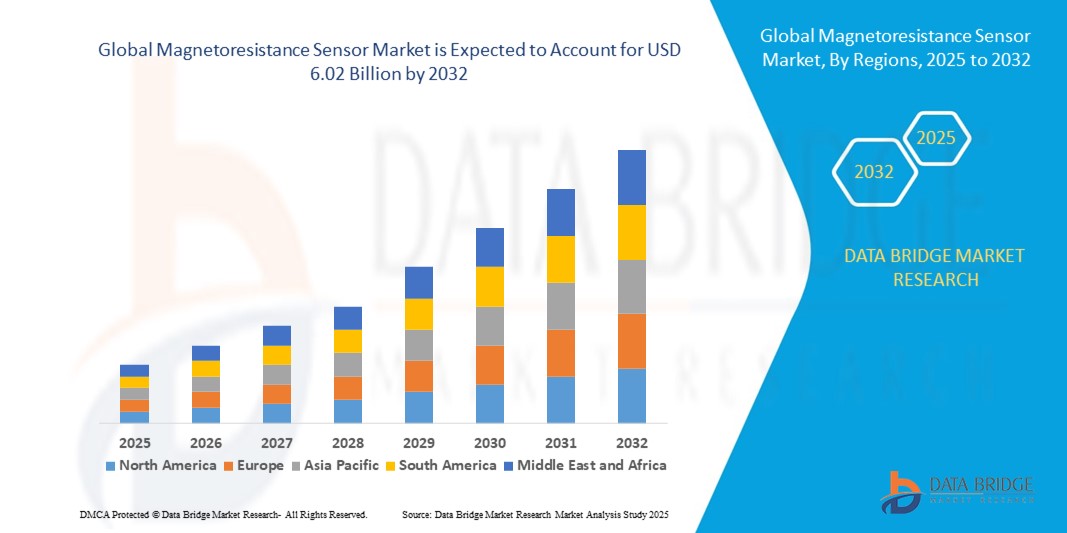
What is the Global Magnetoresistance Sensor Market Size and Growth Rate?
- The global magnetoresistance sensor market size was valued at USD 1.18 billion in 2024 and is expected to reach USD 6.02 billion by 2032, at a CAGR of 22.50% during the forecast period
- Growing marketplace for shopper and automotive trade worldwide is majorly driving behind the expansion of the magnetoresistance sensor market. Surge within the demand of magnetoresistive sensors in each high field moreover as low field applications, such as path and angle measure, determination of magnetic fields, extremely dynamic current measure, and contactless switches and in dynamic measurements beneath extreme conditions, for instance, in vehicle engines are expected to enhance the expansion of magnetoresistance sensor market throughout the forecast period
- Magneto resistive sensors provide some advantages such as low producing price, extraordinarily precise measurements, exaggerated flexibility, hardiness, and low energy consumption, thus will create ample opportunities for the magnetoresistance sensor market
What are the Major Takeaways of Magnetoresistance Sensor Market?
- Growing adoption of magnetoresistance sensor in numerous applications such as in part and defence and in high finish medical devices is also driving the expansion of magnetoresistance sensor market
- Aggressive R&D efforts cause fast innovation in new moveable, consumer, and IoT applications, which, in turn, results in evaluation pressure, particularly for high-volume applications. Consequently, makers' area unit are compelled to decrease the potential value of magnetic sensors
- North America dominated the magnetoresistance sensor market with the largest revenue share of 42.36% in 2024, driven by a growing demand for advanced sensors across consumer electronics, automotive, and industrial applications
- The Asia-Pacific magnetoresistance sensor market is poised to grow at the fastest CAGR of 11.35% during the forecast period of 2025 to 2032, driven by rising urbanization, technological adoption, and increasing disposable incomes in countries such as China, Japan, and India
- The Tunnel Magnetoresistance Sensors segment dominated the market with the largest revenue share of 38.7% in 2024, driven by their superior sensitivity, high stability, and compatibility with advanced electronic systems
Report Scope and Magnetoresistance Sensor Market Segmentation
|
Attributes |
Magnetoresistance Sensor Key Market Insights |
|
Segments Covered |
|
|
Countries Covered |
North America
Europe
Asia-Pacific
Middle East and Africa
South America
|
|
Key Market Players |
|
|
Market Opportunities |
|
|
Value Added Data Infosets |
In addition to the insights on market scenarios such as market value, growth rate, segmentation, geographical coverage, and major players, the market reports curated by the Data Bridge Market Research also include in-depth expert analysis, pricing analysis, brand share analysis, consumer survey, demography analysis, supply chain analysis, value chain analysis, raw material/consumables overview, vendor selection criteria, PESTLE Analysis, Porter Analysis, and regulatory framework. |
What is the Key Trend in the Magnetoresistance Sensor Market?
Integration of AI and Smart Connectivity
- A key and rapidly advancing trend in the global magnetoresistance sensor market is the integration with artificial intelligence (AI) and popular smart ecosystems such as Amazon Alexa, Google Assistant, and Apple HomeKit. This integration is enhancing operational efficiency, user convenience, and real-time monitoring capabilities for industrial, automotive, and consumer applications
- For instance, the next-generation AI-enabled magnetoresistance sensors can optimize vehicle navigation and positioning systems by learning user patterns and predicting environmental changes, providing enhanced accuracy and control. Companies such as Honeywell and Bosch are developing sensors compatible with advanced automation and IoT platforms to improve efficiency and safety
- AI-enabled Magnetoresistance Sensors can offer predictive diagnostics, anomaly detection, and automated alerts for industrial machinery and automotive systems. These sensors also support seamless voice or app-based interaction, enabling hands-free operation and remote monitoring
- The integration of magnetoresistance sensors with broader IoT ecosystems allows centralized management of multiple devices in smart factories, vehicles, or consumer electronics. This unified platform approach enhances operational visibility, automation, and reliability across applications
- This trend towards smarter, AI-driven, and interconnected sensing solutions is reshaping expectations for precision, efficiency, and automation. Consequently, key players are developing sensors with predictive and adaptive features compatible with AI and IoT platforms
- The demand for AI-integrated, connected Magnetoresistance Sensors is rising rapidly across automotive, industrial, and consumer sectors as companies prioritize operational efficiency, accuracy, and real-time control
What are the Key Drivers of Magnetoresistance Sensor Market?
- The growing need for precision sensing in industrial automation, automotive navigation, and consumer electronics is a major driver for the rising adoption of Magnetoresistance Sensors
- For instance, in April 2024, Bosch introduced AI-enabled magnetoresistance sensors for automotive navigation systems, aimed at improving positioning accuracy and predictive maintenance. Such technological advancements by industry leaders are expected to fuel market growth in the forecast period
- Increasing demand for real-time monitoring, predictive analytics, and automated decision-making is encouraging industries to adopt Magnetoresistance Sensors over traditional magnetic sensors. These sensors provide superior sensitivity, reliability, and durability in complex environments
- Furthermore, the proliferation of IoT-enabled systems, smart vehicles, and connected industrial applications is driving the integration of magnetoresistance sensors into larger, intelligent ecosystems
- The compact size, low power consumption, and versatile application capabilities of Magnetoresistance Sensors in automotive, robotics, and consumer electronics are facilitating broader adoption, making them essential components of modern smart systems
Which Factor is Challenging the Growth of the Magnetoresistance Sensor Market?
- Cybersecurity and system reliability concerns are key challenges limiting the adoption of connected Magnetoresistance Sensors. As these sensors are increasingly integrated with IoT and AI systems, they are susceptible to data breaches, hacking, or signal interference
- High-profile vulnerabilities reported in industrial IoT and automotive systems have made some end-users cautious about adopting AI-integrated magnetoresistance solutions
- Ensuring robust encryption, secure authentication, and regular firmware updates is critical for mitigating these concerns. Companies such as Honeywell and Bosch emphasize their secure sensor solutions to maintain consumer and industrial trust
- In addition, the high cost of advanced AI-enabled Magnetoresistance Sensors can restrict adoption among small manufacturers or budget-conscious automotive firms. While entry-level sensors are becoming more affordable, high-end models with advanced features such as adaptive sensing, predictive analytics, or wireless integration remain premium-priced
- Despite gradual price reductions, the perceived premium for high-performance smart sensors may still slow widespread adoption, particularly in emerging markets
- Overcoming these hurdles through cost optimization, enhanced security measures, and user education is essential to ensure sustained growth of the Magnetoresistance Sensor market globally
How is the Magnetoresistance Sensor Market Segmented?
The market is segmented on the basis of type, application, and end user.
- By Type
On the basis of type, the magnetoresistance sensor market is segmented into Giant, Anisotropic, Tunnel, Thin-Film Magnetoresistance Sensors, and Others. The Tunnel Magnetoresistance Sensors segment dominated the market with the largest revenue share of 38.7% in 2024, driven by their superior sensitivity, high stability, and compatibility with advanced electronic systems. Tunnel sensors are widely adopted in automotive and consumer electronics applications for precise magnetic field detection.
The Thin-Film segment is anticipated to witness the fastest growth rate of 22.5% from 2025 to 2032, fueled by its increasing integration in thin-film solar cells and compact electronic devices due to their miniaturized design and energy efficiency.
- By Application
On the basis of application, the magnetoresistance sensor market is segmented into Magnetic Field Measurement, Biomolecular Detection, Thin-Film Solar Cells, Magnetic Storage, Transistors, Three-Dimensional Measurement, and Others. Magnetic Field Measurement accounted for the largest market revenue share of 35.4% in 2024, driven by the growing demand for high-precision industrial and automotive sensors.
Biomolecular Detection is expected to witness the fastest CAGR from 2025 to 2032, driven by the expanding adoption of magnetoresistance sensors in biotechnology and healthcare research for rapid and accurate diagnostics.
- By End User
On the basis of end user, the magnetoresistance sensor market is segmented into Consumer Electronics, Biotechnology, Healthcare, Automotive, Aerospace and Defence, and Others. The Automotive segment held the largest market revenue share of 41.2% in 2024, fueled by the increasing deployment of sensors in navigation systems, electric vehicles, and advanced driver-assistance systems (ADAS).
The Biotechnology segment is expected to witness the fastest CAGR from 2025 to 2032, driven by rising investments in healthcare diagnostics, personalized medicine, and lab-on-chip technologies that leverage magnetoresistance sensors for high-precision analysis.
Which Region Holds the Largest Share of the Magnetoresistance Sensor Market?
- North America dominated the magnetoresistance sensor market with the largest revenue share of 42.36% in 2024, driven by a growing demand for advanced sensors across consumer electronics, automotive, and industrial applications
- Consumers and businesses in the region highly value the reliability, precision, and integration capabilities offered by Magnetoresistance Sensors in navigation systems, robotics, and industrial automation
- This widespread adoption is further supported by high technological awareness, strong R&D infrastructure, and growing investments in smart devices and IoT solutions, establishing magnetoresistance sensors as a preferred choice for both commercial and residential applications
U.S. Magnetoresistance Sensor Market Insight
The U.S. magnetoresistance sensor market captured the largest revenue share of 81% in 2024 within North America, fueled by increasing adoption of electric vehicles, autonomous systems, and smart consumer electronics. The growing preference for high-precision navigation, safety systems, and robotics applications is further propelling market growth. Moreover, ongoing integration with IoT platforms and industrial automation systems is significantly contributing to the expansion of the U.S. market.
Europe Magnetoresistance Sensor Market Insight
The Europe magnetoresistance sensor market is projected to expand at a substantial CAGR during the forecast period, primarily driven by stringent regulatory standards, the rising demand for automotive safety solutions, and rapid urbanization. Increasing adoption of connected devices, energy-efficient applications, and industrial automation is fostering market growth. European countries are experiencing notable expansion across automotive, consumer electronics, and healthcare applications.
U.K. Magnetoresistance Sensor Market Insight
The U.K. magnetoresistance sensor market is anticipated to grow at a noteworthy CAGR during the forecast period, driven by strong adoption of smart automotive technologies, advanced industrial solutions, and IoT-enabled consumer devices. Concerns regarding safety and automation in automotive and industrial sectors are encouraging investments in high-precision sensors. The U.K.’s well-developed technological ecosystem and e-commerce infrastructure further stimulate market growth.
Germany Magnetoresistance Sensor Market Insight
The Germany magnetoresistance sensor market is expected to expand at a considerable CAGR during the forecast period, fueled by the increasing focus on automotive innovation, renewable energy, and precision manufacturing. Germany’s emphasis on sustainability, innovation, and high-quality manufacturing promotes the adoption of Magnetoresistance Sensors across automotive, industrial, and consumer electronics sectors. Integration with smart and automated systems is becoming increasingly prevalent, reflecting strong local demand for advanced sensor technologies.
Which Region is the Fastest Growing Region in the Magnetoresistance Sensor Market?
The Asia-Pacific magnetoresistance sensor market is poised to grow at the fastest CAGR of 11.35% during the forecast period of 2025 to 2032, driven by rising urbanization, technological adoption, and increasing disposable incomes in countries such as China, Japan, and India. The region’s growing inclination toward smart industrial, automotive, and consumer applications, supported by government initiatives promoting digitalization, is driving adoption. In addition, APAC is emerging as a manufacturing hub for Magnetoresistance Sensor components, making solutions more affordable and widely accessible.
Japan Magnetoresistance Sensor Market Insight
The Japan magnetoresistance sensor market is gaining momentum due to the country’s high-tech ecosystem, rapid urbanization, and strong emphasis on automation. Adoption is driven by growing smart automotive and consumer electronics applications, with integration alongside IoT devices such as navigation systems and robotics. Japan’s aging population also increases demand for secure and user-friendly sensor-based solutions in both industrial and residential sectors.
China Magnetoresistance Sensor Market Insight
The China magnetoresistance sensor market accounted for the largest revenue share in Asia-Pacific in 2024, attributed to rapid technological adoption, expansion of the middle class, and government initiatives supporting smart cities. China is one of the largest markets for automotive, industrial, and consumer electronics sensors. The availability of locally manufactured, cost-effective Magnetoresistance Sensors and increasing deployment in smart industrial and automotive solutions are key factors propelling market growth in China.
Which are the Top Companies in Magnetoresistance Sensor Market?
The magnetoresistance sensor industry is primarily led by well-established companies, including:
- AMS (Austria)
- Murata Manufacturing Co., Ltd. (Japan)
- TE Connectivity (Ireland)
- Asahi Kasei Microdevices Corporation (Japan)
- Honeywell International Inc. (U.S.)
- Analog Devices, Inc. (U.S.)
- NXP Semiconductors N.V. (Netherlands)
- Infineon Technologies AG (Germany)
- Memsic Inc. (U.S.)
- Robert Bosch GmbH (Germany)
- Magnachip Semiconductor Corporation (South Korea)
- Diodes Incorporated (U.S.)
- Allegro Microsystems Inc. (U.S.)
- Panasonic Corporation (Japan)
- Melexis NV (Belgium)
- Micronas Semiconductor Holdings AG (Switzerland)
What are the Recent Developments in Global Magnetoresistance Sensor Market?
- In December 2024, Allegro Microsystems, Inc. introduced a new suite of magnetic sensing solutions designed for diverse engineering applications, unveiling inductive position sensors and low-power magnetic switches and latches at Electronica 2024 in Munich. Earlier in September, the company also launched two current sensors featuring its XtremeSense tunnel magneto-resistance (TMR) technology, marking the debut of its first TMR-based products following the acquisition of Crocus Technologies. This launch strengthens Allegro Microsystems’ position in high-precision magnetic sensing solutions
- In October 2023, Movano Health partnered with ams OSRAM to deliver advanced lifestyle monitoring solutions for women, combining Movano Health's expertise in health analytics with ams OSRAM's magnetoresistive sensor technologies. The collaboration aims to create wearable devices capable of precise real-time monitoring of heart rate variability, sleep patterns, and stress levels, enhancing health tracking accuracy
- In June 2024, TDK Corporation launched a new stray-field resistant 3D magnetic position sensor, the HAL/HAR 3936, engineered to handle external signal interference and meet the demanding requirements of automotive and industrial sectors. This innovation marks a significant advancement in high-performance magnetic position sensing technology
- In June 2022, Melexis NV expanded its Tunnel Magnetoresistance (TMR) sensor portfolio by introducing high-temperature models, designed for automotive, industrial, and aerospace applications. The new TMR sensors provide enhanced sensitivity and accuracy even in extreme conditions, offering robust and reliable measurement capabilities for challenging environments

- Interactive Data Analysis Dashboard
- Company Analysis Dashboard for high growth potential opportunities
- Research Analyst Access for customization & queries
- Competitor Analysis with Interactive dashboard
- Latest News, Updates & Trend analysis
- Harness the Power of Benchmark Analysis for Comprehensive Competitor Tracking
Global Magnetoresistance Sensor Market, Supply Chain Analysis and Ecosystem Framework
To support market growth and help clients navigate the impact of geopolitical shifts, DBMR has integrated in-depth supply chain analysis into its Global Magnetoresistance Sensor Market research reports. This addition empowers clients to respond effectively to global changes affecting their industries. The supply chain analysis section includes detailed insights such as Global Magnetoresistance Sensor Market consumption and production by country, price trend analysis, the impact of tariffs and geopolitical developments, and import and export trends by country and HSN code. It also highlights major suppliers with data on production capacity and company profiles, as well as key importers and exporters. In addition to research, DBMR offers specialized supply chain consulting services backed by over a decade of experience, providing solutions like supplier discovery, supplier risk assessment, price trend analysis, impact evaluation of inflation and trade route changes, and comprehensive market trend analysis.
Data collection and base year analysis are done using data collection modules with large sample sizes. The stage includes obtaining market information or related data through various sources and strategies. It includes examining and planning all the data acquired from the past in advance. It likewise envelops the examination of information inconsistencies seen across different information sources. The market data is analysed and estimated using market statistical and coherent models. Also, market share analysis and key trend analysis are the major success factors in the market report. To know more, please request an analyst call or drop down your inquiry.
The key research methodology used by DBMR research team is data triangulation which involves data mining, analysis of the impact of data variables on the market and primary (industry expert) validation. Data models include Vendor Positioning Grid, Market Time Line Analysis, Market Overview and Guide, Company Positioning Grid, Patent Analysis, Pricing Analysis, Company Market Share Analysis, Standards of Measurement, Global versus Regional and Vendor Share Analysis. To know more about the research methodology, drop in an inquiry to speak to our industry experts.
Data Bridge Market Research is a leader in advanced formative research. We take pride in servicing our existing and new customers with data and analysis that match and suits their goal. The report can be customized to include price trend analysis of target brands understanding the market for additional countries (ask for the list of countries), clinical trial results data, literature review, refurbished market and product base analysis. Market analysis of target competitors can be analyzed from technology-based analysis to market portfolio strategies. We can add as many competitors that you require data about in the format and data style you are looking for. Our team of analysts can also provide you data in crude raw excel files pivot tables (Fact book) or can assist you in creating presentations from the data sets available in the report.













