


What is Mailer Packaging Market Size and Overview ?
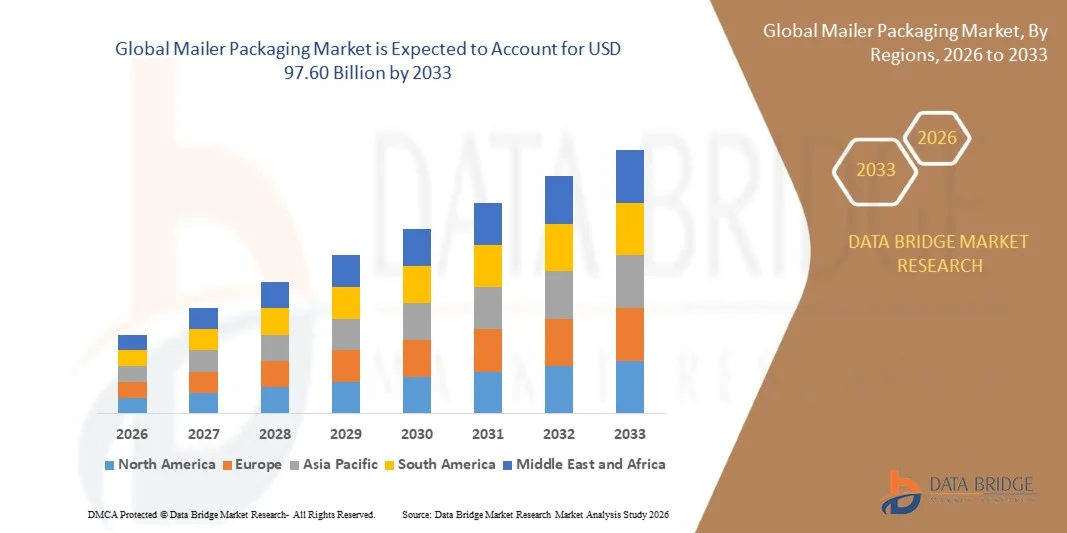
- As per Data Bridge Market Research analysis the Mailer Packaging Market was valued at USD 36.20 billion in 2025 and is projected to reach USD 97.60 billion by 2033, growing at a CAGR of 13.20% from 2026 to 2033. The market is experiencing rapid growth driven by the expanding e-commerce sector, rising demand for lightweight and protective packaging solutions, and increasing preference for convenient, cost-effective, and sustainable shipping formats across retail, logistics, and consumer goods industries.
- The growing volume of online purchases globally, combined with increasing consumer expectations for secure and damage-free deliveries, is encouraging retailers and logistics providers to adopt advanced mailer packaging solutions. Paper mailers, padded envelopes, bubble mailers, and recyclable flexible packaging are increasingly replacing conventional rigid packaging in many applications, offering lower shipping costs, reduced material consumption, and improved convenience for product fulfillment and last-mile delivery.
Market Size & Forecast
- Global Market Value (2025): USD 36.20 Billion
- Expected Market Value (2033): USD 97.60 Billion
- Forecast CAGR (2026–2033): 13.20%
- Leading Region in 2025: North America
- Fastest Growing Region: Asia-Pacific
Key Market Trends & Insights
- North America dominated the mailer packaging market with the largest revenue share of 36.8% in 2025, supported by a mature e-commerce ecosystem, high parcel shipment volumes, widespread adoption of automated fulfillment operations, and increasing demand for sustainable mailer formats among retailers and logistics providers.
- Asia-Pacific is expected to be the fastest-growing region, recording a CAGR of 16.1% from 2026 to 2033. Growth is driven by rising online shopping activity, increasing smartphone and internet penetration, expanding logistics infrastructure, growing cross-border e-commerce, and strong production capabilities for flexible packaging materials across China, India, Japan, and Southeast Asia.
- The Plastic segment held the largest market revenue share of approximately 47.6% in 2025, driven by the widespread use of polyethylene bubble mailers, poly mailers, and moisture-resistant flexible packaging across e-commerce, apparel, consumer electronics, and shipping applications. Plastic mailers are preferred due to their lightweight structure, durability, water resistance, and ability to reduce shipping costs compared with rigid packaging formats.
- The Paper segment is projected to register the fastest growth at a CAGR of 15.1% from 2026 to 2033, driven by rising consumer preference for recyclable packaging and increasing regulatory restrictions on single-use plastic materials. Growing adoption of paper-based padded mailers, kraft envelopes, and fiber-based protective packaging by e-commerce retailers is accelerating segment expansion.
- The Cushioned Mailers segment held the largest market revenue share of approximately 55.8% in 2025, supported by rising demand for protective packaging for electronics accessories, cosmetics, books, pharmaceutical products, and fragile consumer goods. Cushioned mailers provide impact resistance and product protection while using less material and occupying less space than corrugated boxes.
- The Non-cushioned Mailers segment is projected to register the fastest growth at a CAGR of 14.4% from 2026 to 2033, driven by increasing shipment volumes of apparel, documents, accessories, and non-fragile consumer goods. Growing adoption of lightweight poly mailers and paper envelopes in high-volume e-commerce fulfillment operations is supporting segment growth.
- The Non-insulated segment held the largest market revenue share of approximately 68.9% in 2025, driven by its extensive use in standard e-commerce deliveries, apparel shipments, printed materials, and general consumer goods packaging. Non-insulated mailers are widely adopted because of their low cost, compact design, and suitability for products that do not require temperature control.
- The Insulated segment is projected to register the fastest growth at a CAGR of 15.8% from 2026 to 2033, driven by increasing demand for temperature-sensitive packaging across food delivery, pharmaceuticals, meal kits, cosmetics, and healthcare products. Rising adoption of cold-chain logistics and direct-to-consumer delivery models is accelerating demand for insulated mailer packaging solutions.
- The E-commerce segment held the largest market revenue share of approximately 49.3% in 2025, driven by the rapid growth of online retail, direct-to-consumer brands, and marketplace-based product deliveries. E-commerce businesses increasingly use mailer packaging to reduce dimensional shipping costs, improve packing speed, and support convenient last-mile delivery operations.
- The Shipping & Logistics segment is projected to register the fastest growth at a CAGR of 14.7% from 2026 to 2033, driven by expanding parcel volumes, cross-border trade activity, and increasing demand for secure, tamper-evident, and lightweight packaging solutions. Growing investments in automated fulfillment centers and parcel sorting infrastructure are further accelerating segment expansion.
Report Scope and Mailer Packaging Market Segmentation
|
Attributes |
Mailer Packaging Key Market Insights |
|
Segments Covered |
|
|
Countries Covered |
North America
Europe
Asia-Pacific
Middle East and Africa
South America
|
|
Key Market Players |
|
|
Market Opportunities |
|
|
Value Added Data Infosets |
In addition to the insights on market scenarios such as market value, growth rate, segmentation, geographical coverage, and major players, the market reports curated by the Data Bridge Market Research also include import export analysis, production capacity overview, production consumption analysis, price trend analysis, climate change scenario, supply chain analysis, value chain analysis, raw material/consumables overview, vendor selection criteria, PESTLE Analysis, Porter Analysis, and regulatory framework. |
What is the Key Trend in Mailer Packaging Market ?
Trend: Growth In Sustainable Mailer Packaging And E-Commerce Fulfillment Applications
Increasing demand for lightweight, protective, and environmentally responsible packaging across e-commerce, retail, logistics, and direct-to-consumer industries is accelerating adoption of advanced mailer packaging solutions. Conventional rigid packaging formats often use more material, occupy greater shipping space, and increase transportation costs, encouraging brands and logistics providers to shift toward paper mailers, padded envelopes, bubble mailers, and flexible protective packaging with lower material consumption.
In e-commerce fulfillment operations, retailers are increasingly using right-sized mailer packaging to reduce dimensional weight charges and improve warehouse packing efficiency. For instance, Amazon reported that it reduced per-shipment packaging weight by 43% between 2015 and 2023 and avoided more than 3 million metric tons of packaging materials globally, demonstrating the growing industry focus on packaging reduction and optimized delivery formats.
The rapid expansion of online fashion, cosmetics, books, electronics accessories, and subscription box deliveries is also increasing demand for durable mailers capable of protecting products during last-mile transportation. In addition, brands are adopting recycled paper mailers and recyclable padded envelopes to meet sustainability commitments and reduce plastic waste. Packaging industry initiatives during 2024 and 2025 increasingly focused on replacing conventional plastic bubble mailers with paper-based alternatives containing recycled fiber and water-based protective cushioning.
Mailer Packaging Market Dynamics
Key Market Driver: Rising Expansion Of E-Commerce And Direct-To-Consumer Deliveries
The continued expansion of e-commerce platforms and direct-to-consumer retail channels is driving strong demand for efficient, cost-effective, and protective mailer packaging solutions. Rising online purchasing activity is increasing shipment volumes across fashion, consumer electronics, healthcare products, beauty products, books, and household goods, creating sustained demand for lightweight packaging formats that support high-volume fulfillment operations.
E-commerce retailers and logistics providers are increasingly deploying mailers to reduce packaging material usage, lower shipping costs, and improve order processing speed. For instance, the U.S. Census Bureau reported that U.S. retail e-commerce sales reached approximately USD 1.19 trillion in 2024, accounting for 16.1% of total retail sales, highlighting the scale of online order fulfillment supporting mailer packaging demand.
Similarly, growing cross-border e-commerce activity is encouraging packaging suppliers to develop durable, tamper-evident, and moisture-resistant mailers that can withstand extended transportation cycles. Major marketplaces are also expanding automated fulfillment centers, where standardized mailer formats improve packaging line efficiency and reduce manual handling requirements.
Key Restraint/Challenge: Volatility In Raw Material Prices And Recycling Infrastructure Limitations
Mailer packaging manufacturers face challenges related to fluctuations in paper, plastic resin, adhesive, and cushioning material prices. Changes in pulp availability, petroleum-based polymer costs, and transportation expenses can increase production costs and create pricing pressure for packaging suppliers, particularly for high-volume and cost-sensitive e-commerce applications.
In addition, recyclable and compostable mailer packaging formats may require specialized collection, sorting, and processing infrastructure that is not uniformly available across all regions. Paper mailers with plastic bubble linings, labels, adhesives, and protective coatings can also create recycling challenges when materials are not easily separated.
For instance, the U.S. Environmental Protection Agency reported that the recycling rate for plastic packaging and containers was approximately 13.1% in 2018, illustrating the limitations of existing recycling systems for flexible plastic packaging materials. These challenges can restrict the environmental benefits of certain mailer formats and increase compliance requirements for packaging producers.
Key Market Opportunity: Development Of Recyclable Paper Mailers And Smart Packaging Solutions
Growing consumer awareness of packaging waste and strengthening regulatory measures on single-use plastics are creating significant opportunities for recyclable paper mailers, compostable protective packaging, and mono-material flexible packaging solutions. Brands are increasingly seeking packaging formats that provide product protection while supporting circular economy targets and reducing reliance on virgin plastic materials.
Packaging companies are developing paper-based padded mailers, recycled-content envelopes, and fiber-based cushioning alternatives for apparel, cosmetics, books, and consumer goods shipments. For instance, DHL’s GoGreen program targets net-zero logistics-related emissions by 2050, encouraging e-commerce sellers and logistics partners to reduce packaging waste and improve the environmental performance of delivery operations.
In addition, integration of QR codes, RFID labels, and digital tracking features into mailer packaging is creating opportunities for improved shipment visibility, product authentication, and return management. Advancements in water-based adhesives, recyclable barrier coatings, and automated mailer manufacturing systems are further supporting adoption across global e-commerce and direct-to-consumer fulfillment networks.
Mailer Packaging Market Scope
The market is segmented on the basis of material, product type, insulation, and end use application.
- By Material
On the basis of material, the mailer packaging market is segmented into plastic, paper, aluminum foil, and others. The Plastic segment held the largest market revenue share of approximately 47.6% in 2025, driven by the widespread use of polyethylene bubble mailers, poly mailers, and moisture-resistant flexible packaging across e-commerce, apparel, consumer electronics, and shipping applications. Plastic mailers are preferred due to their lightweight structure, durability, water resistance, and ability to reduce shipping costs compared with rigid packaging formats.
The Paper segment is projected to register the fastest growth at a CAGR of 15.1% from 2026 to 2033, driven by rising consumer preference for recyclable packaging and increasing regulatory restrictions on single-use plastic materials. Growing adoption of paper-based padded mailers, kraft envelopes, and fiber-based protective packaging by e-commerce retailers is accelerating segment expansion.
- By Product Type
On the basis of product type, the mailer packaging market is segmented into cushioned mailers and non-cushioned mailers. The Cushioned Mailers segment held the largest market revenue share of approximately 55.8% in 2025, supported by rising demand for protective packaging for electronics accessories, cosmetics, books, pharmaceutical products, and fragile consumer goods. Cushioned mailers provide impact resistance and product protection while using less material and occupying less space than corrugated boxes.
The Non-cushioned Mailers segment is projected to register the fastest growth at a CAGR of 14.4% from 2026 to 2033, driven by increasing shipment volumes of apparel, documents, accessories, and non-fragile consumer goods. Growing adoption of lightweight poly mailers and paper envelopes in high-volume e-commerce fulfillment operations is supporting segment growth.
- By Insulation
On the basis of insulation, the mailer packaging market is segmented into insulated and non-insulated. The Non-insulated segment held the largest market revenue share of approximately 68.9% in 2025, driven by its extensive use in standard e-commerce deliveries, apparel shipments, printed materials, and general consumer goods packaging. Non-insulated mailers are widely adopted because of their low cost, compact design, and suitability for products that do not require temperature control.
The Insulated segment is projected to register the fastest growth at a CAGR of 15.8% from 2026 to 2033, driven by increasing demand for temperature-sensitive packaging across food delivery, pharmaceuticals, meal kits, cosmetics, and healthcare products. Rising adoption of cold-chain logistics and direct-to-consumer delivery models is accelerating demand for insulated mailer packaging solutions.
- By End Use
On the basis of end use, the mailer packaging market is segmented into e-commerce, shipping & logistics, manufacturing & warehousing, and others. The E-commerce segment held the largest market revenue share of approximately 49.3% in 2025, driven by the rapid growth of online retail, direct-to-consumer brands, and marketplace-based product deliveries. E-commerce businesses increasingly use mailer packaging to reduce dimensional shipping costs, improve packing speed, and support convenient last-mile delivery operations.
The Shipping & Logistics segment is projected to register the fastest growth at a CAGR of 14.7% from 2026 to 2033, driven by expanding parcel volumes, cross-border trade activity, and increasing demand for secure, tamper-evident, and lightweight packaging solutions. Growing investments in automated fulfillment centers and parcel sorting infrastructure are further accelerating segment expansion.
Mailer Packaging Market Regional Analysis
North America Mailer Packaging Market Insight
North America dominated the mailer packaging market with the largest revenue share of approximately 36.8% in 2025, supported by the well-established e-commerce sector, high parcel delivery volumes, and growing adoption of sustainable packaging solutions. Retailers and logistics providers across the region are increasingly using lightweight poly mailers, paper mailers, padded envelopes, and recyclable protective packaging to reduce shipping costs and improve fulfillment efficiency. The strong presence of major online retailers, direct-to-consumer brands, and automated distribution networks is further supporting market expansion.
U.S. Mailer Packaging Market Insight
The U.S. mailer packaging market captured the largest revenue share in 2025 within North America, fueled by rapid growth in online retail, subscription-based commerce, and direct-to-consumer product deliveries. E-commerce companies are increasingly prioritizing right-sized mailer packaging to reduce dimensional weight charges, lower material consumption, and improve last-mile delivery efficiency. Growing consumer preference for recyclable and paper-based mailers, combined with increasing investments in automated fulfillment centers, is further propelling market growth.
Europe Mailer Packaging Market Insight
The Europe mailer packaging market is expected to witness strong growth from 2026 to 2033, primarily driven by stringent packaging waste regulations, increasing demand for recyclable packaging materials, and the expanding e-commerce sector. Retailers and packaging suppliers are increasingly adopting paper-based mailers, recycled-content flexible packaging, and mono-material protective solutions to support circular economy targets. The growing focus on reducing single-use plastic waste across retail, logistics, and consumer goods applications is further accelerating regional market development.
U.K. Mailer Packaging Market Insight
The U.K. mailer packaging market is expected to witness significant growth from 2026 to 2033, driven by rising online shopping activity, expanding parcel delivery networks, and increasing consumer awareness of sustainable packaging. Retailers are increasingly adopting recyclable paper mailers, compostable shipping envelopes, and lightweight protective packaging to improve environmental performance and reduce delivery costs. The country’s mature e-commerce infrastructure and strong direct-to-consumer retail ecosystem are further supporting market expansion.
Germany Mailer Packaging Market Insight
The Germany mailer packaging market is expected to grow steadily from 2026 to 2033, fueled by strong environmental regulations, advanced recycling infrastructure, and increasing demand for sustainable e-commerce packaging solutions. German retailers and manufacturers are increasingly using recycled paper mailers, fiber-based cushioning materials, and recyclable flexible packaging to reduce packaging waste. The country’s established logistics industry and focus on circular economy practices are supporting the adoption of advanced mailer packaging formats.
Asia-Pacific Mailer Packaging Market Insight
The Asia-Pacific mailer packaging market is expected to witness the fastest growth rate from 2026 to 2033, supported by rapid expansion of e-commerce platforms, rising disposable incomes, increasing smartphone penetration, and growing investments in logistics infrastructure across China, India, Japan, South Korea, and Southeast Asian countries. The region’s large consumer base and expanding cross-border trade activity are increasing demand for cost-effective, lightweight, and protective packaging solutions. Growing local production of flexible packaging materials is also improving the affordability and availability of mailer packaging products.
Japan Mailer Packaging Market Insight
The Japan mailer packaging market is expected to witness strong growth from 2026 to 2033 due to the country’s advanced retail infrastructure, high consumer expectations for secure deliveries, and increasing adoption of sustainable packaging materials. E-commerce companies are increasingly using high-quality paper mailers, protective envelopes, and compact packaging formats to support efficient urban deliveries and reduce material usage. The growing demand for convenient home delivery services and environmentally responsible packaging is further driving market growth.
China Mailer Packaging Market Insight
The China mailer packaging market accounted for the largest market revenue share in Asia-Pacific in 2025, attributed to the country’s large e-commerce ecosystem, high parcel shipment volumes, and expanding network of logistics and fulfillment centers. Online retailers are increasingly adopting poly mailers, paper mailers, bubble mailers, and tamper-evident packaging to support high-volume deliveries across fashion, electronics, cosmetics, and household goods categories. Government initiatives focused on reducing excessive packaging waste, combined with the availability of low-cost packaging materials and strong domestic manufacturing capabilities, are significantly propelling market expansion.
Mailer Packaging Market Share
The Mailer Packaging industry is primarily led by well-established companies, including:
- Sealed Air (U.S.)
- Mondi (U.K.)
- Pregis Corporation (U.S.)
- Smurfit Kappa (Ireland)
- DS Smith (U.K.)
- ProAmpac (U.S.)
- Tipa Ltd. (Israel)
- Crown Packaging Corp. (U.S.)
- Intertape Polymer Group Inc. (U.S.)
- 3M (U.S.)
- Novolex (U.S.)
- Georgia-Pacific LLC (U.S.)
- Storopack Hans Reichenecker GmbH (Germany)
- Uline (U.S.)
- Primary Packaging Inc. (U.S.)
- BASF SE (Germany)
Latest Developments in Mailer Packaging Market
- In September 2025, PAC Worldwide, a division of ProAmpac, product showcase, introduced new sustainable e-commerce packaging solutions at Pack Expo Las Vegas, including post-consumer recycled Bubble Roll and a fixed release liner for wicketed paper mailers. These developments support reduced virgin material use, improved packing efficiency, and wider adoption of sustainable protective packaging across e-commerce and retail sectors.
- In October 2024, PAC Worldwide Corporation, product launch, introduced Polyjacket mailers manufactured using 100% recycled materials, including 100% post-consumer resin and 100% post-industrial recycled variants. The RCS-certified mailers help brands validate recycled-content claims, strengthen sustainability positioning, and increase demand for circular mailer packaging solutions.
- In May 2024, Pregis Corporation, product launch, introduced the EverTec Automated Mailer designed for use with Pregis Sharp MaxPro automated bagging machines. The kraft paper mailer improves packaging throughput, supports secure parcel delivery, reduces shipping costs, and expands automated paper-based packaging adoption among e-commerce fulfillment operators.
- In March 2024, 3M, product launch, introduced Padded Automatable Curbside Recyclable Mailer Material, combining protective padding and paper in a curbside-recyclable format. The material can increase packaging speeds by up to three times when used with compatible automated systems, supporting productivity improvements and reducing dependence on plastic-based padded mailers.
- In July 2022, Sealed Air, product launch, introduced Paper Bubble Mailer, a fiber-based padded mailer designed for curbside recycling. The launch expanded the company’s paper mailer portfolio and supported growing demand for recyclable protective packaging solutions across e-commerce, retail, and shipping applications.

- Interactive Data Analysis Dashboard
- Company Analysis Dashboard for high growth potential opportunities
- Research Analyst Access for customization & queries
- Competitor Analysis with Interactive dashboard
- Latest News, Updates & Trend analysis
- Harness the Power of Benchmark Analysis for Comprehensive Competitor Tracking
Global Mailer Packaging Market, Supply Chain Analysis and Ecosystem Framework
To support market growth and help clients navigate the impact of geopolitical shifts, DBMR has integrated in-depth supply chain analysis into its Global Mailer Packaging Market research reports. This addition empowers clients to respond effectively to global changes affecting their industries. The supply chain analysis section includes detailed insights such as Global Mailer Packaging Market consumption and production by country, price trend analysis, the impact of tariffs and geopolitical developments, and import and export trends by country and HSN code. It also highlights major suppliers with data on production capacity and company profiles, as well as key importers and exporters. In addition to research, DBMR offers specialized supply chain consulting services backed by over a decade of experience, providing solutions like supplier discovery, supplier risk assessment, price trend analysis, impact evaluation of inflation and trade route changes, and comprehensive market trend analysis.
Data collection and base year analysis are done using data collection modules with large sample sizes. The stage includes obtaining market information or related data through various sources and strategies. It includes examining and planning all the data acquired from the past in advance. It likewise envelops the examination of information inconsistencies seen across different information sources. The market data is analysed and estimated using market statistical and coherent models. Also, market share analysis and key trend analysis are the major success factors in the market report. To know more, please request an analyst call or drop down your inquiry.
The key research methodology used by DBMR research team is data triangulation which involves data mining, analysis of the impact of data variables on the market and primary (industry expert) validation. Data models include Vendor Positioning Grid, Market Time Line Analysis, Market Overview and Guide, Company Positioning Grid, Patent Analysis, Pricing Analysis, Company Market Share Analysis, Standards of Measurement, Global versus Regional and Vendor Share Analysis. To know more about the research methodology, drop in an inquiry to speak to our industry experts.
Data Bridge Market Research is a leader in advanced formative research. We take pride in servicing our existing and new customers with data and analysis that match and suits their goal. The report can be customized to include price trend analysis of target brands understanding the market for additional countries (ask for the list of countries), clinical trial results data, literature review, refurbished market and product base analysis. Market analysis of target competitors can be analyzed from technology-based analysis to market portfolio strategies. We can add as many competitors that you require data about in the format and data style you are looking for. Our team of analysts can also provide you data in crude raw excel files pivot tables (Fact book) or can assist you in creating presentations from the data sets available in the report.













