


Maleic Anhydride Market Size
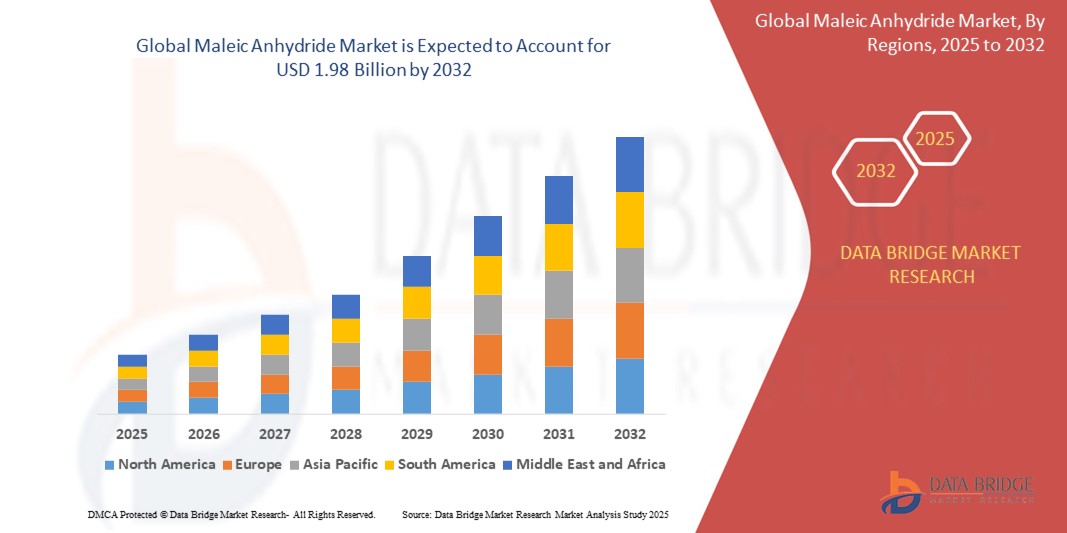
- The Global Maleic Anhydride Market size was valued at USD 1.42 Billion in 2024 and is projected to reach USD 1.98 Billion by 2032, at a CAGR of 4.20% during the forecast period.
- Market growth is primarily driven by rising consumption of unsaturated polyester resins (UPR) across automotive, construction, and marine sectors—where UPR is used for fiber-reinforced plastics, gel coats, and sealants that demand high mechanical strength and corrosion resistance. Additionally, expanding agricultural chemical formulations (herbicides, fungicides, and plant growth regulators) in emerging economies are bolstering maleic anhydride demand as a key intermediate in producing 2,4-D, benomyl, and other derivatives.
- Furthermore, stringent environmental regulations on benzene-derived feedstocks have prompted producers to shift toward n-butane oxidation processes to reduce aromatic emissions. Investment in advanced catalytic oxidation technologies and energy-efficient process units is enhancing yield and lowering production costs. Development of bio-based maleic anhydride from renewable feedstocks (e.g., furfural, biomass-derived furan) is also gaining traction among market participants seeking to offer greener product portfolios
Maleic Anhydride Market Analysis
- Maleic anhydride (C₄H₂O₃) is a colorless crystalline dicarboxylic acid anhydride primarily manufactured through vapor-phase catalytic oxidation of n-butane or liquid-phase oxidation of benzene. As a versatile chemical intermediate, it finds extensive applications in producing unsaturated polyester resins, agricultural chemicals, lubricating oil additives (e.g., succinic acid and its derivatives), copolymers, surfactants, and specialty chemicals.
- Rising demand for UPR in the automotive industry—particularly for manufacturing lightweight composite parts and body panels—remains a key driver. The global push toward weight reduction and fuel efficiency is prompting OEMs to adopt glass-reinforced polyester composites, increasing feedstock requirements for maleic anhydride. Concurrently, expansion in construction activities in Asia-Pacific is fueling consumption of roof coatings, flooring materials, and corrosion-resistant coatings, all of which incorporate UPR derived from maleic anhydride.
- In the agriculture segment, maleic anhydride serves as a precursor to 2,4-D and other herbicidal formulations. Growing food security concerns and rising acreage under cultivation—especially in India, China, Brazil, and Argentina—are driving higher uptake of agrochemicals, thereby underpinning maleic anhydride demand. Likewise, increasing mechanization of agriculture and demand for high-performance lubricants are boosting demand for succinic acid esters, which are synthesized from maleic anhydride.
- Asia-Pacific held a dominant share of 46.8% in 2024, supported by large-scale manufacturing capacity in China (accounting for over 40% of global production). Rapid industrialization, substantial investments in construction, and rising automotive production in China and India are key consumption drivers. Local producers are expanding capacity through debottlenecking and greenfield plants to cater to domestic and export markets.
- North America accounted for 24.7% of global revenue in 2024, led by the U.S., where extensive shale gas resources have made n-butane-based production more cost-competitive. The region’s strong UPR demand for wind turbine blades, infrastructure projects, and marine composites is fostering steady growth. Environmental regulations restricting benzene oxidation routes are accelerating transition toward n-butane feedstock and advanced oxidation catalysts.
- Europe contributed 19.2% of the global market in 2024, with Germany, Italy, and France being major consumers. The EU’s focus on building renovation and infrastructure modernization is stimulating demand for corrosion-resistant coatings and composite materials. Strict REACH regulations on benzene usage are prompting manufacturers to upgrade to n-butane oxidation facilities and invest in cleaner production technologies.
Report Scope and Maleic Anhydride Market Segmentation
|
Attributes |
Maleic Anhydride Key Market Insights |
|
Segments Covered |
|
|
Countries Covered |
North America
Europe
Asia-Pacific
Middle East and Africa
South America
|
|
Key Market Players |
|
|
Market Opportunities |
|
|
Value Added Data Infosets |
In addition to the insights on market scenarios such as market value, growth rate, segmentation, geographical coverage, and major players, the market reports curated by the Data Bridge Market Research also include in-depth expert analysis, pricing analysis, brand share analysis, consumer survey, demography analysis, supply chain analysis, value chain analysis, raw material/consumables overview, vendor selection criteria, PESTLE Analysis, Porter Analysis, and regulatory framework. |
Maleic Anhydride Market Trends
“Integration of Bio-Based Feedstocks and Expansion of UPR Applications”
- A primary trend in the Global Maleic Anhydride Market is the shift toward bio-based production routes—utilizing biomass-derived furfural, corn cobs, and other agricultural residues as feedstocks to synthesize maleic anhydride via catalytic oxidation. Companies such as SOVENTIX and SK Capital are investing in pilot plants and R&D to commercialize greener processes, reducing dependence on n-butane and benzene, and lowering CO₂ emissions.
- Rapid growth in the wind energy sector is driving demand for unsaturated polyester resins (UPR) used in manufacture of fiberglass-reinforced composite wind turbine blades. As global onshore and offshore capacity installations accelerate—particularly in China, the U.S., and Europe—UPR producers are expanding maleic anhydride feedstock sourcing agreements to ensure uninterrupted supply.
- Digitalization and Industry 4.0 adoption in maleic anhydride manufacturing facilities are enhancing process efficiency, yield optimization, and real-time monitoring. Leading players are deploying advanced process control (APC), predictive maintenance algorithms, and IoT-enabled catalysts to maximize conversion rates and minimize by-product formation (e.g., CO, CO₂, maleic acid).
- Rising environmental regulations in North America and Europe are accelerating the phase-out of benzene-based production in favor of n-butane oxidation routes. This transition is complemented by investments in low-NOx burners, energy recovery systems, and closed-loop water treatment to comply with local emissions standards and wastewater discharge norms.
- Expansion of specialty maleic anhydride derivatives—such as maleic anhydride-functionalized polymers, surfactants, and copolymers for high-performance coatings and adhesives—is becoming a notable sub-trend. Manufacturers are collaborating with downstream resin formulators to create tailored chemistries that improve adhesion, UV resistance, and durability in industrial coatings, automotive clearcoats, and marine paints
Maleic Anhydride Market Dynamics
Driver
“Growing Demand for Unsaturated Polyester Resins (UPR) in Automotive and Construction”
- The Maleic Anhydride (MAN) market is experiencing robust growth driven by the escalating demand for unsaturated polyester resins (UPR), which consume over 50% of global MAN output. UPRs are extensively used in fiberglass-reinforced plastics for applications in automotive body panels, marine components, and building materials due to their superior corrosion resistance and mechanical strength.
- The global push for lightweight vehicles and sustainable building practices is intensifying demand for MAN-based resins. Automotive OEMs are adopting UPR composites to meet stringent emission regulations and reduce vehicle weight without compromising performance.
- For instance, in March 2025, AOC, LLC launched its new "EcoVance MA-300" UPR system with bio-based maleic anhydride content, offering 25% lower lifecycle carbon emissions compared to traditional formulations, targeting EV platforms and high-performance marine craft.
- In the construction sector, rising infrastructure investments in Asia-Pacific, the Middle East, and Latin America are fueling the demand for MAN-derived composites in decorative panels, electrical insulation, sanitary wares, and door skins.
- Furthermore, the wind energy sector is emerging as a secondary growth avenue for MAN through UPR applications in turbine blade production, particularly in China, India, and the U.S., where government-backed renewable energy programs are accelerating turbine installations
Restraint/Challenge
“Volatile Feedstock Prices and Environmental Compliance Costs”
- One of the key challenges in the Maleic Anhydride market is the price volatility of n-butane and benzene—primary feedstocks in MAN production via the fixed-bed and fluidized-bed catalytic oxidation processes. Crude oil price fluctuations and geopolitical tensions impact supply chains and manufacturing economics.
- In 2024, average n-butane prices showed a ±22% year-over-year variation, significantly affecting MAN production margins, especially for integrated players without long-term procurement contracts.
- Moreover, increasingly stringent emission control regulations across Europe and North America are pressuring producers to invest in scrubbers, wastewater treatment, and VOC abatement systems. These upgrades can increase operational expenditures by 8–15%, making profitability more sensitive to raw material and energy price shocks.
- The requirement for REACH registration in Europe and the Toxic Substances Control Act (TSCA) compliance in the U.S. also entails considerable documentation, testing, and safety assessments—posing a barrier for smaller manufacturers or new entrants.
- While biobased alternatives to maleic anhydride are under early-stage development, such as itaconic acid and bio-succinic acid, they currently lack the scale, cost competitiveness, and performance parity required to displace petroleum-derived MAN
Maleic Anhydride Market Scope
- By Polymer Material Type
The Ethyl & Methyl Cellulose segment leads with a 34.6% revenue share in 2024. These derivatives, synthesized using MAN-based intermediates, are widely used in pharmaceutical coatings, controlled-release formulations, and specialty films due to their excellent film-forming, water resistance, and pH tolerance properties.
- By Substrate
Tablets account for 46.1% of market demand in 2024, primarily in the pharmaceutical sector, where sustained-release coatings containing maleic anhydride polymers improve bioavailability, reduce dosing frequency, and enhance patient compliance
- By Application
The In Vivo segment dominates with a 59.3% share, reflecting the integration of MAN-based polymers in drug delivery systems, bioadhesive gels, and implant coatings that ensure prolonged therapeutic effect while minimizing systemic toxicity
Maleic Anhydride Market Regional Analysis
- North America commands a 31.8% revenue share in 2024. The U.S. leads with a strong domestic demand for UPRs and lubricant additives. Expansion of shale-based n-butane supplies has stabilized feedstock pricing, boosting local MAN production
U.S. Maleic Anhydride Market Insight
The U.S. holds 72% of North American market share. Leading players like Huntsman Corporation and Polynt-Reichhold are investing in continuous process upgrades and new downstream resin formulations, aligning with automotive OEMs’ light-weighting strategies
Europe Maleic Anhydride Market Insight
Europe holds a 27.5% global share. The region emphasizes circular economy principles and reduced emissions. MAN demand is fueled by composites in construction, wind energy, and automotive lightweighting
Germany Maleic Anhydride Market Insight
Germany is a major hub, driven by demand from premium automotive and chemical sectors. Domestic firms are focusing on high-purity MAN for use in plasticizers, lubricants, and alkyd resins. Stringent EU Green Deal mandates are pushing investment in sustainable MAN alternatives
Asia-Pacific is projected to grow at a CAGR of 6.8% (2025–2032), with a 26.9% market share in 2024. Rapid industrialization, low-cost manufacturing, and rising demand from construction, marine, and chemical sectors make the region a MAN growth powerhouse
China Maleic Anhydride Market Insight
China dominates with 41.3% of Asia-Pacific revenue. Its large-scale UPR production, robust wind energy investments, and expanding domestic automotive industry are key drivers. Environmental pressures are gradually steering investments toward more energy-efficient MAN production technologies
India Maleic Anhydride Market Insight
India is witnessing a 7.6% CAGR. Major growth stems from automotive parts, paints, and adhesives. In Q1 2025, the Indian government allocated subsidies for specialty chemical parks, catalyzing new MAN capacity additions and R&D in green chemistry
Maleic Anhydride Market Share
The sustained release coating is primarily led by well-established companies, including:
- Huntsman Corporation (U.S.)
- Polynt-Reichhold Group (Italy)
- LANXESS AG (Germany)
- Ashland Inc. (U.S.)
- Mitsubishi Chemical Corporation (Japan)
- Changzhou Yabang Chemical Co. Ltd. (China)
- Zibo Qixiang Tengda Chemical (China)
- Bartek Ingredients Inc. (Canada)
- Thirumalai Chemicals Ltd. (India)
- Nippon Shokubai Co., Ltd. (Japan)
Latest Developments in Global Luxury Folding Carton Market
- May 2025 – LANXESS launched a new low-VOC maleic anhydride-based additive for high-performance lubricants, offering enhanced thermal stability for aerospace and EV applications.
- April 2025 – Huntsman Corporation announced a $100 million investment to expand its MAN capacity at the Port Neches facility, incorporating energy-efficient catalytic oxidation reactors to reduce CO₂ emissions by 18%.
- March 2025 – Thirumalai Chemicals Ltd. commissioned a greenfield plant in Gujarat, India, adding 40,000 MT/year capacity with advanced emission control systems and integrated feedstock recovery.
- February 2025 – Mitsubishi Chemical unveiled plans to develop bio-based maleic anhydride precursors in collaboration with Sumitomo Forestry, targeting biodegradable polymer applications.
- January 2025 – Polynt-Reichhold launched its “ResiOne X3” UPR resin line based on high-purity MAN for use in structural marine composites and wind blade core materials

- Interactive Data Analysis Dashboard
- Company Analysis Dashboard for high growth potential opportunities
- Research Analyst Access for customization & queries
- Competitor Analysis with Interactive dashboard
- Latest News, Updates & Trend analysis
- Harness the Power of Benchmark Analysis for Comprehensive Competitor Tracking
Global Maleic Anhydride Market, Supply Chain Analysis and Ecosystem Framework
To support market growth and help clients navigate the impact of geopolitical shifts, DBMR has integrated in-depth supply chain analysis into its Global Maleic Anhydride Market research reports. This addition empowers clients to respond effectively to global changes affecting their industries. The supply chain analysis section includes detailed insights such as Global Maleic Anhydride Market consumption and production by country, price trend analysis, the impact of tariffs and geopolitical developments, and import and export trends by country and HSN code. It also highlights major suppliers with data on production capacity and company profiles, as well as key importers and exporters. In addition to research, DBMR offers specialized supply chain consulting services backed by over a decade of experience, providing solutions like supplier discovery, supplier risk assessment, price trend analysis, impact evaluation of inflation and trade route changes, and comprehensive market trend analysis.
Data collection and base year analysis are done using data collection modules with large sample sizes. The stage includes obtaining market information or related data through various sources and strategies. It includes examining and planning all the data acquired from the past in advance. It likewise envelops the examination of information inconsistencies seen across different information sources. The market data is analysed and estimated using market statistical and coherent models. Also, market share analysis and key trend analysis are the major success factors in the market report. To know more, please request an analyst call or drop down your inquiry.
The key research methodology used by DBMR research team is data triangulation which involves data mining, analysis of the impact of data variables on the market and primary (industry expert) validation. Data models include Vendor Positioning Grid, Market Time Line Analysis, Market Overview and Guide, Company Positioning Grid, Patent Analysis, Pricing Analysis, Company Market Share Analysis, Standards of Measurement, Global versus Regional and Vendor Share Analysis. To know more about the research methodology, drop in an inquiry to speak to our industry experts.
Data Bridge Market Research is a leader in advanced formative research. We take pride in servicing our existing and new customers with data and analysis that match and suits their goal. The report can be customized to include price trend analysis of target brands understanding the market for additional countries (ask for the list of countries), clinical trial results data, literature review, refurbished market and product base analysis. Market analysis of target competitors can be analyzed from technology-based analysis to market portfolio strategies. We can add as many competitors that you require data about in the format and data style you are looking for. Our team of analysts can also provide you data in crude raw excel files pivot tables (Fact book) or can assist you in creating presentations from the data sets available in the report.













