


Global Malic Acid Market Size
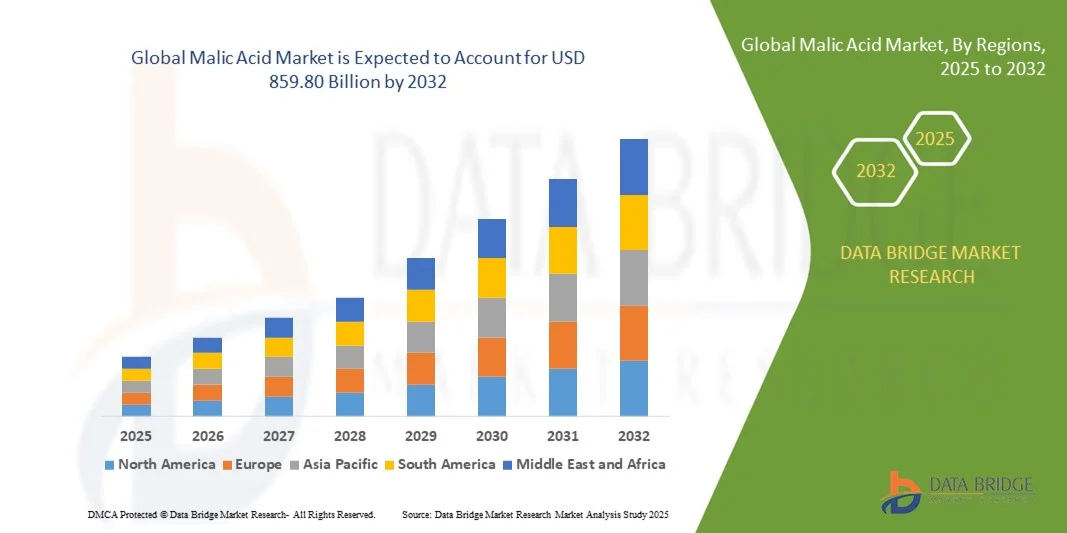
- The global Malic Acid Market size was valued at USD 589.54 billion in 2024 and is expected to reach USD 859.80 billion by 2032, at a CAGR of 4.83% during the forecast period.
- The market growth is primarily driven by increasing demand from the food and beverage industry, where malic acid is widely used as a flavor enhancer and preservative, along with its growing applications in pharmaceuticals and cosmetics.
- Additionally, rising consumer preference for natural and clean-label ingredients is propelling the adoption of malic acid derived from sustainable sources, further fueling market expansion across various end-use sectors.
Global Malic Acid Market Analysis
- Malic acid, a naturally occurring organic acid used widely as a flavoring agent and acidulant, is increasingly essential across the food, beverage, pharmaceutical, and cosmetic industries due to its multifunctional properties and clean-label appeal.
- The growing demand for natural preservatives and acidity regulators in processed foods and beverages is a key factor driving the market, alongside rising applications in personal care products and dietary supplements.
- North America dominated the Global Malic Acid Market with the largest revenue share of 32.8% in 2024, supported by well-established food and pharmaceutical industries, increasing consumer awareness of natural ingredients, and significant investments in R&D by leading manufacturers.
- Asia-Pacific is expected to be the fastest-growing region in the Global Malic Acid Market during the forecast period, fueled by rapid urbanization, expanding food processing sectors, and rising disposable incomes in countries like China and India.
- The DL-Malic Acid segment dominated the market with the largest revenue share of 54.2% in 2024, owing to its extensive use as a cost-effective acidulant in the food and beverage industry
Report Scope and Global Malic Acid Market Segmentation
|
Attributes |
Malic Acid Key Market Insights |
|
Segments Covered |
|
|
Countries Covered |
North America
Europe
Asia-Pacific
Middle East and Africa
South America
|
|
Key Market Players |
|
|
Market Opportunities |
|
|
Value Added Data Infosets |
In addition to the insights on market scenarios such as market value, growth rate, segmentation, geographical coverage, and major players, the market reports curated by the Data Bridge Market Research also include in-depth expert analysis, pricing analysis, brand share analysis, consumer survey, demography analysis, supply chain analysis, value chain analysis, raw material/consumables overview, vendor selection criteria, PESTLE Analysis, Porter Analysis, and regulatory framework. |
Global Malic Acid Market Trends
Enhanced Applications Through Sustainable and Natural Sourcing
- A significant and accelerating trend in the global Malic Acid Market is the increasing shift towards sustainable and naturally sourced malic acid, driven by growing consumer demand for clean-label and environmentally friendly ingredients across food, beverage, pharmaceutical, and cosmetic industries.
- For instance, companies such as Jungbunzlauer and Corbion are expanding their production capacities for bio-based malic acid, derived from renewable feedstocks such as corn and sugar beet, catering to manufacturers seeking natural alternatives to synthetic acids.
- The adoption of sustainable malic acid enables formulators to meet regulatory requirements and consumer preferences for non-GMO, allergen-free, and eco-conscious products. This trend is particularly prominent in organic food and beverage segments, where malic acid serves as a natural acidulant and flavor enhancer.
- Moreover, advances in biotechnology and fermentation processes are improving the efficiency and yield of natural malic acid production, reducing environmental impact and production costs, thereby making it more accessible to a wider range of applications.
- This shift towards sustainable sourcing is reshaping industry standards and encouraging innovation, with companies like Mitsubishi Chemical and Fuso Chemical developing bio-based malic acid products that align with green chemistry principles.
- The demand for malic acid derived from natural and sustainable sources is rapidly growing across food, beverage, and personal care sectors, as manufacturers and consumers alike prioritize health, safety, and environmental responsibility.
Global Malic Acid Market Dynamics
Driver
Growing Demand Driven by Health Awareness and Expanding End-Use Applications
-
Increasing consumer awareness regarding health and wellness, along with expanding applications of malic acid in food, beverage, pharmaceutical, and cosmetic industries, is a significant driver of market growth.
- For instance, in early 2024, Corbion announced an expansion of their natural ingredient portfolio, focusing on malic acid for use in clean-label beverages and dietary supplements, reflecting the rising trend toward healthier product formulations. Such initiatives by key players are expected to accelerate market growth during the forecast period.
- As consumers increasingly seek natural additives that enhance flavor, shelf life, and nutritional benefits, malic acid’s multifunctional properties make it a preferred ingredient, especially in organic and natural products.
- Furthermore, growing applications in personal care products and pharmaceuticals, such as skin care formulations and effervescent tablets, are broadening the scope for malic acid usage, driving demand across various sectors.
- The rising preference for minimally processed, preservative-free, and natural food and cosmetic products is boosting the adoption of malic acid, with manufacturers innovating formulations to meet evolving consumer expectations.
Restraint/Challenge
Supply Chain Constraints and Price Volatility
- Fluctuations in raw material availability and prices, particularly those related to corn and sugar beet used for bio-based malic acid production, present significant challenges to the market. Supply chain disruptions can lead to increased production costs and price volatility, impacting market stability.
- For instance, seasonal variability and geopolitical factors affecting crop yields have occasionally resulted in raw material shortages, causing malic acid prices to spike and limiting accessibility for smaller manufacturers.
- Managing these supply chain risks through diversification of feedstock sources, investment in fermentation technology, and strategic partnerships is essential for maintaining steady supply and controlling costs.
- Additionally, stringent regulations on synthetic additives in some regions can complicate sourcing and increase compliance costs, which may discourage some manufacturers from expanding malic acid usage.
- While advances in biotechnology and process optimization are expected to improve supply resilience and reduce costs over time, price sensitivity among end-users, especially in developing markets, could slow adoption rates.
- Addressing these supply and cost challenges through innovation, sustainable sourcing, and transparent communication with customers will be critical to sustaining long-term growth in the global malic acid market.
Global Malic Acid Market Scope
The malic acid market is segmented on the basis of type, size and end-use.
- By Type
On the basis of type, the malic acid market is segmented into D-Malic Acid, L-Malic Acid, and DL-Malic Acid. The DL-Malic Acid segment dominated the market with the largest revenue share of 54.2% in 2024, owing to its extensive use as a cost-effective acidulant in the food and beverage industry. DL-Malic Acid, being a racemic mixture of D- and L-isomers, offers enhanced flavor modulation, improved shelf stability, and broader compatibility with different food formulations. Its chemical versatility also supports usage in animal feed, pharmaceuticals, and personal care products.
The L-Malic Acid segment is projected to witness the fastest CAGR of 21.4% from 2025 to 2032, driven by growing demand for bio-based and naturally derived ingredients. L-Malic Acid is naturally found in fruits and is increasingly used in organic and clean-label formulations, especially in beverages and nutraceuticals, making it a preferred option for health-conscious consumers.
- By Size
Based on particle size, the malic acid market is segmented into Fine, Dust, Granular, and Special Fine. The Granular segment held the dominant revenue share of 41.3% in 2024, due to its widespread adoption in industrial food processing and blending applications. Granular malic acid offers excellent flowability, reduced dust generation, and is easier to handle in high-volume production lines. It is commonly used in powdered drink mixes, instant beverages, and bakery premixes, where controlled release and processing efficiency are crucial.
The Special Fine segment is expected to register the highest growth rate, with a projected CAGR of 22.7% during 2025–2032. This is attributed to its growing use in pharmaceuticals, cosmetics, and specialty food applications requiring high purity and uniform particle distribution. As precision dosing and fast solubility become increasingly important in high-performance formulations, demand for special fine malic acid is rising steadily in niche, value-added segments.
- By End-Use
On the basis of end-use, the malic acid market is categorized into Beverages, Confectionery & Food, Personal Care & Cosmetics, and Others. The Beverages segment led the market with the highest revenue share of 48.9% in 2024, owing to malic acid’s critical role in enhancing tartness, flavor complexity, and shelf life in juices, carbonated drinks, and functional beverages. Its compatibility with natural flavors and ability to reduce sugar without compromising taste are key benefits supporting widespread usage in low-calorie and health-focused drinks.
The Personal Care & Cosmetics segment is forecasted to experience the fastest CAGR of 23.3% between 2025 and 2032. Increasing use of malic acid in exfoliating agents, pH adjusters, and anti-aging formulations is driving demand in this sector. As consumer interest in clean beauty, natural ingredients, and dermatologically tested products grows, malic acid is becoming a popular choice for manufacturers seeking safe and effective cosmetic actives.
Global Malic Acid Market Regional Analysis
- North America dominated the Global Malic Acid Market with the largest revenue share of 32.8% in 2024, driven by strong demand from the food and beverage sector, as well as increased consumer awareness regarding clean-label and health-oriented products.
- Consumers in the region prioritize high-quality, natural ingredients, making malic acid a preferred acidulant in beverages, confectionery, and functional foods due to its ability to enhance flavor and extend shelf life.
- This dominance is further supported by the presence of major food and pharmaceutical manufacturers, advanced R&D infrastructure, and strict regulatory standards promoting the use of safe and effective ingredients. Additionally, a growing trend toward sustainable and bio-based food additives is accelerating the adoption of malic acid, especially in the U.S. and Canada, where demand for organic and health-focused products continues to rise across multiple end-use industries.
U.S. Malic Acid Market Insight
The U.S. malic acid market captured the largest revenue share of 81% in 2024 within North America, driven by increasing demand for natural acidulants in the food and beverage industry. Consumers are showing a strong preference for clean-label products, boosting the use of malic acid in functional beverages, low-calorie foods, and nutraceuticals. The presence of leading food manufacturers and a robust pharmaceutical sector further fuels market growth. Additionally, the U.S. is witnessing growing applications of malic acid in cosmetics and personal care, aligned with rising health consciousness and regulatory support for bio-based ingredients.
Europe Malic Acid Market Insight
The Europe malic acid market is projected to grow at a substantial CAGR throughout the forecast period, fueled by stringent EU regulations on food additives and a rising shift towards sustainable ingredients. The clean-label movement is gaining momentum, especially in Germany, France, and Italy, where consumer awareness of health and natural food products is high. Increasing use of malic acid in confectionery, beverages, and dietary supplements is propelling market demand. Moreover, European manufacturers are focusing on green chemistry and environmentally friendly production processes, which aligns with the region’s sustainability goals.
U.K. Malic Acid Market Insight
The U.K. malic acid market is anticipated to grow at a noteworthy CAGR during the forecast period, driven by consumer demand for organic and health-enhancing food products. The trend toward sugar reduction and flavor enhancement is encouraging manufacturers to use malic acid in beverages, fruit preparations, and low-calorie snacks. Additionally, the U.K.'s active nutraceutical and personal care markets are opening new avenues for malic acid in non-food applications. The growing presence of clean-label and plant-based brands further boosts malic acid adoption in both established and emerging product lines.
Germany Malic Acid Market Insight
The Germany malic acid market is expected to expand at a considerable CAGR over the forecast period, supported by a well-established food processing industry and increasing demand for functional and fortified foods. German consumers emphasize natural, additive-free products, encouraging the use of malic acid as a flavor enhancer and acidulant in beverages, sauces, and dairy alternatives. In addition, Germany's strong pharmaceutical and cosmetic sectors are integrating malic acid into topical treatments and pH-regulated formulations. The country’s focus on sustainability and innovation positions it as a leader in the European malic acid market.
Asia-Pacific Malic Acid Market Insight
The Asia-Pacific malic acid market is poised to grow at the fastest CAGR of 24% from 2025 to 2032, driven by rapid urbanization, rising disposable incomes, and dietary transitions in countries like China, India, and Japan. The growing consumption of packaged foods and beverages, coupled with increased awareness of food safety and quality, is boosting malic acid adoption. Government initiatives promoting natural additives and the region’s emergence as a major manufacturing base for food ingredients are enhancing supply chain efficiencies. Expanding cosmetic and pharmaceutical industries are further diversifying malic acid applications across APAC.
Japan Malic Acid Market Insight
The Japan malic acid market is experiencing steady growth, driven by high health awareness and demand for innovative, functional foods. Malic acid is commonly used in sports drinks, confectionery, and dietary supplements due to its energy-boosting and taste-enhancing properties. Japan’s focus on high-quality, bio-based ingredients has led to increased usage of malic acid in personal care formulations, including exfoliants and anti-aging products. As a technologically advanced nation with an aging population, Japan is likely to see growing demand for malic acid in nutraceuticals and wellness-focused products.
China Malic Acid Market Insight
The China malic acid market accounted for the largest revenue share in Asia-Pacific in 2024, driven by strong demand across food, beverage, and personal care industries. Rapid urbanization, rising income levels, and shifting consumer preferences toward healthy and functional foods are propelling malic acid usage in the country. China is a leading producer and exporter of malic acid, supported by a robust manufacturing base and government incentives for food safety. The expanding e-commerce and retail sectors also contribute to the widespread availability of malic acid-enriched products across urban and semi-urban markets.
Global Malic Acid Market Share
The Malic Acid industry is primarily led by well-established companies, including:
• Fuso Chemical Co., Ltd. (Japan)
• Bartek Ingredients Inc. (Canada)
• Isegen (iNKhaus Media) (South Africa)
• Polynt SpA (Italy)
• Thirumalai Chemicals Ltd. (India)
• Junsei Chemical Co., Ltd. (Japan)
• Changmao Biochemical Engineering Co. (China)
• Kishida Chemical Co., Ltd. (Japan)
• Muby Chemicals (India)
• Merck & Co., Inc. (U.S.)
• Dubi Chem Marine International (U.A.E.)
• Otto Chemie Pvt. Ltd. (India)
• NACALAI TESQUE, INC. (Japan)
• Ingreland Limited (Ireland)
• Foodchem International Corp. (China)
• Jigs Chemical (India)
• Prinova Group LLC (U.S.)
• Zhonglan Industry Co., Ltd. (China)
What are the Recent Developments in Global Malic Acid Market?
- In April 2023, Bartek Ingredients Inc., a leading producer of malic and fumaric acid based in Canada, announced the expansion of its production capacity with the construction of a new state-of-the-art facility in Ontario. This strategic investment is aimed at meeting the surging global demand for malic acid in food, beverage, and personal care applications. The facility will incorporate advanced manufacturing technologies to enhance sustainability, efficiency, and product purity, reinforcing Bartek’s position as a key supplier in the growing Global Malic Acid Market.
- In March 2023, Thirumalai Chemicals Ltd., a prominent Indian manufacturer, revealed its plan to significantly scale up malic acid production to cater to rising domestic and international demand. The expansion aligns with India’s growing processed food and nutraceutical sectors. The company is investing in green chemistry innovations and fermentation-based processes, demonstrating its commitment to sustainable manufacturing while supporting the market’s shift toward bio-based food acidulants.
- In March 2023, Polynt SpA, headquartered in Italy, introduced a new line of high-purity malic acid products designed for pharmaceutical and cosmetic applications. This launch reflects Polynt's strategic focus on diversifying its product portfolio beyond food-grade applications, targeting premium markets with increasing regulatory and consumer demand for clean, effective, and natural ingredients. The company’s innovation underscores the evolving role of malic acid in wellness and personal care industries.
- In February 2023, Fuso Chemical Co., Ltd., a Japanese chemical manufacturer, announced a collaborative R&D initiative with local food-tech startups to develop customized malic acid solutions for plant-based and alternative protein products. The project aims to improve taste profiles and shelf stability using natural acidulants. This collaboration exemplifies Fuso’s proactive approach to innovation and responsiveness to changing dietary trends, particularly the surge in demand for plant-based alternatives in Asia.
- In January 2023, Foodchem International Corp., a major Chinese supplier of food additives, launched a logistics optimization program to improve the global distribution of malic acid and related products. The program involves advanced inventory management, AI-based demand forecasting, and regional warehouse expansion across Europe and Southeast Asia. This initiative is designed to enhance supply chain reliability, reduce delivery times, and support the company’s expanding global footprint in the malic acid market.

- Interactive Data Analysis Dashboard
- Company Analysis Dashboard for high growth potential opportunities
- Research Analyst Access for customization & queries
- Competitor Analysis with Interactive dashboard
- Latest News, Updates & Trend analysis
- Harness the Power of Benchmark Analysis for Comprehensive Competitor Tracking
Global Malic Acid Market, Supply Chain Analysis and Ecosystem Framework
To support market growth and help clients navigate the impact of geopolitical shifts, DBMR has integrated in-depth supply chain analysis into its Global Malic Acid Market research reports. This addition empowers clients to respond effectively to global changes affecting their industries. The supply chain analysis section includes detailed insights such as Global Malic Acid Market consumption and production by country, price trend analysis, the impact of tariffs and geopolitical developments, and import and export trends by country and HSN code. It also highlights major suppliers with data on production capacity and company profiles, as well as key importers and exporters. In addition to research, DBMR offers specialized supply chain consulting services backed by over a decade of experience, providing solutions like supplier discovery, supplier risk assessment, price trend analysis, impact evaluation of inflation and trade route changes, and comprehensive market trend analysis.
Data collection and base year analysis are done using data collection modules with large sample sizes. The stage includes obtaining market information or related data through various sources and strategies. It includes examining and planning all the data acquired from the past in advance. It likewise envelops the examination of information inconsistencies seen across different information sources. The market data is analysed and estimated using market statistical and coherent models. Also, market share analysis and key trend analysis are the major success factors in the market report. To know more, please request an analyst call or drop down your inquiry.
The key research methodology used by DBMR research team is data triangulation which involves data mining, analysis of the impact of data variables on the market and primary (industry expert) validation. Data models include Vendor Positioning Grid, Market Time Line Analysis, Market Overview and Guide, Company Positioning Grid, Patent Analysis, Pricing Analysis, Company Market Share Analysis, Standards of Measurement, Global versus Regional and Vendor Share Analysis. To know more about the research methodology, drop in an inquiry to speak to our industry experts.
Data Bridge Market Research is a leader in advanced formative research. We take pride in servicing our existing and new customers with data and analysis that match and suits their goal. The report can be customized to include price trend analysis of target brands understanding the market for additional countries (ask for the list of countries), clinical trial results data, literature review, refurbished market and product base analysis. Market analysis of target competitors can be analyzed from technology-based analysis to market portfolio strategies. We can add as many competitors that you require data about in the format and data style you are looking for. Our team of analysts can also provide you data in crude raw excel files pivot tables (Fact book) or can assist you in creating presentations from the data sets available in the report.













