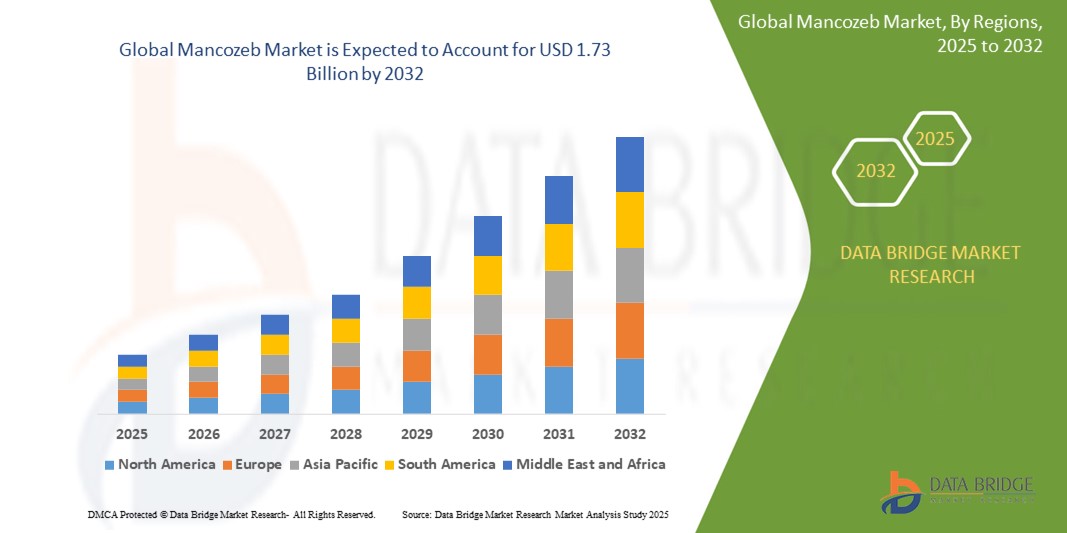
Mancozeb Market Size
- The global mancozeb market size was valued at USD 1.16 billion in 2024 and is expected to reach USD 1.73 billion by 2032, at a CAGR of 5.2% during the forecast period
- The market growth is growth is driven by the increasing demand for crop protection solutions, advancements in agricultural practices, and the rising need for higher crop yields to meet global food demand
- The growing adoption of mancozeb as a broad-spectrum fungicide, coupled with its cost-effectiveness and efficacy in controlling fungal diseases, is significantly boosting market expansion
Mancozeb Market Analysis
- Mancozeb, a widely used fungicide, plays a critical role in protecting crops from fungal diseases, enhancing yield quality, and ensuring food security across agricultural, horticultural, and ornamental applications
- The demand for mancozeb is propelled by the increasing global population, rising food security concerns, and the need for sustainable agricultural practices to combat crop losses due to fungal infections
- North America dominated the mancozeb market with the largest revenue share of 38.5% in 2024, driven by advanced agricultural infrastructure, high adoption of modern farming techniques, and the presence of major agrochemical companies
- Asia-Pacific is expected to be the fastest-growing region during the forecast period, fueled by rapid urbanization, increasing agricultural output, and growing awareness of crop protection solutions in countries like India and China
- The dry segment dominated the largest market revenue share of 60.5% in 2024, driven by its shelf-stable nature, ease of storage, and widespread use in agriculture and horticulture due to its ability to be easily mixed with water for application
Report Scope and Mancozeb Market Segmentation
|
Attributes |
Mancozeb Key Market Insights |
|
Segments Covered |
|
|
Countries Covered |
North America
Europe
Asia-Pacific
Middle East and Africa
South America
|
|
Key Market Players |
|
|
Market Opportunities |
|
|
Value Added Data Infosets |
In addition to the insights on market scenarios such as market value, growth rate, segmentation, geographical coverage, and major players, the market reports curated by the Data Bridge Market Research also include import export analysis, production capacity overview, production consumption analysis, price trend analysis, climate change scenario, supply chain analysis, value chain analysis, raw material/consumables overview, vendor selection criteria, PESTLE Analysis, Porter Analysis, and regulatory framework. |
Mancozeb Market Trends
“Increasing Adoption of Advanced Agricultural Technologies”
- The global mancozeb market is experiencing a significant trend toward the integration of advanced agricultural technologies, such as precision farming and data-driven crop management
- These technologies leverage data analytics to optimize the application of mancozeb, a broad-spectrum fungicide, ensuring efficient disease control and improved crop yields
- Smart farming solutions enable real-time monitoring of crop health, allowing farmers to apply mancozeb precisely where and when it is needed, reducing waste and environmental impact
- For instance, companies are developing platforms that use satellite imagery and IoT sensors to monitor fungal disease risks, enabling targeted mancozeb applications for crops such as potatoes, grapes, and tomatoes
- This trend enhances the efficacy of mancozeb, making it more appealing to farmers aiming to maximize productivity while adhering to sustainable practices
- Data analytics can assess environmental factors, such as humidity and temperature, to predict disease outbreaks, allowing for proactive mancozeb applications to prevent crop losses
Mancozeb Market Dynamics
Driver
“Rising Demand for High Crop Yields and Food Security”
- The increasing global demand for food, driven by population growth and changing dietary preferences, is a major driver for the mancozeb market
- Mancozeb is widely used to protect crops such as fruits, vegetables, and cereals from fungal diseases, ensuring higher yields and quality produce
- Government initiatives promoting sustainable agriculture and food security, particularly in regions such as North America, which dominates the market, are boosting the adoption of mancozeb-based solutions
- The expansion of IoT and precision agriculture technologies further supports mancozeb applications by enabling efficient and targeted fungicide use, reducing costs and environmental impact
- Agricultural companies are increasingly incorporating mancozeb into integrated pest management (IPM) programs to meet the rising demand for disease-resistant crops
Restraint/Challenge
“Regulatory Restrictions and Environmental Concerns”
- The high cost of developing and registering mancozeb-based products, coupled with stringent regulatory requirements, poses a significant barrier to market growth
- Regulatory bodies in regions such as Europe have imposed restrictions on mancozeb use due to concerns about its environmental impact and potential health risks, as highlighted by the EU's 2020 decision to withdraw mancozeb
- The complexity of complying with diverse regulatory frameworks across countries, particularly regarding residue limits and environmental safety, creates challenges for manufacturers and distributors
- Environmental concerns, such as soil and water contamination from improper mancozeb application, deter adoption in regions with high environmental awareness
- These factors can limit market expansion, especially in cost-sensitive emerging markets and regions with strict environmental regulations
Mancozeb market Scope
The market is segmented on the basis of form, mode of application, crop type, and application.
- By Form
On the basis of form, the global mancozeb market is segmented into dry and liquid. The dry segment dominated the largest market revenue share of 60.5% in 2024, driven by its shelf-stable nature, ease of storage, and widespread use in agriculture and horticulture due to its ability to be easily mixed with water for application. Dry mancozeb, often referred to as a dry flowable formulation, provides advantages such as extended shelf life and reduced need for frequent replacements, making it a preferred choice for farmers.
The liquid segment is expected to witness the fastest growth rate of 6.2% from 2025 to 2032, driven by its ease of use, effective solubility, and increasing adoption in precision agriculture practices. Liquid mancozeb is particularly favored for its convenience in large-scale farming operations, enhancing crop productivity by providing uniform application.
- By Mode of Application
On the basis of mode of application, the global mancozeb market is segmented into foliar spray, soil treatment, and seed treatment. The foliar spray segment dominated the market with a revenue share of 62.5% in 2024, owing to its simplicity and effectiveness in delivering direct protection to plant leaves and stems, where fungal infections are most prevalent. Foliar sprays are widely used across various crops, including fruits, vegetables, and cereals, for both preventive and curative protection against fungal diseases such as downy mildew, blight, and rust.
The seed treatment segment is anticipated to experience the fastest growth rate of 6.8% from 2025 to 2032, driven by the increasing adoption of seed treatment practices to protect crops at early growth stages. This method enhances seedling health and reduces the risk of fungal infections, contributing to higher yields and sustainable farming practices.
- By Crop Type
On the basis of crop type, the global mancozeb market is segmented into fruits & vegetables, cereals & grains, oilseeds & pulses, turf & ornamentals, and others. The fruits & vegetables segment dominated the largest market revenue share of 42.5% in 2024, fueled by the urgent need to protect high-value crops such as grapes, tomatoes, and cucumbers from fungal diseases like downy mildew and late blight. The growing global demand for nutritious diets and high-quality produce further drives the adoption of mancozeb in this segment.
The cereals & grains segment is expected to witness significant growth from 2025 to 2032, with a projected CAGR of 5.9%. The increasing global food demand, particularly for staples like wheat, rice, and maize, coupled with the need to combat fungal diseases such as rust and blight, is driving the adoption of mancozeb in this segment.
- By Application
On the basis of application, the global mancozeb market is segmented into agriculture, plantation and estates, horticulture and ornamental crops, turf & ornamentals, and others. The agriculture segment dominated the largest market revenue share of 50.5% in 2024, driven by the critical role of mancozeb in protecting a wide range of crops from fungal diseases, ensuring higher yields and food security. Its cost-effectiveness and broad-spectrum efficacy make it a cornerstone of integrated pest management (IPM) strategies in large-scale farming.
The horticulture and ornamental crops segment is anticipated to witness the fastest growth rate of 7.1% from 2025 to 2032. The rising demand for high-quality flowers, potted plants, and bedding plants, coupled with the increasing use of mancozeb to control fungal diseases in floriculture and ornamental crops, is driving growth in this segment.
Mancozeb Market Regional Analysis
- North America dominated the mancozeb market with the largest revenue share of 38.5% in 2024, driven by advanced agricultural infrastructure, high adoption of modern farming techniques, and the presence of major agrochemical companies
- Consumers prioritize mancozeb for its broad-spectrum fungicidal properties, protecting crops from fungal diseases such as blight, mildew, and rust, particularly in regions with intensive farming practices
- Growth is supported by advancements in fungicide formulations, such as water-dispersible granules and eco-friendly variants, alongside rising adoption in both conventional and integrated pest management programs
U.S. Mancozeb Market Insight
The U.S. mancozeb market captured the largest revenue share of 73.9% in 2024 within North America, fueled by strong demand in agricultural and horticultural applications. The trend towards high-yield farming and increasing regulations promoting sustainable fungicide use boost market expansion. The integration of mancozeb in both OEM seed treatments and aftermarket foliar sprays creates a diverse product ecosystem.
Europe Mancozeb Market Insight
The Europe mancozeb market is expected to witness significant growth, supported by regulatory emphasis on sustainable agriculture and crop protection. Consumers seek fungicides that enhance crop yield while adhering to environmental standards. The growth is prominent in both large-scale agriculture and horticultural applications, with countries such as Germany and France showing significant uptake due to rising concerns about fungal diseases and food security.
U.K. Mancozeb Market Insight
The U.K. market for mancozeb is expected to witness steady growth, driven by demand for effective fungal disease control in agricultural and ornamental crops. Increased interest in crop productivity and rising awareness of mancozeb’s protective benefits encourage adoption. Evolving regulations, such as those addressing pesticide residues, influence consumer choices, balancing efficacy with compliance.
Germany Mancozeb Market Insight
Germany is expected to witness robust growth in the mancozeb market, attributed to its advanced agricultural sector and high consumer focus on crop health and sustainability. German farmers prefer technologically advanced formulations that control fungal diseases and contribute to higher yields. The integration of mancozeb in premium crop protection programs and aftermarket applications supports sustained market growth.
Asia-Pacific Mancozeb Market Insight
The Asia-Pacific region is expected to witness the fastest growth rate, driven by expanding agricultural production and rising food demand in countries such as China, India, and Japan. Increasing awareness of crop protection, food security, and sustainable farming practices boosts demand. Government initiatives promoting high-yield agriculture and integrated pest management further encourage the use of advanced mancozeb formulations.
Japan Mancozeb Market Insight
Japan’s mancozeb market is expected to witness rapid growth due to strong consumer preference for high-quality, broad-spectrum fungicides that enhance crop safety and yield. The presence of major agricultural stakeholders and integration of mancozeb in commercial farming accelerate market penetration. Rising interest in horticultural applications and eco-friendly formulations also contributes to growth.
China Mancozeb Market Insight
China holds the largest share of the Asia-Pacific mancozeb market, propelled by rapid urbanization, rising agricultural output, and increasing demand for crop protection solutions. The country’s growing population and focus on food security support the adoption of mancozeb. Strong domestic manufacturing capabilities and competitive pricing enhance market accessibility.
Mancozeb Market Share
The mancozeb industry is primarily led by well-established companies, including:
- UPL Ltd. (India)
- Coromandel International Ltd. (India)
- Indofil Industries Ltd. (India)
- Dow AgroSciences (U.S.)
- Limin Group Co Ltd. (China)
- Hebei Shuangji Chemical (China)
- Nantong Baoye Chemical (China)
- XI’AN MPC Stock Co., Ltd. (China)
- Sumitomo Chemical Co Ltd. (Japan)
- Corteva Inc. (U.S.)
- Zhejiang Rayfull Chemicals Co Ltd. (China)
- Natursim Science Co Ltd. (China)
- Ningbo Generic Chemical Co Ltd. (China)
- Hebei Enge Biotech Co Ltd. (China)
- Zagro (Singapore)
What are the Recent Developments in Global Mancozeb Market?
- In June 2025, UPL Corporation Ltd., in partnership with the Center of Excellence in Regulatory Science in Agriculture (CERSA) at North Carolina State University, hosted the Global Mancozeb Summit at Rothamsted Research, UK. The event convened farmers, scientists, and agricultural experts from around the world to explore the vital role of mancozeb, a multi-site fungicide, in sustainable agriculture and integrated disease management. Discussions emphasized mancozeb’s importance in preventing resistance and ensuring crop yields, especially as the EU General Court prepares to review its regulatory status on July 1, following its revocation in the EU and UK
- In June 2025, BASF launched InVigor® Gold, a groundbreaking canola seed innovation designed to thrive in hotter, drier climates and low organic soils, expanding canola cultivation into previously underutilized regions. Developed from Brassica juncea, InVigor Gold features LibertyLink® herbicide tolerance, pod shatter resistance, and strong blackleg disease resistance—a key trait that indirectly supports the fungicide market by reducing reliance on chemical treatments while enhancing integrated crop protection strategies. This innovation reflects BASF’s commitment to sustainable agriculture, offering farmers improved yield stability and new income opportunities in challenging environments
- In January 2024, UPL Ltd. announced its planned acquisition of Corteva Agriscience’s solo mancozeb global fungicide business, excluding markets such as China, Japan, South Korea, and EU member countries. The deal grants UPL ownership of Dithane®, the original global mancozeb brand, and access to Rainshield™ technology, which enhances crop protection under wet weather conditions. This strategic move reinforces UPL’s leadership in the multisite fungicide segment, expanding its portfolio of plant disease management solutions and supporting global efforts toward sustainable agriculture and food security
- In April 2024, UPL Corporation Ltd. finalized its acquisition of Corteva Agriscience’s solo mancozeb global fungicide business, excluding markets such as China, Japan, South Korea, the UK, Switzerland, and EU member countries. This strategic move cements UPL’s leadership in the multisite fungicide segment, granting it ownership of the iconic Dithane® brand, access to Rainshield™ technology, and full rights to regulatory data, registrations, and trademarks associated with Corteva’s solo mancozeb products. The acquisition enhances UPL’s global crop protection portfolio and reinforces its commitment to sustainable agriculture and food security
- In August 2024, the U.S. Environmental Protection Agency (EPA) issued a proposed interim registration review for mancozeb, signaling a potential regulatory shift in a key agricultural market. The proposal includes the cancellation of mancozeb use on all grape varieties, citing post-application worker exposure risks. In addition measures include mandatory buffer zones for aerial applications near residential and aquatic areas, and extended restricted entry intervals (REIs)—notably increasing from 24 hours to 4 days for pome fruits such as apples and pears

- Interactive Data Analysis Dashboard
- Company Analysis Dashboard for high growth potential opportunities
- Research Analyst Access for customization & queries
- Competitor Analysis with Interactive dashboard
- Latest News, Updates & Trend analysis
- Harness the Power of Benchmark Analysis for Comprehensive Competitor Tracking
Data collection and base year analysis are done using data collection modules with large sample sizes. The stage includes obtaining market information or related data through various sources and strategies. It includes examining and planning all the data acquired from the past in advance. It likewise envelops the examination of information inconsistencies seen across different information sources. The market data is analysed and estimated using market statistical and coherent models. Also, market share analysis and key trend analysis are the major success factors in the market report. To know more, please request an analyst call or drop down your inquiry.
The key research methodology used by DBMR research team is data triangulation which involves data mining, analysis of the impact of data variables on the market and primary (industry expert) validation. Data models include Vendor Positioning Grid, Market Time Line Analysis, Market Overview and Guide, Company Positioning Grid, Patent Analysis, Pricing Analysis, Company Market Share Analysis, Standards of Measurement, Global versus Regional and Vendor Share Analysis. To know more about the research methodology, drop in an inquiry to speak to our industry experts.
Data Bridge Market Research is a leader in advanced formative research. We take pride in servicing our existing and new customers with data and analysis that match and suits their goal. The report can be customized to include price trend analysis of target brands understanding the market for additional countries (ask for the list of countries), clinical trial results data, literature review, refurbished market and product base analysis. Market analysis of target competitors can be analyzed from technology-based analysis to market portfolio strategies. We can add as many competitors that you require data about in the format and data style you are looking for. Our team of analysts can also provide you data in crude raw excel files pivot tables (Fact book) or can assist you in creating presentations from the data sets available in the report.