What is the Manganese Lignosulfonate Chelate Market Size and Growth Rate?
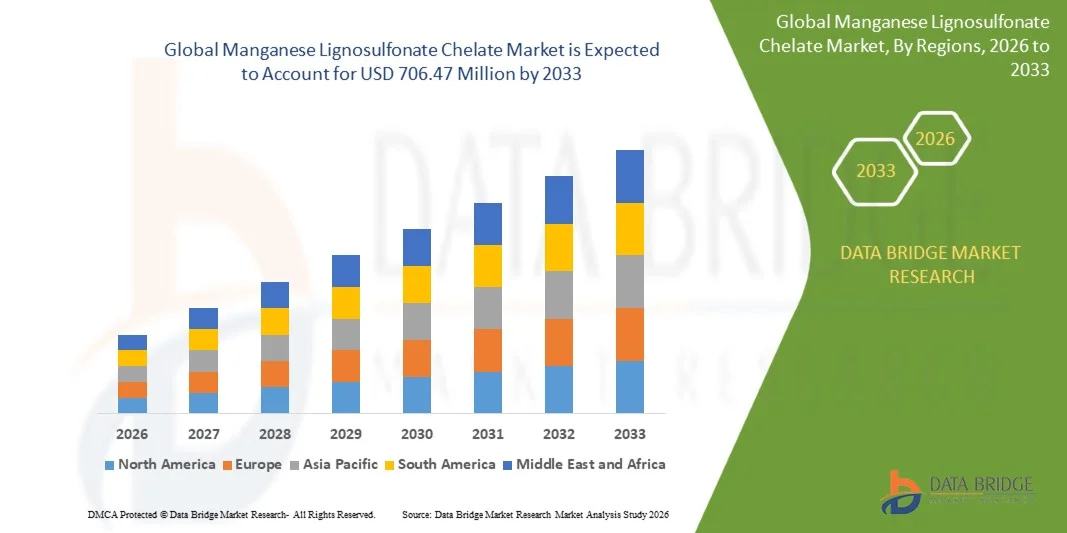
- As per Data Bridge Market Research analysis, the manganese lignosulfonate chelate market was valued at USD 450.00 billion in 2025 and is projected to reach USD 706.47 million by 2033, growing at a CAGR of 5.80% from 2026 to 2033.
- The market is experiencing consistent growth driven by increasing demand for micronutrient fertilizers and efficient crop nutrition solutions, as manganese is an essential micronutrient for plant growth and lignosulfonate can function as a complexing agent for micronutrient delivery.
- The increasing emphasis on sustainable agriculture, improved micronutrient-use efficiency, and controlled nutrient release is further supporting demand for lignosulfonate-based manganese formulations. Research has examined lignosulfonates as natural ligands for micronutrient fertilization and their ability to form complexes with metals, while manganese lignosulfonate has also been investigated for controlled-release fertilizer applications
Market Size & Forecast
- Global Market Value (2025): USD 450.00 Million
- Expected Market Value (2033): USD 706.47 Million
- Forecast CAGR (2026–2033): 5.80%
- Leading Region in 2025: North America
- Fastest Growing Region: Asia Pacific
What are the Major Takeaways of the Manganese Lignosulfonate Chelate Market?
- North America dominated the manganese lignosulfonate chelate market with a 35.5% revenue share in 2025, supported by advanced agricultural practices, widespread adoption of precision farming, and significant investments in agricultural research and development.
- Asia-Pacific is expected to be the fastest-growing region at a CAGR of 7.6% from 2026 to 2033, fueled by rapid agricultural modernization, rising population and food demand, and increasing adoption of micronutrient-enriched fertilizers in countries such as China and India.
- The liquid segment led the market with a 58.7% share in 2025, driven by its high solubility, ease of application, and suitability for foliar spraying and fertigation.
- Powder is the fastest-growing product type, projected to register a CAGR of 6.0%, reflecting the surge in longer shelf life, ease of storage and transportation, and compatibility with dry fertilizer blends.
- The agriculture segment dominated the application category with a 47.3% revenue share in 2025, led by the use of manganese lignosulfonate as a micronutrient source for correcting manganese deficiencies and supporting crop productivity
- Standard-grade accounted for 55% of the market share in 2025, preferred by its broad applicability across agricultural fertilizers, feed formulations, and general industrial uses.
- The functional-grade segment is the fastest-growing grade category, with a CAGR of 6.3%, driven by increasing demand for specialized nutrient-delivery properties.
Report Scope and Manganese Lignosulfonate Chelate Market Segmentation
|
Attributes |
Manganese Lignosulfonate Chelate Key Market Insights |
|
Segments Covered |
|
|
Countries Covered |
North America
Europe
Asia-Pacific
Middle East and Africa
South America
|
|
Key Market Players |
|
|
Market Opportunities |
|
|
Value Added Data Infosets |
|
What is the Key Trend in the Manganese Lignosulfonate Chelate Market?
- Agricultural fertilizer manufacturers are increasingly incorporating lignosulfonate-based micronutrient complexes into fertilizer formulations to improve manganese availability, support plant uptake, and provide more efficient alternatives for micronutrient management.
- For instance, in February 2024, researchers published a study in the International Journal of Biological Macromolecules developing Mn@LNS-EL, a slow-release manganese fertilizer based on lignin nanoparticles derived from sodium lignosulfonate; the formulation was evaluated for rice growth and manganese/cadmium uptake under cadmium stress.
- Research is increasingly focusing on the ability of lignosulfonates to function as natural complexing agents, with their biodegradability, low cost, and environmental characteristics supporting their application in micronutrient fertilizers.
- Fertilizer developers are also investigating lignosulfonate complexes for controlled-release and coated fertilizer systems, allowing manganese release to be influenced by formulation and coating characteristics.
- For instance, in January 2023, researchers published a Journal of Cleaner Production study investigating slow-release manganese fertilizers, demonstrating that geopolymer-based formulations could retard rapid manganese release and provide controlled manganese delivery, supporting the broader shift toward slow-release manganese fertilizer technologies.
- As agricultural producers increasingly prioritize efficient micronutrient delivery, improved nutrient availability, and sustainable fertilizer technologies, lignosulfonate-based manganese formulations are expected to gain greater application across modern crop nutrition systems.
What are the Key Drivers of the Manganese Lignosulfonate Chelate Market?
- The increasing prevalence of manganese deficiency in crops, particularly where soil conditions restrict micronutrient availability, is strengthening demand for manganese-containing fertilizer formulations capable of maintaining manganese in plant-available forms.
- For instance, in June 2023, researchers at Punjab Agricultural University and the Indian Council of Agricultural Research published a Frontiers in Plant Science study showing that mineral and chelated manganese fertilization influenced manganese uptake, mobilization, and wheat productivity, demonstrating the importance of effective manganese supplementation for crop nutrition.
- Agricultural fertilizer manufacturers are integrating manganese lignosulfonate into NPK coatings, micronutrient fertilizers, foliar formulations, and other nutrient-delivery systems to improve manganese availability while reducing the need for separate manganese applications.
- For instance, in July 2023, researchers published a Soil Science Society of America Journal study demonstrating that manganese fertilizers increased available soil manganese fractions and affected plant manganese concentrations in soybean, while also showing that manganese can become converted into less-available soil fractions, reinforcing the need for efficient manganese fertilizer formulations.
- The growing emphasis on micronutrient-use efficiency and alternative natural complexing agents is further supporting market development, particularly where conventional manganese sources have limitations under challenging soil conditions.
Which Factors are Challenging the Growth of the Manganese Lignosulfonate Chelate Market?
- The effectiveness of manganese lignosulfonate can be constrained by soil chemistry, pH, molecular-weight distribution, and the stability of manganese–lignosulfonate complexes, creating variability in nutrient availability across agricultural conditions.
- For instance, in June 2023, a study published in the Soil Science Society of America Journal found that manganese added to soil can be converted from plant-available forms into unavailable manganese-oxide fractions; at the highest application rate, total soil Mn increased by 18.5%, while available Mn decreased by 4.3%, highlighting challenges in maintaining manganese availability.
- These factors can limit consistent manganese delivery, particularly in calcareous and alkaline soils, where micronutrient availability is already affected by soil conditions and where fertilizer formulations must maintain adequate manganese in solution.
- The performance of manganese lignosulfonate is also influenced by lignosulfonate molecular weight, pH, and the sulfite pulping process, which can affect the amount of manganese complexed and consequently the fertilizer performance.
- For instance, in September 2024, researchers studying 15 calcareous soils found that the effectiveness of manganese release varied substantially between organic complexing agents and depended on soil characteristics and the binding strength of Mn with soil functional groups, demonstrating that soil conditions can create variability in manganese availability and fertilizer performance.
- Consequently, the need for consistent complex stability, predictable manganese availability, and formulation optimization can increase technical requirements for manufacturers and may constrain adoption where conventional manganese fertilizers offer simpler or more established application options.
How is the Manganese Lignosulfonate Chelate Market Segmented?
The manganese lignosulfonate chelate market is segmented on the basis of product type, application, grade, end-use industry, and distribution channel.
- By Product Type
On the basis of product type, the manganese lignosulfonate chelate market is segmented into powder and liquid. The liquid segment dominated the market with an estimated 58.7% share in 2025, owing to its high solubility, ease of application, and suitability for foliar spraying and fertigation. Liquid formulations enable more uniform distribution of manganese and can be readily incorporated into modern irrigation systems. They are increasingly relevant to precision agriculture, where accurate dosing and efficient micronutrient delivery are important. Their convenient handling and rapid availability of nutrients further support adoption among agricultural users. Increasing demand for efficient micronutrient formulations is strengthening the position of liquid products in the market
e The powder segment is projected to register the fastest growth at an estimated CAGR of 6.0% from 2026 to 2033, driven by its longer shelf life, ease of storage and transportation, and compatibility with dry fertilizer blends. Powder formulations are particularly suitable for large-scale fertilizer manufacturing and bulk agricultural applications. Their relatively stable storage characteristics can reduce handling and transportation challenges. Increasing demand for dry micronutrient fertilizer blends is creating additional opportunities for powder products. Manufacturers are also developing formulations with improved dispersibility and solubility to expand their agricultural applications. These advantages are expected to support faster growth of powder manganese lignosulfonate chelates during the forecast period.
- By Application
On the basis of application, the manganese lignosulfonate chelate market is segmented into agriculture, animal feed, industrial, and others. The agriculture segment dominated the market with an estimated 47.3% share in 2025, driven by the use of manganese lignosulfonate as a micronutrient source for correcting manganese deficiencies and supporting crop productivity. Manganese is required for photosynthesis, enzyme activation, and several plant metabolic processes. Lignosulfonate-complexed manganese has been investigated for foliar fertilization and improved manganese delivery to crops. Increasing soil micronutrient deficiencies are encouraging greater use of specialized manganese fertilizers. The increasing emphasis on balanced crop nutrition and nutrient-use efficiency is further strengthening agricultural demand
The animal feed segment is projected to register the fastest growth at an estimated CAGR of 6.5% from 2026 to 2033, supported by increasing livestock production and demand for trace-mineral supplementation. Manganese contributes to bone development, reproductive performance, enzyme activation, and carbohydrate metabolism in animals. Expanding commercial livestock farming is increasing the requirement for reliable mineral sources in animal diets. Feed manufacturers are also focusing on improving animal productivity through more effective nutritional formulations. Greater awareness of trace-mineral deficiencies is encouraging the incorporation of manganese into feed products. These trends are expected to increase the application of manganese lignosulfonate in animal-feed formulations.
- By Grade
On the basis of grade, the market is segmented into standard grade, high-purity grade, and functional grade. The standard-grade segment dominated the market with an estimated 55% share in 2025, primarily because of its broad applicability across agricultural fertilizers, feed formulations, and general industrial uses. Standard-grade manganese lignosulfonate products are suitable for high-volume applications where consistent manganese content and cost efficiency are important. Their broad compatibility with conventional fertilizer formulations supports widespread adoption. Agricultural users generally prioritize economical micronutrient products for large-area applications. Standard-grade products also require fewer specialized specifications than high-purity or functional formulations. Their broad application base is therefore expected to maintain their leading position.
The functional-grade segment is projected to register the fastest growth at an estimated CAGR of 6.3% from 2026 to 2033, driven by increasing demand for specialized nutrient-delivery properties. Functional formulations can be designed to provide improved solubility, controlled nutrient release, enhanced stability, or application-specific performance. Research has demonstrated the potential of lignosulfonate-based materials in controlled-release manganese fertilizer systems. Increasing precision in fertilizer formulation is encouraging manufacturers to develop products with more targeted performance characteristics. Demand for improved micronutrient-use efficiency is also creating opportunities for differentiated formulations. Consequently, functional-grade products are expected to gain importance faster than conventional grades.
- By End-Use Industry
On the basis of end-use industry, the market is segmented into fertilizers, feed additives, industrial chemicals, and others. The fertilizers segment dominated the market with an estimated 47% share in 2025, consistent with the leading contribution of agriculture to manganese lignosulfonate demand. Manganese lignosulfonate is used as a micronutrient source in fertilizer formulations to address manganese deficiencies. Increasing focus on balanced crop nutrition is supporting demand for manganese-containing specialty fertilizers. Lignosulfonate-based manganese can also be incorporated into coated and controlled-release fertilizer systems. Research has demonstrated manganese lignosulfonate applications in experimental fertilizer formulations. The continuing need to improve crop productivity and micronutrient-use efficiency is supporting the fertilizer industry's leading position.
The feed additives segment is projected to witness the fastest growth at an estimated CAGR of 6.2% from 2026 to 2033, supported by expanding livestock production and increasing demand for trace-mineral nutrition. Manganese is an essential mineral involved in bone formation, reproduction, metabolism, and enzyme activity in animals. Growing commercial livestock production is increasing the demand for specialized mineral feed additives. Feed manufacturers are increasingly focused on nutritional efficiency and animal health, creating opportunities for manganese-based supplementation. The need to maintain adequate trace-mineral intake is particularly important in intensive livestock production systems. These factors are expected to support faster growth of feed additives compared with more established fertilizer and industrial applications.
- By Distribution Channel
On the basis of distribution channel, the market is segmented into direct sales, distributors/wholesalers, and online retail. The direct sales segment dominated the market with an estimated 48% share in 2025, owing to the importance of bulk procurement among fertilizer manufacturers, agricultural enterprises, and industrial customers. Direct purchasing enables customers to obtain larger volumes and application-specific product specifications. Manufacturers can provide technical support and customized formulations through direct commercial relationships. Long-term supply arrangements are particularly important for industrial and agricultural buyers requiring consistent product availability. Direct sales also allow manufacturers to maintain closer relationships with major customers. These advantages support the continued dominance of direct sales in the distribution structure.
The online retail segment is projected to register the fastest growth at an estimated CAGR of 7.0% from 2026 to 2033, supported by increasing digitalization of agricultural-input procurement. Online platforms provide convenient access to specialized micronutrient products for small and medium-sized agricultural users. Buyers can compare product specifications, packaging, pricing, and availability through digital channels. Growing adoption of digital agriculture is encouraging farmers to use online platforms for purchasing crop inputs. Manufacturers and distributors are also expanding their digital sales and marketing capabilities to reach geographically dispersed customers. Continued growth in e-commerce and digital agricultural services is therefore expected to accelerate online retail adoption.
Which Region Holds the Largest Share of the Manganese Lignosulfonate Chelate Market?
- North America dominated the manganese lignosulfonate chelate market with a 35.5% revenue share in 2025, supported by advanced agricultural practices, widespread adoption of precision farming, and significant investments in agricultural research and development.
- The region also benefits from high adoption of micronutrient fertilizers, increasing emphasis on soil fertility management, and growing demand for efficient crop-nutrition solutions. Extensive commercial farming and increasing use of precision-agriculture technologies are supporting the adoption of manganese-based micronutrient formulations. The presence of established fertilizer and agricultural-input manufacturers further strengthens regional supply capabilities. Increasing awareness of manganese deficiency and the importance of balanced plant nutrition is supporting market demand.
U.S. Manganese Lignosulfonate Chelate Market Insight
The U.S. manganese lignosulfonate chelate market is witnessing growth due to the country’s extensive agricultural activity, increasing focus on soil fertility, and demand for efficient micronutrient fertilizers. Manganese is an essential micronutrient for plant growth, while its availability is strongly influenced by soil pH, with deficiencies more likely in alkaline soils. The U.S. Department of Agriculture identifies manganese deficiency as an important crop-nutrition consideration and notes that only a fraction of total soil manganese is plant available. In addition, U.S. agronomic guidance identifies corn, soybeans, wheat, sugar beets, and other major crops as responsive to manganese fertilization. Increasing adoption of precision nutrient management and specialized micronutrient formulations is therefore supporting demand for manganese-based products in U.S. agriculture.
Asia-Pacific Manganese Lignosulfonate Chelate Market Insight
The Asia-Pacific manganese lignosulfonate chelate market is expected to witness rapid growth, driven by large agricultural production, increasing micronutrient-management requirements, and rising demand for improved crop productivity across China and other Asian economies. Research conducted in China has found that manganese deficiencies are common in soils of the Loess Plateau, demonstrating the need for practices that improve manganese availability. A long-term 28-year field experiment found that crop-legume rotation, continuous alfalfa cultivation, and manure application could increase available manganese in agricultural soils. Increasing attention to soil micronutrient availability and sustainable nutrient management is therefore supporting opportunities for manganese fertilizer products. The region's large agricultural base and continuing intensification of crop production further strengthen the potential for manganese-based micronutrient solutions.
Japan Manganese Lignosulfonate Chelate Market Insight
The Japan manganese lignosulfonate chelate market is witnessing consistent growth due to continued emphasis on crop nutrition, soil management, and efficient use of essential trace elements. Manganese is recognized as an essential mineral nutrient for plants and is involved in important physiological processes, including photosynthesis and enzyme activity. Japanese research has specifically examined manganese nutrition and its effects on plant growth, highlighting that manganese deficiency can reduce crop yield through impaired photosynthetic activity. These findings support the need for controlled and efficient manganese-delivery technologies rather than indiscriminate application. Growing interest in precision nutrient management therefore creates opportunities for specialized manganese formulations, including chelated and complexed products.
China Manganese Lignosulfonate Chelate Market Insight
The China manganese lignosulfonate chelate market is growing rapidly, driven by widespread manganese deficiency in agricultural soils and increasing research into efficient manganese-fertilizer applications. A study published in Pedosphere found that manganese deficiencies are common in soils of China's Loess Plateau, particularly under intensive agricultural systems. The research analyzed a 28-year field experiment and found that crop rotation and manure application could significantly improve available manganese in soil. More recently, a February 2026 study in the Journal of Environmental Sciences found that manganese fertilizer applications reduced cadmium concentrations in rice grains by up to 30.2% under specific treatment conditions, demonstrating additional agronomic benefits of manganese fertilization. These findings are increasing interest in manganese management as part of broader soil and crop-health strategies
U.K. Manganese Lignosulfonate Chelate Market Insight
The U.K. manganese lignosulfonate chelate market is experiencing steady growth, supported by increasing attention to micronutrient management, fertilizer efficiency, and soil fertility. U.K. government research notes that approximately 10% of important agricultural soils globally were estimated to be deficient in manganese, highlighting the broader importance of manganese fertilization for crop production. Manganese is included among the recognized essential micronutrients required for plant development and crop productivity. The U.K. fertilizer regulatory framework also specifically recognizes manganese as a micronutrient in inorganic micronutrient fertilizers. Increasing demand for efficient micronutrient delivery and improved nutrient-use efficiency is creating opportunities for specialized manganese formulations in the U.K. market.
Germany Manganese Lignosulfonate Chelate Market Insight
The Germany manganese lignosulfonate chelate market is expanding steadily due to increasing emphasis on balanced plant nutrition, micronutrient efficiency, and sustainable agricultural input management. Manganese is an essential micronutrient required for plant growth, photosynthesis, and metabolic regulation, making reliable manganese availability important for productive crop cultivation. Recent agricultural research has highlighted the importance of manganese management under both deficiency and excess conditions, reinforcing the need for controlled fertilizer application. The use of organic complexing agents and specialized micronutrient formulations can provide opportunities for improving manganese delivery efficiency. Growing focus on sustainable agriculture and nutrient-use efficiency is therefore supporting the potential adoption of manganese lignosulfonate chelate products in Germany.
Which are the Top Companies in Manganese Lignosulfonate Chelate Market?
The manganese lignosulfonate chelate industry is primarily led by well-established companies, including:
- Borregaard ASA (Norway)
- Sappi Ltd (South Africa)
- Nippon Paper Industries Co., Ltd. (Japan)
- Green Agrochem (China)
- Shandong Jufu Chemical Technology Co., Ltd. (China)
- HUBEI AGING CHEMICAL CO.,LTD (China)
- ENASPOL a.s. (Czech Republic)
- Agrii Polska Sp. z o.o. (Poland)
- arvensis agro, s.a. (Spain)
- Cultifort (Spain)
- Stora Enso Oyj (Finland)
- UPM-Kymmene Corporation (Finland)
- Rayonier Inc. (U.S.)
- Dallas Group of America, LLC (U.S.)
- Pacific Dust Control (U.S.)
- Abelin Polymers (India)
- KMT Polymers Ltd. (Türkiye)
What are Latest Developments in Manganese Lignosulfonate Chelate Market?
- In July 2025, China Lignin presented Manganese Lignosulfonate (Mn LS) as a water-soluble manganese-containing lignosulfonate product for micronutrient fertilizer, foliar nutrition, and soil-related formulations. The product is positioned specifically for agricultural and fertilizer applications, demonstrating commercial availability of manganese lignosulfonate as a specialized micronutrient formulation.
- In July 2025, Green Agrochem introduced its Manganese Lignosulfonate product for industrial and agricultural formulation use, specifying a minimum 10% manganese content, more than 90% water solubility at 20°C, and availability in 25-kg and 500-kg bulk bags. The product is positioned for micronutrient formulation and agricultural-input applications, providing evidence of commercial product availability in the manganese lignosulfonate category.
- In July 2025, Corteva Agriscience launched Lumidapt Valta LS, a naturally derived biological nutrition seed treatment added to its LumiGEN corn seed treatment package. The formulation contains lignosulfonates and supplies several micronutrients, including manganese, boron, sulfur, potassium, cobalt, and molybdenum, to support early-season corn health, germination, and root development. Corteva reported a 2.0 bushel-per-acre yield advantage in multi-year testing. The product was introduced for the 2026 planting season, pending regulatory approval, demonstrating commercial adoption of lignosulfonate-based nutrient-delivery technology incorporating manganese.
- In February 2024, researchers developed Mn@LNS-EL, a novel slow-release manganese fertilizer using lignin nanoparticles derived from sodium lignosulfonate. Manganese sulfate was encapsulated within lignin-based microcapsules to create a controlled-release fertilizer, which was then evaluated for rice growth under cadmium-stress conditions. The research represents a direct development of a lignosulfonate-derived manganese fertilizer, although it was a research product rather than a commercial market launch.
- In April 2023, researchers published a study on novel organic chelated lignosulfonate fertilizers, describing lignosulfonate chelates as natural-source fertilizers capable of providing continuous slow release of nutrients, while also functioning as soil conditioners and biostimulants. The research supports continued development of lignosulfonate-based chelated fertilizers as sustainable alternatives for micronutrient delivery.

- Interactive Data Analysis Dashboard
- Company Analysis Dashboard for high growth potential opportunities
- Research Analyst Access for customization & queries
- Competitor Analysis with Interactive dashboard
- Latest News, Updates & Trend analysis
- Harness the Power of Benchmark Analysis for Comprehensive Competitor Tracking
Data collection and base year analysis are done using data collection modules with large sample sizes. The stage includes obtaining market information or related data through various sources and strategies. It includes examining and planning all the data acquired from the past in advance. It likewise envelops the examination of information inconsistencies seen across different information sources. The market data is analysed and estimated using market statistical and coherent models. Also, market share analysis and key trend analysis are the major success factors in the market report. To know more, please request an analyst call or drop down your inquiry.
The key research methodology used by DBMR research team is data triangulation which involves data mining, analysis of the impact of data variables on the market and primary (industry expert) validation. Data models include Vendor Positioning Grid, Market Time Line Analysis, Market Overview and Guide, Company Positioning Grid, Patent Analysis, Pricing Analysis, Company Market Share Analysis, Standards of Measurement, Global versus Regional and Vendor Share Analysis. To know more about the research methodology, drop in an inquiry to speak to our industry experts.
Data Bridge Market Research is a leader in advanced formative research. We take pride in servicing our existing and new customers with data and analysis that match and suits their goal. The report can be customized to include price trend analysis of target brands understanding the market for additional countries (ask for the list of countries), clinical trial results data, literature review, refurbished market and product base analysis. Market analysis of target competitors can be analyzed from technology-based analysis to market portfolio strategies. We can add as many competitors that you require data about in the format and data style you are looking for. Our team of analysts can also provide you data in crude raw excel files pivot tables (Fact book) or can assist you in creating presentations from the data sets available in the report.