


What is the Manganese-Rich Cathodes Market Size and Growth Rate?
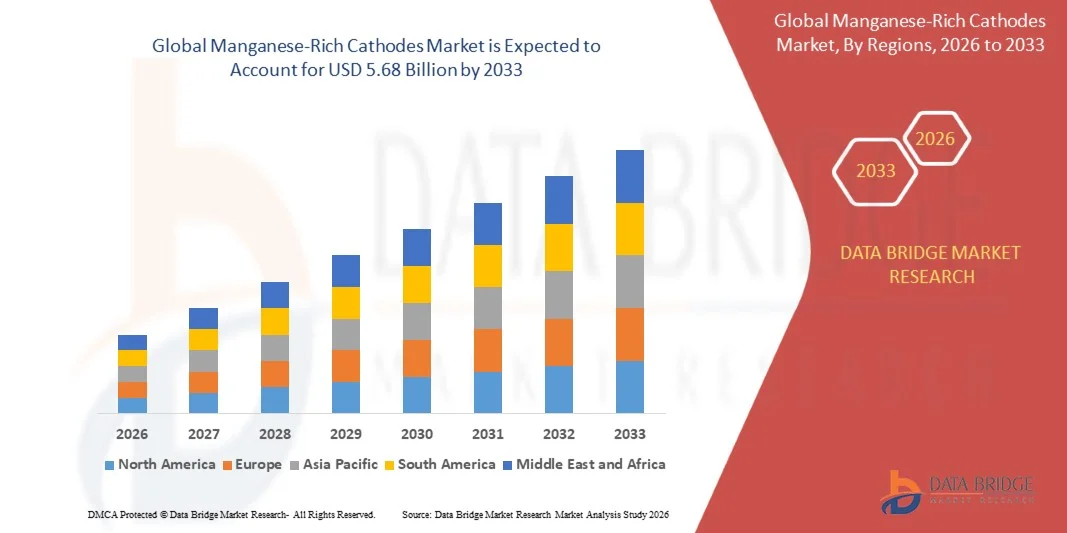
- As per Data Bridge Market Research analysis, the manganese-rich cathodes market was valued at USD 1.05 billion in 2025 and is projected to reach USD 5.68 billion by 2033, growing at a CAGR of 23.50% from 2026 to 2033.
- The market is experiencing strong growth driven by rising demand for cobalt-free, lower-cost cathode chemistries in electric vehicle and energy storage batteries, growing investment in domestic manganese processing capacity, and increasing adoption of high-voltage manganese-rich formulations that improve energy density over conventional nickel-cobalt-based cathodes.
- Growing government support for critical mineral supply chain diversification, stricter regulations around cobalt sourcing, and continued advancements in manganese-rich NMC and LMFP chemistries are compelling battery manufacturers and automakers to accelerate qualification and adoption of manganese-rich cathode materials.
Market Size & Forecast
- Global Market Value (2025): USD 1.05 Billion
- Expected Market Value (2033): USD 5.68 Billion
- Forecast CAGR (2026-2033): 23.50%
- Leading Region in 2025: Asia-Pacific
- Fastest Growing Region: North America
What are the Major Takeaways of the Manganese-Rich Cathodes Market?
- Asia-Pacific dominated the global manganese-rich cathodes market with the largest revenue share of 44.15% in 2025, supported by large-scale battery cell manufacturing capacity, established cathode precursor supply chains, and strong government backing for domestic battery material production in China, South Korea, and Japan.
- North America is expected to be the fastest-growing region at a CAGR of 25.9% from 2026 to 2033, fueled by growing investment in domestic critical mineral processing, rising EV production, and policy incentives supporting non-China battery supply chains.
- The lithium manganese-rich NMC (LMR-NMC) segment led the market with a 39.80% share in 2025, driven by its ability to deliver higher energy density and lower cobalt content compared to conventional NMC formulations.
- The lithium manganese iron phosphate (LMFP) segment is the fastest-growing cathode type, projected to register a CAGR of 26.7%, reflecting rising adoption in cost-sensitive EV and energy storage applications seeking improved energy density over standard LFP.
- The lithium-ion batteries segment dominated the battery type category with a 68.40% revenue share in 2025, led by widespread commercial deployment across EVs, energy storage systems, and consumer electronics.
- The electric vehicles segment accounted for 51.20% of the market share in 2025, driven by automakers' pursuit of lower-cost, cobalt-free cathode chemistries to reduce battery cost while maintaining competitive range.
- The co-precipitation segment is the fastest-growing manufacturing process, with a CAGR of 25.3%, driven by its scalability and ability to produce uniform, high-purity precursor materials required for advanced manganese-rich cathode formulations.
Report Scope and Manganese-Rich Cathodes Market Segmentation
| Attributes |
Manganese-Rich Cathodes Key Market Insights |
|
Segments Covered |
|
|
Countries Covered |
North America
Europe
Asia-Pacific
Middle East and Africa
South America
|
|
Key Market Players |
|
|
Market Opportunities |
|
|
Value Added Data Infosets |
In addition to the insights on market scenarios such as market value, growth rate, segmentation, geographical coverage, and major players, the market reports curated by the Data Bridge Market Research also include in-depth expert analysis, geographically represented company-wise production and capacity, network layouts of distributors and partners, detailed and updated price trend analysis and deficit analysis of supply chain and demand. |
What is the Key Trend in the Manganese-Rich Cathodes Market?
- Battery manufacturers are increasingly adopting high-voltage manganese-rich NMC formulations to reduce reliance on cobalt while improving energy density for mass-market electric vehicles.
- For instance, in April 2025, LG Energy Solution, Ltd. announced progress on its manganese-rich cathode development program aimed at reducing cobalt content while maintaining competitive energy density for next-generation EV cells.
- Growing collaboration between cathode material producers and automotive OEMs is accelerating the qualification and commercialization of manganese-rich chemistries for volume EV production.
- Suppliers are increasingly investing in domestic manganese refining and precursor production to reduce supply chain dependence on a single region and improve cost stability.
- For instance, in January 2025, Umicore N.V. announced an expansion of its cathode active material production capacity in Europe to support growing demand for low-cobalt and manganese-rich formulations from regional automakers.
- As automakers and battery producers continue to prioritize cost reduction, supply chain diversification, and improved energy density, the adoption of manganese-rich cathodes is expected to accelerate, reinforcing their role as a key enabling material for next-generation, lower-cost battery chemistries.
What are the Key Drivers of the Manganese-Rich Cathodes Market?
- The rising cost and supply chain risk associated with cobalt and nickel has significantly increased demand for manganese-rich cathode chemistries that reduce dependence on these critical minerals while maintaining competitive battery performance.
- For instance, in March 2025, CATL announced advancements in its manganese-based cathode research program, targeting improved cycle life and energy density for next-generation cost-optimized EV battery cells.
- Automotive OEMs and battery cell manufacturers are increasingly integrating manganese-rich cathodes into their product roadmaps to lower battery pack costs and improve access to geographically diversified raw material supply chains.
- For instance, in November 2024, Samsung SDI Co., Ltd. expanded its research partnership with a global automaker to co-develop manganese-rich cathode materials aimed at reducing battery cost for mid-range EV models.
- With the global push toward affordable electric mobility and increasing government support for diversified, non-cobalt-dependent battery supply chains, manganese-rich cathodes will remain a critical enabling material for next-generation, cost-optimized battery systems.
Which Factors are Challenging the Growth of the Manganese-Rich Cathodes Market?
- Manganese-rich cathode chemistries, particularly LMR-NMC formulations, continue to face technical challenges related to voltage fade and capacity degradation over repeated charge-discharge cycles.
- These technical limitations require significant investment in doping strategies, surface coatings, and electrolyte optimization, increasing overall development costs and slowing large-scale commercialization.
- For instance, in September 2024, several cathode material developers cited persistent challenges in achieving long-term voltage stability in high-manganese-content NMC formulations, limiting near-term adoption in premium EV applications.
- The need for specialized precursor synthesis processes, precise particle morphology control, and rigorous quality validation further adds to production complexity, restraining broader adoption among smaller battery developers and limiting the pace of market penetration in performance-sensitive applications.
How is the Manganese-Rich Cathodes Market Segmented?
The manganese-rich cathodes market is segmented on the basis of cathode type, battery type, application, manufacturing process, particle size, end user, and sales channel.
-
By Cathode Type
On the basis of cathode type, the global manganese-rich cathodes market is segmented into lithium manganese-rich (LMR), lithium manganese-rich NMC (LMR-NMC), lithium manganese iron phosphate (LMFP), and spinel lithium manganese oxide (LMO). The LMR-NMC segment dominated the market with a 39.80% share in 2025, owing to its ability to deliver higher energy density and reduced cobalt content compared to conventional NMC formulations. These systems provide an effective balance between performance and cost, making them the preferred choice for automotive OEMs seeking to optimize battery economics without compromising range.
The LMFP segment is projected to register the fastest growth at a CAGR of 26.7% from 2026 to 2033, driven by rising demand for cost-effective cathode materials that offer improved energy density over standard LFP formulations. Advances in particle coating and doping techniques, combined with growing adoption in mid-range EV and energy storage applications, are accelerating segment expansion.
- By Battery Type
On the basis of battery type, the global manganese-rich cathodes market is segmented into lithium-ion batteries, lithium-manganese batteries, and solid-state batteries. The lithium-ion batteries segment led the market with a 68.40% share in 2025, supported by widespread commercial deployment across electric vehicles, energy storage systems, and consumer electronics.
The solid-state batteries segment is expected to experience the fastest growth at a CAGR of 27.8% from 2026 to 2033, driven by increasing research and pilot-scale integration of manganese-rich cathodes into next-generation solid-state cell architectures.
- By Application
On the basis of application, the global manganese-rich cathodes market is segmented into electric vehicles, energy storage systems, consumer electronics, and power tools. The electric vehicles segment dominated the market with a share of 51.20% in 2025 due to automakers' pursuit of lower-cost, cobalt-free cathode chemistries to reduce battery cost while maintaining competitive driving range. Additionally, rising investment in domestic cathode material production and growing consumer demand for affordable EVs further supports strong adoption of manganese-rich cathode solutions.
The energy storage systems segment is anticipated to witness the fastest CAGR of 26.1% from 2026 to 2033, driven by increasing deployment of grid-scale and behind-the-meter battery storage projects that prioritize cost-effective, long-cycle-life cathode chemistries.
-
By Manufacturing Process
On the basis of manufacturing process, the global manganese-rich cathodes market is segmented into co-precipitation, solid-state synthesis, sol-gel process, and spray pyrolysis. The co-precipitation segment dominated the market with a share of 47.60% in 2025 due to its scalability, cost-effectiveness, and ability to produce uniform, high-purity precursor materials at commercial volumes. The widespread adoption of co-precipitation by established cathode material producers to ensure consistent, high-throughput production is reinforcing the dominance of this segment.
The spray pyrolysis segment is expected to witness the fastest CAGR through 2033, driven by growing research interest in producing finely controlled particle morphologies that improve rate capability and cycle stability.
-
By Particle Size
On the basis of particle size, the global manganese-rich cathodes market is segmented into below 10 microns, 10-20 microns, and above 20 microns. The 10-20 microns segment dominated the market with a share of 45.90% in 2025 due to its favorable balance of energy density, tap density, and electrode processing characteristics.
The below 10 microns segment is expected to witness the fastest CAGR through 2033, driven by increasing demand for high-rate-capability cathode materials in fast-charging EV and power tool applications.
-
By End User
On the basis of end user, the global manganese-rich cathodes market is segmented into automotive OEMs, battery cell manufacturers, grid storage developers, and electronics manufacturers. The battery cell manufacturers segment dominated the market in 2025, supported by large-scale procurement of manganese-rich cathode materials for commercial-scale lithium-ion cell production.
The grid storage developers segment is gaining share steadily as utilities and independent power producers increasingly prioritize cost-effective, long-cycle-life cathode chemistries for large-scale energy storage deployments.
-
By Sales Channel
On the basis of sales channel, the global manganese-rich cathodes market is segmented into direct/OEM and distributors. The direct/OEM segment dominated the market in 2025, supported by long-term supply agreements between cathode material producers and battery cell manufacturers that require customized formulations and technical collaboration.
The distributors segment continues to support smaller battery developers and regional cell manufacturers, providing broader access to standardized cathode active materials.
Which Region Holds the Largest Share of the Manganese-Rich Cathodes Market?
- Asia-Pacific dominated the manganese-rich cathodes market and accounted for the largest revenue share of 44.15% in 2025, supported by large-scale battery cell manufacturing capacity, established cathode precursor supply chains, and strong government backing for domestic battery material production in China, South Korea, and Japan.
- The region also benefits from vertically integrated manganese and precursor supply chains, growing investment in low-cobalt cathode research, and increasing collaboration between material producers and automotive OEMs. Continued expansion of cathode active material production capacity across China and South Korea is expected to further strengthen Asia-Pacific's leadership position in the global market.
China Manganese-Rich Cathodes Market Insight
The China manganese-rich cathodes market is growing rapidly, driven by the country's dominant position in global battery cell manufacturing and cathode precursor production. Rising government investment in critical mineral processing, growing domestic production of manganese-rich NMC and LMFP materials, and increasing focus on reducing battery cost are supporting strong market growth.
South Korea Manganese-Rich Cathodes Market Insight
The South Korea manganese-rich cathodes market is expanding steadily due to the country's strong battery cell manufacturing base, advanced materials research capabilities, and increasing collaboration between cathode producers and automotive OEMs on low-cobalt chemistry development. Continuous innovation in voltage-stability and doping technologies, along with strong corporate investment in next-generation cathode research, is further driving market growth in South Korea.
U.S. Manganese-Rich Cathodes Market Insight
The U.S. manganese-rich cathodes market is experiencing rapid growth, supported by large-scale investment in domestic critical mineral processing, rising EV production, and policy incentives encouraging diversification away from single-region battery material supply chains. Increasing federal support for domestic cathode active material manufacturing is further contributing to market expansion.
Japan Manganese-Rich Cathodes Market Insight
The Japan manganese-rich cathodes market is witnessing consistent growth due to the country's long-standing leadership in advanced battery materials research and strong automotive industry demand for cost-optimized energy storage. Materials companies and automakers are increasingly investing in manganese-rich cathode development to maintain competitive advantage in the global EV market.
Which are the Top Companies in Manganese-Rich Cathodes Market?
The manganese-rich cathodes industry is primarily led by well-established companies, including:
- Umicore N.V. (Belgium)
- BASF SE (Germany)
- LG Energy Solution, Ltd. (South Korea)
- Samsung SDI Co., Ltd. (South Korea)
- Panasonic Holdings Corporation (Japan)
- Sumitomo Metal Mining Co., Ltd. (Japan)
- Nichia Corporation (Japan)
- Umicore Rechargeable Battery Materials (Belgium)
- EcoPro BM Co., Ltd. (South Korea)
- L&F Co., Ltd. (South Korea)
- Beijing Easpring Material Technology Co., Ltd. (China)
- Ningbo Ronbay New Energy Technology Co., Ltd. (China)
- POSCO Future M Co., Ltd. (South Korea)
- Xiamen Tungsten Co., Ltd. (China)
- Toda Kogyo Corp. (Japan)
What are Latest Developments in Manganese-Rich Cathodes Market?
- In September 2025, Umicore N.V. announced the commissioning of a new cathode active material line in Europe dedicated to low-cobalt and manganese-rich formulations, aimed at supporting regional automakers' cost-reduction targets.
- In March 2025, LG Energy Solution, Ltd. disclosed progress on its manganese-rich cathode research program, targeting commercial qualification of a high-voltage LMR-NMC formulation for mid-range EV platforms by 2027.
- In November 2024, EcoPro BM Co., Ltd. expanded its cathode precursor production capacity in South Korea to support growing demand for manganese-rich and low-cobalt cathode active materials.
- In July 2024, Nano One Materials Corp. announced pilot-scale production results for its one-pot manganese-rich cathode synthesis process, demonstrating reduced production steps and lower manufacturing costs.
- In April 2024, Redwood Materials, Inc. expanded its battery materials recycling and cathode precursor operations in the U.S., supporting a domestic supply chain for manganese-rich cathode active materials.

- Interactive Data Analysis Dashboard
- Company Analysis Dashboard for high growth potential opportunities
- Research Analyst Access for customization & queries
- Competitor Analysis with Interactive dashboard
- Latest News, Updates & Trend analysis
- Harness the Power of Benchmark Analysis for Comprehensive Competitor Tracking
Global Manganese Rich Cathodes Market, Supply Chain Analysis and Ecosystem Framework
To support market growth and help clients navigate the impact of geopolitical shifts, DBMR has integrated in-depth supply chain analysis into its Global Manganese Rich Cathodes Market research reports. This addition empowers clients to respond effectively to global changes affecting their industries. The supply chain analysis section includes detailed insights such as Global Manganese Rich Cathodes Market consumption and production by country, price trend analysis, the impact of tariffs and geopolitical developments, and import and export trends by country and HSN code. It also highlights major suppliers with data on production capacity and company profiles, as well as key importers and exporters. In addition to research, DBMR offers specialized supply chain consulting services backed by over a decade of experience, providing solutions like supplier discovery, supplier risk assessment, price trend analysis, impact evaluation of inflation and trade route changes, and comprehensive market trend analysis.
Data collection and base year analysis are done using data collection modules with large sample sizes. The stage includes obtaining market information or related data through various sources and strategies. It includes examining and planning all the data acquired from the past in advance. It likewise envelops the examination of information inconsistencies seen across different information sources. The market data is analysed and estimated using market statistical and coherent models. Also, market share analysis and key trend analysis are the major success factors in the market report. To know more, please request an analyst call or drop down your inquiry.
The key research methodology used by DBMR research team is data triangulation which involves data mining, analysis of the impact of data variables on the market and primary (industry expert) validation. Data models include Vendor Positioning Grid, Market Time Line Analysis, Market Overview and Guide, Company Positioning Grid, Patent Analysis, Pricing Analysis, Company Market Share Analysis, Standards of Measurement, Global versus Regional and Vendor Share Analysis. To know more about the research methodology, drop in an inquiry to speak to our industry experts.
Data Bridge Market Research is a leader in advanced formative research. We take pride in servicing our existing and new customers with data and analysis that match and suits their goal. The report can be customized to include price trend analysis of target brands understanding the market for additional countries (ask for the list of countries), clinical trial results data, literature review, refurbished market and product base analysis. Market analysis of target competitors can be analyzed from technology-based analysis to market portfolio strategies. We can add as many competitors that you require data about in the format and data style you are looking for. Our team of analysts can also provide you data in crude raw excel files pivot tables (Fact book) or can assist you in creating presentations from the data sets available in the report.













