


Manual Car Charger Market Size
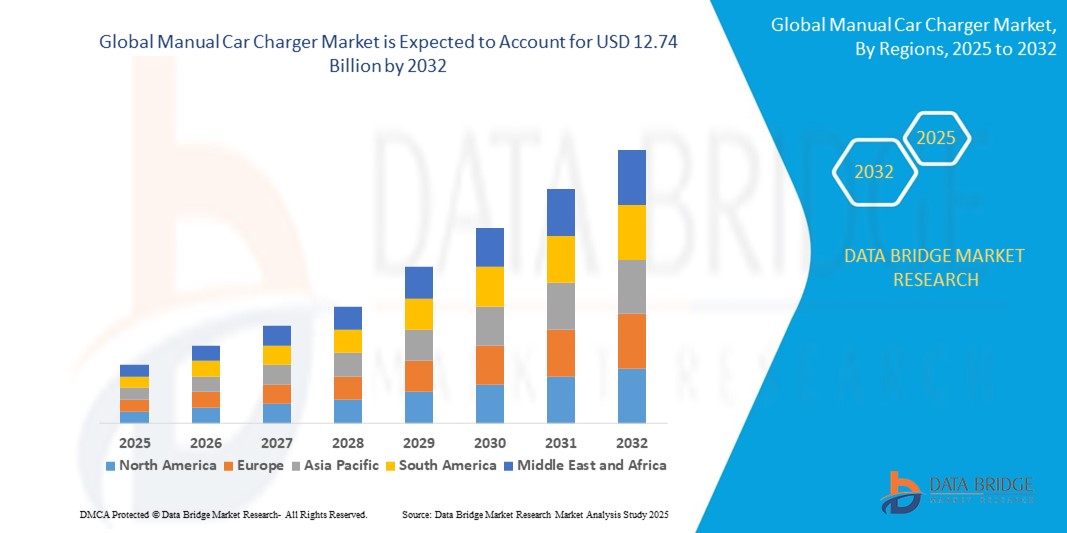
- The global manual car charger market size was valued at USD 10.54 billion in 2024 and is expected to reach USD 12.74 billion by 2032, at a CAGR of 2.40% during the forecast period
- The market growth is primarily driven by the increasing adoption of electric vehicles (EVs), rising awareness of environmental sustainability, and the need for cost-effective and reliable charging solutions for both residential and commercial applications
- Growing consumer preference for manual control over charging processes, coupled with the expansion of EV infrastructure, is further propelling demand across OEM and aftermarket channels
Manual Car Charger Market Analysis
- The manual car charger market is experiencing steady growth due to the rising penetration of electric vehicles and the demand for affordable, user-controlled charging solutions that enhance convenience and efficiency
- The market is supported by increasing demand from both luxury and economy vehicle segments, encouraging manufacturers to innovate with durable, efficient, and user-friendly charging solutions, such as smart controllers and timer-regulated chargers
- North America dominated the manual car charger market with the largest revenue share of 36.2% in 2024, driven by a mature EV market, widespread adoption of BEVs, and robust infrastructure development
- Asia-Pacific is expected to be the fastest-growing region during the forecast period, fueled by rapid urbanization, increasing EV ownership, and government initiatives promoting EV adoption in countries such as China, India, and Southeast Asian nations
- The Battery Electric Vehicle segment dominated the largest market revenue share of 76.2% in 2024, driven by the rising demand for zero-emission mobility and supportive government policies promoting electric vehicle adoption. BEVs benefit from higher energy efficiency and lower operating costs compared to hybrid alternatives, making them attractive to both individual consumers and fleet operators
Report Scope and Manual Car Charger Market Segmentation
|
Attributes |
Manual Car Charger Key Market Insights |
|
Segments Covered |
|
|
Countries Covered |
North America
Europe
Asia-Pacific
Middle East and Africa
South America
|
|
Key Market Players |
|
|
Market Opportunities |
|
|
Value Added Data Infosets |
In addition to the insights on market scenarios such as market value, growth rate, segmentation, geographical coverage, and major players, the market reports curated by the Data Bridge Market Research also include in-depth expert analysis, geographically represented company-wise production and capacity, network layouts of distributors and partners, detailed and updated price trend analysis and deficit analysis of supply chain and demand. |
Manual Car Charger Market Trends
Increasing Adoption of Smart and Connected Charging Solutions
- The global manual car charger market is experiencing a notable trend toward the integration of smart and connected technologies
- These advancements enable enhanced control over charging processes, allowing users to monitor and manage charging through mobile apps or digital interfaces
- Smart chargers provide features such as real-time charge status, remote start/stop functionality, and compatibility with smart home systems, improving user convenience
- For instances, companies are developing intelligent chargers that adjust charging speeds based on battery health or grid demand, optimizing efficiency and reducing energy costs
- This trend enhances the appeal of manual car chargers for both individual consumers and commercial fleet operators, supporting the broader adoption of electric vehicles
- Smart charging systems can analyze usage patterns to provide tailored charging schedules, reducing wear on batteries and improving longevity
Manual Car Charger Market Dynamics
Driver
Rising Demand for Electric Vehicles and Cost-Effective Charging Solutions
- The global manual car charger market is experiencing a notable trend toward the integration of smart and connected technologies
- These advancements enable enhanced control over charging processes, allowing users to monitor and manage charging through mobile apps or digital interfaces
- Smart chargers provide features such as real-time charge status, remote start/stop functionality, and compatibility with smart home systems, improving user convenience
- For instances, companies are developing intelligent chargers that adjust charging speeds based on battery health or grid demand, optimizing efficiency and reducing energy costs
- This trend enhances the appeal of manual car chargers for both individual consumers and commercial fleet operators, supporting the broader adoption of electric vehicles
- Smart charging systems can analyze usage patterns to provide tailored charging schedules, reducing wear on batteries and improving longevity
Restraint/Challenge
High Initial Costs and Concerns Over Compatibility
- The high upfront costs associated with purchasing and installing manual car chargers, including hardware and integration, can be a significant barrier, particularly for residential users and small businesses in emerging markets
- Compatibility issues between chargers and different vehicle types (BEVs, PHEVs, HEVs) or charging standards can complicate adoption and increase costs for retrofitting or upgrades
- Data security concerns also pose a challenge, as smart manual chargers may collect and transmit user data, raising issues about privacy, potential breaches, and compliance with varying regional data protection regulations
- The fragmented regulatory environment across regions, particularly in Asia-Pacific, the fastest-growing region, complicates standardization and deployment for manufacturers and service providers
- These factors may hinder market growth in cost-sensitive regions or areas with heightened awareness of data privacy and regulatory compliance
Manual Car Charger market Scope
The market is segmented on the basis of vehicle type, end user, and charging type.
- By Vehicle Type
On the basis of vehicle type, the global manual car charger market is segmented into Battery Electric Vehicle (BEV), Plug-in Hybrid Electric Vehicle (PHEV), and Hybrid Electric Vehicle (HEV). The Battery Electric Vehicle segment dominated the largest market revenue share of 76.2% in 2024, driven by the rising demand for zero-emission mobility and supportive government policies promoting electric vehicle adoption. BEVs benefit from higher energy efficiency and lower operating costs compared to hybrid alternatives, making them attractive to both individual consumers and fleet operators. The expansion of charging infrastructure and declining battery costs further solidify BEVs as the preferred choice for eco-conscious consumers and businesses.
The PHEV segment is expected to register the fastest growth rate from 2025 to 2032, as consumers increasingly value the flexibility of dual-mode vehicles. PHEVs combine electric motors with internal combustion engines, addressing range anxiety and appealing to buyers in regions with developing charging infrastructure. The segment’s growth is fueled by increasing production capacities of major automakers and the rising deployment of charging stations tailored to PHEV needs, supporting seamless transitions between electric and fuel-based driving.
- By End User
On the basis of end user, the global manual car charger market is categorized into residential and commercial. The residential segment accounted for the highest revenue share in 2024, driven by the widespread adoption of home-based charging solutions. Consumers prefer charging their vehicles overnight using affordable and convenient on-board chargers, supported by government incentives and rebates for residential charger installations. The integration of smart charging features and mobile apps enhances user experience, further boosting the segment’s dominance.
The commercial segment is anticipated to grow at the fastest CAGR from 2025 to 2032, propelled by the rapid expansion of public charging infrastructure and corporate investments in fleet electrification. Commercial chargers, particularly off-board fast chargers, are increasingly deployed in urban hubs, highways, and workplaces to meet the needs of growing EV adoption. Government initiatives, such as subsidies for public charging stations and mandates for EV infrastructure in commercial spaces, are key drivers of this segment’s growth, alongside rising demand for fast-charging solutions for long-distance travel.
- By Charging Type
On the basis of charging type, the global manual car charger market is segmented into on-board chargers and off-board chargers. The on-board chargers segment held the largest revenue share in 2024, accounting for nearly 90% of the market, due to their widespread use in residential settings and compatibility with readily available AC power sources. On-board chargers offer flexibility and ease of integration into vehicles, making them a cost-effective solution for daily charging needs. Their dominance is further supported by advancements in charger efficiency and compatibility with diverse EV models.
The off-board chargers segment is projected to grow at the fastest rate from 2025 to 2032, driven by the increasing demand for fast-charging infrastructure in public and commercial spaces. Off-board chargers, such as DC fast chargers, provide higher power output and significantly reduced charging times, catering to the needs of long-distance travelers and commercial fleets. The expansion of ultra-fast charging networks and government funding for public charging infrastructure, particularly in North America and Asia-Pacific, are key factors accelerating this segment’s growth.
Manual Car Charger Market Regional Analysis
- North America dominated the manual car charger market with the largest revenue share of 36.2% in 2024, driven by a mature EV market, widespread adoption of BEVs, and robust infrastructure development
- Consumers prioritize manual car chargers for their reliability, cost-effectiveness, and compatibility with diverse vehicle types
- Growth is supported by advancements in charging technology, such as fast on-board and portable off-board chargers, alongside rising demand in both residential and commercial segments
U.S. Manual Car Charger Market Insight
The U.S. manual car charger market captured the largest revenue share of 72.8% in 2024 within North America, fueled by strong aftermarket demand and growing consumer awareness of the benefits of manual chargers for EV charging efficiency. The trend toward vehicle electrification and supportive regulations for EV infrastructure development further boost market expansion. The integration of manual chargers in both OEM and aftermarket applications creates a diverse product ecosystem, catering to residential and commercial end users.
Europe Manual Car Charger Market Insight
The Europe manual car charger market is expected to witness significant growth, supported by regulatory emphasis on EV adoption and sustainable transportation. Consumers seek manual chargers that offer flexibility and compatibility with BEVs, PHEVs, and HEVs, while ensuring efficient charging for both residential and commercial applications. The growth is prominent in new vehicle installations and retrofit projects, with countries such as Germany and France showing notable uptake due to increasing environmental concerns and urban mobility needs.
U.K. Manual Car Charger Market Insight
The U.K. market for manual car chargers is expected to experience rapid growth, driven by demand for cost-effective and reliable charging solutions in urban and suburban settings. Increased interest in vehicle electrification and awareness of the benefits of manual chargers, such as on-board and off-board options, encourage adoption. Evolving regulations promoting EV infrastructure and safety standards influence consumer choices, balancing charging efficiency with compliance.
Germany Manual Car Charger Market Insight
Germany is expected to witness significant growth in the manual car charger market, attributed to its advanced automotive manufacturing sector and high consumer focus on energy-efficient charging solutions. German consumers prefer technologically advanced chargers, including fast on-board and portable off-board options, that support BEVs, PHEVs, and HEVs while contributing to lower energy consumption. The integration of these chargers in premium vehicles and aftermarket applications supports sustained market growth.
Asia-Pacific Manual Car Charger Market Insight
The Asia-Pacific region is expected to witness the fastest growth rate in the global manual car charger market, driven by expanding EV production and rising disposable incomes in countries such as China, India, and Japan. Increasing awareness of efficient charging solutions, including on-board and off-board chargers, and their benefits for vehicle types such as BEVs, PHEVs, and HEVs is boosting demand. Government initiatives promoting energy efficiency and EV infrastructure further encourage the adoption of manual car chargers.
Japan Manual Car Charger Market Insight
Japan’s manual car charger market is expected to witness rapid growth due to strong consumer preference for high-quality, technologically advanced chargers that enhance charging efficiency and compatibility with BEVs, PHEVs, and HEVs. The presence of major automotive manufacturers and the integration of manual chargers in OEM vehicles accelerate market penetration. Rising interest in aftermarket customization for both residential and commercial end users also contributes to growth.
China Manual Car Charger Market Insight
China holds the largest share of the Asia-Pacific manual car charger market, propelled by rapid urbanization, rising EV ownership, and increasing demand for efficient charging solutions. The country’s growing middle class and focus on smart mobility support the adoption of advanced manual chargers, including on-board and off-board types. Strong domestic manufacturing capabilities and competitive pricing enhance market accessibility for residential and commercial applications.
Manual Car Charger Market Share
The manual car charger industry is primarily led by well-established companies, including:
- Delphi Technologies PLC (U.K.)
- ChargePoint, Inc. (U.S.)
- ABB (Switzerland)
- Siemens (Germany)
- Pod Point (U.K.)
- Schaffner Holding AG (Switzerland)
- Robert Bosch GmbH (Germany)
- Chroma ATE Inc. (Taiwan)
- Chargemaster (U.K.)
- AeroVironment, Inc. (U.S.)
What are the Recent Developments in Global Manual Car Charger Market?
- In June 2025, a product safety information notice was issued for the Yamaha PA-300C AC Adaptor and Yamaha AC Adapter PA-300, both sold by Yamaha Music Europe GmbH. The notice highlighted a potential safety hazard involving abnormal heat generation at the DC plug, which could lead to melting, smoke, or ignition. These adaptors were sold individually and also bundled with Yamaha digital pianos and music workstations. Consumers are advised to immediately stop using the affected adaptors and contact Yamaha for a free replacement to ensure safety
- In June 2025, a product safety notice was issued for a charger supplied with the Chentianxia Electric Wrench, warning consumers of a high risk of fire. The charger, identified as model ZFY-12610A, was found to contain an incorrectly rated fuse, which could lead to overheating and ignition. In addition, the plug failed to meet BS 1363 dimensional standards, lacked proper creepage and clearance distances, and was missing required documentation and markings. As a result, the product was rejected at the border under UK safety regulations
- In February 2025, the EU-India Trade and Technology Council (TTC) hosted its first workshop on electric vehicle (EV) charging technology in Pune, India, aimed at fostering harmonized solutions for sustainable transport. Organized by the Automotive Research Association of India (ARAI) and the European Commission’s Joint Research Centre (JRC), the event brought together policymakers, industry leaders, and standardization bodies to discuss interoperability, charging standards, and strategic cooperation. The workshop marked a key milestone in advancing bilateral collaboration and was supported by the Office of the Principal Scientific Adviser to the Government of India
- In January 2024, Siemens, the German technology conglomerate, completed its acquisition of Heliox, a Netherlands-based specialist in DC fast charging solutions for electric buses, trucks, and passenger vehicles. This strategic move expands Siemens’ eMobility charging portfolio, adding scalable solutions ranging from 40 kW to megawatt-level charging for commercial EV depots and en-route applications. The acquisition also strengthens Siemens’ capabilities in power electronics, charger monitoring, and energy management services, reinforcing its position in the rapidly growing EV infrastructure market across Europe and North America
- In October 2023, Schumacher Electric Corporation, a leading U.S. manufacturer of automotive battery chargers, launched a new line of manual timer-controlled battery chargers and jump starters. These products, including models such as the SC1667
- and FR01666, offer users full manual control over charging and jump-starting through precision 135-minute timers, mode selectors, and rate dials. Designed to be compact, portable, and powerful, they cater to DIY enthusiasts and farm equipment users asuch as. With up to 250A engine start capability and multiple boost modes, this lineup reflects Schumacher’s commitment to empowering mobility and user control

- Interactive Data Analysis Dashboard
- Company Analysis Dashboard for high growth potential opportunities
- Research Analyst Access for customization & queries
- Competitor Analysis with Interactive dashboard
- Latest News, Updates & Trend analysis
- Harness the Power of Benchmark Analysis for Comprehensive Competitor Tracking
Global Manual Car Charger Market, Supply Chain Analysis and Ecosystem Framework
To support market growth and help clients navigate the impact of geopolitical shifts, DBMR has integrated in-depth supply chain analysis into its Global Manual Car Charger Market research reports. This addition empowers clients to respond effectively to global changes affecting their industries. The supply chain analysis section includes detailed insights such as Global Manual Car Charger Market consumption and production by country, price trend analysis, the impact of tariffs and geopolitical developments, and import and export trends by country and HSN code. It also highlights major suppliers with data on production capacity and company profiles, as well as key importers and exporters. In addition to research, DBMR offers specialized supply chain consulting services backed by over a decade of experience, providing solutions like supplier discovery, supplier risk assessment, price trend analysis, impact evaluation of inflation and trade route changes, and comprehensive market trend analysis.
Data collection and base year analysis are done using data collection modules with large sample sizes. The stage includes obtaining market information or related data through various sources and strategies. It includes examining and planning all the data acquired from the past in advance. It likewise envelops the examination of information inconsistencies seen across different information sources. The market data is analysed and estimated using market statistical and coherent models. Also, market share analysis and key trend analysis are the major success factors in the market report. To know more, please request an analyst call or drop down your inquiry.
The key research methodology used by DBMR research team is data triangulation which involves data mining, analysis of the impact of data variables on the market and primary (industry expert) validation. Data models include Vendor Positioning Grid, Market Time Line Analysis, Market Overview and Guide, Company Positioning Grid, Patent Analysis, Pricing Analysis, Company Market Share Analysis, Standards of Measurement, Global versus Regional and Vendor Share Analysis. To know more about the research methodology, drop in an inquiry to speak to our industry experts.
Data Bridge Market Research is a leader in advanced formative research. We take pride in servicing our existing and new customers with data and analysis that match and suits their goal. The report can be customized to include price trend analysis of target brands understanding the market for additional countries (ask for the list of countries), clinical trial results data, literature review, refurbished market and product base analysis. Market analysis of target competitors can be analyzed from technology-based analysis to market portfolio strategies. We can add as many competitors that you require data about in the format and data style you are looking for. Our team of analysts can also provide you data in crude raw excel files pivot tables (Fact book) or can assist you in creating presentations from the data sets available in the report.













