


What is the Marine Armor Market Size and Growth Rate?
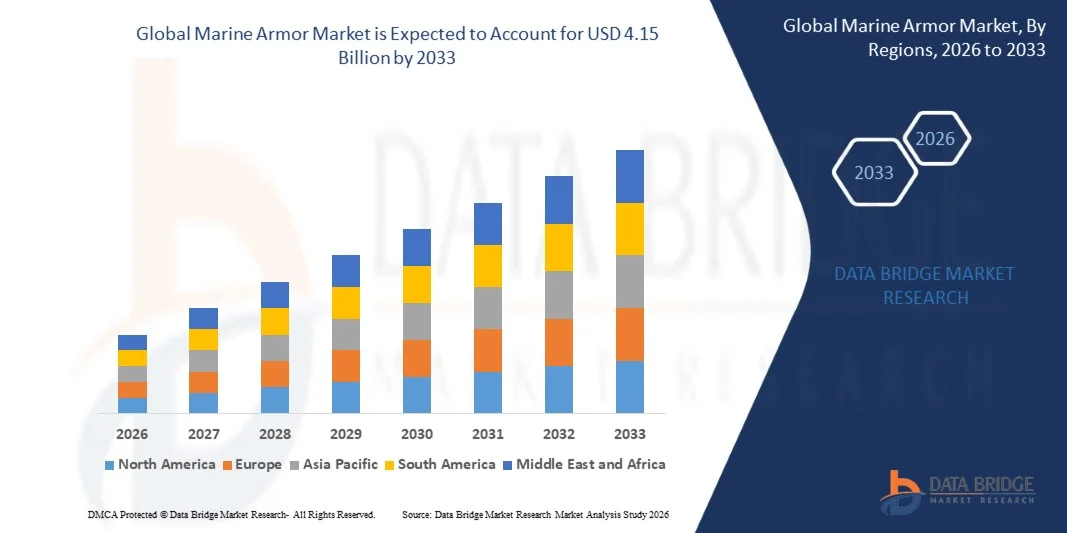
As per Data Bridge Market Research Analysis the global marine armor market was valued at USD 2.79 Billion in 2025 and is projected to reach USD 4.15 Billion by 2033, growing at a CAGR of 5.1% from 2026 to 2033. The market is experiencing consistent growth driven by increasing naval modernization programs, rising maritime security concerns, and growing investments in advanced ballistic protection systems for naval and amphibious operations. Expanding adoption of lightweight composite armor materials and advancements in ceramic and ultra-high-molecular-weight polyethylene protection technologies are further supporting market expansion across global defense sectors.
The increasing focus on strengthening maritime defense capabilities and enhancing personnel survivability in hostile marine environments, combined with rising geopolitical tensions and cross-border security threats, is compelling defense organizations to invest in next-generation marine armor solutions. Advanced marine protection systems are increasingly being integrated into naval vessels, amphibious combat vehicles, and tactical marine equipment to improve operational safety and combat effectiveness. Growing emphasis on lightweight armor systems with improved durability, corrosion resistance, and ballistic performance is further accelerating market demand across military and coast guard applications.
Market Size & Forecast
- Global Market Value (2025): USD 2.79 Billion
- Expected Market Value (2033): USD 4.15 Billion
- Forecast CAGR (2026–2033): 5.1%
- Leading Region in 2025: North America
- Fastest Growing Region: Asia-Pacific
What are the Major Takeaways of Marine Armor Market?
- North America dominated the global marine armor market with the largest revenue share of 38.5% in 2025, supported by strong naval modernization programs, high defense expenditure, and increasing investments in advanced maritime protection technologies
- The water armor chaps segment led the market with a 41% share in 2025, driven by their extensive usage in lower body protection for marine defense personnel and offshore tactical operations
- Asia-Pacific is expected to be the fastest-growing region at a CAGR of 8% from 2026 to 2033, fueled by rising naval expansion programs, increasing territorial security concerns, and growing defense spending across emerging economies
- Ultra-high-molecular-weight polyethylene are the fastest-growing material type, projected to register a CAGR of 14% from 2026 to 2033, supported by increasing demand for ultra-lightweight armor solutions with enhanced ballistic protection efficiency
- The composite segment dominated the material type category with a 38.5% revenue share in 2025, led by the increasing demand for lightweight yet high-strength protective materials across naval defense and marine security applications
- The water armor gauntlet segment is the fastest-growing components category, with a CAGR of 13.5% from 2026 to 2033, driven by rising demand for advanced hand protection systems in underwater combat, rescue missions, and offshore industrial operations
Report Scope and Global Marine Armor Market Segmentation
|
Attributes |
Marine Armor Key Market Insights |
|
Segments Covered |
|
|
Countries Covered |
North America
Europe
Asia-Pacific
Middle East and Africa
South America
|
|
Key Market Players |
|
|
Market Opportunities |
|
|
Value Added Data Infosets |
In addition to the market insights such as market value, growth rate, market segments, geographical coverage, market players, and market scenario, the market report curated by the Data Bridge Market Research team includes in-depth expert analysis, import/export analysis, pricing analysis, production consumption analysis, and pestle analysis. |
What is the Key Trend in the Marine Armor Market?
Trend: Rising Adoption of Lightweight Marine Armor
Naval defense organizations are increasingly adopting lightweight composite and advanced ceramic armor systems to improve operational mobility, survivability, and fuel efficiency across marine combat platforms. Lightweight marine armor solutions are gaining strong demand in amphibious combat vehicles, patrol vessels, and tactical marine equipment due to their superior ballistic resistance and corrosion protection capabilities. Advancements in ultra-high-molecular-weight polyethylene materials, composite layering technologies, and modular armor systems are further improving performance in harsh maritime environments.
Companies such as BAE Systems are actively developing advanced amphibious combat vehicles equipped with lightweight ballistic protection systems for the U.S. Marine Corps, supporting increasing adoption of next-generation marine armor technologies across naval defense operations.
Global Marine Armor Market Dynamics
Key Market Driver: Increasing Naval Modernization Investments
The growing global focus on strengthening naval defense capabilities and maritime security infrastructure is significantly driving demand for advanced marine armor systems. Naval forces are increasingly investing in armored amphibious combat vehicles, ballistic-resistant vessels, and tactical marine protection equipment to improve operational safety and combat readiness. Governments across the U.S., China, India, and Europe are increasing defense expenditure for naval fleet modernization and maritime border protection programs.
Major companies such as Saab, BAE Systems, and Kongsberg Defence & Aerospace are expanding investments in advanced naval combat systems and armored marine platforms to support evolving maritime defense requirements.
Key Restraint/Challenge: High Cost of Advanced Armor Materials
A major challenge in the Marine Armor market is the high cost associated with advanced ballistic materials and specialized marine-grade armor integration technologies. High-performance ceramic armor, composite materials, and ultra-lightweight ballistic fibers require significant manufacturing investment and complex engineering processes to meet naval defense standards. Marine armor systems must also withstand extreme corrosion, water pressure, and operational stress in harsh maritime environments, increasing maintenance and lifecycle costs.
The ongoing development of advanced amphibious combat vehicle programs by the U.S. Marine Corps and defense contractors such as BAE Systems highlights the substantial investment and technical complexity involved in deploying next-generation marine armor protection systems.
Key Market Opportunity: Expansion of Amphibious Combat Programs
The increasing expansion of amphibious combat and coastal defense programs is creating significant growth opportunities for the Marine Armor market. Defense agencies are increasingly deploying advanced armored amphibious vehicles and tactical marine equipment to strengthen rapid response capabilities and maritime combat efficiency. Rising geopolitical tensions, coastal surveillance requirements, and naval expeditionary operations are accelerating procurement of lightweight and high-durability marine armor solutions.
Organizations such as the U.S. Marine Corps and defense manufacturers including BAE Systems and Saab are actively investing in amphibious combat vehicle modernization and advanced naval protection technologies, supporting long-term market expansion across global marine defense sectors.
How is the Marine Armor Market Segmented?
The marine armor market is segmented on the basis of material type and component.
- By Material Type
On the basis of material type, the global Marine Armor market is segmented into metal and alloys, ceramics, composite, para-aramid fiber, ultra-high-molecular-weight polyethylene, fiberglass, and others. The Composite segment dominated the market with the largest share of 38.5% in 2025, driven by the increasing demand for lightweight yet high-strength protective materials across naval defense and marine security applications. Composite materials provide superior corrosion resistance, impact absorption, and durability under harsh marine conditions, making them highly suitable for advanced armor systems. Growing modernization programs for naval fleets and maritime patrol vessels are significantly increasing deployment of composite-based protection systems. The segment also benefits from technological advancements in layered armor structures and enhanced ballistic resistance capabilities. Rising adoption of high-performance marine protection solutions across military and coast guard operations further strengthens segment dominance.
The Ultra-High-Molecular-Weight Polyethylene segment is projected to register the fastest growth at a CAGR of 14% from 2026 to 2033, driven by increasing demand for ultra-lightweight armor solutions with enhanced ballistic protection efficiency. The material offers exceptional strength-to-weight ratio and buoyancy characteristics, making it highly suitable for marine tactical equipment and personal protection systems. Rising investments in advanced naval combat systems and amphibious security operations are accelerating product adoption across defense agencies. Advancements in fiber engineering and thermal resistance technologies are further improving operational performance in extreme maritime environments. Expanding focus on soldier mobility, reduced equipment weight, and next-generation marine armor technologies is significantly supporting segment expansion across global defense markets.
- By Components
On the basis of components, the global Marine Armor market is segmented into water armor chaps, water armor gauntlet, water armor gaiters, and others. The Water Armor Chaps segment dominated the market with the largest share of 41% in 2025, driven by their extensive usage in lower body protection for marine defense personnel and offshore tactical operations. These components provide enhanced resistance against underwater hazards, sharp marine objects, and ballistic threats while maintaining operational flexibility in aquatic environments. Increasing deployment of marine combat units and underwater security personnel is supporting strong product demand across military and coast guard applications. The segment benefits from continuous product innovation focused on lightweight construction and improved mobility. Growing emphasis on personnel safety and protective efficiency during maritime operations further reinforces segment leadership.
The Water Armor Gauntlet segment is projected to register the fastest growth at a CAGR of 13.5% from 2026 to 2033, driven by rising demand for advanced hand protection systems in underwater combat, rescue missions, and offshore industrial operations. These protective systems offer improved grip performance, puncture resistance, and operational control under challenging marine conditions. Increasing integration of smart materials and reinforced protective coatings is enhancing durability and tactical performance of marine gauntlets. Growing investments in specialized naval equipment and diver protection technologies are significantly accelerating segment adoption across defense and emergency response sectors. Expanding focus on enhancing operational safety and precision handling capabilities in marine environments is further supporting long-term market growth.
Global Marine Armor Market Regional Analysis
North America dominated the marine armor market and accounted for the largest revenue share of 38.5% in 2025, driven by strong naval modernization programs, high defense expenditure, and increasing investments in advanced maritime protection technologies. The region benefits from the presence of leading defense equipment manufacturers and extensive deployment of armored systems across naval vessels, coast guard operations, and marine security applications. Growing focus on enhancing survivability and operational safety in hostile marine environments is significantly increasing adoption of lightweight and high-performance armor materials. In addition, rising investments in amphibious combat systems and underwater tactical protection equipment continue to reinforce North America’s leadership position in the global market.
U.S. Marine Armor Market Insight
The U.S. Marine Armor market is experiencing strong growth driven by increasing defense modernization initiatives, rising procurement of advanced naval combat systems, and growing demand for lightweight ballistic protection technologies. Military agencies are heavily investing in next-generation marine armor solutions to enhance operational efficiency and personnel safety during maritime missions. The country’s strong naval infrastructure and presence of major defense technology companies are supporting continuous product innovation and deployment. In addition, increasing focus on amphibious warfare capabilities and underwater tactical operations is further accelerating market expansion across the U.S.
Canada Marine Armor Market Insight
The Canada Marine Armor market is witnessing steady growth supported by rising investments in maritime security infrastructure and increasing adoption of advanced protective systems for naval and coast guard operations. Defense organizations are increasingly deploying lightweight and corrosion-resistant armor materials to improve operational performance in harsh marine environments. The country’s expanding focus on Arctic surveillance and coastal defense modernization is significantly supporting product demand. In addition, growing emphasis on personnel protection and tactical mobility is further contributing to market growth in Canada
Europe Marine Armor Market Insight
The Europe Marine Armor market is expanding steadily due to increasing naval modernization programs, rising geopolitical tensions, and growing investments in maritime defense technologies. The region benefits from strong defense manufacturing capabilities and continuous development of advanced ballistic and underwater protection systems. Naval forces across the region are increasingly adopting lightweight composite armor and high-durability protective equipment to enhance mission effectiveness. Rising collaboration between defense contractors and government agencies for next-generation marine security solutions continues to support regional market growth
U.K. Marine Armor Market Insight
The U.K. Marine Armor market is growing steadily, driven by increasing investments in naval fleet enhancement, rising maritime security concerns, and growing adoption of advanced tactical protection systems. Defense agencies are focusing on improving survivability and operational readiness through deployment of high-performance marine armor technologies. The country’s strong naval defense infrastructure and continuous investments in underwater combat systems are supporting market expansion. In addition, increasing focus on lightweight and flexible armor materials is strengthening demand across the U.K.
Germany Marine Armor Market Insight
The Germany Marine Armor market is expanding due to strong defense modernization initiatives, increasing adoption of advanced composite protection systems, and rising investments in naval security technologies. Military and marine defense organizations are increasingly integrating lightweight and corrosion-resistant armor materials into vessels and tactical equipment to improve operational durability. The country’s strong engineering expertise and growing focus on advanced manufacturing technologies are supporting innovation in marine armor systems. In addition, increasing emphasis on NATO defense readiness and maritime protection capabilities is further accelerating market development in Germany
Asia-Pacific Marine Armor Market Insight
The Asia-Pacific Marine Armor market is expected to register the fastest growth with a CAGR of 8% from 2026 to 2033, driven by rising naval expansion programs, increasing territorial security concerns, and growing defense spending across emerging economies. Countries such as China, India, Japan, and South Korea are significantly investing in advanced maritime combat systems and next-generation protective equipment. Rapid modernization of naval fleets and increasing procurement of amphibious warfare systems are boosting demand for lightweight and durable marine armor materials. In addition, expanding focus on coastal surveillance and maritime border security is further accelerating regional market expansion
Japan Marine Armor Market Insight
The Japan Marine Armor market is witnessing steady growth supported by increasing maritime defense preparedness, rising investments in naval modernization, and growing demand for advanced underwater protection systems. Defense organizations are increasingly deploying lightweight armor technologies to improve tactical mobility and operational efficiency across marine operations. The country’s strong technological capabilities and focus on advanced materials research are supporting innovation in marine armor manufacturing. In addition, increasing emphasis on coastal security and regional defense readiness is strengthening market demand in Japan
China Marine Armor Market Insight
The China Marine Armor market is growing rapidly due to large-scale naval expansion, rising investments in advanced maritime defense technologies, and increasing development of indigenous combat protection systems. Defense agencies are actively adopting high-strength composite and ballistic-resistant armor solutions to enhance naval operational capabilities and personnel protection. The country’s strong shipbuilding industry and growing focus on military modernization are enabling rapid deployment of advanced marine armor systems. In addition, increasing investments in amphibious assault capabilities and underwater tactical operations are further driving market growth in China
Which are the Top Companies in Marine Armor Market?
The marine armor industry is primarily led by well-established companies, including:
- DuPont (U.S.)
- SM (Netherlands)
- ASL Group (Netherlands)
- Point Blank Enterprises, Inc. (U.S.)
- Marine Armor System (U.S.)
- CoorsTek Inc. (U.S.)
- PPG Industries, Inc. (U.S.)
- Craig International Ballistics Pty Ltd. (Australia)
- Gaffco Ballistics (U.S.)
- ECOncrete (Israel)
- Honeywell International Inc. (U.S.)
- 3M (U.S.)
- Saint-Gobain Group (France)
- Alcoa Corporation (U.S.)
- TenCate Protective Fabrics (Netherlands)
- Saab (Sweden)
- CeramTec GmbH (Germany)
- Morgan Advanced Materials (U.K.)
- Tata Steel (India)
- ATI (U.S.)
What are Latest Developments in Global Marine Armor Market?
- In April 2025, Epirus delivered its ExDECS high-power microwave counter-drone prototype to the U.S. Navy for Marine Corps applications, strengthening the development of advanced marine protection systems against rising drone swarm threats in maritime combat environments. The deployment is accelerating demand for next-generation electronic defense and tactical armor integration technologies across naval and amphibious operations
- In November 2024, Naval Group announced significant progress in the development of its MPLS close-in weapon system during Euronaval 2024, supporting advancement of integrated naval protection technologies for enhanced ship survivability against modern missile and airborne threats. The development is contributing to increasing investments in modular marine defense systems and advanced naval armor platforms across global defense programs
- In November 2024, Terma and SEA entered into a strategic partnership to develop integrated naval countermeasure capabilities aimed at improving vessel protection against missile and torpedo threats. The collaboration is supporting innovation in marine defense technologies and increasing adoption of advanced protective systems across naval fleets and maritime security operations
- In November 2024, Kongsberg Defence & Aerospace secured a contract from the U.S. Marine Corps for long lead items supporting full-rate production of the ACV-30 amphibious combat vehicle program, strengthening deployment of advanced armored combat systems for marine warfare applications. The contract is contributing to rising demand for high-performance marine armor technologies focused on survivability, mobility, and tactical efficiency
- In February 2024, BAE Systems delivered the first production representative test vehicle of the ACV-30 variant to the U.S. Marine Corps, enhancing development of amphibious combat platforms equipped with advanced ballistic protection and firepower systems. The launch is accelerating modernization of marine combat vehicles and supporting increased adoption of lightweight and durable armor solutions across defense sectors

- Interactive Data Analysis Dashboard
- Company Analysis Dashboard for high growth potential opportunities
- Research Analyst Access for customization & queries
- Competitor Analysis with Interactive dashboard
- Latest News, Updates & Trend analysis
- Harness the Power of Benchmark Analysis for Comprehensive Competitor Tracking
Data collection and base year analysis are done using data collection modules with large sample sizes. The stage includes obtaining market information or related data through various sources and strategies. It includes examining and planning all the data acquired from the past in advance. It likewise envelops the examination of information inconsistencies seen across different information sources. The market data is analysed and estimated using market statistical and coherent models. Also, market share analysis and key trend analysis are the major success factors in the market report. To know more, please request an analyst call or drop down your inquiry.
The key research methodology used by DBMR research team is data triangulation which involves data mining, analysis of the impact of data variables on the market and primary (industry expert) validation. Data models include Vendor Positioning Grid, Market Time Line Analysis, Market Overview and Guide, Company Positioning Grid, Patent Analysis, Pricing Analysis, Company Market Share Analysis, Standards of Measurement, Global versus Regional and Vendor Share Analysis. To know more about the research methodology, drop in an inquiry to speak to our industry experts.
Data Bridge Market Research is a leader in advanced formative research. We take pride in servicing our existing and new customers with data and analysis that match and suits their goal. The report can be customized to include price trend analysis of target brands understanding the market for additional countries (ask for the list of countries), clinical trial results data, literature review, refurbished market and product base analysis. Market analysis of target competitors can be analyzed from technology-based analysis to market portfolio strategies. We can add as many competitors that you require data about in the format and data style you are looking for. Our team of analysts can also provide you data in crude raw excel files pivot tables (Fact book) or can assist you in creating presentations from the data sets available in the report.













