


What is the Marine Fuel Injection Market Size and Growth Rate?
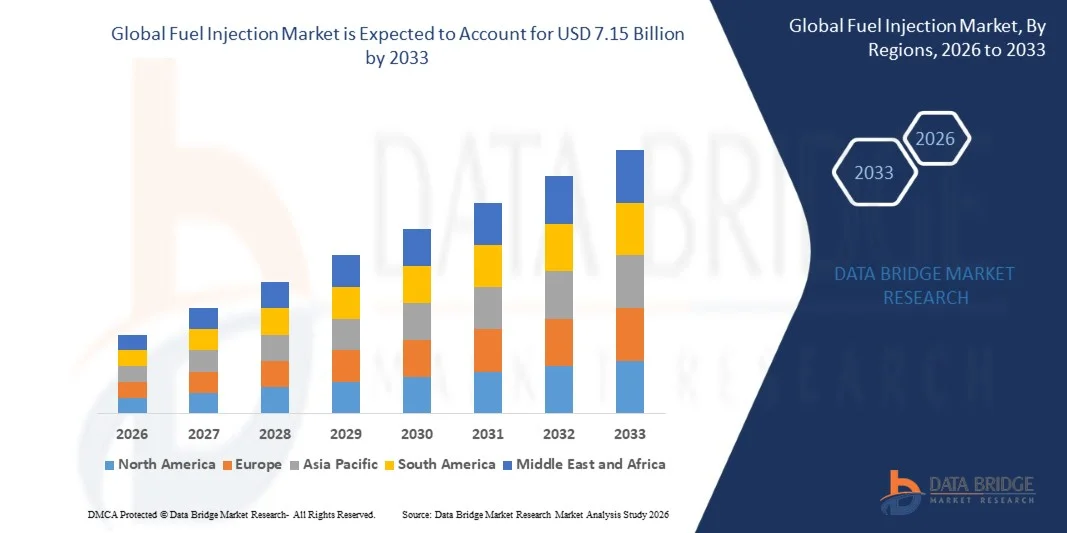
- As per Data Bridge Market Research analysis, the marine fuel injection market was valued at USD 5.78 billion in 2025 and is projected to reach USD 7.15 billion by 2033, growing at a CAGR of 2.70% from 2026 to 2033.
- The market is experiencing consistent growth driven by rising demand for fuel-efficient marine engines, increasing maritime transportation and shipbuilding activities, advancements in common rail and electronic fuel injection technologies, and the growing need for reliable fuel delivery systems across commercial, fishing, military, and other vessels.
- The implementation of stringent marine emission regulations, combined with the industry's focus on improving fuel efficiency and reducing operational costs, is compelling vessel operators and marine engine manufacturers to adopt advanced fuel injection systems. Common rail, electronic, and dual-fuel injection technologies are gaining adoption by enabling precise fuel delivery, improved combustion efficiency, lower emissions, and compatibility with evolving marine fuels.
Market Size & Forecast
- Global Market Value (2025): USD 5.78 Billion
- Expected Market Value (2033): USD 7.15 Billion
- Forecast CAGR (2026–2033): 2.70%
- Leading Region in 2025: North America
- Fastest Growing Region: Asia Pacific
What are the Major Takeaways of the Marine Fuel Injection Market?
- North America dominated the marine fuel injection market with a 36.0% revenue share in 2025, supported by established commercial shipping, offshore operations, naval modernization, and increasing adoption of electronically controlled marine fuel injection systems.
- Asia-Pacific is expected to be the fastest-growing region at a CAGR of 3.5% from 2026 to 2033, fueled by expanding maritime trade, shipbuilding activity, vessel modernization, and increasing adoption of fuel-efficient injection technologies across China, Japan, South Korea, and India
- The fuel injector segment led the market with a 31% share in 2025, driven by its critical role in controlling fuel delivery and supporting efficient combustion in marine engines.
- Electronic control unit (ECU) are the fastest-growing component type, projected to register a CAGR of 7.8%, reflecting the surge in digitalization of marine engine management systems.
- The 2 stroke segment dominated the engine type category with a 55% revenue share in 2025, led by its extensive deployment in large ocean-going commercial vessels
- Cargo carriers accounted for 40% of the market share in 2025, preferred by the extensive use of marine propulsion systems across container ships, bulk carriers, tankers, and other commercial transport vessels
- The service vessels segment is the fastest-growing application category, with a CAGR of 4.2%, driven by expanding offshore activities, marine infrastructure development, port operations, and specialized maritime services.
Report Scope and Marine Fuel Injection Market Segmentation
|
Attributes |
Marine Fuel Injection Key Market Insights |
|
Segments Covered |
|
|
Countries Covered |
North America
Europe
Asia-Pacific
Middle East and Africa
South America
|
|
Key Market Players |
|
|
Market Opportunities |
|
|
Value Added Data Infosets |
In addition to the market insights such as market value, growth rate, market segments, geographical coverage, market players, and market scenario, the market report curated by the Data Bridge Market Research team includes in-depth expert analysis, import/export analysis, pricing analysis, production consumption analysis, and pestle analysis. |
What is the Key Trend in the Marine Fuel Injection Market?
- Marine engine manufacturers and vessel operators are increasingly adopting fuel-flexible injection technologies that support methanol, LNG, biofuels, and other lower-emission fuels while maintaining reliable engine performance.
- For instance, in May 2025, MAN Energy Solutions announced its 82,440 kW MAN B&W 12G95ME-C10.5-LGIM two-stroke methanol engine for 24,000-TEU container vessels, with the engine using the company’s liquid-gas-injection methanol technology. MAN stated that it had secured more than 230 ME-LGIM references with over 600,000 operating hours on methanol, demonstrating growing adoption of fuel-flexible marine injection technology.
- Advanced fuel injection systems are being developed to provide more precise fuel metering, optimize combustion, and support compliance with increasingly stringent marine emission requirements.
- Common-rail and electronically controlled injection systems are gaining adoption because they allow flexible injection timing and improved control of fuel delivery across different engine operating conditions.
- For instance, in February 2025, MAN Energy Solutions announced that its MAN 7L21/31DF-M dual-fuel methanol GenSet successfully passed type-approval testing in China; the company also reported that sales of the 21/31DF-M had already reached double digits since its 2024 market launch, highlighting increasing demand for fuel-flexible marine engines and methanol-capable fuel systems.
- As shipping companies transition toward alternative fuels and increasingly efficient propulsion systems, demand for fuel injection technologies capable of supporting multi-fuel operation, precise combustion control, and retrofit applications is expected to increase, reinforcing advanced injection systems as an important component of marine decarbonization.
What are the Key Drivers of the Marine Fuel Injection Market?
- The growing focus on marine fuel efficiency and emissions reduction is increasing demand for advanced fuel injection systems capable of delivering precise fuel quantities and optimizing combustion across different engine loads.
- For instance, in September 2024, MAN Energy Solutions introduced its second-generation Common Rail 2.2 fuel-injection system, providing more precise control of injection pressure, timing, and duration. The system can reach up to 2,200 bar pressure and is designed to reduce fuel consumption, emissions, vibration, and noise, supporting the marine industry's focus on fuel efficiency and emissions reduction.
- Shipowners, marine engine manufacturers, and fleet operators are increasingly integrating electronically controlled injection technologies into newbuild and existing vessels to improve fuel economy, engine performance, and compliance with evolving environmental requirements.
- For instance, in August 2025, Wärtsilä reported that Kuwait Oil Tanker Company achieved 6% fuel savings at 50% engine load after upgrading a VLCC engine with Wärtsilä Fuel Efficiency Boost technology. The solution improves combustion by optimizing engine parameters and injector nozzles, demonstrating demand for fuel-injection and engine-efficiency upgrades that lower fuel consumption and emissions.
- With maritime operators under increasing pressure to improve fuel efficiency and reduce emissions while extending vessel operating life, advanced fuel injection systems will remain essential for engine modernization, combustion optimization, and transition toward alternative marine fuels.
Which Factors are Challenging the Growth of the Marine Fuel Injection Market?
- Advanced marine fuel injection systems require significant engineering, integration, and retrofit investment, particularly when vessels transition from conventional fuel systems to electronically controlled, common-rail, or alternative-fuel injection technologies.
- For instance, in March 2024, Lloyd’s Register reported that the total cost of ownership for passenger ships retrofitted with methanol dual-fuel engines was more than double that of several conventional-fuel alternatives. The report identified methanol bunkering costs as a major commercial barrier, highlighting the financial challenge associated with upgrading marine fuel systems and related infrastructure.
- These costs can limit adoption among smaller vessel operators and aging fleets, particularly where retrofit projects require modifications to fuel storage, piping, engine controls, and safety systems.
- Alternative fuels also introduce technical constraints because fuel characteristics can affect injection pressure, combustion behavior, storage requirements, and engine configuration, increasing the complexity of marine fuel-system upgrades.
- For instance, in July 2024, MAN Energy Solutions announced its methanol retrofit package for existing four-stroke engines, with the conversion requiring existing MAN 48/60 engines to be upgraded to 51/60R-DF-M engines and equipped with new control and safety systems. The company noted that the retrofit had been undergoing extensive testing before planned commercial availability, illustrating the engineering complexity involved in upgrading existing marine propulsion systems.
- The high technical complexity, vessel-specific retrofit requirements, and additional infrastructure needed for alternative-fuel operation continue to challenge widespread adoption, particularly among operators seeking to minimize capital expenditure and vessel downtime during fuel-system modernization.
How is the Marine Fuel Injection Market Segmented?
The marine fuel injection market is segmented on the basis of HP range, component, engine type, application, sales channel, and injector type.
- By HP Range
On the basis of HP range, the marine fuel injection market is segmented into 0 HP–2,000 HP, 2,001 HP–10,000 HP, 10,001 HP–20,000 HP, 20,001 HP–50,000 HP, 50,001 HP–80,000 HP, and above 80,000 HP. The 2,001 HP–10,000 HP segment dominated the market with 35% share in 2025, supported by its broad use across commercial vessels, service vessels, offshore applications, and medium-powered marine engines. This power category represents a large installed base of marine propulsion systems requiring reliable and efficient fuel delivery. Increasing emphasis on fuel economy is encouraging operators to adopt improved injectors, pumps, and electronic fuel-control technologies. The segment also benefits from regular maintenance and replacement demand for fuel injection components in operating vessels. Growing fleet modernization is further supporting the adoption of more advanced injection technologies within this power range.
The 50,001 HP–80,000 HP segment is projected to register the fastest growth at 4.2% CAGR from 2026 to 2033, driven by increasing demand for high-output propulsion systems used in large commercial vessels and specialized marine applications. High-power engines require highly precise fuel injection to maintain combustion efficiency under demanding operating conditions. Increasing adoption of electronically controlled injection systems is improving fuel metering and combustion management in these engines. The transition toward lower-emission and alternative marine fuels is also encouraging development of advanced injection technologies for high-capacity propulsion systems. Large vessel modernization programs are creating additional demand for upgraded fuel injection components.
- By Component
On the basis of component, the marine fuel injection market is segmented into fuel injector, electronic control unit (ECU), fuel pump, fuel valves, and others. The fuel injector segment dominated the market with 31% share in 2025, owing to its critical role in controlling fuel delivery and supporting efficient combustion in marine engines. Fuel injectors operate under demanding pressure, temperature, and vibration conditions, creating continuous maintenance and replacement requirements. Their performance directly affects fuel atomization, combustion quality, engine output, and emission characteristics. Increasing vessel efficiency requirements are encouraging operators to replace older injectors with improved designs. Retrofit activity across existing marine fleets is also generating recurring demand for replacement injectors.
The electronic control unit (ECU) segment is projected to register the fastest growth at 7.8% CAGR from 2026 to 2033, driven by increasing digitalization of marine engine management systems. ECUs enable precise regulation of fuel quantity, injection timing, engine parameters, and combustion conditions. Their integration with sensors and electronic engine controls supports improved fuel efficiency and operational monitoring. The growth of dual-fuel and alternative-fuel engines is also increasing demand for flexible electronic control architectures. Marine operators are increasingly adopting digitally managed propulsion technologies to improve performance and support environmental compliance.
- By Engine Type
On the basis of engine type, the marine fuel injection market is segmented into 2 stroke and 4 stroke. The 2 stroke segment dominated the market with 55% share in 2025, supported by its extensive deployment in large ocean-going commercial vessels. Two-stroke engines are widely used in container ships, bulk carriers, tankers, and other large vessels requiring high propulsion efficiency. Their ability to generate high torque at relatively low operating speeds makes them particularly suitable for deep-sea transportation. The large commercial vessel fleet therefore generates substantial demand for associated fuel injectors, pumps, valves, and electronic control systems. Increasing adoption of electronically controlled and dual-fuel two-stroke engines is further supporting demand for advanced injection technologies.
The 4 stroke segment is projected to register the fastest growth at 3.7% CAGR from 2026 to 2033, driven by its broad use across service vessels, passenger vessels, offshore support vessels, and recreational marine applications. Four-stroke engines provide flexible operating characteristics across a wide range of marine applications. Increasing demand for efficient medium-speed engines is supporting the adoption of improved fuel injection systems. Growing use of electronic fuel management is also strengthening the performance of four-stroke marine engines. Demand for cleaner combustion and lower emissions is encouraging manufacturers to develop increasingly sophisticated injection technologies for these engines.
- By Application
On the basis of application, the marine fuel injection market is segmented into service vessels, passenger vessels, cargo carriers, fishing vessels, personal watercrafts and sailboats, and others. The cargo carriers segment dominated the market with 40% share in 2025, owing to the extensive use of marine propulsion systems across container ships, bulk carriers, tankers, and other commercial transport vessels. Cargo carriers operate for long durations and require reliable fuel injection systems to maintain efficient propulsion. Increasing international maritime transportation activity continues to support demand for marine engines and their fuel-system components. Fuel efficiency is particularly important for commercial carriers because fuel represents a major portion of vessel operating costs. Fleet modernization and emission-compliance initiatives are also encouraging operators to upgrade injection technologies.
The service vessels segment is projected to register the fastest growth at 4.2% CAGR from 2026 to 2033, supported by expanding offshore activities, marine infrastructure development, port operations, and specialized maritime services. Service vessels require dependable propulsion systems because they frequently operate under changing load conditions and demanding marine environments. Growth in offshore energy and marine construction is increasing demand for these vessels and their associated engine systems. Operators are increasingly focusing on fuel-efficient propulsion technologies to control operating costs and emissions. Replacement and modernization of fuel injection components are also creating additional demand across the existing service-vessel fleet.
- By Sales Channel
On the basis of sales channel, the marine fuel injection market is segmented into OEM and aftermarket. The OEM segment dominated the market with 62% share in 2025, supported by the integration of fuel injection systems directly into newly manufactured marine engines and vessels. OEM-supplied systems are designed to match the engine architecture, fuel requirements, control systems, and emissions specifications of new vessels. New vessel construction therefore represents an important source of demand for marine fuel injection technologies. Engine manufacturers also increasingly integrate sophisticated electronic controls and high-precision injection components into new propulsion platforms. Growing shipbuilding activity and fleet renewal are supporting OEM demand across commercial and specialized vessels.
The aftermarket segment is projected to register the fastest growth at 4.1% CAGR from 2026 to 2033, driven by replacement, maintenance, repair, and retrofit activities across the installed marine fleet. Fuel injectors, pumps, valves, and electronic components require periodic inspection and replacement because marine engines operate under demanding conditions. Aging vessels are increasingly being modernized rather than replaced, creating demand for upgraded fuel injection technologies. Environmental compliance is also encouraging operators to improve the efficiency and combustion performance of existing engines. Expanding marine maintenance networks are supporting access to replacement components and technical services.
- By Injector Type
On the basis of injector type, the marine fuel injection market is segmented into cooled and uncooled injectors. The uncooled injector segment dominated the market with 60% share in 2025, supported by its established use across conventional marine engine applications. Uncooled injectors use the circulating fuel to provide temperature management around the injector and nozzle area. Their comparatively straightforward design supports reliable operation and maintenance in a wide range of marine engines. These systems have an established installed base across commercial and other vessel categories. Their operational familiarity and maintenance advantages continue to support widespread adoption.
The cooled injector segment is projected to register the fastest growth at 4.0% CAGR from 2026 to 2033, driven by increasing demand for improved thermal management in advanced marine engine applications. Higher engine performance requirements are placing greater emphasis on maintaining stable injector operating temperatures. Cooled injector designs can support reliable operation under demanding thermal conditions and sustained engine loads. Their application is becoming increasingly relevant as marine engines evolve toward higher efficiency and more sophisticated combustion systems. The development of alternative-fuel and high-performance propulsion technologies is also encouraging interest in specialized injector configurations.
Which Region Holds the Largest Share of the Marine Fuel Injection Market?
- North America dominated the marine fuel injection market with a 36.0% revenue share in 2025, supported by established commercial shipping, offshore operations, naval modernization, and increasing adoption of electronically controlled marine fuel injection systems
- The region also benefits from extensive inland waterway transportation, fleet modernization, stringent marine-emission requirements, and increasing adoption of fuel-efficient and electronically controlled injection systems. The strong presence of marine engine manufacturers and continued investments in commercial, recreational, and defense vessels further support demand for advanced marine fuel injection technologies across North America.
U.S. Marine Fuel Injection Market Insight
The U.S. marine fuel injection market is witnessing steady growth due to rising investments in efficient marine engines, vessel modernization, emission-control technologies, and advanced propulsion systems. The country’s large commercial, offshore, defense, and recreational marine sectors are generating demand for reliable fuel injection components and electronically controlled fuel systems. In addition, stringent marine diesel emission requirements are encouraging vessel operators and engine manufacturers to improve combustion efficiency and fuel management. Increasing adoption of advanced engine technologies, together with replacement and retrofit activities across the existing fleet, is further supporting demand for marine fuel injection systems in the U.S.
Asia-Pacific Marine Fuel Injection Market Insight
The Asia-Pacific marine fuel injection market is expected to witness rapid growth, driven by expanding shipbuilding activities, increasing maritime trade, and rising investments in fuel-efficient propulsion technologies across countries such as China, Japan, South Korea, and India. Growing adoption of alternative marine fuels, digital engine controls, and advanced fuel injection technologies is supporting regional market expansion. In addition, increasing investments in green shipping infrastructure, fleet modernization, and cleaner marine engines are accelerating demand for sophisticated fuel injection systems. The region’s strong manufacturing and maritime ecosystem is further contributing to the adoption of advanced propulsion and fuel-management technologies.
Japan Marine Fuel Injection Market Insight
The Japan marine fuel injection market is witnessing consistent growth due to rising investments in fuel-efficient marine engines, vessel modernization, and maritime decarbonization technologies. Shipbuilders, engine manufacturers, and vessel operators are increasingly focusing on advanced propulsion systems that improve fuel efficiency and support cleaner marine operations. Moreover, increasing development of methanol, ammonia, and other alternative-fuel infrastructure is creating demand for flexible fuel-management and injection technologies. The country’s focus on energy-efficient coastal shipping and the modernization of domestic vessels is further supporting adoption of advanced marine engine systems.
China Marine Fuel Injection Market Insight
The China marine fuel injection market is growing rapidly, driven by expanding shipbuilding activities, increasing maritime transportation, and rising government focus on green and low-carbon shipping. Growing adoption of LNG, methanol, ammonia, battery, and other alternative propulsion technologies is boosting demand for advanced marine engine and fuel-management systems. In addition, increasing development of green fuel bunkering infrastructure and modernization of inland and ocean-going vessels are supporting fuel injection technology adoption. China’s large maritime manufacturing base, expanding clean-energy vessel fleet, and continued investments in sustainable shipping are further strengthening demand for advanced marine fuel injection solutions.
U.K. Marine Fuel Injection Market Insight
The U.K. marine fuel injection market is experiencing steady growth, supported by increasing adoption of fuel-efficient propulsion systems, maritime decarbonization initiatives, and advanced marine-engine technologies. Growing investments in alternative fuels such as ammonia, hydrogen, methanol, and advanced biofuels are creating demand for adaptable fuel systems and sophisticated injection technologies. Furthermore, government-supported clean maritime programs are encouraging innovation in vessel efficiency, propulsion, and fuel management. Increasing emphasis on reducing maritime emissions, modernizing vessels, and developing cleaner marine technologies is contributing to greater adoption of advanced fuel injection systems across the U.K. maritime sector.
Germany Marine Fuel Injection Market Insight
The Germany marine fuel injection market is expanding steadily due to the country’s strong marine engineering capabilities, established shipbuilding ecosystem, and increasing adoption of efficient and lower-emission propulsion technologies. Marine engine manufacturers, shipbuilders, and technology providers are increasingly focusing on advanced fuel injection and combustion systems to improve vessel efficiency and meet evolving environmental requirements. Continuous development of alternative-fuel propulsion, digital engine-management systems, and energy-efficient marine technologies is further supporting market demand. In addition, Germany’s participation in the broader European maritime decarbonization transition is encouraging investment in cleaner propulsion systems and advanced fuel-management technologies for commercial and specialized vessels.
Which are the Top Companies in Marine Fuel Injection Market?
The marine fuel injection industry is primarily led by well-established companies, including:
- Robert Bosch GmbH (Germany)
- Cummins Inc. (U.S.)
- Caterpillar (U.S.)
- Woodward (U.S.)
- Wärtsilä (Finland)
- YANMAR HOLDINGS CO., LTD. (Japan)
- Everllence SE (Germany)
- Rolls-Royce plc (U.K.)
- IHI Power Systems Co., Ltd. (Japan)
- Mitsubishi Heavy Industries, Ltd. (Japan)
- Scania CV AB (publ) (Sweden)
- DEUTZ AG (Germany)
- Kawasaki Heavy Industries, Ltd. (Japan)
- Suzuki Motor Corporation (Japan)
- Honda Motor Co., Ltd. (Japan)
- Yamaha Motor Co., Ltd. (Japan)
- Heinzmann GmbH & Co. KG (Germany)
- Liebherr-International Deutschland GmbH (Germany)
- AB Volvo (Sweden)
- HD Hyundai Heavy Industries (South Korea)
What are Latest Developments in Marine Fuel Injection Market?
- In May 2025, MAN Energy Solutions announced the delivery of the world’s most powerful two-stroke methanol engine, an MAN B&W 12G95ME-C10.5-LGIM engine rated at 82,440 kW at 80 rpm. The engine is the first of 12 units intended for a series of 24,000-TEU container vessels and incorporates MAN’s liquid-gas-injection methanol technology, highlighting continued development of advanced marine fuel-injection systems for alternative fuels.
- In September 2024, MAN Energy Solutions introduced its second-generation Common Rail 2.2 fuel-injection system for its medium-speed four-stroke engine portfolio. The system provides precise and flexible control of injection pressure, timing, and duration, with pressure capability of up to 2,200 bar and support for fuels including HVO and FAME. The development is designed to improve engine performance, fuel consumption, emissions, and operational flexibility.
- In December 2023, Wärtsilä announced the introduction of four additional methanol-capable marine engines, expanding its portfolio with the Wärtsilä 20, 31, 46F, and 46TS alongside the existing Wärtsilä 32 Methanol engine. The development expanded the availability of marine engines capable of operating with methanol and strengthened the use of fuel-flexible combustion and injection technologies for lower-emission shipping.
- In March 2022, Wärtsilä announced the development of MethanolPac, its first dedicated methanol fuel supply system for marine applications. The system incorporated high- and low-pressure fuel supply components, fuel valve trains, bunkering stations, tank instrumentation, and associated control and safety functions. It was designed to work with the Wärtsilä 32 Methanol engine and could also support methanol fuel-injection retrofits for existing Wärtsilä 32 engines.
- In August 2021, YANMAR Marine International commenced the first European installations of its new 6LF common-rail diesel engines, with two 6LF530 engines installed to repower the Magnum 40 motorboat Adriana. The electronically managed common-rail engines replaced older mechanical engines and delivered improved vessel speed, fuel efficiency, and reduced noise during testing and sea trials, demonstrating the growing use of electronically controlled marine fuel-injection technology.

- Interactive Data Analysis Dashboard
- Company Analysis Dashboard for high growth potential opportunities
- Research Analyst Access for customization & queries
- Competitor Analysis with Interactive dashboard
- Latest News, Updates & Trend analysis
- Harness the Power of Benchmark Analysis for Comprehensive Competitor Tracking
Data collection and base year analysis are done using data collection modules with large sample sizes. The stage includes obtaining market information or related data through various sources and strategies. It includes examining and planning all the data acquired from the past in advance. It likewise envelops the examination of information inconsistencies seen across different information sources. The market data is analysed and estimated using market statistical and coherent models. Also, market share analysis and key trend analysis are the major success factors in the market report. To know more, please request an analyst call or drop down your inquiry.
The key research methodology used by DBMR research team is data triangulation which involves data mining, analysis of the impact of data variables on the market and primary (industry expert) validation. Data models include Vendor Positioning Grid, Market Time Line Analysis, Market Overview and Guide, Company Positioning Grid, Patent Analysis, Pricing Analysis, Company Market Share Analysis, Standards of Measurement, Global versus Regional and Vendor Share Analysis. To know more about the research methodology, drop in an inquiry to speak to our industry experts.
Data Bridge Market Research is a leader in advanced formative research. We take pride in servicing our existing and new customers with data and analysis that match and suits their goal. The report can be customized to include price trend analysis of target brands understanding the market for additional countries (ask for the list of countries), clinical trial results data, literature review, refurbished market and product base analysis. Market analysis of target competitors can be analyzed from technology-based analysis to market portfolio strategies. We can add as many competitors that you require data about in the format and data style you are looking for. Our team of analysts can also provide you data in crude raw excel files pivot tables (Fact book) or can assist you in creating presentations from the data sets available in the report.













