


What is the Marine Hybrid Propulsion Market Size and Growth Rate?
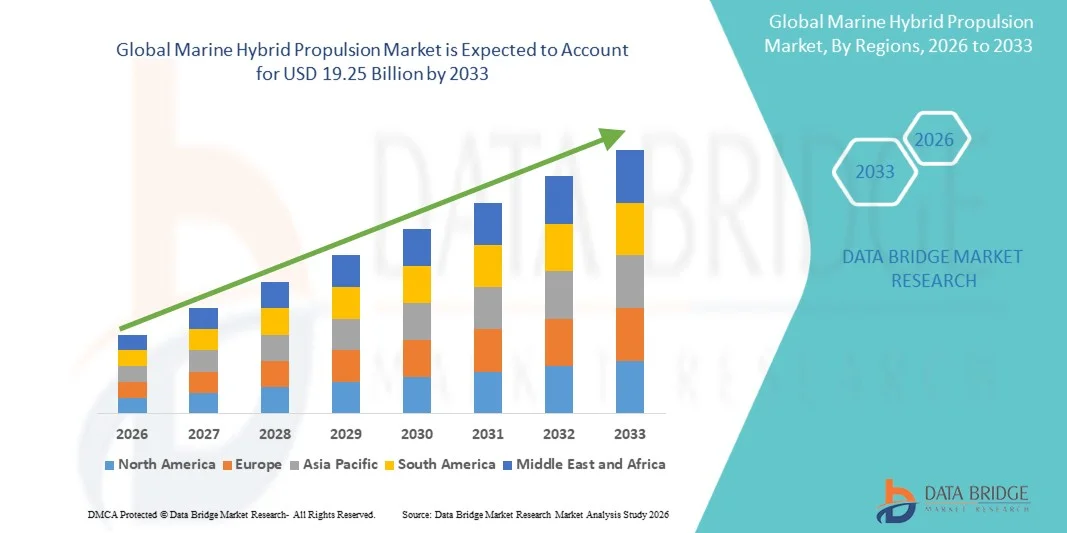
- As per Data Bridge Market Research Analysis the global marine hybrid propulsion market size was valued at USD 8.17 billion in 2025 and is expected to reach USD 19.25 billion by 2033, at a CAGR of 11.31% during the forecast period
- The market growth is largely fueled by the increasing demand for fuel-efficient and low-emission marine transportation systems, along with rising investments in sustainable ship technologies across commercial, passenger, and defense vessels
- Furthermore, stringent environmental regulations targeting maritime carbon emissions and growing adoption of advanced hybrid-electric propulsion systems are encouraging shipowners to modernize fleets with energy-efficient solutions. These converging factors are accelerating the deployment of marine hybrid propulsion technologies, thereby significantly boosting the industry’s growth
Market Size & Forecast
- Global Market Value (2025): 8.17 billion USD
- Expected Market Value (2033): 19.25 billion USD
- Forecast CAGR (2026–2033): 11.31%
What are the Major Takeaways of Marine Hybrid Propulsion Market ?
- Marine hybrid propulsion systems, combining conventional engines with electric propulsion technologies, are becoming increasingly important across commercial shipping, ferries, offshore vessels, and naval applications due to their ability to improve fuel efficiency, reduce emissions, and enhance operational flexibility
- The rising demand for marine hybrid propulsion is primarily driven by increasing global focus on decarbonization in the maritime sector, growing investments in hybrid-electric vessel technologies, and rising preference for environmentally sustainable and cost-efficient marine transportation systems
- Asia-Pacific dominated the marine hybrid propulsion market with a share of8% in 2025, due to rising shipbuilding activities, expanding commercial shipping operations, and increasing investments in sustainable marine technologies
- North America is expected to be the fastest growing region in the marine hybrid propulsion market during the forecast period due to increasing demand for fuel-efficient marine systems and growing investments in sustainable shipping technologies
- Retrofit segment dominated the market with a market share of 65.5% in 2025, due to the increasing modernization of existing marine fleets and rising demand for cost-effective emission reduction solutions across commercial and offshore vessels. Ship owners are increasingly retrofitting hybrid propulsion systems into aging vessels to improve fuel efficiency, comply with evolving environmental regulations, and extend operational lifespan without investing in complete fleet replacement
Report Scope and Marine Hybrid Propulsion Market Segmentation
|
Attributes |
Marine Hybrid Propulsion Key Market Insights |
|
Segments Covered |
|
|
Countries Covered |
North America · U.S. · Canada · Mexico Europe · Germany · France · U.K. · Netherlands · Switzerland · Belgium · Russia · Italy · Spain · Turkey · Rest of Europe Asia-Pacific · China · Japan · India · South Korea · Singapore · Malaysia · Australia · Thailand · Indonesia · Philippines · Rest of Asia-Pacific Middle East and Africa · Saudi Arabia · U.A.E. · South Africa · Egypt · Israel · Rest of Middle East and Africa South America · Brazil · Argentina · Rest of South America |
|
Key Market Players |
· Cummins Inc. (U.S.) · Kongsberg Gruppen (Norway) · Rolls-Royce Holdings plc (U.K.) · Torqeedo GmbH (Germany) · Caterpillar Inc. (U.S.) · ABB Ltd. (Switzerland) · Volvo Penta (Sweden) · Wärtsilä Corporation (Finland) · Siemens Energy AG (Germany) · Yanmar Holdings Co., Ltd. (Japan) · BAE Systems (U.K.) · Schottel GmbH (Germany) · MAN Energy Solutions (Germany) · Corvus Energy (Canada) · GE Marine (U.S.) |
|
Market Opportunities |
· Expansion of Hydrogen Fuel Cell-Based Marine Hybrid Systems · Growing Retrofit Demand for Commercial and Offshore Vessel Electrification |
|
Value Added Data Infosets |
In addition to the market insights such as market value, growth rate, market segments, geographical coverage, market players, and market scenario, the market report curated by the Data Bridge Market Research team includes in-depth expert analysis, import/export analysis, pricing analysis, production consumption analysis, and pestle analysis. |
What is the Key Trend in the Marine Hybrid Propulsion Market?
“Rising Adoption of Hybrid-Electric Ferries and Low-Emission Marine Vessels”
- A significant trend in the marine hybrid propulsion market is the increasing adoption of hybrid-electric ferries and low-emission marine vessels, driven by rising pressure on the maritime industry to reduce fuel consumption and comply with environmental regulations. This transition is strengthening the role of hybrid propulsion technologies as critical solutions for sustainable marine transportation across passenger, commercial, and offshore applications
- For instance, ABB Ltd. and BC Ferries collaborated on hybrid-electric ferry projects designed to reduce emissions and underwater noise through advanced propulsion and energy management systems. These systems improve operational efficiency while supporting long-term sustainability goals across passenger ferry networks
- The deployment of hybrid propulsion technologies in ferries is increasing rapidly as operators focus on reducing operating costs and improving energy efficiency during frequent stop-and-go operations. This trend is positioning hybrid-electric vessels as preferred solutions for short-distance and coastal transportation services
- Cruise operators and offshore vessel companies are also integrating hybrid propulsion systems to improve onboard energy management and reduce environmental impact during port operations. This is expanding the application scope of marine hybrid technologies across tourism and offshore support industries
- Governments and maritime organizations are increasingly supporting low-emission vessel development through funding programs and sustainability initiatives aimed at reducing maritime carbon emissions. This support is accelerating innovation in battery integration, power electronics, and intelligent propulsion management systems
- The market is witnessing growing investments in next-generation hybrid propulsion platforms capable of supporting future zero-emission operations through battery-electric and hydrogen fuel integration. This increasing adoption of hybrid-electric marine technologies is reinforcing the transition toward cleaner, quieter, and more energy-efficient maritime transportation systems across global shipping industries
Marine Hybrid Propulsion Market Dynamics
Driver
“Increasing Maritime Decarbonization Regulations and Fuel Efficiency Demand”
- The increasing implementation of maritime decarbonization regulations and rising demand for fuel-efficient vessel technologies are driving the adoption of marine hybrid propulsion systems across global shipping industries. These systems enable ship operators to reduce fuel consumption, lower greenhouse gas emissions, and improve operational efficiency while complying with international environmental standards
- For instance, International Maritime Organization introduced stricter emission reduction targets encouraging vessel operators and shipbuilders to invest in cleaner propulsion technologies. These regulations are accelerating the deployment of hybrid-electric systems across ferries, commercial ships, and naval fleets to achieve sustainability and fuel efficiency objectives
- The rising fuel costs associated with marine transportation are increasing demand for propulsion systems capable of optimizing engine performance and reducing operational expenses. Hybrid propulsion technologies support efficient power distribution and energy recovery, helping operators improve long-term cost management across vessel operations
- Commercial shipping companies are modernizing fleets with hybrid propulsion systems to strengthen environmental compliance and enhance competitiveness within global logistics networks. This growing focus on sustainable fleet management is boosting investments in advanced marine power and energy storage technologies
- The growing global emphasis on reducing maritime emissions and improving fuel efficiency continues to reinforce this driver. The need for advanced propulsion systems that support sustainability, operational optimization, and long-term regulatory compliance is significantly accelerating growth in the marine hybrid propulsion market
Restraint/Challenge
“High Initial Investment and Integration Complexity of Hybrid Propulsion Systems”
- The marine hybrid propulsion market faces challenges due to the high initial investment required for hybrid propulsion technologies and the complexity associated with integrating advanced power systems into marine vessels. These systems involve sophisticated energy management infrastructure, battery storage technologies, and propulsion control systems that increase overall vessel development and installation costs
- For instance, Wärtsilä Corporation deploys integrated hybrid propulsion solutions combining engines, energy storage systems, and digital propulsion controls that require specialized engineering and installation expertise. These advanced integration processes increase project complexity and raise capital expenditure for shipbuilders and vessel operators
- The retrofitting of existing vessels with hybrid propulsion technologies presents additional technical challenges related to space limitations, system compatibility, and onboard power management optimization. These factors increase installation timelines and create operational complexities during fleet modernization projects
- Hybrid propulsion systems also require high-capacity batteries, advanced cooling systems, and intelligent energy distribution technologies that contribute to elevated manufacturing and maintenance costs. Ship operators often face financial constraints when balancing sustainability investments with operational profitability objectives
- The increasing need for advanced engineering capabilities, specialized maintenance expertise, and significant capital investment continues to restrain broader adoption of marine hybrid propulsion systems. These challenges collectively influence deployment rates and create barriers for small and medium-sized vessel operators seeking transition toward sustainable marine technologies
How is the Marine Hybrid Propulsion Market Segmented?
The market is segmented on the basis of propulsion type, installation, power rating, vessel, and application.
- By Propulsion Type
On the basis of propulsion type, the marine hybrid propulsion market is segmented into parallel hybrid propulsion, diesel-electric hybrid, series hybrid propulsion, and fuel cell hybrid. The diesel-electric hybrid segment dominated the market with the largest market revenue share in 2025, driven by its extensive adoption across commercial and offshore vessels due to its operational flexibility and fuel efficiency advantages. Ship operators increasingly prefer diesel-electric systems as they enable optimized engine performance, reduced fuel consumption, and lower emissions during variable load operations. These systems also support quieter vessel operations and improved maneuverability, making them suitable for ferries, cruise vessels, and offshore support ships. The compatibility of diesel-electric propulsion with existing marine infrastructure and regulations further strengthens its market demand across global shipping fleets.
The fuel cell hybrid segment is anticipated to witness the fastest growth rate from 2026 to 2033, fueled by increasing investments in zero-emission marine technologies and stricter environmental regulations targeting greenhouse gas emissions. Fuel cell hybrid systems provide clean energy generation with significantly reduced noise and vibration levels, making them highly attractive for next-generation passenger and defense vessels. Governments and maritime organizations are actively supporting hydrogen and fuel cell projects to accelerate sustainable marine transportation. The growing focus on decarbonization and advancements in hydrogen storage technologies are expected to further boost adoption of fuel cell hybrid propulsion systems across the maritime sector.
- By Installation
On the basis of installation, the marine hybrid propulsion market is segmented into retrofit and newbuild. The retrofit segment dominated the market with the largest market revenue share of 65.5% in 2025, driven by the increasing modernization of existing marine fleets and rising demand for cost-effective emission reduction solutions across commercial and offshore vessels. Ship owners are increasingly retrofitting hybrid propulsion systems into aging vessels to improve fuel efficiency, comply with evolving environmental regulations, and extend operational lifespan without investing in complete fleet replacement. Retrofit installations also provide operational flexibility and reduced maintenance costs while enabling compliance with emission control area standards across international shipping routes. The growing focus on decarbonization and sustainable marine operations continues to strengthen demand for retrofit hybrid propulsion solutions across global maritime industries
The newbuild segment is anticipated to witness the fastest growth rate from 2026 to 2033, fueled by growing investments in technologically advanced hybrid-powered vessels and increasing adoption of integrated low-emission propulsion systems in newly manufactured ships. Shipbuilders are increasingly designing next-generation vessels with factory-installed hybrid systems to optimize energy efficiency, reduce fuel consumption, and support advanced digital power management capabilities. Newbuild hybrid vessels also offer improved operational reliability, better space utilization, and enhanced compliance with global sustainability targets. Rising demand for eco-friendly ferries, cruise ships, and defense vessels is expected to further accelerate the adoption of newbuild marine hybrid propulsion systems during the forecast period.
- By Power Rating
On the basis of power rating, the marine hybrid propulsion market is segmented into up to 1 MW, 1 MW – 5 MW, and above 5 MW. The 1 MW – 5 MW segment dominated the market with the largest market revenue share in 2025, driven by its widespread suitability for medium-sized commercial vessels, ferries, and offshore support ships. This power range provides an optimal balance between propulsion efficiency, fuel savings, and operational flexibility for vessels operating in coastal and regional routes. Shipping companies increasingly prefer systems within this category due to their ability to support auxiliary loads while maintaining lower emissions. The growing deployment of hybrid ferries and medium-capacity vessels across Europe and Asia-Pacific continues to strengthen segment growth.
The above 5 MW segment is anticipated to witness the fastest growth rate from 2026 to 2033, fueled by increasing demand for high-capacity hybrid propulsion systems in large cruise ships, naval fleets, and long-distance commercial vessels. Operators are focusing on high-power hybrid technologies to improve operational efficiency and comply with global decarbonization goals for large marine transportation systems. Advancements in battery energy storage, fuel management systems, and power electronics are enabling the development of more efficient high-capacity propulsion solutions. Rising investments in sustainable deep-sea shipping infrastructure are expected to further support the rapid growth of this segment.
- By Vessel
On the basis of vessel, the marine hybrid propulsion market is segmented into offshore support vessels, ferries, naval / defense vessels, cruise ships, yachts & recreational boats, and others. The ferries segment dominated the market with the largest market revenue share in 2025, driven by the increasing adoption of hybrid propulsion systems in short-distance and urban water transportation services. Ferry operators are focusing on reducing fuel expenses and meeting stringent emission regulations while maintaining reliable daily operations. Hybrid propulsion technologies help ferries achieve lower noise emissions, improved passenger comfort, and enhanced energy efficiency during frequent stop-and-go operations. Government initiatives promoting sustainable public transportation across coastal cities and island regions are further contributing to the segment’s market leadership.
The naval / defense vessels segment is anticipated to witness the fastest growth rate from 2026 to 2033, fueled by rising defense investments and increasing demand for advanced low-noise propulsion technologies in military applications. Hybrid propulsion systems enhance stealth capabilities, fuel efficiency, and operational endurance, making them highly suitable for modern naval operations. Defense organizations are increasingly investing in next-generation vessels equipped with hybrid energy systems to support mission flexibility and lower maintenance requirements. The growing focus on energy-efficient maritime defense infrastructure is expected to accelerate the adoption of hybrid propulsion technologies within this segment.
- By Application
On the basis of application, the marine hybrid propulsion market is segmented into commercial shipping, offshore, defense, passenger transport, and recreational. The commercial shipping segment dominated the market with the largest market revenue share in 2025, driven by increasing pressure on shipping companies to reduce carbon emissions and improve fuel efficiency across cargo transportation operations. Hybrid propulsion systems help commercial vessels optimize engine usage, lower fuel costs, and comply with international maritime emission regulations. The rising adoption of energy-efficient technologies across container ships, bulk carriers, and cargo fleets is supporting significant market expansion. Growing global trade activities and sustainability commitments from shipping operators continue to strengthen the dominance of the commercial shipping segment.
The passenger transport segment is anticipated to witness the fastest growth rate from 2026 to 2033, fueled by increasing investments in eco-friendly ferries, water taxis, and cruise transportation services. Passenger vessel operators are prioritizing hybrid propulsion technologies to improve onboard comfort through reduced vibration and noise levels while achieving lower operational emissions. Rising urbanization and growth in coastal tourism activities are increasing demand for sustainable marine passenger transportation systems. Government support for green mobility initiatives and low-emission public transport infrastructure is expected to further drive segment growth during the forecast period.
Which Region Holds the Largest Share of the Marine Hybrid Propulsion Market ?
- Asia-Pacific dominated the marine hybrid propulsion market with the largest revenue share of 35.8% in 2025, driven by rising shipbuilding activities, expanding commercial shipping operations, and increasing investments in sustainable marine technologies
- The region benefits from strong manufacturing capabilities, growing maritime trade networks, and rising adoption of fuel-efficient propulsion systems across ferries, offshore vessels, and commercial fleets
- Increasing government initiatives supporting low-emission marine transportation and rapid modernization of port infrastructure are accelerating regional market expansion
China Marine Hybrid Propulsion Market Insight
China held the largest share in the Asia-Pacific marine hybrid propulsion market in 2025, supported by its dominant shipbuilding industry and strong investments in advanced marine technologies. The country has a well-established maritime manufacturing ecosystem that enables large-scale production of hybrid-powered commercial and defense vessels. Rising demand for energy-efficient shipping systems and increasing implementation of emission reduction targets are further driving market growth. In addition, strong government support for green shipping initiatives and modernization of marine infrastructure are reinforcing China’s leadership in marine hybrid propulsion adoption and production.
India Marine Hybrid Propulsion Market Insight
India is witnessing the fastest growth in the Asia-Pacific region, driven by increasing investments in coastal transportation, naval modernization, and sustainable maritime infrastructure. Government initiatives promoting domestic shipbuilding and green marine transportation are significantly supporting hybrid propulsion system adoption across commercial and defense applications. Growing offshore activities and rising demand for fuel-efficient ferries are also contributing to market expansion. In addition, increasing investments in port development and maritime logistics modernization are accelerating long-term market growth.
Europe Marine Hybrid Propulsion Market Insight
The Europe marine hybrid propulsion market is expanding steadily, supported by strong environmental regulations and increasing adoption of low-emission marine transportation technologies. The region places strong emphasis on sustainable shipping solutions, particularly across ferries, cruise ships, and offshore support vessels. Rising investments in battery-powered and fuel-efficient propulsion systems are encouraging wider deployment of hybrid marine technologies. In addition, continuous technological advancements in marine energy management systems are enhancing operational efficiency across commercial and passenger vessel applications.
Germany Marine Hybrid Propulsion Market Insight
Germany accounted for the largest share in the Europe marine hybrid propulsion market in 2025, driven by its advanced maritime engineering capabilities and strong focus on sustainable transportation technologies. The country has extensive adoption of hybrid propulsion systems across commercial vessels, research ships, and naval applications. Strong investments in marine innovation and energy-efficient vessel technologies are supporting continuous market development. In addition, collaboration between shipbuilders, technology providers, and government agencies is reinforcing Germany’s leadership in hybrid marine propulsion advancements.
U.K. Marine Hybrid Propulsion Market Insight
The U.K. market is supported by increasing investments in clean maritime transportation and modernization of passenger ferry infrastructure. Rising demand for low-emission propulsion systems across coastal and offshore vessels is driving hybrid technology adoption. The country’s strong focus on maritime sustainability and carbon reduction targets is encouraging investment in advanced propulsion solutions. In addition, growing development of smart ports and green shipping corridors is further supporting market expansion.
North America Marine Hybrid Propulsion Market Insight
North America is projected to grow at the fastest CAGR from 2026 to 2033, driven by increasing demand for fuel-efficient marine systems and growing investments in sustainable shipping technologies. Strong adoption of hybrid propulsion systems across commercial, passenger, and defense vessels is supporting regional market growth. Increasing environmental regulations targeting marine emissions are further accelerating the deployment of low-emission propulsion technologies. In addition, rising investments in advanced ship modernization programs and clean marine infrastructure are strengthening regional expansion.
U.S. Marine Hybrid Propulsion Market Insight
The U.S. accounted for the largest share in the North America marine hybrid propulsion market in 2025, supported by strong demand from defense, commercial shipping, and passenger transport sectors. The country benefits from advanced shipbuilding capabilities and strong investments in hybrid and electric marine technologies. Hybrid propulsion systems are increasingly being adopted across naval vessels, ferries, and offshore support fleets to improve operational efficiency and reduce fuel consumption. In addition, continuous technological innovation and government support for sustainable maritime operations are reinforcing the U.S. leadership position in the regional market.
Which are the Top Companies in Marine Hybrid Propulsion Market ?
The marine hybrid propulsion industry is primarily led by well-established companies, including:
- Cummins Inc. (U.S.)
- Kongsberg Gruppen (Norway)
- Rolls-Royce Holdings plc (U.K.)
- Torqeedo GmbH (Germany)
- Caterpillar Inc. (U.S.)
- ABB Ltd. (Switzerland)
- Volvo Penta (Sweden)
- Wärtsilä Corporation (Finland)
- Siemens Energy AG (Germany)
- Yanmar Holdings Co., Ltd. (Japan)
- BAE Systems (U.K.)
- Schottel GmbH (Germany)
- MAN Energy Solutions (Germany)
- Corvus Energy (Canada)
- GE Marine (U.S.)
What are Latest Developments in Marine Hybrid Propulsion Market?
- In March 2026, ABB Ltd. announced the supply of an integrated hybrid-electric propulsion system for a new 75-car passenger and vehicle ferry operating on the Cape May–Lewes route in the U.S. The solution includes ABB’s Onboard DC Grid platform, advanced energy management systems, and engineering support designed to optimize onboard energy usage and operational performance. The project is expected to reduce fuel consumption by nearly 35% while lowering maintenance and operational expenses, strengthening the adoption of hybrid-electric ferry technologies in the marine hybrid propulsion market. The development also highlights growing industry focus on scalable propulsion systems capable of supporting future transition toward fully battery-electric and zero-emission vessel operations
- In January 2026, Chartwell Marine secured a design contract for a new lifeline ferry featuring a customized catamaran hull integrated with a hybrid propulsion system. The vessel has been designed in collaboration with ferry operators and local stakeholders to efficiently transport passengers and cargo across island routes while improving environmental sustainability. The development reflects rising demand for hybrid-powered ferries capable of reducing fuel consumption and emissions in regional marine transportation networks. The project is expected to support broader market growth by encouraging adoption of environmentally efficient propulsion technologies in short-distance passenger vessel applications
- In January 2026, ABB Ltd. was selected to supply propulsion, power, and control systems for four hybrid-electric vessels being developed under BC Ferries’ New Major Vessels programme. The initiative focuses on replacing aging ferries while reducing emissions and underwater noise levels across marine transportation routes in the Strait of Georgia. The deployment of hybrid-electric propulsion technologies is expected to improve operational efficiency and strengthen sustainability performance within large passenger ferry fleets. The project further reinforces increasing investments in hybrid vessel modernization programs across the global marine transportation sector
- In June 2025, Wärtsilä Corporation announced the supply of an integrated hybrid propulsion solution for four new 10,700 DWT geared tween decker vessels being built for Vertom Group. The propulsion package combines a medium-speed engine with a hybrid drivetrain capable of supporting battery-powered, zero-emission sailing operations without reliance on combustion-based propulsion during specific operational modes. The development demonstrates growing industry emphasis on fuel-efficient and low-emission propulsion systems for commercial cargo shipping applications. It is also expected to accelerate adoption of hybrid propulsion technologies within the global maritime logistics and cargo transport industry
- In July 2025, Wärtsilä Corporation confirmed the supply of a comprehensive hybrid propulsion package for four new vessels being constructed for Dutch shipowner Vertom. The integrated solution includes the Wärtsilä 25 engine, controllable pitch propeller systems, transverse thrusters, NOx reduction technology, and advanced remote propulsion control capabilities. The project is expected to improve vessel propulsion efficiency, reduce emissions, and support advanced energy management during marine operations. This development highlights increasing market demand for integrated hybrid propulsion platforms that combine operational performance with environmental sustainability objectives across commercial shipping fleets

- Interactive Data Analysis Dashboard
- Company Analysis Dashboard for high growth potential opportunities
- Research Analyst Access for customization & queries
- Competitor Analysis with Interactive dashboard
- Latest News, Updates & Trend analysis
- Harness the Power of Benchmark Analysis for Comprehensive Competitor Tracking
Data collection and base year analysis are done using data collection modules with large sample sizes. The stage includes obtaining market information or related data through various sources and strategies. It includes examining and planning all the data acquired from the past in advance. It likewise envelops the examination of information inconsistencies seen across different information sources. The market data is analysed and estimated using market statistical and coherent models. Also, market share analysis and key trend analysis are the major success factors in the market report. To know more, please request an analyst call or drop down your inquiry.
The key research methodology used by DBMR research team is data triangulation which involves data mining, analysis of the impact of data variables on the market and primary (industry expert) validation. Data models include Vendor Positioning Grid, Market Time Line Analysis, Market Overview and Guide, Company Positioning Grid, Patent Analysis, Pricing Analysis, Company Market Share Analysis, Standards of Measurement, Global versus Regional and Vendor Share Analysis. To know more about the research methodology, drop in an inquiry to speak to our industry experts.
Data Bridge Market Research is a leader in advanced formative research. We take pride in servicing our existing and new customers with data and analysis that match and suits their goal. The report can be customized to include price trend analysis of target brands understanding the market for additional countries (ask for the list of countries), clinical trial results data, literature review, refurbished market and product base analysis. Market analysis of target competitors can be analyzed from technology-based analysis to market portfolio strategies. We can add as many competitors that you require data about in the format and data style you are looking for. Our team of analysts can also provide you data in crude raw excel files pivot tables (Fact book) or can assist you in creating presentations from the data sets available in the report.













