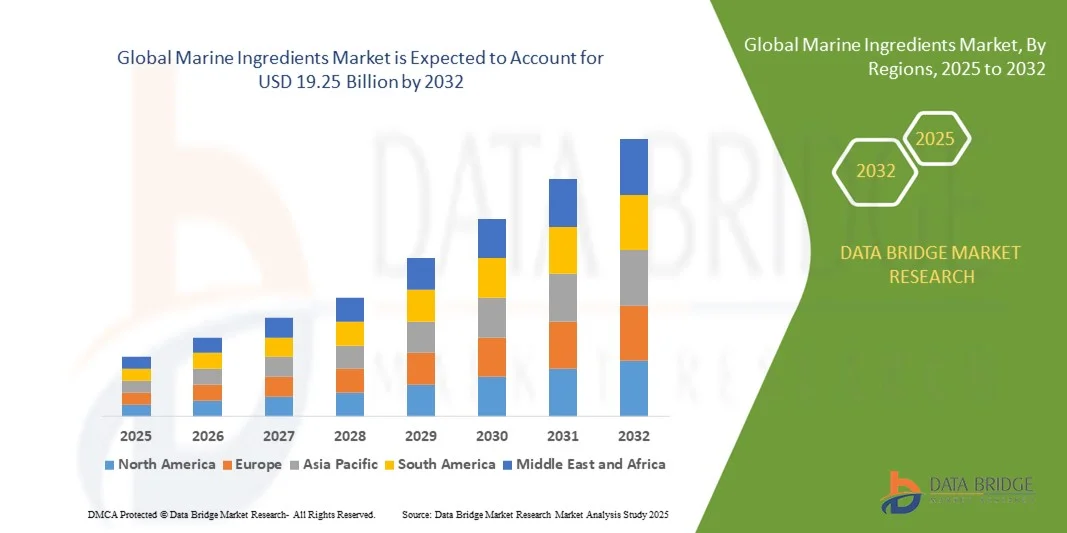
Global Marine Ingredients Market Size
- The global marine ingredients market size was valued at USD 9,96 billion in 2024 and is projected to reach USD 19.25 billion by 2032, growing at a CAGR of 8.59% during the forecast period
- Market expansion is primarily driven by the rising demand for sustainable aquafeed, pet food, and dietary supplements, supported by growing awareness of marine-based nutritional benefits and circular economy practices
- Additionally, advances in extraction technologies and increased utilization of by-products from the seafood industry are enhancing production efficiency and value, further accelerating the growth of the marine ingredients market globally
Global Marine Ingredients Market Analysis
- Marine ingredients, derived primarily from fish and other marine organisms, are becoming increasingly essential across aquaculture, animal feed, pharmaceuticals, and nutraceuticals due to their high nutritional value, sustainability, and functional properties such as omega-3 content and bioactive compounds
- The rising demand for marine ingredients is largely driven by the growth of the aquaculture industry, heightened consumer focus on natural and health-boosting supplements, and an increasing shift toward circular economy practices that utilize seafood by-products
- North America dominated the global marine ingredients market with the largest revenue share of 35.5% in 2024, supported by strong regulatory frameworks, advanced marine processing technologies, and widespread demand for functional food and feed ingredients, particularly in countries like Norway, Denmark, and Iceland
- Asia-Pacific is anticipated to be the fastest growing region during the forecast period, fueled by expanding aquaculture production, rising health awareness, and increasing investment in marine biotechnology
- The fish meal segment dominated the market with the largest market revenue share of 38.5% in 2024, driven by its extensive use in aquaculture feed due to its high protein content and nutritional benefits.
Report Scope and Global Marine Ingredients Market Segmentation
|
Attributes |
Marine Ingredients Key Market Insights |
|
Segments Covered |
|
|
Countries Covered |
North America
Europe
Asia-Pacific
Middle East and Africa
South America
|
|
Key Market Players |
|
|
Market Opportunities |
|
|
Value Added Data Infosets |
In addition to the insights on market scenarios such as market value, growth rate, segmentation, geographical coverage, and major players, the market reports curated by the Data Bridge Market Research also include in-depth expert analysis, pricing analysis, brand share analysis, consumer survey, demography analysis, supply chain analysis, value chain analysis, raw material/consumables overview, vendor selection criteria, PESTLE Analysis, Porter Analysis, and regulatory framework. |
Global Marine Ingredients Market Trends
Advancements in Extraction Technologies and Functional Applications
- A significant and accelerating trend in the Global Marine Ingredients Market is the advancement in extraction technologies and the expansion of functional applications in sectors such as pharmaceuticals, nutraceuticals, cosmetics, and functional foods. These innovations are enhancing the quality, purity, and sustainability of marine-derived compounds, making them increasingly valuable across high-growth industries.
- For instance, modern enzymatic hydrolysis techniques are being used to extract high-purity marine peptides, which exhibit anti-inflammatory and antioxidant properties suitable for use in dietary supplements and skincare products. Similarly, supercritical CO₂ extraction is gaining traction for isolating omega-3 fatty acids with minimal environmental impact and improved bioavailability.
- These advanced methods enable manufacturers to target specific bioactive compounds—such as EPA, DHA, collagen, and marine proteins—leading to customized ingredient formulations tailored to consumer health needs like cardiovascular wellness, joint health, and cognitive function. For example, companies like Aker BioMarine are leveraging patented technologies to extract krill oil rich in phospholipid-bound omega-3s for superior absorption and efficacy.
- Innovations in marine biotechnology are also driving the development of microalgae-based ingredients, which provide a sustainable, plant-based alternative to traditional fish-derived oils. Companies such as Veramaris and Corbion are pioneering large-scale algal production to meet the growing global demand for vegan omega-3 solutions, especially in aquafeed and infant nutrition.
- The integration of these technologies into the production process not only enhances nutritional value and product safety but also aligns with clean label and sustainability trends that are increasingly influencing purchasing behavior across global markets.
- As a result, companies are investing heavily in R&D to optimize marine ingredient yields, reduce processing waste, and expand into high-margin markets. This trend is reshaping the competitive landscape, with players differentiating themselves through innovation, traceability, and eco-conscious practices, in response to evolving consumer expectations and stricter regulatory standards.
Global Marine Ingredients Market Dynamics
Driver
Growing Demand Driven by Health Trends and Sustainable Aquaculture
-
The increasing global emphasis on health and wellness, along with the rapid growth of sustainable aquaculture, is a significant driver for the rising demand in the Global Marine Ingredients Market
- For instance, in March 2024, Austevoll Seafood (Pelagia AS) announced a new initiative to expand its fishmeal and fish oil production using trimmings from certified sustainable fisheries, aligning with environmental goals and supporting responsible aquafeed development. Such moves by key players are accelerating market adoption and innovation
- As consumers become more focused on natural, nutrient-rich food and supplement sources, marine ingredients such as omega-3 fatty acids, marine collagen, and protein hydrolysates are gaining popularity across nutraceutical, functional food, and cosmetic sectors
- Simultaneously, the rising need for high-performance aquafeed in aquaculture—driven by the global demand for seafood—is creating sustained demand for fishmeal and fish oil, which are essential for the growth and health of farmed fish species
- The appeal of marine ingredients lies in their high bioavailability, sustainability (when sourced responsibly), and functional benefits, which include anti-inflammatory, cardiovascular, and cognitive support properties. In addition, the circular economy model—utilizing by-products like fish trimmings—enhances both environmental and economic value
- Furthermore, marine ingredients are increasingly seen as a sustainable alternative to land-based proteins and synthetic additives, aligning with the global push toward greener food and health systems. Innovations in algae-based omega-3 and marine peptides are also opening new markets, including vegan supplements and infant nutrition
Restraint/Challenge
Resource Dependency, Supply Volatility, and Regulatory Barriers
- One of the primary challenges facing the marine ingredients market is its high dependency on finite marine resources, such as small pelagic fish and crustaceans. Environmental factors, overfishing, and climate change can lead to fluctuations in raw material availability, which directly impact supply chains and pricing stability
- For instance, seasonal fishery closures in major producing countries like Peru and Chile—often due to El Niño events or regulatory quotas—have historically caused sharp supply drops and price spikes for fishmeal and fish oil
- Moreover, stringent environmental regulations and sustainability certifications are increasingly required for market access in Europe and North America. While these regulations promote responsible sourcing, they also increase operational complexity and cost for producers, particularly in emerging economies
- Companies must navigate varying international standards for quality, safety, and traceability, which can slow down time-to-market and limit exports for smaller or less technologically advanced producers
- Additionally, despite the growing popularity of marine-based supplements, consumer concerns around taste, odor, heavy metal contamination, and allergenicity continue to present hurdles—especially in the nutraceutical and food segments
- Addressing these challenges through responsible fishery practices, technological innovation in by-product utilization, and transparent sourcing will be essential for long-term, scalable growth in the global marine ingredients industry
Global Marine Ingredients Market Scope
The market is segmented on the basis of product type, ingredient type, source and application.
- By Product Type
On the basis of product type, the marine ingredients market is segmented into fish meal, fish oil, marine proteins, marine peptides, marine collagen, fish bone, and others. The fish meal segment dominated the market with the largest market revenue share of 38.5% in 2024, driven by its extensive use in aquaculture feed due to its high protein content and nutritional benefits. Fish meal remains a staple ingredient for improving feed efficiency and promoting sustainable aquaculture practices.
The marine collagen segment is expected to witness the fastest growth rate of 22.4% from 2025 to 2032, propelled by rising demand in the cosmetics, pharmaceutical, and dietary supplement industries. Marine collagen’s superior bioavailability and health benefits, such as skin regeneration and joint health, have made it highly sought after globally, especially in North America and Europe.
- By Ingredients
On the basis of ingredients, the marine ingredients market is segmented into protein, ash, fatty acids, vitamins, fat, enzymes, and others. The protein segment held the largest market revenue share of 42.3% in 2024, attributed to its vital role in aquaculture feed and animal nutrition. Proteins derived from marine sources are preferred for their high digestibility and amino acid profiles, essential for the growth and health of farmed species.
The fatty acids segment is projected to witness the fastest CAGR of 21.1% during the forecast period, driven by the increasing awareness of omega-3 and other essential fatty acids in human health supplements. Demand for marine-derived fatty acids is surging, especially for cardiovascular health, cognitive function, and anti-inflammatory benefits.
- By Source
On the basis of source, the marine ingredients market is segmented into fish, krill, squid, seaweed, microalgae, and others. The fish segment accounted for the largest market revenue share of 45.7% in 2024, primarily because fish by-products are widely available and have long been the primary raw materials for marine ingredients. Fish-derived ingredients offer a broad spectrum of nutritional and functional benefits, making them crucial for both feed and supplement markets.
The seaweed segment is expected to register the fastest growth rate of 23.5% from 2025 to 2032, fueled by the rising interest in sustainable and plant-based marine ingredients. Seaweed’s versatility as a source of bioactive compounds, antioxidants, and polysaccharides positions it as a promising ingredient for food, feed, and pharmaceutical applications.
- By Application
On the basis of application, the marine ingredients market is segmented into aquaculture feed, animal nutrition & pet food, dietary supplements, and more. The aquaculture feed segment dominated the market with the largest revenue share of 49.6% in 2024, driven by the rapid expansion of the aquaculture industry and the essential role marine ingredients play in formulating high-quality, nutritious feed.
The dietary supplements segment is anticipated to witness the fastest CAGR of 24.2% during the forecast period, boosted by increasing consumer health awareness and demand for natural, marine-derived supplements rich in omega-3 fatty acids, peptides, and collagen. Growing trends in wellness and preventive healthcare are further supporting this segment’s expansion globally.
Global Marine Ingredients Market Regional Analysis
- North America dominated the global marine ingredients market with the largest revenue share of 35.5% in 2024, driven by strong demand for sustainable aquafeed, functional foods, and marine-based nutraceuticals
- Consumers and industries in the region are increasingly focused on health, sustainability, and clean-label products, creating a favorable environment for marine-derived ingredients such as omega-3 oils, marine collagen, and protein hydrolysates
- This widespread adoption is further supported by well-established marine processing infrastructure, stringent environmental regulations promoting responsible sourcing, and a high level of innovation in marine biotechnology, positioning Europe as a key hub for both production and consumption across aquaculture, food, and health sectors
U.S. Marine Ingredients Market Insight
The U.S. marine ingredients market captured the largest revenue share of 42% in 2024 within North America, driven by rising demand for high-quality fishmeal, fish oil, and krill oil across aquaculture feed and dietary supplements. Increasing consumer awareness about the health benefits of omega-3 fatty acids and marine-based nutraceuticals is fueling market growth. The growing trend towards sustainable sourcing and clean-label ingredients, coupled with strong investments in marine biotechnology, supports product innovation. Additionally, the expansion of aquaculture activities and pet food sectors further propels the U.S. marine ingredients market.
Europe Marine Ingredients Market Insight
The Europe marine ingredients market is projected to grow at a substantial CAGR over the forecast period, primarily driven by stringent regulations on sustainable fishing and the rising demand for environmentally responsible marine ingredients. The increasing focus on clean-label and health-promoting products fuels consumer interest in omega-3-rich fish oils and algae-based ingredients. Growth is also supported by the well-established aquaculture industry and the incorporation of marine ingredients in animal nutrition and dietary supplements across residential and commercial sectors.
U.K. Marine Ingredients Market Insight
The U.K. marine ingredients market is anticipated to expand steadily during the forecast period, driven by growing awareness of marine-derived health supplements and increased demand for sustainable aquafeed ingredients. Government policies promoting sustainable fisheries and marine resource management further support market expansion. The U.K.’s focus on innovation in marine biotechnology and the rising adoption of marine collagen and krill oil in functional foods contribute to sustained growth.
Germany Marine Ingredients Market Insight
Germany’s marine ingredients market is expected to grow at a notable CAGR, fueled by increasing consumer health consciousness and demand for sustainable and ethically sourced products. The pharmaceutical and nutraceutical sectors in Germany are significant consumers of fish oil and algae-derived omega-3s. The country’s commitment to environmental sustainability and technological innovation drives adoption of marine ingredients in dietary supplements and animal nutrition, aligning with local consumer preferences for eco-friendly solutions.
Asia-Pacific Marine Ingredients Market Insight
The Asia-Pacific marine ingredients market is poised to grow at the fastest CAGR of 23% from 2025 to 2032, driven by expanding aquaculture industries in China, Japan, India, and Southeast Asia. Rising disposable incomes, urbanization, and health awareness fuel demand for marine-based dietary supplements and pet food ingredients. Government initiatives to promote sustainable fishing and digitalization in agriculture further accelerate growth. The region’s dominance in fishmeal and fish oil production, along with increasing investments in marine biotechnology, underpins market expansion.
Japan Marine Ingredients Market Insight
Japan’s marine ingredients market is gaining momentum due to the country’s traditional seafood consumption and strong health and wellness culture. Increasing demand for high-quality marine omega-3 oils and marine collagen supports market growth, particularly among the aging population seeking cardiovascular and joint health benefits. Integration of marine ingredients into functional foods and cosmetics, combined with rising smart agriculture practices, further fuels market adoption.
China Marine Ingredients Market Insight
China accounted for the largest market revenue share in Asia-Pacific in 2024, attributed to its vast aquaculture production and expanding middle-class consumer base. Rapid urbanization and increasing health consciousness are driving demand for fish oil, krill oil, and algal ingredients in dietary supplements and functional foods. Government support for sustainable fisheries, smart agriculture, and the domestic manufacturing of marine ingredients bolster China’s leadership position. Additionally, affordable product availability and growing exports contribute to robust market growth.
Global Marine Ingredients Market Share
The Marine Ingredients industry is primarily led by well-established companies, including:
- Cargill, Incorporated (U.S.)
- Symrise (Germany)
- KD Pharma Group SA (Germany)
- Algaia (France)
- American Seafoods Company LLC (U.S.)
- Bio-marine Ingredients Ireland (Ireland)
- COBIOSA (Spain)
- GONMISOL (Spain)
- Omega Protein Corporation (U.S.)
- Abyss Ingredients (France)
- Hofseth BioCare ASA (Norway)
- Kodiak Fishmeal Company (U.S.)
- NutriFish (Canada)
- OLVEA FISH OILS (France)
- Pacific Seafood (U.S.)
- Pelagia (Norway)
- TerraMar Ingredients (U.S.)
- Sea Pride LLC (U.S.)
- The Scoular Company (U.S.)
- Vesteraalens (Norway)
What are the Recent Developments in Global Marine Ingredients Market?
- In April 2023, Norwegian Marine Ingredients ASA, a global leader in marine-based nutrition solutions, launched a strategic initiative in South Africa aimed at promoting sustainable sourcing and advanced marine ingredient applications in aquaculture and animal nutrition. This initiative highlights the company’s commitment to delivering innovative, eco-friendly marine products tailored to the specific needs of regional markets. By leveraging its global expertise and cutting-edge processing technologies, Norwegian Marine Ingredients is addressing local sustainability challenges while reinforcing its position in the rapidly expanding global marine ingredients market.
- In March 2023, Blue Ocean Nutraceuticals, a U.S.-based veteran-led company, introduced a new concentrated omega-3 fish oil supplement designed specifically for the dietary supplement and functional food sectors. This product, rich in EPA and DHA, emphasizes purity and sustainability, meeting the rising consumer demand for high-quality marine-derived health products. This advancement highlights Blue Ocean Nutraceuticals’ dedication to developing innovative marine ingredients that support wellness and sustainable marine resource utilization.
- In March 2023, Cargill Inc. successfully launched a large-scale marine collagen production facility in India, aimed at catering to the growing demand for marine-derived ingredients in cosmetics, dietary supplements, and functional foods. This facility utilizes advanced extraction technologies to ensure high purity and bioavailability, underscoring Cargill’s commitment to innovation and sustainable ingredient sourcing. The project reflects the increasing importance of marine ingredients in emerging markets and supports the growth of sustainable industries.
- In February 2023, BioMar Group, a leading provider of sustainable aquaculture feed solutions, announced a strategic partnership with the Southeast Asian Fisheries Development Center (SEAFDEC) to promote the use of high-quality fishmeal and fish oil in regional aquaculture. This collaboration aims to improve feed efficiency and support environmentally responsible fish farming practices. The initiative demonstrates BioMar’s focus on enhancing sustainability and operational effectiveness within the aquaculture sector through marine ingredient innovation.
- In January 2023, Aker BioMarine ASA, a prominent supplier of krill oil and marine ingredients, unveiled its latest product line featuring enhanced phospholipid-rich krill oil at the Natural Products Expo West 2023. This product, designed for dietary supplements and functional foods, offers superior absorption and health benefits, showcasing the company’s commitment to advancing marine ingredient technology. The launch underscores Aker BioMarine’s leadership in delivering cutting-edge marine nutrition solutions that meet evolving consumer preferences globally.

- Interactive Data Analysis Dashboard
- Company Analysis Dashboard for high growth potential opportunities
- Research Analyst Access for customization & queries
- Competitor Analysis with Interactive dashboard
- Latest News, Updates & Trend analysis
- Harness the Power of Benchmark Analysis for Comprehensive Competitor Tracking
Global Marine Ingredients Market, Supply Chain Analysis and Ecosystem Framework
To support market growth and help clients navigate the impact of geopolitical shifts, DBMR has integrated in-depth supply chain analysis into its Global Marine Ingredients Market research reports. This addition empowers clients to respond effectively to global changes affecting their industries. The supply chain analysis section includes detailed insights such as Global Marine Ingredients Market consumption and production by country, price trend analysis, the impact of tariffs and geopolitical developments, and import and export trends by country and HSN code. It also highlights major suppliers with data on production capacity and company profiles, as well as key importers and exporters. In addition to research, DBMR offers specialized supply chain consulting services backed by over a decade of experience, providing solutions like supplier discovery, supplier risk assessment, price trend analysis, impact evaluation of inflation and trade route changes, and comprehensive market trend analysis.
Data collection and base year analysis are done using data collection modules with large sample sizes. The stage includes obtaining market information or related data through various sources and strategies. It includes examining and planning all the data acquired from the past in advance. It likewise envelops the examination of information inconsistencies seen across different information sources. The market data is analysed and estimated using market statistical and coherent models. Also, market share analysis and key trend analysis are the major success factors in the market report. To know more, please request an analyst call or drop down your inquiry.
The key research methodology used by DBMR research team is data triangulation which involves data mining, analysis of the impact of data variables on the market and primary (industry expert) validation. Data models include Vendor Positioning Grid, Market Time Line Analysis, Market Overview and Guide, Company Positioning Grid, Patent Analysis, Pricing Analysis, Company Market Share Analysis, Standards of Measurement, Global versus Regional and Vendor Share Analysis. To know more about the research methodology, drop in an inquiry to speak to our industry experts.
Data Bridge Market Research is a leader in advanced formative research. We take pride in servicing our existing and new customers with data and analysis that match and suits their goal. The report can be customized to include price trend analysis of target brands understanding the market for additional countries (ask for the list of countries), clinical trial results data, literature review, refurbished market and product base analysis. Market analysis of target competitors can be analyzed from technology-based analysis to market portfolio strategies. We can add as many competitors that you require data about in the format and data style you are looking for. Our team of analysts can also provide you data in crude raw excel files pivot tables (Fact book) or can assist you in creating presentations from the data sets available in the report.