


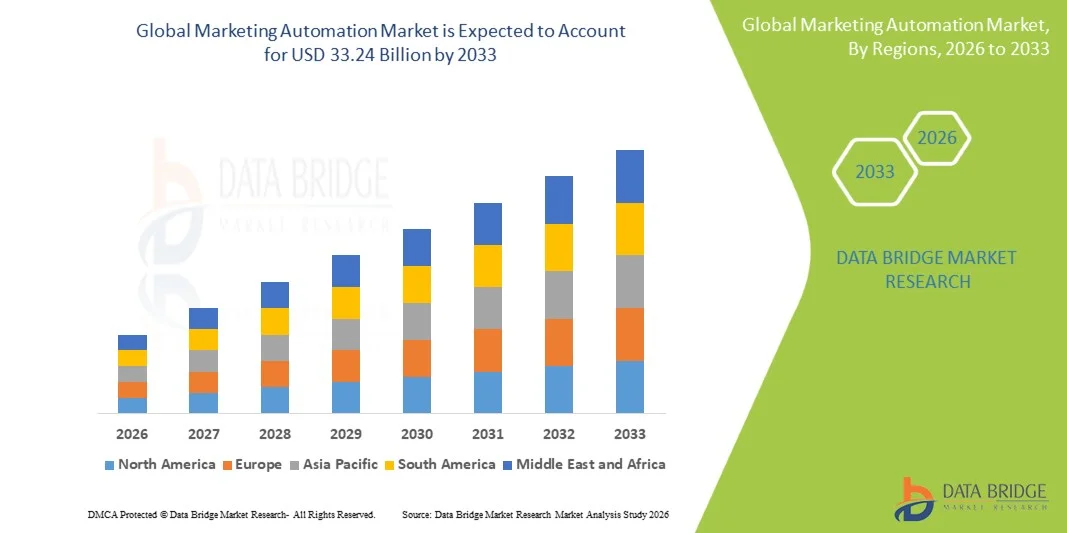
Marketing Automation Market Size
- The global marketing automation market size was valued at USD 10.51 billion in 2025 and is expected to reach USD 33.24 billion by 2033, at a CAGR of 15.47% during the forecast period
- The market growth is largely fueled by the rising adoption of digital marketing solutions and technological advancements in automation, analytics, and AI-driven customer engagement tools, leading to enhanced personalization and efficiency in marketing operations across industries
- Furthermore, increasing demand for data-driven marketing strategies, customer retention solutions, and omnichannel communication platforms is establishing marketing automation as an essential component of modern marketing ecosystems. These converging factors are accelerating the uptake of automation platforms, thereby significantly boosting the market’s growth
Marketing Automation Market Analysis
- Marketing automation solutions, designed to streamline, execute, and monitor marketing tasks across multiple channels, are becoming indispensable for organizations aiming to optimize customer engagement and enhance lead generation. These platforms integrate functions such as email marketing, campaign management, social media analytics, and CRM integration to drive operational efficiency and targeted communication
- The escalating demand for marketing automation is primarily fueled by the need for personalized content delivery, efficient resource management, and real-time analytics. The adoption of AI and machine learning technologies further strengthens the market by enabling predictive insights, customer behavior analysis, and automated decision-making, making marketing automation a cornerstone of modern digital marketing strategies
- North America dominated the marketing automation market with a share of 44.1% in 2025, due to growing adoption of digital marketing strategies and increasing integration of AI-powered automation tools
- Asia-Pacific is expected to be the fastest growing region in the marketing automation market during the forecast period due to rising internet penetration, mobile adoption, and the expansion of e-commerce in countries such as China, Japan, and India
- Hosted segment dominated the market with a market share of 61.7% in 2025, due to the ease of access, scalability, and lower upfront costs associated with cloud-based antiviral solutions. Hosted deployments allow health organizations to quickly roll out updates, share critical antiviral information across multiple locations, and maintain consistent security standards. Its popularity is reinforced by the ability to integrate with existing digital health platforms, enabling centralized monitoring and analytics of antiviral interventions
Report Scope and Marketing Automation Market Segmentation
|
Attributes |
Marketing Automation Key Market Insights |
|
Segments Covered |
|
|
Countries Covered |
North America
Europe
Asia-Pacific
Middle East and Africa
South America
|
|
Key Market Players |
|
|
Market Opportunities |
|
|
Value Added Data Infosets |
In addition to the market insights such as market value, growth rate, market segments, geographical coverage, market players, and market scenario, the market report curated by the Data Bridge Market Research team includes in-depth expert analysis, import/export analysis, pricing analysis, production consumption analysis, and pestle analysis. |
Marketing Automation Market Trends
“AI and Machine Learning Integration”
- The marketing automation market is rapidly evolving with the deep integration of artificial intelligence (AI) and machine learning technologies, which enable more effective segmentation, customer profiling, and predictive analytics. These technologies enhance marketers’ ability to automate and optimize campaigns with higher accuracy and personalized messaging, leading to improved engagement and conversion rates
- For instance, companies such as HubSpot and Salesforce have incorporated advanced AI-driven features into their platforms that allow real-time customer behavior analysis and automated campaign adjustments. These innovations support marketers in delivering dynamic content and personalized interactions at scale, ensuring better return on investment
- Machine learning algorithms are increasingly used to analyze vast amounts of customer data to identify patterns and predict future behaviors, enabling proactive marketing strategies. This integration allows for automated decision-making processes such as customer churn prediction, lead scoring, and personalized content recommendations
- In addition, AI-powered chatbots and virtual assistants integrated within marketing automation systems facilitate interactive and immediate customer communication, providing seamless experiences across digital touchpoints. These tools contribute to higher customer satisfaction and improved lead management
- The growing adoption of AI also supports advanced analytics capabilities, including attribution modeling and sentiment analysis, which help marketers measure campaign effectiveness more accurately and adjust strategies accordingly. This evolution promotes data-driven marketing, making campaigns more agile and responsive to market changes
- Overall, the integration of AI and machine learning is fundamentally transforming marketing automation by enhancing capabilities for deeper customer insights, smarter automation, and personalized experiences. This trend is set to continue shaping the future of digital marketing strategies worldwide
Marketing Automation Market Dynamics
Driver
“Rising Demand for Personalized Marketing”
- The increasing consumer demand for personalized and relevant interactions is a major driver fueling the marketing automation market. Marketers are leveraging automation platforms to deliver customized content, product recommendations, and offers tailored to individual preferences, which significantly improves customer engagement and loyalty
- For instance, Adobe Experience Cloud has enhanced its platform with personalization engines that allow marketers to create hyper-targeted campaigns based on real-time customer data and behavior. Such capabilities are central to meeting consumer expectations for individualized communication and brand experiences
- The growing complexity of customer journeys across multiple channels has made manual campaign management impractical. Marketing automation tools help streamline and coordinate cross-channel marketing, ensuring consistent and personalized messaging throughout the customer lifecycle
- In addition, the surge in digital commerce and social media usage has raised the bar for delivering highly relevant content at scale. Automated personalization enables companies to remain competitive by increasing conversion rates and enhancing customer lifetime value through tailored marketing approaches
- The shift towards data-driven decision-making and CRM integration further supports the adoption of marketing automation. As companies accumulate more granular consumer data, the ability to automate and personalize interactions becomes essential for effective targeting and resource optimization
Restraint/Challenge
“High Implementation and Integration Costs”
- The significant upfront investment and complexity associated with implementing marketing automation systems create a considerable barrier for many organizations, particularly small and mid-sized businesses. Costs include software licensing, integration with existing IT infrastructure, training, and ongoing maintenance, which can strain budgets and resources
- For instance, some enterprises experience lengthy deployment timelines and require dedicated technical teams to manage integrations between marketing automation platforms and other enterprise software such as CRM and ERP systems. These challenges often delay project realization and increase total cost of ownership
- Integration complexities arise when aligning marketing automation with diverse data sources and legacy systems, leading to data silos or incomplete customer profiles. Inadequate integration can reduce automation effectiveness and hinder seamless campaign execution
- In addition, operational hurdles including user adoption, change management, and content creation for automated campaigns add to implementation challenges. Organizations may need to invest in specialized skills to maximize platform capabilities, further increasing costs
- Addressing these financial and technical constraints through scalable solutions, modular automation tools, and vendor support programs will be vital for broadening marketing automation adoption. Reducing total cost of ownership while improving integration ease will help companies realize value more quickly and efficiently
Marketing Automation Market Scope
The market is segmented on the basis of solution type, deployment type, enterprise size, and end-user.
• By Solution Type
On the basis of solution type, the antiviral market is segmented into Campaign Management, Email Marketing, Inbound Marketing, Mobile Applications, Lead Nurturing & Lead Scoring, Reporting & Analytics, Social Media Marketing, and Others. The Campaign Management segment dominated the market with the largest revenue share in 2025, driven by its comprehensive ability to plan, execute, and monitor antiviral awareness initiatives efficiently. Organizations increasingly rely on campaign management solutions to target specific populations, track intervention effectiveness, and coordinate multiple outreach channels. Its dominance is further strengthened by integration with analytics tools that provide real-time insights, allowing health agencies to refine messaging and maximize impact across regions.
The Mobile Applications segment is anticipated to witness the fastest growth rate from 2026 to 2033, fueled by rising smartphone penetration and the growing preference for accessible, on-the-go antiviral guidance. Mobile apps offer features such as symptom tracking, vaccination reminders, and personalized health tips, making them highly convenient for individual users. Healthcare providers and government bodies increasingly leverage mobile apps to reach wider audiences, engage with patients directly, and promote antiviral adherence in real time. The segment’s growth is also driven by advanced app functionalities, including push notifications, AI-based recommendations, and integration with wearable health devices.
• By Deployment Type
On the basis of deployment type, the antiviral market is segmented into On-premise and Hosted. The Hosted segment held the largest revenue share of 61.7% in 2025, owing to the ease of access, scalability, and lower upfront costs associated with cloud-based antiviral solutions. Hosted deployments allow health organizations to quickly roll out updates, share critical antiviral information across multiple locations, and maintain consistent security standards. Its popularity is reinforced by the ability to integrate with existing digital health platforms, enabling centralized monitoring and analytics of antiviral interventions.
The On-premise segment is expected to witness the fastest CAGR from 2026 to 2033, driven by organizations seeking enhanced control over sensitive patient data and compliance with local regulations. On-premise deployments are particularly favored by large hospitals and research institutions, as they provide customizable environments for internal antiviral management systems. The segment benefits from tailored solutions, robust data security, and reduced dependency on internet connectivity, making it suitable for regions with limited network infrastructure.
• By Enterprise Size
On the basis of enterprise size, the antiviral market is segmented into Large Enterprises and Small & Medium Enterprises. The Large Enterprises segment dominated the market with the largest revenue share in 2025, due to their extensive healthcare networks, substantial budgets, and capacity to implement comprehensive antiviral programs. Large enterprises often drive antiviral innovation, invest in analytics-driven solutions, and partner with technology providers to ensure wide-reaching and effective deployment of antiviral initiatives. Their scale allows for integration across multiple departments, improving overall operational efficiency and patient outreach.
The Small & Medium Enterprises segment is anticipated to witness the fastest growth rate from 2026 to 2033, fueled by increasing adoption of cost-effective antiviral solutions and mobile health technologies. SMEs are progressively leveraging digital platforms to enhance antiviral awareness, optimize resource allocation, and engage with smaller communities efficiently. The flexibility of cloud-based solutions and user-friendly interfaces also supports SMEs in implementing antiviral programs without extensive IT infrastructure, driving rapid adoption across the segment.
• By End-User
On the basis of end-user, the antiviral market is segmented into BFSI, Retail, Healthcare, Telecom & IT, Discrete Manufacturing, Government & Education, and Others. The Healthcare segment dominated the market with the largest revenue share in 2025, driven by its critical role in antiviral research, distribution, and patient care. Healthcare providers, hospitals, and clinics prioritize antiviral solutions to improve treatment outcomes, monitor infections, and ensure timely interventions. The segment benefits from continuous investments in technology, data analytics, and patient management systems that optimize antiviral program efficiency.
The Telecom & IT segment is expected to witness the fastest CAGR from 2026 to 2033, fueled by the growing use of digital platforms for antiviral awareness campaigns and telemedicine services. Telecom operators and IT companies provide essential infrastructure for mobile applications, cloud-based platforms, and data analytics tools that support remote patient monitoring and public health initiatives. The segment’s growth is further driven by innovative collaborations with healthcare organizations to disseminate antiviral guidance efficiently across urban and rural populations.
Marketing Automation Market Regional Analysis
- North America dominated the marketing automation market with the largest revenue share of 44.1% in 2025, driven by growing adoption of digital marketing strategies and increasing integration of AI-powered automation tools
- Businesses in the region highly value the efficiency, personalization, and analytics capabilities offered by marketing automation platforms, enabling them to streamline campaigns and improve customer engagement
- This widespread adoption is further supported by high digital literacy, technological infrastructure, and the increasing focus on data-driven marketing, establishing marketing automation as a key solution across various industries
U.S. Marketing Automation Market Insight
The U.S. marketing automation market captured the largest revenue share in 2025 within North America, fueled by the rapid adoption of CRM-integrated automation tools and omnichannel marketing strategies. Companies are increasingly prioritizing personalized customer journeys, automated lead nurturing, and real-time analytics to enhance marketing efficiency. The growing use of AI, predictive analytics, and integration with social media and email platforms further propels market growth. In addition, the demand for scalable, cloud-based solutions among SMEs and enterprises is significantly contributing to the expansion of the marketing automation industry in the U.S.
Europe Marketing Automation Market Insight
The Europe marketing automation market is projected to expand at a substantial CAGR during the forecast period, primarily driven by the adoption of advanced digital marketing practices and the increasing need for customer engagement solutions. Stringent data privacy regulations, such as GDPR, are encouraging companies to invest in compliant, automated marketing platforms. The rise in e-commerce, coupled with a preference for omnichannel strategies, is fostering adoption. European businesses across retail, BFSI, and healthcare are increasingly integrating marketing automation to improve operational efficiency and enhance customer experience.
U.K. Marketing Automation Market Insight
The U.K. marketing automation market is anticipated to grow at a noteworthy CAGR, fueled by the rising trend of personalized marketing campaigns and the demand for streamlined customer interactions. Businesses are leveraging automation to improve lead management, enhance campaign effectiveness, and integrate multiple digital channels. In addition, the strong presence of e-commerce and retail sectors, alongside growing awareness of marketing analytics, is expected to continue stimulating market growth.
Germany Marketing Automation Market Insight
The Germany marketing automation market is expected to expand at a considerable CAGR during the forecast period, driven by the increasing adoption of AI-powered marketing tools and cloud-based platforms. Companies are focusing on advanced analytics, campaign personalization, and multi-channel integration to gain competitive advantage. Germany’s emphasis on digital transformation, robust technological infrastructure, and innovation-friendly ecosystem promotes the widespread adoption of marketing automation solutions across enterprises.
Asia-Pacific Marketing Automation Market Insight
The Asia-Pacific marketing automation market is poised to grow at the fastest CAGR during the forecast period of 2026 to 2033, driven by rising internet penetration, mobile adoption, and the expansion of e-commerce in countries such as China, Japan, and India. The region’s growing focus on digital marketing, supported by government initiatives promoting technology adoption, is accelerating the deployment of marketing automation solutions. In addition, the emergence of affordable cloud-based platforms and local technology providers is increasing accessibility for businesses of all sizes.
Japan Marketing Automation Market Insight
The Japan marketing automation market is gaining momentum due to the country’s tech-savvy population, high smartphone penetration, and growing e-commerce sector. Companies are adopting automation tools to deliver personalized campaigns, optimize lead scoring, and streamline marketing workflows. Integration with CRM systems, social media platforms, and email marketing is fueling growth. Moreover, Japan’s emphasis on efficiency and precision in business operations is driving the adoption of advanced marketing automation platforms across multiple industries.
China Marketing Automation Market Insight
The China marketing automation market accounted for the largest revenue share in Asia-Pacific in 2025, driven by rapid urbanization, digital transformation initiatives, and the expanding e-commerce ecosystem. Businesses are increasingly using automation for customer segmentation, lead nurturing, and omnichannel engagement. The availability of cost-effective cloud-based solutions, coupled with domestic software providers, supports widespread adoption. Strong government support for digitalization and the competitive business environment are key factors propelling the growth of marketing automation in China.
Marketing Automation Market Share
The marketing automation industry is primarily led by well-established companies, including:
- Act-On Software, Inc. (U.S.)
- Brevo (France)
- ActiveCampaign, LLC (U.S.)
- Adobe Systems Inc. (U.S.)
- Cognizant Technology Solutions Corporation (U.S.)
- HubSpot, Inc. (U.S.)
- IBM Corporation (U.S.)
- Microsoft Corporation (U.S.)
- Keap (U.S.)
- Oracle Corporation (U.S.)
- Salesforce, Inc. (U.S.)
- SAP SE (Germany)
- Thryv Holdings, Inc. (U.S.)
- Zoho Corporation Pvt. Ltd. (India)
- SAS Institute Inc. (U.S.)
Latest Developments in Global Marketing Automation Market
- In October 2024, Bloomreach launched Rich Communication Services (RCS), transforming SMS marketing by enabling interactive, two-way communication within native messaging applications. This development significantly enhanced the engagement capabilities of marketing automation platforms, allowing brands to deliver personalized messaging at scale and drive higher response rates across mobile channels. The integration of RCS also strengthened marketers’ ability to track and analyze customer interactions in real time, improving campaign effectiveness and ROI
- In September 2024, HubSpot was recognized as a leader for the fourth consecutive year in the Gartner Magic Quadrant for B2B Marketing Automation Platforms, underscoring the growing maturity and adoption of AI-powered, multichannel automation solutions. This recognition reinforced market confidence in platforms that integrate CRM, predictive analytics, and omnichannel campaign orchestration, driving enterprise investment in advanced marketing automation tools to enhance customer engagement and revenue growth
- In September 2024, SuperOffice launched a marketing automation tool fully integrated with its CRM system, streamlining lifecycle marketing by connecting marketing, sales, and service touchpoints. This integration improved operational efficiency, enabled personalized campaign delivery, and enhanced lead management processes, allowing businesses to maximize the effectiveness of their marketing strategies while reducing manual workflow dependencies
- In August 2024, Salesforce expanded its Marketing Cloud with AI-powered predictive analytics and real-time personalization capabilities. This enhancement enabled enterprises to automate complex customer journeys, optimize lead conversion rates, and deliver hyper-personalized experiences at scale. The introduction of AI-driven insights also allowed marketers to make data-backed decisions, improving campaign performance and supporting strategic marketing objectives
- In August 2024, Shiprocket introduced Engage 360, a data-driven marketing automation platform aimed at empowering over 150,000 MSME merchants in India. The platform provides advanced marketing intelligence to improve customer loyalty, optimize marketing expenditures, and support scalable business growth. Its adoption is expected to accelerate digital marketing transformation among small and medium enterprises, enhancing their ability to compete in increasingly competitive markets

- Interactive Data Analysis Dashboard
- Company Analysis Dashboard for high growth potential opportunities
- Research Analyst Access for customization & queries
- Competitor Analysis with Interactive dashboard
- Latest News, Updates & Trend analysis
- Harness the Power of Benchmark Analysis for Comprehensive Competitor Tracking
Data collection and base year analysis are done using data collection modules with large sample sizes. The stage includes obtaining market information or related data through various sources and strategies. It includes examining and planning all the data acquired from the past in advance. It likewise envelops the examination of information inconsistencies seen across different information sources. The market data is analysed and estimated using market statistical and coherent models. Also, market share analysis and key trend analysis are the major success factors in the market report. To know more, please request an analyst call or drop down your inquiry.
The key research methodology used by DBMR research team is data triangulation which involves data mining, analysis of the impact of data variables on the market and primary (industry expert) validation. Data models include Vendor Positioning Grid, Market Time Line Analysis, Market Overview and Guide, Company Positioning Grid, Patent Analysis, Pricing Analysis, Company Market Share Analysis, Standards of Measurement, Global versus Regional and Vendor Share Analysis. To know more about the research methodology, drop in an inquiry to speak to our industry experts.
Data Bridge Market Research is a leader in advanced formative research. We take pride in servicing our existing and new customers with data and analysis that match and suits their goal. The report can be customized to include price trend analysis of target brands understanding the market for additional countries (ask for the list of countries), clinical trial results data, literature review, refurbished market and product base analysis. Market analysis of target competitors can be analyzed from technology-based analysis to market portfolio strategies. We can add as many competitors that you require data about in the format and data style you are looking for. Our team of analysts can also provide you data in crude raw excel files pivot tables (Fact book) or can assist you in creating presentations from the data sets available in the report.













