What is the Massage Equipment Size and Growth Rate?
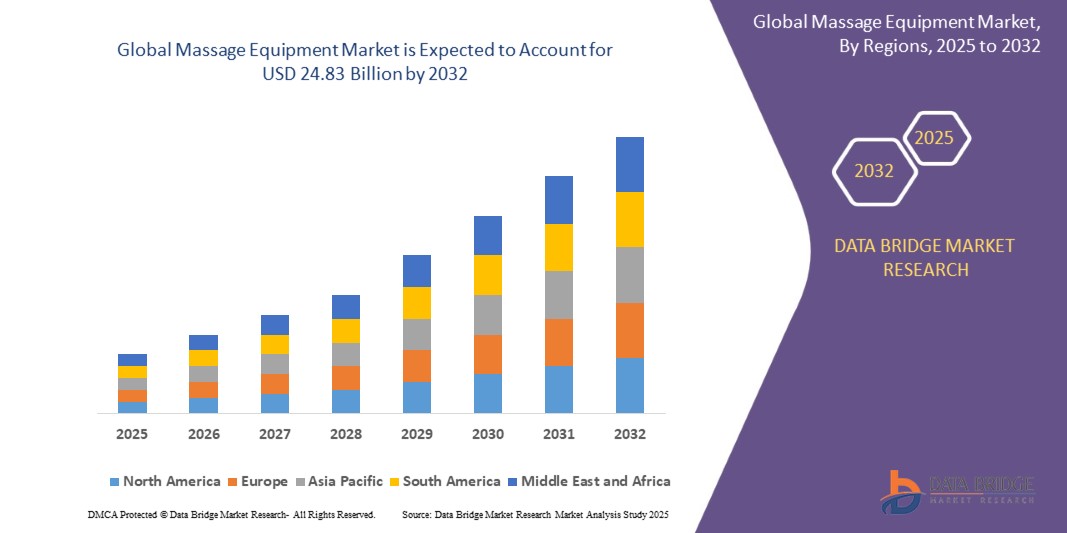
- As per Data Bridge Market Research Analysis the global massage equipment market size was valued at USD 11.17 billion in 2024 and is expected to reach USD 24.83 billion by 2032, at a CAGR of 10.50% during the forecast period
- The market growth is largely fuelled by the increasing awareness of physical wellness, rising prevalence of lifestyle-related stress and fatigue, and growing demand for at-home therapy solutions that promote relaxation and recovery
- In addition, advancements in massage technology, expanding geriatric population, and the surge in consumer spending on personal care and wellness products are further supporting the expansion of the global massage equipment market
Market Size & Forecast
- Global Market Value (2024): USD 11.17 billion
- Expected Market Value (2032): USD 24.83 billion
- Forecast CAGR (2024–2032): 10.50%
What are the Major Takeaways of Massage Equipment?
- The massage equipment market is experiencing robust growth as consumers increasingly adopt self-care routines and prioritize holistic health solutions for managing physical discomfort, stress, and chronic pain
- The demand for portable and smart massage devices is rising, particularly in urban regions, where individuals seek convenience, time-saving, and compact wellness solutions for home and office use
- North America dominated the massage equipment market with the largest revenue share of 40.3% in 2024, driven by rising consumer focus on wellness, increasing prevalence of muscle-related ailments, and growing demand for home-based therapy solutions
- Asia-Pacific region is expected to witness the highest growth rate in the global massage equipment market, driven by booming middle class, increasing focus on health and wellness, strong local manufacturing capacity, and expanding availability of technologically advanced yet cost-effective massage products across countries such as China, Japan, South Korea, and India
- The back massagers segment dominated the market with the largest revenue share in 2024, driven by the widespread prevalence of lower back pain among working individuals and the elderly. These devices are often designed for deep tissue massage and spinal relief, making them highly desirable for home use and clinical environments. The increasing demand for stress relief and ergonomic comfort in sedentary lifestyles continues to support strong adoption of back massagers
Report Scope and Massage Equipment Market Segmentation
|
Attributes |
Massage Equipment Key Market Insights |
|
Segments Covered |
|
|
Countries Covered |
North America
Europe
Asia-Pacific
Middle East and Africa
South America
|
|
Key Market Players |
|
|
Market Opportunities |
|
|
Value Added Data Infosets |
|
What is the Key Trend in the Massage Equipment?
“Growing Integration of Smart Features in Massage Equipment”
- The increasing demand for personalized wellness experiences is encouraging manufacturers to integrate smart technologies such as Bluetooth, app control, and real-time feedback into massage equipment, making devices more interactive and user-centric, particularly for health-conscious and tech-savvy consumers
- Smart massage chairs and handheld devices now include features such as AI-based pressure detection, memory settings, and posture tracking, allowing users to experience customized relief based on body type, stress levels, or recovery needs, which elevates their perceived value
- Integration with smart home ecosystems, such as voice assistants or smartphone apps, enables users to sync massage sessions with their routines, improving convenience and making massage equipment a seamless part of daily wellness habits across homes and offices
- For instance, Therabody’s Theragun Elite connects to a mobile app to suggest massage routines and monitor muscle recovery, illustrating how smart connectivity enhances both functionality and customer engagement in modern massage devices
- The trend toward connected and intelligent massage equipment is reshaping the market, appealing to both premium and mainstream segments, and is expected to become a key factor in consumer purchasing decisions moving forward
Massage Equipment Market Dynamics
Driver
“Rising Demand for At-Home Wellness and Recovery Solutions”
- Growing awareness of the importance of stress relief, physical recovery, and holistic health is pushing consumers to invest in at-home wellness tools, with massage equipment providing a practical alternative to time-consuming and costly spa visits
- The convenience of using massage chairs, cushions, or handheld tools at home empowers users to treat chronic pain, muscle fatigue, and anxiety on their own schedule, making it ideal for working professionals, athletes, and the elderly
- The rise in fitness culture and post-workout recovery routines has also contributed to increased sales of portable massage devices, such as percussion massagers, that deliver fast relief and support active lifestyles in both men and women
- For instance, Hyperice’s massage guns have gained popularity among athletes and fitness enthusiasts who seek fast, deep tissue relief at home or on-the-go, highlighting the growing appeal of portable, high-performance massage tools
- As wellness becomes a daily priority and consumers seek self-managed health solutions, the demand for reliable, easy-to-use massage equipment will continue to grow across diverse demographics and global regions
Restraint/Challenge
“High Cost of Advanced Massage Equipment and Limited Product Affordability”
- The premium pricing of high-end massage chairs and advanced devices equipped with smart features makes them inaccessible for middle-income consumers, creating a significant affordability gap in both developed and emerging economies
- Budget alternatives often compromise on quality, functionality, and longevity, which can lead to poor user experience and damage brand reputation, ultimately affecting overall consumer confidence in the massage equipment market
- Limited financing options and lack of installment-based payment models restrict access further, especially in markets where upfront purchases of wellness devices are not seen as essential or are considered luxury expenses
- For instance, luxury massage chairs from brands such as Inada or Human Touch can cost upwards of USD 5,000, which remains a deterrent for average households despite their advanced therapeutic capabilities and durability
- Unless pricing models are made more flexible and innovation is balanced with cost-efficiency, the market’s full potential will remain untapped among budget-sensitive users, restricting broader global adoption
How is the Massage Equipment Segmented?
The market is segmented on the basis of application, price range, and distribution channel.
• By Application
On the basis of application, the massage equipment market is segmented into back massagers, neck and shoulder massagers, leg massagers, hand massagers, and others. The back massagers segment dominated the market with the largest revenue share in 2024, driven by the widespread prevalence of lower back pain among working individuals and the elderly. These devices are often designed for deep tissue massage and spinal relief, making them highly desirable for home use and clinical environments. The increasing demand for stress relief and ergonomic comfort in sedentary lifestyles continues to support strong adoption of back massagers.
The leg massagers segment is expected to witness the fastest growth rate from 2025 to 2032, propelled by rising cases of muscle fatigue and circulation issues, especially among aging populations and individuals with diabetic neuropathy. These massagers offer compression and heat therapy benefits, which enhance blood flow and reduce leg swelling, making them popular in both residential and physiotherapy settings.
• By Price Range
On the basis of price range, the market is segmented into premium, mid-range, and economic. The mid-range segment held the largest market revenue share in 2024, supported by a balanced combination of affordability, quality, and features that appeal to a wide consumer base. Products in this category typically include reliable massagers with basic smart features and are preferred by households seeking value for money.
The premium segment is expected to witness the fastest growth rate from 2025 to 2032, driven by rising disposable income and demand for advanced, AI-enabled massage chairs and devices. Premium offerings often include full-body coverage, app connectivity, and personalized programs, catering to health-conscious and luxury-oriented consumers.
• By Distribution Channel
On the basis of distribution channel, the massage equipment market is segmented into direct sales, wholesalers and retailers, hypermarkets/supermarkets, online retailers, specialty stores, multi-brand stores, and others. Online retailers held the largest market share in 2024 due to the convenience of product comparison, access to a wide variety of brands, and increasing preference for contactless shopping. E-commerce platforms also enable consumers to read reviews and select products suited to their specific wellness needs.
Specialty stores is expected to witness the fastest growth rate from 2025 to 2032, driven by personalized consultations, hands-on product trials, and premium product availability. These stores cater to consumers seeking high-quality massage equipment with professional guidance, making them a growing choice in urban centers and wellness-focused markets.
Which Region Holds the Largest Share of the How is Massage Equipment Segmented?
- North America dominated the massage equipment market with the largest revenue share of 40.3% in 2024, driven by rising consumer focus on wellness, increasing prevalence of muscle-related ailments, and growing demand for home-based therapy solutions
- The region’s advanced healthcare infrastructure, high disposable incomes, and increasing awareness of self-care routines have supported the rapid adoption of massage chairs, handheld devices, and targeted therapeutic tools
- Expansion of online retail and presence of leading wellness brands across the U.S. and Canada further enhance accessibility and market penetration for massage equipment across both residential and commercial segments
U.S. Massage Equipment Market Insight
The U.S. massage equipment market captured the largest revenue share within North America in 2024, fueled by a tech-savvy consumer base, rising workplace stress, and increasing interest in at-home wellness solutions. The market benefits from the popularity of multifunctional massage tools that combine portability with smart features such as app connectivity and automated programs. Brands such as Therabody and Hyperice continue to influence consumer choices by offering innovative products tailored to fitness, recovery, and stress relief. Growth in digital health awareness and the preference for personal care gadgets are further accelerating the U.S. market.
Europe Massage Equipment Market Insight
The Europe massage equipment market is expected to witness the fastest growth rate from 2025 to 2032, supported by increasing awareness of preventive healthcare and the growing adoption of wellness devices in homes and workplaces. Rising stress levels, aging demographics, and the shift toward remote working are influencing consumers to invest in ergonomic and therapeutic massage tools. The demand for compact and eco-friendly massage solutions is also rising, especially in urban regions. Countries such as Germany, France, and the U.K. are leading the adoption of massage equipment through strong retail networks and health-focused consumer behavior.
U.K. Massage Equipment Market Insight
The U.K. massage equipment market is expected to witness the fastest growth rate from 2025 to 2032, driven by a growing interest in holistic wellness and rising demand for self-managed physical therapy. The increasing focus on mental well-being and physical recovery post-pandemic is pushing consumers toward massage chairs, neck massagers, and other home-use devices. Robust e-commerce infrastructure and a wide presence of health tech products in retail spaces are supporting this shift. Moreover, an increasing number of consumers are seeking personalized and premium-grade massage equipment to support their daily wellness routines.
Germany Massage Equipment Market Insight
The Germany massage equipment market is expected to witness the fastest growth rate from 2025 to 2032, backed by a strong healthcare-conscious population and high demand for therapeutic and rehabilitation-focused massage devices. Germany's emphasis on innovation, precision engineering, and sustainability makes it a key market for advanced massage equipment with smart functionality. With the rise in workplace-related physical discomfort and the popularity of at-home recovery solutions, Germany is seeing increased adoption of massage tools in both household and professional settings.
Asia-Pacific Massage Equipment Market Insight
The Asia-Pacific massage equipment market is expected to witness the fastest growth rate from 2025 to 2032, driven by rising disposable incomes, urbanization, and the growing culture of health and wellness in countries such as China, Japan, South Korea, and India. Consumers are increasingly adopting compact, affordable, and technologically advanced massage devices for stress management and physical recovery. Government-led initiatives to promote preventive healthcare and the rapid expansion of the middle class are also contributing to market growth in the region. Local production and the presence of cost-effective brands make the market highly competitive and accessible.
Japan Massage Equipment Market Insight
The Japan massage equipment market is expected to witness the fastest growth rate from 2025 to 2032, due to its aging population, wellness-oriented culture, and high acceptance of smart health technologies. Japanese consumers favor quiet, space-saving, and highly automated massage devices that align with their minimalist lifestyles. The market is being further driven by innovations in wearable massage tools and heated therapy devices designed for elderly care. A growing number of working professionals and senior citizens are opting for daily-use massagers that provide comfort, circulation improvement, and muscle relaxation at home or in healthcare centers.
China Massage Equipment Market Insight
The China massage equipment market held the largest revenue share in Asia-Pacific in 2024, driven by a booming middle class, increased health consciousness, and the widespread availability of affordable massage products. China is a major manufacturing hub for massage chairs, handheld massagers, and electronic therapy tools, which has lowered product costs and enhanced consumer access. The country’s rapidly growing wellness and personal care sectors, combined with urban stress levels and rising e-commerce penetration, are fuelling continuous market expansion across both residential and commercial channels.
Which are the Top Companies in Massage Equipment?
The Massage Equipment industry is primarily led by well-established companies, including:
- OSIM International Pte. Ltd. (Singapore)
- JSB Healthcare. (India)
- Panasonic Corporation (Japan)
- Valmont Industries, Inc. (U.S.)
- Beurer GmbH (Germany)
- Danish Healthcare Care (U.S.)
- HoMedics (U.S.)
- OMRON Corporation (Japan)
- Casada International (Germany)
- Xiaomi Global Community (China)
- Kelvin Electric Trading Co Ltd (China)
- BODYFRIEND (South Korea)
- FUJIIRYOKI (Japan)
- Family Inada Co., Ltd. (Japan)
- DAITO KASEI KOGYO CO., LTD. (Japan)
- Human Touch (U.S.)
What are Latest Developments in Massage Equipment?
- In January 2023, Ogawa Corporation completed the acquisition of Swedish massage chair manufacturer Ligne Roset. This strategic development aims to broaden Ogawa’s product portfolio by integrating Ligne Roset’s premium design expertise and established customer base. The acquisition enhances Ogawa's global reach and strengthens its competitive positioning in the high-end massage equipment market, potentially driving innovation and accelerating growth across key regions
- In February 2023, HoMedics announced the acquisition of assets from Therabody, a leading personal massage device manufacturer. This move expands HoMedics' product range with cutting-edge massage technologies known for performance and user-centric design. The acquisition not only increases HoMedics’ competitiveness but also reinforces its role as a leading provider of wellness solutions tailored to evolving consumer needs
- In March 2023, Panasonic acquired the assets of Japanese massage chair pioneer Inada. By absorbing Inada’s advanced engineering and innovation capabilities, Panasonic is set to enhance its premium massage chair lineup. The move strengthens its market leadership in the wellness technology space and positions the brand to meet growing global demand for smart, therapeutic massage solutions

- Interactive Data Analysis Dashboard
- Company Analysis Dashboard for high growth potential opportunities
- Research Analyst Access for customization & queries
- Competitor Analysis with Interactive dashboard
- Latest News, Updates & Trend analysis
- Harness the Power of Benchmark Analysis for Comprehensive Competitor Tracking
Data collection and base year analysis are done using data collection modules with large sample sizes. The stage includes obtaining market information or related data through various sources and strategies. It includes examining and planning all the data acquired from the past in advance. It likewise envelops the examination of information inconsistencies seen across different information sources. The market data is analysed and estimated using market statistical and coherent models. Also, market share analysis and key trend analysis are the major success factors in the market report. To know more, please request an analyst call or drop down your inquiry.
The key research methodology used by DBMR research team is data triangulation which involves data mining, analysis of the impact of data variables on the market and primary (industry expert) validation. Data models include Vendor Positioning Grid, Market Time Line Analysis, Market Overview and Guide, Company Positioning Grid, Patent Analysis, Pricing Analysis, Company Market Share Analysis, Standards of Measurement, Global versus Regional and Vendor Share Analysis. To know more about the research methodology, drop in an inquiry to speak to our industry experts.
Data Bridge Market Research is a leader in advanced formative research. We take pride in servicing our existing and new customers with data and analysis that match and suits their goal. The report can be customized to include price trend analysis of target brands understanding the market for additional countries (ask for the list of countries), clinical trial results data, literature review, refurbished market and product base analysis. Market analysis of target competitors can be analyzed from technology-based analysis to market portfolio strategies. We can add as many competitors that you require data about in the format and data style you are looking for. Our team of analysts can also provide you data in crude raw excel files pivot tables (Fact book) or can assist you in creating presentations from the data sets available in the report.