


Mastitis Market Size
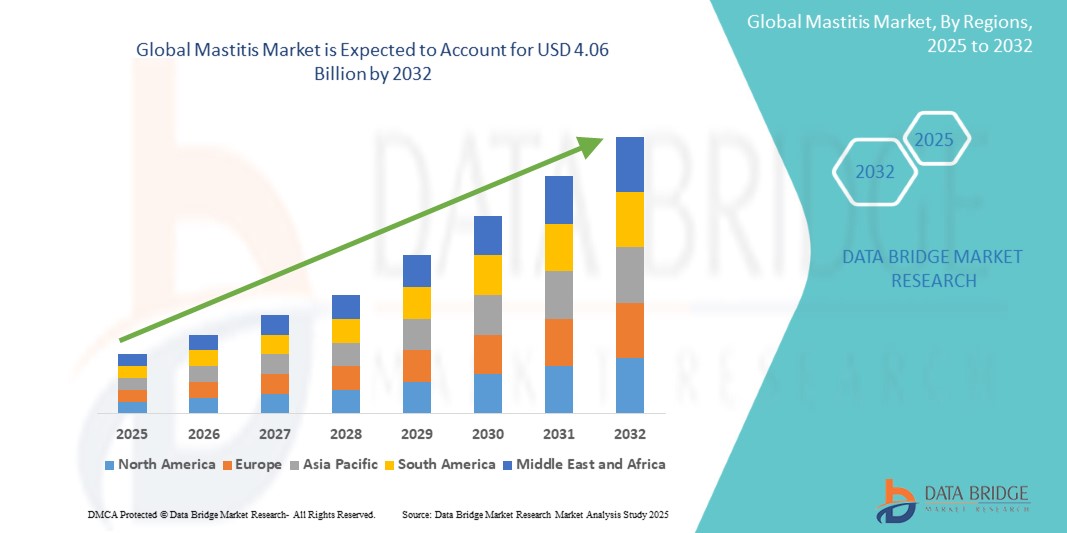
- The Global Mastitis Market size was valued at USD 2.15 Billion in 2024 and is expected to reach USD 4.06 Billion by 2032, at a CAGR of 8.26% during the forecast period
- Market growth is driven by the increasing incidence of mastitis among both dairy animals and humans, especially breastfeeding women, along with greater awareness and improved diagnostic and treatment options
- Additionally, the growing demand for high-quality dairy production, rising emphasis on animal health, and expanding research investments in antimicrobial and non-antibiotic therapies are boosting adoption of mastitis treatment solutions. These converging factors are contributing to the sustained expansion of the mastitis market across both veterinary and human healthcare segments
Mastitis Market Analysis
- Mastitis, an inflammatory condition of the mammary glands primarily caused by infection or injury, remains a significant health concern in both human and veterinary medicine. In dairy animals, it leads to reduced milk yield and quality, while in breastfeeding women, it causes pain, swelling, and potential lactation issues, necessitating timely diagnosis and treatment.
- The growing demand for effective mastitis treatment is primarily driven by increasing awareness among dairy farmers and healthcare providers, higher incidence rates globally, and the rising focus on animal welfare, breastfeeding health, and milk hygiene standards. Innovations in diagnostic methods (such as milk sample examination and point-of-care diagnostics) and the availability of a broader range of antibiotic and NSAID-based therapies are also propelling market expansion.
- North America leads the mastitis market, accounting for the largest revenue share of 38.7% in 2025, driven by advanced veterinary care infrastructure, strong awareness campaigns, and robust healthcare systems for women’s health. The U.S. sees high volumes of mastitis-related hospital visits and dairy farm treatments, supported by structured intervention programs.
- Asia-Pacific is projected to be the fastest-growing region during the forecast period, with a CAGR of 6.4%, fueled by expanding dairy industries in countries like India and China, growing maternal healthcare initiatives, and increased investments in rural veterinary services.
- Within treatment categories, the medication segment dominates the global mastitis market with a market share of 64.2% in 2025, led by antibiotics due to their crucial role in resolving bacterial infections efficiently and reducing inflammation.
Report Scope and Mastitis Market Segmentation
|
Attributes |
Mastitis Key Market Insights |
|
Segments Covered |
|
|
Countries Covered |
North America
Europe
Asia-Pacific
Middle East and Africa
South America
|
|
Key Market Players |
|
|
Market Opportunities |
|
|
Value Added Data Infosets |
In addition to the insights on market scenarios such as market value, growth rate, segmentation, geographical coverage, and major players, the market reports curated by the Data Bridge Market Research also include in-depth expert analysis, pricing analysis, brand share analysis, consumer survey, demography analysis, supply chain analysis, value chain analysis, raw material/consumables overview, vendor selection criteria, PESTLE Analysis, Porter Analysis, and regulatory framework. |
Mastitis Market Trends
“Shift Toward Antibiotic Alternatives and Precision Diagnostics”
- A major and accelerating trend in the global mastitis market is the shift toward non-antibiotic therapies and advanced precision diagnostics, particularly driven by growing concerns about antimicrobial resistance and stricter regulations in both human healthcare and the dairy industry.
- For instance, several veterinary and biotech companies are investing in probiotic-based mastitis prevention and herbal formulations, aiming to reduce reliance on traditional antibiotics while maintaining efficacy. In the human segment, interest is rising in anti-inflammatory therapy and immunomodulators to manage non-infectious and recurring mastitis cases.
- Diagnostic innovation is also reshaping the market, with rapid on-site testing, automated milk culture analyzers, and molecular diagnostic kits being adopted, especially in high-volume dairy operations. These tools allow for early pathogen detection, enabling targeted therapy and reducing the risk of unnecessary antibiotic use.
- For example, portable mastitis detection tools like California Mastitis Test (CMT) kits and PCR-based mastitis identification systems are seeing increased demand across North America and Europe.
- This trend is being fueled by industry efforts to maintain milk quality standards, improve animal productivity, and minimize milk withdrawal periods due to drug residues. In human healthcare, emphasis on breastfeeding education, lactation support, and early-stage diagnosis of mastitis is driving the integration of telemedicine and point-of-care solutions.
- Consequently, companies such as HIPRA and ImmuCell are developing next-generation mastitis vaccines and immune-boosting formulations, while startups are exploring wearable mastitis detection devices to alert nursing mothers about inflammation onset.
- The growing push for sustainable, cost-effective, and resistance-free therapies is likely to reshape the treatment landscape for mastitis in both veterinary and human applications.
Mastitis Market Dynamics
Driver
“Rising Mastitis Incidence and Demand for Early Intervention Solutions”
- The increasing global incidence of mastitis in dairy animals and breastfeeding women is a key driver fueling the demand for more effective treatment and diagnostic solutions.
- In livestock, mastitis remains a leading cause of reduced milk yield and economic losses, prompting dairy producers to adopt preventive strategies and invest in early detection and herd health programs.
- For instance, the National Dairy Development Board (NDDB) in India and similar agencies globally are promoting mastitis control programs that emphasize timely diagnostics, hygiene practices, and proper udder care.
- In human healthcare, breastfeeding-related mastitis affects up to 33% of lactating women, according to recent studies, contributing to increased healthcare visits, treatment prescriptions, and awareness campaigns.
- The availability of antibiotic therapies, NSAIDs, and supportive physical therapies provides a robust treatment arsenal, while the growing accessibility of diagnostic services in hospitals, specialty clinics, and home healthcare settings enhances patient outcomes.
- The expansion of distribution channels, including online pharmacies and direct hospital tenders, also facilitates timely access to mastitis treatments, especially in rural and underserved areas.
Restraint/Challenge
“Antibiotic Resistance and Low Awareness in Developing Regions”
- A major challenge facing the mastitis market is the growing concern over antibiotic resistance, especially in the dairy sector, where overuse of intramammary antibiotics can lead to drug-resistant bacterial strains and milk residue issues.
- Regulatory bodies such as the European Medicines Agency (EMA) and the U.S. FDA are increasingly advocating for responsible antibiotic use, pushing stakeholders toward alternative therapies, which are still under development or not widely adopted.
- In parallel, limited awareness, lack of infrastructure, and low access to diagnostic tools in developing regions hinder early detection and proper mastitis management.
- Many smallholder farmers in Asia and Africa still rely on symptomatic treatment without lab confirmation, leading to underreporting and recurrence of infections. Similarly, many lactating women delay seeking medical care due to social stigma or unawareness of early mastitis symptoms, particularly in rural healthcare settings.
- Addressing these barriers requires targeted education initiatives, public health campaigns, and training programs for farmers and healthcare providers. Companies and governments need to focus on cost-effective solutions, mobile vet/lactation clinics, and localized diagnostics to overcome these gaps.
- Additionally, the cost of next-gen diagnostics and non-antibiotic therapeutics remains a concern in cost-sensitive markets, highlighting the need for scalable, affordable innovations.
Mastitis Market Scope
The market is segmented on the basis of type, diagnosis, treatment, medication, end-users, and distribution channel.
• By Type
On the basis of type, the mastitis market is segmented into infectious mastitis, non-infectious mastitis, and others. The infectious mastitis segment dominates the largest market revenue share of 68.4% in 2025, driven by the high incidence of bacterial infections in both lactating women and dairy animals. Prompt treatment is crucial in these cases to prevent complications such as abscess formation or reduced milk productivity. The widespread clinical presence and reliance on antibiotic therapy make this the most established and revenue-generating segment across both human and veterinary healthcare systems.
The non-infectious mastitis segment is anticipated to witness the fastest growth rate of 6.8% CAGR from 2025 to 2032, fueled by increasing awareness of non-bacterial inflammation causes—such as milk stasis, physical trauma, or autoimmune responses. Non-infectious cases are particularly common in breastfeeding women and are often managed through physical therapy, supportive care, and improved breastfeeding techniques. The growing preference for non-pharmacological treatment approaches is further driving growth in this segment.
• By Diagnosis
On the basis of diagnosis, the mastitis market is segmented into physical examination, milk sample examination, and others. Milk sample examination held the largest market revenue share in 2025, owing to its routine use in dairy farms for pathogen identification and somatic cell count testing. Techniques such as California Mastitis Test (CMT), microbial culture, and PCR-based diagnostics support accurate treatment decisions and help mitigate production losses.
The physical examination segment is expected to witness the fastest CAGR from 2025 to 2032, as it remains the first-line assessment method for both human and bovine cases. Physical assessment, including palpation and visual inspection of symptoms such as swelling or redness, is especially crucial in resource-limited settings where lab-based diagnostics may not be readily available.
• By Treatment
On the basis of treatment, the mastitis market is segmented into medication, physical therapy, and others. The medication segment dominates the market with the largest revenue share in 2025, led by the extensive use of antibiotics and NSAIDs for effective infection control and inflammation management. Both systemic and intramammary therapies are used across veterinary and human settings, contributing to consistent demand.
Physical therapy is projected to witness the fastest CAGR from 2025 to 2032, driven by its growing adoption in managing non-infectious mastitis and supporting breastfeeding in postpartum women. Techniques such as breast massage, hot/cold compresses, and ultrasound therapy are gaining traction due to their non-invasive nature and minimal side effects.
• By Medication
On the basis of medication, the mastitis market is segmented into antibiotics, NSAIDs, and others. The antibiotics segment held the highest market share in 2025, attributed to their critical role in eliminating infectious agents in both dairy cattle and humans. Widespread veterinary protocols and prescription-based human treatments continue to rely heavily on antibiotic regimens for clinical mastitis.
The NSAIDs segment is anticipated to grow at the fastest rate during the forecast period, as these drugs are widely used for symptom relief, especially to reduce inflammation and pain. NSAIDs are often prescribed alongside antibiotics and are also used independently in mild or non-infectious cases.
• By End-Users
On the basis of end-users, the market is segmented into hospitals, specialty clinics, home healthcare, and others. The hospital segment accounted for the largest market revenue share in 2025, owing to the high patient flow for both human mastitis treatments and veterinary consultations. Hospitals offer comprehensive diagnostic, medication, and monitoring services, making them a primary point of care.
The home healthcare segment is expected to witness the fastest growth from 2025 to 2032, driven by the increasing preference for at-home treatment for lactating women and mobile veterinary services in rural areas. The rise of telehealth and DIY mastitis care kits is further accelerating this trend.
• By Distribution Channel
On the basis of distribution channel, the market is segmented into direct tender, hospital pharmacy, retail pharmacy, online pharmacy, and others. The hospital pharmacy segment holds the largest market share in 2025, as it serves as a centralized source for prescribed treatments, particularly antibiotics and NSAIDs, administered immediately after diagnosis.
The online pharmacy segment is anticipated to witness the fastest CAGR during the forecast period, driven by the convenience of digital ordering, doorstep delivery, and increasing consumer trust in e-commerce platforms—especially in urban and semi-urban regions for human mastitis care.
Mastitis Market Regional Analysis
- North America dominates the global mastitis market with the largest revenue share of 38.7% in 2024, driven by a high incidence of mastitis in both dairy herds and breastfeeding women, along with well-established healthcare and veterinary infrastructure.
- Consumers and healthcare providers in the region place significant emphasis on early diagnosis, effective treatment, and infection control, particularly in the U.S., where advanced technologies such as PCR-based diagnostics and automated milk culture systems are widely adopted in veterinary practices.
- The market is further supported by high awareness, government-supported animal health programs, and a robust presence of leading pharmaceutical and biotech companies focused on developing mastitis-specific therapies and vaccines.
- Additionally, North America’s rising demand for premium milk quality, coupled with increased public health campaigns on breastfeeding education and postpartum care, reinforces the region’s leadership in both human and animal mastitis segments.
U.S. Mastitis Market Insight
The U.S. mastitis market captured the largest revenue share of 82% within North America in 2025, driven by the high prevalence of mastitis in both dairy cattle and breastfeeding women. The country benefits from advanced veterinary healthcare infrastructure, widespread availability of diagnostic tools, and strong lactation support services in hospitals and clinics. Additionally, increasing focus on milk quality standards, government-supported animal health programs, and consumer awareness around early intervention are driving both human and bovine mastitis treatment adoption. The presence of leading pharmaceutical firms and biotech companies is further contributing to market expansion through innovation in antibiotics, vaccines, and supportive therapies.
Europe Mastitis Market Insight
The European mastitis market is projected to expand at a substantial CAGR throughout the forecast period, fueled by stringent regulations on antibiotic usage in livestock, high standards in milk hygiene, and a proactive approach to breastfeeding health. Countries across the region are implementing preventive mastitis control programs, driving demand for rapid diagnostics, herd health monitoring tools, and non-antibiotic therapies. The region is also seeing strong growth in home-based mastitis care solutions and a surge in educational campaigns to raise awareness among farmers and mothers. This is particularly relevant in Northern and Western Europe, where dairy farming and maternal health infrastructure are well-established.
U.K. Mastitis Market Insight
The U.K. mastitis market is anticipated to grow at a noteworthy CAGR during the forecast period, supported by the country's commitment to reducing antibiotic resistance and increasing animal welfare regulations. The adoption of herd-level diagnostics, udder health programs, and breastfeeding education services is accelerating, especially within the National Health Service (NHS) and commercial dairy farms. The demand for sustainable treatment approaches, including alternative therapeutics and preventive care models, is expected to drive innovation and market growth.
Germany Mastitis Market Insight
The German mastitis market is expected to expand at a considerable CAGR during the forecast period, driven by the country's emphasis on animal productivity, farm automation, and postpartum maternal health. Germany’s advanced infrastructure and proactive approach to sustainable dairy practices support the adoption of early diagnostic solutions, pathogen-specific therapies, and mastitis vaccines. Additionally, the country’s strong focus on biotech R&D is contributing to the development of next-generation mastitis treatments that align with EU-wide regulations on antimicrobial stewardship.
Asia-Pacific Mastitis Market Insight
The Asia-Pacific mastitis market is poised to grow at the fastest CAGR of over 6.9% in 2025, driven by expanding dairy industries, rising maternal health awareness, and government efforts to modernize rural healthcare and animal husbandry. Countries like India, China, and Japan are witnessing a surge in mastitis cases due to increased livestock populations and changing breastfeeding patterns. The market is benefiting from greater investment in mobile veterinary services, diagnostic kits, and low-cost therapeutic solutions. Additionally, the rapid growth of the e-commerce sector is enhancing access to mastitis medications across underserved regions.
Japan Mastitis Market Insight
The Japan mastitis market is gaining traction due to the country’s commitment to high-quality dairy standards and maternal health support systems. Japan’s technological advancements are enabling the use of automated milking systems, early-detection software, and precision treatment protocols. In human healthcare, Japan’s aging population and emphasis on postnatal care are creating a growing need for gentle, non-invasive mastitis treatments and lactation management technologies. Hospitals and clinics in Japan are increasingly integrating telehealth consultations for mastitis, contributing to a digitally advanced market landscape.
China Mastitis Market Insight
The China mastitis market accounted for the largest market revenue share in Asia-Pacific in 2025, attributed to rapid dairy sector industrialization, a growing middle-class population, and a government-led push for food safety and quality milk production. China is also seeing rising incidence of breastfeeding-related mastitis, driving demand for hospital-based and OTC treatment solutions. The increasing availability of affordable diagnostic kits, probiotic therapies, and mobile healthcare services is expanding access in both urban and rural settings. Strong local pharmaceutical manufacturers are playing a pivotal role in offering cost-effective mastitis therapies across the nation.
Mastitis Market Share
The Mastitis industry is primarily led by well-established companies, including:
- Teva Pharmaceutical Industries Ltd. (Israel)
- LUPIN (India)
- Hikma Pharmaceuticals PLC (UK)
- Alkem Labs Ltd. (India)
- PRAGMA therapeutics (France)
- Sandoz AG (Switzerland)
- GlaxoSmithKline Plc. (UK)
- Par Pharmaceutical Ltd. (U.S.)
- Amneal Pharmaceutical Inc. (U.S.)
- Mylan N.V. (U.S.)
- Sun Pharmaceutical Industries Ltd. (India)
- Dr. Reddy's Laboratories (India)
- Aurobindo Pharma Limited (India)
- Perrigo Company plc. (Ireland)
- Akorn Inc. (U.S.)
- Cosette Pharmaceuticals (U.S.)

- Interactive Data Analysis Dashboard
- Company Analysis Dashboard for high growth potential opportunities
- Research Analyst Access for customization & queries
- Competitor Analysis with Interactive dashboard
- Latest News, Updates & Trend analysis
- Harness the Power of Benchmark Analysis for Comprehensive Competitor Tracking
Data collection and base year analysis are done using data collection modules with large sample sizes. The stage includes obtaining market information or related data through various sources and strategies. It includes examining and planning all the data acquired from the past in advance. It likewise envelops the examination of information inconsistencies seen across different information sources. The market data is analysed and estimated using market statistical and coherent models. Also, market share analysis and key trend analysis are the major success factors in the market report. To know more, please request an analyst call or drop down your inquiry.
The key research methodology used by DBMR research team is data triangulation which involves data mining, analysis of the impact of data variables on the market and primary (industry expert) validation. Data models include Vendor Positioning Grid, Market Time Line Analysis, Market Overview and Guide, Company Positioning Grid, Patent Analysis, Pricing Analysis, Company Market Share Analysis, Standards of Measurement, Global versus Regional and Vendor Share Analysis. To know more about the research methodology, drop in an inquiry to speak to our industry experts.
Data Bridge Market Research is a leader in advanced formative research. We take pride in servicing our existing and new customers with data and analysis that match and suits their goal. The report can be customized to include price trend analysis of target brands understanding the market for additional countries (ask for the list of countries), clinical trial results data, literature review, refurbished market and product base analysis. Market analysis of target competitors can be analyzed from technology-based analysis to market portfolio strategies. We can add as many competitors that you require data about in the format and data style you are looking for. Our team of analysts can also provide you data in crude raw excel files pivot tables (Fact book) or can assist you in creating presentations from the data sets available in the report.












