


What is the Materials Informatics Market Size and Overview?
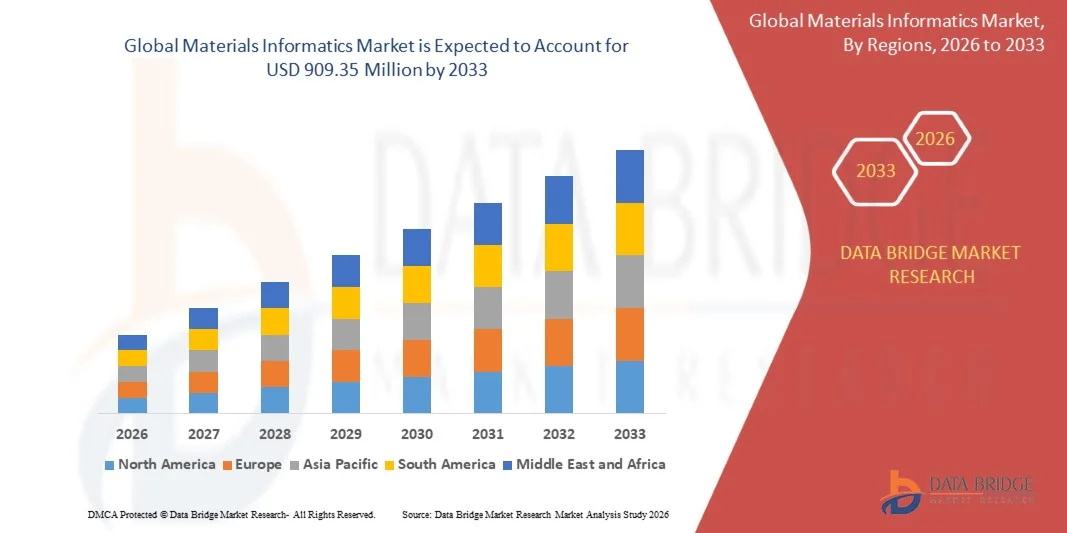
As per Data Bridge Market Research analysis the global materials informatics market was valued at USD 208.41 Million in 2025 and is projected to reach USD 909.35 Million by 2033, growing at a CAGR of 20.22% from 2026 to 2033. The materials informatics market is experiencing robust growth driven by the increasing adoption of artificial intelligence (AI), machine learning (ML), and big data analytics in materials research and development, along with the rising demand for accelerated materials discovery and sustainable product innovation. The growing complexity of advanced materials used across industries such as automotive, aerospace, electronics, energy, and healthcare is encouraging organizations to leverage materials informatics platforms for predictive modeling, high-throughput screening, and data-driven decision-making.
The increasing need to reduce research and development costs, shorten product development cycles, and improve material performance is compelling manufacturers, research institutions, and chemical companies to integrate AI-powered materials informatics solutions into their innovation workflows. These platforms enable researchers to analyze large materials datasets, predict material properties, optimize formulations, and identify high-performance materials more efficiently than conventional experimental methods. Furthermore, growing investments in digital transformation, Industry 4.0 initiatives, cloud computing, and high-performance computing infrastructure are enhancing the scalability and effectiveness of materials informatics solutions. Rising collaborations between software developers, academic institutions, and industrial manufacturers, coupled with increasing emphasis on sustainable materials, battery innovation, semiconductor development, and next-generation advanced materials, continue to accelerate market growth worldwide.
Market Size & Forecast
- Market Value (2025): USD 208.41 Million
- Expected Market Value (2033): USD 909.35 Million
- Forecast CAGR (2026–2033): 20.22%
- Leading Region in 2025: North America
- Fastest Growing Region: Asia-Pacific
Key Market Trends & Insights
- North America dominated the global materials informatics market with an estimated revenue share of 42.8% in 2025, driven by the strong presence of leading materials science software providers, significant investments in artificial intelligence and high-performance computing, robust R&D activities across the pharmaceutical, chemicals, semiconductor, and advanced materials industries, and extensive collaborations between research institutions and industry. The region also benefits from substantial government funding for materials innovation and digital transformation, reinforcing its leadership in the global market.
- The chemicals segment dominated the market with an estimated 63% share in 2025, owing to its extensive application in computational chemistry, catalyst development, specialty chemicals, polymers, battery materials, and pharmaceutical intermediates.
- Asia-Pacific is projected to be the fastest-growing regional market, registering an estimated CAGR of 18.9% during 2026–2033, supported by increasing investments in AI-driven materials discovery, rapid industrialization, expanding semiconductor and electric vehicle manufacturing, growing adoption of digital R&D platforms, and rising government initiatives promoting advanced manufacturing in China, Japan, South Korea, and India. Increasing collaboration between academia, technology companies, and industrial manufacturers is further accelerating regional market growth.
- The elements segment is expected to witness the fastest CAGR of 2% from 2026 to 2033, driven by increasing research into advanced metals, rare earth elements, semiconductors, superconductors, and energy storage materials.
- The electronics and semiconductors segment is expected to witness the fastest CAGR of 14.1% from 2026 to 2033, driven by rapidly increasing demand for advanced semiconductor materials, AI processors, power electronics, and next-generation electronic devices.
Report Scope and Materials Informatics Market Segmentation
|
Attributes |
Materials Informatics Key Market Insights |
|
Segments Covered |
|
|
Countries Covered |
North America
Europe
Asia-Pacific
Middle East and Africa
South America
|
|
Market Opportunities |
|
|
Value Added Data Infosets |
In addition to the insights on market scenarios such as market value, growth rate, segmentation, geographical coverage, and major players, the market reports curated by the Data Bridge Market Research also include in-depth expert analysis, geographically represented company-wise production and capacity, network layouts of distributors and partners, detailed and updated price trend analysis and deficit analysis of supply chain and demand. |
What is the Key Trend in the Materials Informatics Market?
Trend: Growing Adoption of Artificial Intelligence for Accelerated Materials Discovery
Organizations across the pharmaceuticals, chemicals, electronics, energy, and advanced manufacturing sectors are increasingly adopting materials informatics platforms to accelerate the discovery and optimization of novel materials. By integrating artificial intelligence (AI), machine learning, high-throughput computing, and large materials databases, materials informatics enables researchers to predict material properties, reduce experimental iterations, and significantly shorten product development cycles. The technology is increasingly being utilized for battery materials, semiconductors, polymers, catalysts, and sustainable chemicals, allowing organizations to lower R&D costs while improving innovation efficiency. Growing investments in digital laboratories, cloud computing, and data-driven materials research are further accelerating the adoption of materials informatics across industrial and academic research environments. For instance, in April 2024, Citrine Informatics announced the launch of Citrine DataManager, a scientific data infrastructure solution designed to organize experimental and materials data for AI-driven materials development. The platform enables organizations to centralize materials datasets and accelerate machine learning–based materials discovery across manufacturing industries. The growing convergence of AI, machine learning, and digital research infrastructure is transforming materials innovation by enabling faster, more cost-effective, and data-driven materials discovery, positioning materials informatics as a critical technology for next-generation industrial R&D.
Materials Informatics Market Dynamics
Key Market Driver: Increasing Demand for AI-Driven Materials Discovery and Digital R&D
The increasing need to accelerate materials innovation while reducing research costs is a major driver of the global materials informatics market. Industries including pharmaceuticals, chemicals, automotive, aerospace, electronics, and energy are increasingly adopting AI-powered materials informatics platforms to predict material properties, optimize formulations, and identify high-performance materials with significantly fewer laboratory experiments. Machine learning algorithms combined with high-performance computing enable researchers to analyze vast materials datasets, improving product development speed and reducing time-to-market. Growing investments in digital transformation, computational materials science, and cloud-based research platforms are further driving market adoption. Increasing collaboration between industrial manufacturers, research institutes, and software providers continues to strengthen commercialization of materials informatics solutions. For instance, in February 2024, Dassault Systèmes announced the expansion of its collaboration with the Acceleration Consortium at the University of Toronto to supportautonomous laboratories and AI-driven materials discovery using the 3DEXPERIENCE platform. The collaboration aims to accelerate the development of advanced materials through data-driven research and virtual experimentation. Rising investments in AI-enabled research platforms, digital laboratories, and collaborative innovation ecosystems are expected to remain key factors driving the adoption of materials informatics, enabling faster commercialization of advanced materials across multiple industries.
Key Restraint/Challenge: Limited Availability of High-Quality Materials Data and Integration Complexity
A major challenge facing the global materials informatics market is the limited availability of standardized, high-quality experimental data required to train reliable machine learning models. Materials data are often fragmented across different laboratories, stored in incompatible formats, or generated using inconsistent testing methodologies, making integration difficult. In addition, organizations frequently encounter challenges integrating materials informatics platforms with existing laboratory information management systems (LIMS), simulation software, and enterprise R&D infrastructure. Protecting proprietary research data while enabling collaborative innovation further increases implementation complexity. These challenges can slow AI model development and limit the scalability of materials informatics across industrial research programs. For instance, the U.S. National Institute of Standards and Technology (NIST) continues to support the Materials Genome Initiative by developing standardized materials data infrastructure and interoperability frameworks to improve AI-enabled materials research and data sharing. Addressing data standardization, interoperability, and secure integration challenges will be essential for unlocking the full potential of AI-driven materials informatics and enabling broader adoption across industrial research environments.
Key Market Opportunity: Expansion of Materials Informatics in Battery Materials and Sustainable Manufacturing
The rapid growth of electric vehicles, renewable energy, semiconductors, and sustainable manufacturing presents a significant long-term opportunity for the global materials informatics market. Companies are increasingly utilizing AI-driven materials informatics platforms to accelerate the discovery of next-generation battery materials, lightweight composites, hydrogen storage materials, catalysts, and recyclable polymers. Digital experimentation enables manufacturers to optimize material performance while significantly reducing development time and laboratory costs. Increasing investment in advanced batteries, clean energy technologies, and sustainable materials research is creating substantial demand for computational materials design platforms. Growing collaborations between AI software companies, material manufacturers, universities, and government research organizations are expected to further accelerate market growth. For instance, in January 2024, Microsoft Research announced MatterGen, a generative AI model capable of designing entirely new materials with targeted properties for scientific and industrial applications, representing a major advancement in AI-driven materials discovery. Expanding applications in advanced batteries, sustainable materials, and clean energy technologies are expected to create substantial long-term growth opportunities, making materials informatics a strategic enabler of future materials innovation and sustainable industrial development.
How is the Materials Informatics Market Segmented?
The materials informatics market is segmented on the basis of material type, technology, and end-use.
- By Material Type
On the basis of material type, the global materials informatics market is segmented into elements, chemicals, and others. The chemicals segment dominated the market with an estimated 48.63% share in 2025, owing to its extensive application in computational chemistry, catalyst development, specialty chemicals, polymers, battery materials, and pharmaceutical intermediates. organizations are increasingly utilizing materials informatics platforms to predict chemical behavior, optimize molecular structures, and accelerate formulation development using artificial intelligence and data-driven simulations. the growing need to reduce laboratory experimentation while improving research productivity has significantly increased adoption across chemical manufacturers and research institutions. rapid advances in machine learning algorithms and molecular databases are enabling researchers to discover novel compounds with enhanced physical and chemical properties in substantially shorter timeframes. increasing investments in sustainable chemistry, green solvents, battery electrolytes, and advanced catalysts are further supporting market expansion. collaborations between chemical companies, software providers, and academic institutions continue strengthening innovation across digital material discovery. the availability of large chemical datasets combined with high-performance computing infrastructure has improved predictive accuracy and reduced product development costs. increasing digital transformation across chemical research laboratories and manufacturing facilities continues reinforcing the dominant position of the chemicals segment within the global materials informatics market.
The elements segment is expected to witness the fastest CAGR of 13.2% from 2026 to 2033, driven by increasing research into advanced metals, rare earth elements, semiconductors, superconductors, and energy storage materials. researchers are increasingly using materials informatics to predict elemental interactions, optimize crystal structures, and accelerate the discovery of high-performance materials for next-generation industrial applications. growing investments in electric vehicles, renewable energy systems, hydrogen technologies, and semiconductor manufacturing are significantly increasing demand for computational analysis of elemental materials. artificial intelligence and predictive modeling are enabling scientists to rapidly evaluate thousands of elemental combinations before laboratory validation, reducing research costs and accelerating commercialization. governments worldwide are investing in critical mineral research and strategic material development to strengthen domestic supply chains. increasing utilization of quantum computing and high-performance computing platforms is further enhancing research efficiency. expanding applications across aerospace, defense, electronics, and advanced manufacturing are expected to drive robust growth, positioning the elements segment as the fastest-growing material category during the forecast period.
- By Technology
On the basis of technology, the global materials informatics market is segmented into machine learning, deep tensor, statistical analysis, digital annealer, and others. The machine learning segment dominated the market with an estimated 43.76% share in 2025 owing to its ability to rapidly analyze large-scale materials datasets, identify complex structure-property relationships, and accurately predict material performance before physical experimentation. machine learning algorithms are extensively utilized to accelerate materials discovery, optimize formulations, and reduce research and development timelines across chemicals, electronics, automotive, aerospace, and energy industries. organizations are increasingly integrating supervised learning, unsupervised learning, and reinforcement learning models into computational materials science platforms to improve prediction accuracy and minimize experimental costs. continuous expansion of digital materials databases and improvements in algorithm performance are supporting wider adoption across industrial research laboratories. increasing investments in generative artificial intelligence, autonomous laboratories, and cloud-based research platforms continue strengthening the implementation of machine learning technologies. collaborations between software providers, research institutes, and manufacturing companies are further accelerating digital transformation across materials engineering. the capability of machine learning to improve innovation efficiency while reducing product development risks continues to reinforce its dominant position within the global materials informatics market.
The deep tensor segment is projected to witness the fastest CAGR of 14.3% from 2026 to 2033, driven by increasing demand for advanced deep learning architectures capable of modeling complex atomic interactions and predicting material properties with significantly higher precision. researchers are increasingly utilizing deep tensor neural networks to accelerate molecular simulations, crystal structure prediction, catalyst optimization, and battery material development. growing investments in quantum materials, semiconductor research, advanced polymers, and sustainable energy storage technologies are expanding adoption of deep tensor models across industrial and academic research. integration of deep tensor algorithms with high-performance computing infrastructure enables rapid processing of extremely large scientific datasets while improving computational efficiency. continuous advancements in neural network architectures and explainable artificial intelligence are enhancing prediction reliability and supporting commercialization of next-generation materials. expanding collaborations between AI developers, material manufacturers, and research organizations continue driving technological innovation. increasing demand for high-accuracy computational modeling is expected to position the deep tensor segment as the fastest-growing technology throughout the forecast period.
- By End-use
On the basis of end-use, the global materials informatics market is segmented into material science, chemical and pharmaceutical, electronics and semiconductors, automotive, aerospace and defense, and others. The material science segment dominated the market with an estimated 35.92% share in 2025 owing to increasing utilization of computational platforms for advanced materials discovery, characterization, optimization, and performance prediction. research organizations and industrial laboratories are increasingly adopting materials informatics to accelerate innovation across metals, polymers, ceramics, composites, electronic materials, and functional materials. artificial intelligence, machine learning, and predictive analytics are enabling scientists to significantly reduce experimental cycles while improving research efficiency and lowering development costs. expanding investments in sustainable materials, battery technologies, hydrogen storage materials, and lightweight structural materials continue driving adoption. governments and academic institutions are increasingly funding digital materials research to strengthen innovation capabilities and industrial competitiveness. continuous integration of laboratory automation, digital twins, and high-performance computing platforms is further enhancing research productivity. the growing need to commercialize advanced materials faster while improving product performance continues reinforcing the dominant position of the material science segment across the global materials informatics market.
The electronics and semiconductors segment is expected to witness the fastest CAGR of 14.1% from 2026 to 2033, driven by rapidly increasing demand for advanced semiconductor materials, AI processors, power electronics, and next-generation electronic devices. manufacturers are increasingly utilizing materials informatics platforms to optimize semiconductor compounds, dielectric materials, packaging materials, thermal interface materials, and nanomaterials through predictive computational modeling. growing investments in artificial intelligence infrastructure, electric vehicles, 5G communication, high-performance computing, and consumer electronics are significantly increasing demand for accelerated material innovation. computational materials design enables manufacturers to reduce product development timelines while improving device efficiency and manufacturing yields. continuous advancements in chip miniaturization, advanced packaging technologies, and quantum materials research are further expanding market opportunities. strategic investments in global semiconductor manufacturing capacity and government support for domestic chip production continue supporting adoption. increasing reliance on AI-driven material optimization is expected to position the electronics and semiconductors segment as the fastest-growing end-use industry during the forecast period.
Which Region Holds the Largest Share of the Materials Informatics Market?
North America dominated the global materials informatics market and accounted for the largest revenue share of 42.8% in 2025, driven by the strong presence of leading materials science software providers, extensive investments in artificial intelligence, machine learning, and high-performance computing, and robust research activities across the pharmaceutical, chemicals, aerospace, semiconductor, and advanced materials industries. The region benefits from close collaboration between national laboratories, universities, and private enterprises, accelerating the discovery and commercialization of next-generation materials. In addition, significant government funding for advanced manufacturing, clean energy technologies, and digital transformation initiatives continues to strengthen adoption of materials informatics platforms. The growing use of predictive modeling, simulation, and data-driven materials discovery is further reinforcing North America's leadership in the global materials informatics market.
U.S. Materials Informatics Market Insight
The U.S. materials informatics market is witnessing strong growth due to increasing investments in artificial intelligence, computational materials science, and digital research platforms across multiple industries. Pharmaceutical companies, chemical manufacturers, semiconductor firms, and advanced materials developers are increasingly utilizing AI-powered materials informatics solutions to accelerate material discovery, optimize formulations, and reduce product development timelines. The presence of leading technology companies, national research laboratories, and world-renowned universities is fostering continuous innovation in machine learning-driven materials design. Furthermore, growing government support for advanced manufacturing, clean energy technologies, battery innovation, and semiconductor research continues to accelerate adoption of materials informatics solutions across the United States.
Europe Materials Informatics Market Insight
The Europe materials informatics market remains a significant contributor to global revenue, supported by strong investments in sustainable materials research, advanced manufacturing, and digital innovation. The region is witnessing increasing adoption of artificial intelligence, high-performance computing, and data analytics to accelerate the discovery of lightweight composites, advanced polymers, battery materials, and sustainable chemicals. Growing collaboration between industrial manufacturers, research institutions, and technology providers is supporting rapid innovation across automotive, aerospace, renewable energy, and pharmaceutical sectors. Furthermore, supportive policies under the European Green Deal and increasing investment in circular economy initiatives continue to promote the adoption of materials informatics throughout Europe.
U.K. Materials Informatics Market Insight
The U.K. materials informatics market is experiencing steady growth, supported by increasing investments in artificial intelligence, computational chemistry, and digital materials research. Universities, research organizations, and industrial companies are increasingly adopting machine learning and predictive modeling platforms to accelerate materials discovery for pharmaceuticals, clean energy, aerospace, and advanced manufacturing applications. Growing collaboration between academia, technology companies, and industrial manufacturers is improving research efficiency and reducing product development cycles. In addition, government initiatives supporting digital innovation and advanced manufacturing continue to strengthen the adoption of materials informatics across the United Kingdom.
Germany Materials Informatics Market Insight
The Germany materials informatics market is expanding steadily due to the country's strong industrial manufacturing base, advanced engineering capabilities, and increasing investments in artificial intelligence-driven materials research. Automotive manufacturers, chemical companies, battery developers, and industrial research organizations are increasingly utilizing materials informatics to accelerate innovation in lightweight materials, battery chemistries, coatings, and advanced composites. Growing adoption of digital R&D platforms and simulation technologies is improving product development efficiency while reducing experimental costs. Furthermore, Germany's strong focus on Industry 4.0, sustainable manufacturing, and advanced materials innovation continues to support market growth.
Asia-Pacific Materials Informatics Market Insight
The Asia-Pacific materials informatics market is expected to witness the fastest growth during the forecast period, registering an estimated CAGR of 18.9% from 2026 to 2033. Growth is driven by rapid industrialization, increasing investments in AI-driven materials discovery, expanding semiconductor and electric vehicle manufacturing, and rising adoption of digital R&D platforms across China, Japan, South Korea, and India. Governments throughout the region are actively supporting advanced manufacturing, battery innovation, and next-generation materials research through favorable policies and strategic investments. Increasing collaboration between academic institutions, technology companies, and industrial manufacturers is further accelerating adoption of materials informatics solutions across the Asia-Pacific region.
Japan Materials Informatics Market Insight
The Japan materials informatics market is witnessing consistent growth due to the country's strong expertise in advanced materials science, semiconductor technologies, and precision manufacturing. Japanese companies are increasingly leveraging artificial intelligence, molecular simulation, and high-performance computing to accelerate the development of battery materials, functional polymers, electronic materials, and lightweight composites. Strong collaboration between universities, research institutes, and industrial manufacturers is fostering continuous innovation in digital materials discovery. Moreover, increasing investments in sustainable manufacturing, hydrogen technologies, and next-generation energy materials continue to strengthen market growth across Japan.
China Materials Informatics Market Insight
The China materials informatics market is growing rapidly, driven by increasing investments in artificial intelligence, advanced manufacturing, semiconductor production, and electric vehicle technologies. Industrial manufacturers, research institutes, and technology companies are increasingly adopting AI-powered materials informatics platforms to accelerate materials discovery, optimize manufacturing processes, and reduce product development timelines. Government initiatives promoting digital transformation, smart manufacturing, and scientific innovation are further supporting market expansion. In addition, rapid growth in battery manufacturing, renewable energy technologies, and advanced materials research is positioning China as one of the fastest-growing markets for materials informatics globally.
Materials Informatics Market Share
The materials informatics industry is primarily led by well-established companies, including:
- Citrine Informatics (U.S.)
- MaterialsZone (Israel)
- Exabyte company. (U.S.)
- Kebotix, Inc. (U.S.)
- Schrödinger, Inc. (U.S.)
- Dassault Systèmes (France)
- Ansys, Inc. (U.S.)
- Siemens (Germany)
- Intellegens Limited (U.K.)
- BIOVIA (France)
- Thermo Fisher Scientific Inc. (U.S.)
- IBM Corporation (U.S.)
- Microsoft Corporation (U.S.)
- Oracle (U.S.)
- SAP SE (Germany)
- Hitachi High-Tech Corporation (Japan)
- Elsevier (Netherlands)
What are Latest Developments in Materials Informatics Market?
- In April 2023, Preferred Computational Chemistry (PFCC), a joint venture between Preferred Networks and ENEOS Corporation, announced the U.S. launch of Matlantis, its AI-driven universal atomistic simulator for materials discovery. The cloud-based platform leverages neural network potentials to perform atomic-level simulations at speeds significantly faster than conventional density functional theory (DFT), enabling researchers to accelerate the discovery and optimization of advanced materials for batteries, semiconductors, catalysts, and clean energy applications. The launch marked a significant advancement in commercial materials informatics by enabling faster, AI-powered materials design across industrial R&D
- In October 2023, Citrine Informatics announced the launch of Citrine Catalyst, an AI-powered digital assistant designed to accelerate materials and chemicals product development. Built on large language models (LLMs), Catalyst enables scientists and engineers to rapidly search scientific literature, answer domain-specific technical questions, and generate data-driven insights directly within the Citrine Platform. The launch strengthens AI-enabled materials informatics by improving research productivity, reducing development timelines, and supporting faster innovation across the materials and chemicals industries
- In May 2024, Hitachi High-Tech Corporation and Industrial Technology Research Institute (ITRI) announced a collaborative project to integrate Hitachi's Materials Informatics solutions with ITRI's AI-driven MACSiMUM platform. The collaboration is designed to accelerate digital transformation in materials research and development by combining artificial intelligence, data analytics, and computational modeling to reduce experimental workloads and speed the discovery of advanced materials. The initiative highlights the growing adoption of materials informatics across semiconductor, electronics, and advanced manufacturing industries
- In November 2024, Enthought announced that Idemitsu Kosan Co., Ltd. expanded its partnership with the company to accelerate battery materials innovation using materials informatics. The expanded collaboration includes strategic consulting services and participation in Enthought's Materials Informatics Acceleration Program to enhance AI-driven research, process informatics, and digital transformation for next-generation battery materials. The partnership underscores the increasing use of materials informatics to accelerate product development and sustainable materials innovation

- Interactive Data Analysis Dashboard
- Company Analysis Dashboard for high growth potential opportunities
- Research Analyst Access for customization & queries
- Competitor Analysis with Interactive dashboard
- Latest News, Updates & Trend analysis
- Harness the Power of Benchmark Analysis for Comprehensive Competitor Tracking
Global Materials Informatics Market, Supply Chain Analysis and Ecosystem Framework
To support market growth and help clients navigate the impact of geopolitical shifts, DBMR has integrated in-depth supply chain analysis into its Global Materials Informatics Market research reports. This addition empowers clients to respond effectively to global changes affecting their industries. The supply chain analysis section includes detailed insights such as Global Materials Informatics Market consumption and production by country, price trend analysis, the impact of tariffs and geopolitical developments, and import and export trends by country and HSN code. It also highlights major suppliers with data on production capacity and company profiles, as well as key importers and exporters. In addition to research, DBMR offers specialized supply chain consulting services backed by over a decade of experience, providing solutions like supplier discovery, supplier risk assessment, price trend analysis, impact evaluation of inflation and trade route changes, and comprehensive market trend analysis.
Data collection and base year analysis are done using data collection modules with large sample sizes. The stage includes obtaining market information or related data through various sources and strategies. It includes examining and planning all the data acquired from the past in advance. It likewise envelops the examination of information inconsistencies seen across different information sources. The market data is analysed and estimated using market statistical and coherent models. Also, market share analysis and key trend analysis are the major success factors in the market report. To know more, please request an analyst call or drop down your inquiry.
The key research methodology used by DBMR research team is data triangulation which involves data mining, analysis of the impact of data variables on the market and primary (industry expert) validation. Data models include Vendor Positioning Grid, Market Time Line Analysis, Market Overview and Guide, Company Positioning Grid, Patent Analysis, Pricing Analysis, Company Market Share Analysis, Standards of Measurement, Global versus Regional and Vendor Share Analysis. To know more about the research methodology, drop in an inquiry to speak to our industry experts.
Data Bridge Market Research is a leader in advanced formative research. We take pride in servicing our existing and new customers with data and analysis that match and suits their goal. The report can be customized to include price trend analysis of target brands understanding the market for additional countries (ask for the list of countries), clinical trial results data, literature review, refurbished market and product base analysis. Market analysis of target competitors can be analyzed from technology-based analysis to market portfolio strategies. We can add as many competitors that you require data about in the format and data style you are looking for. Our team of analysts can also provide you data in crude raw excel files pivot tables (Fact book) or can assist you in creating presentations from the data sets available in the report.













