


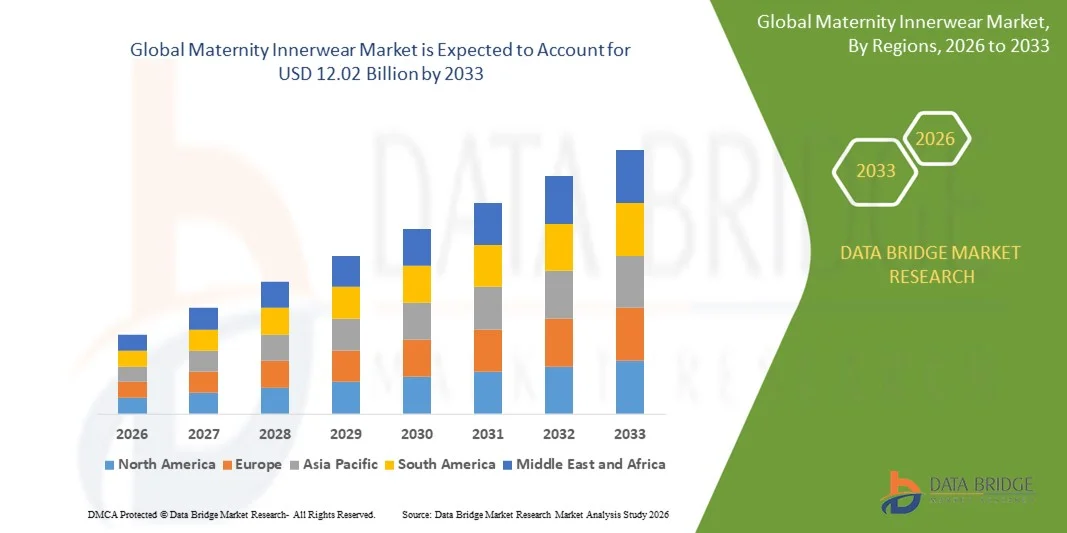
What is the Global Maternity Innerwear Market Size and Growth Rate?
- The global maternity innerwear market size was valued at USD 8.45 billion in 2025 and is expected to reach USD 12.02 billion by 2033, at a CAGR of 4.50% during the forecast period
- The rise in demand for nursing-friendly innerwear is one of the major factors anticipated to drive the maternity innerwear market growth rate
- Moreover, the increase in the urban population is also expected to fuel the growth of the maternity innerwear market. Also, the market is largely driven by the global fashion exposure in emerging countries such as China and India
What are the Major Takeaways of Maternity Innerwear Market?
- The high demand for convenient innerwear, improving female education levels, and increase in the disposable incomes are also expected to highly impact the growth of the maternity innerwear market
- While, high rise in awareness for pregnancy garments and the increase in the number of pregnant women from the working population are also amongst the major factors expected to fuel the growth of the maternity innerwear market
- North America dominated the maternity innerwear market with a 43.5% revenue share in 2025, supported by strong consumer preference for high-quality, comfortable, and multifunctional maternity and nursing innerwear across the U.S. and Canada
- Asia-Pacific is projected to register the fastest CAGR of 8.9% from 2026 to 2033, driven by growing awareness of maternal wellness, postpartum support, and ergonomic maternity wear in China, India, Japan, and South Korea
- The Maternity/Nursing Bras segment dominated the market with a revenue share of 45.3% in 2025, driven by high demand for supportive, adjustable, and comfortable designs during pregnancy and postpartum
Report Scope and Maternity Innerwear Market Segmentation
|
Attributes |
Maternity Innerwear Key Market Insights |
|
Segments Covered |
|
|
Countries Covered |
North America
Europe
Asia-Pacific
Middle East and Africa
South America
|
|
Key Market Players |
|
|
Market Opportunities |
|
|
Value Added Data Infosets |
In addition to the insights on market scenarios such as market value, growth rate, segmentation, geographical coverage, and major players, the market reports curated by the Data Bridge Market Research also include in-depth expert analysis, pricing analysis, brand share analysis, consumer survey, demography analysis, supply chain analysis, value chain analysis, raw material/consumables overview, vendor selection criteria, PESTLE Analysis, Porter Analysis, and regulatory framework. |
What is the Key Trend in the Maternity Innerwear Market?
Rising Demand for Comfortable, Functional, and Stylish Maternity Innerwear
- The maternity innerwear market is witnessing strong growth toward comfortable, multifunctional, and sustainable products, including designs with breathable fabrics, moisture-wicking technology, adjustable fittings, and eco-friendly materials to enhance comfort, support, and durability
- Manufacturers are introducing multi-purpose maternity bras, shapewear, and underwear systems that provide postpartum support, nursing convenience, and body-shaping benefits, catering to evolving lifestyle needs
- Consumers are increasingly seeking natural, hypoallergenic, and skin-friendly fabrics to avoid irritation and ensure health and comfort during pregnancy and postpartum
- For instance, brands such as H&M, Seraphine, Triumph, Wacoal, and Clovia have expanded their maternity innerwear portfolios by introducing soft-cup, adjustable, and organic cotton designs suitable for both everyday wear and nursing purposes
- Growing awareness of maternal health, postpartum support, and eco-conscious apparel is accelerating global adoption
- As consumers continue prioritizing comfort, functionality, and style, maternity innerwear is expected to remain central to product innovation within the global apparel market
What are the Key Drivers of Maternity Innerwear Market?
- Rising consumer preference for comfortable, functional, and skin-friendly maternity wear is driving strong adoption globally
- For instance, in 2025, brands such as H&M, Seraphine, Triumph, Wacoal, and Clovia expanded their maternity collections with organic, adjustable, and nursing-friendly innerwear
- Growing global awareness of maternal health, postpartum recovery, and ergonomic support is boosting demand across the U.S., Europe, and Asia-Pacific
- Advancements in fabric technology, stitching techniques, and adjustable designs have improved comfort, fit, and support versatility across different stages of pregnancy
- Rising demand for organic, sustainable, and ethically sourced fabrics is further contributing to market expansion, supported by environmentally conscious and health-focused consumers
- With ongoing R&D, product launches, collaborations, and global distribution, the maternity innerwear market is expected to maintain strong growth in the coming years
Which Factor is Challenging the Growth of the Maternity Innerwear Market?
- High production costs associated with premium, sustainable, and technologically enhanced fabrics limit affordability in price-sensitive regions
- For instance, during 2024–2025, fluctuations in cotton, bamboo, and organic fabric supply affected production volumes for several manufacturers
- Strict regulatory standards for material safety, labeling, and ethical sourcing increase operational complexities
- Limited consumer awareness in emerging markets about maternal support apparel and functional benefits restricts widespread adoption
- Competition from low-cost, conventional innerwear brands creates pressure on pricing and product differentiation
- To overcome these challenges, companies are focusing on cost-efficient manufacturing, scalable sourcing, regulatory compliance, and consumer education to expand global adoption of high-quality maternity innerwear
How is the Maternity Innerwear Market Segmented?
The market is segmented on the basis of product type, type, and distribution channel.
- By Product Type
On the basis of product type, the maternity innerwear market is segmented into Maternity/Nursing Bras, Camisoles, Shapewear, Maternity Briefs, and Others. The Maternity/Nursing Bras segment dominated the market with a revenue share of 45.3% in 2025, driven by high demand for supportive, adjustable, and comfortable designs during pregnancy and postpartum. These products are widely preferred due to features such as seamless construction, soft fabrics, and nursing accessibility. Shapewear and camisoles are gaining traction for their multifunctional benefits, including posture support, comfort, and body shaping.
The Shapewear segment is projected to grow at the fastest CAGR from 2026 to 2033, fueled by rising consumer awareness of ergonomic support, postpartum recovery, and fashion-forward maternity solutions. Increasing launches of premium, organic, and breathable fabrics are further driving adoption globally.
- By Type
On the basis of type, the market is segmented into Outerwear, Innerwear, and Nightwear. The Innerwear segment dominated with a 53.7% revenue share in 2025, owing to the growing focus on comfort, daily wear, and support garments during pregnancy and lactation. Innerwear, including maternity bras, briefs, and camisoles, remains critical for functional support, fabric breathability, and hypoallergenic properties.
Nightwear is expected to register the fastest CAGR from 2026 to 2033, driven by increasing consumer preference for multifunctional, soft, and adjustable sleepwear designed for comfort, postpartum nursing, and ergonomic support. Rising awareness of maternal health and adoption of sustainable fabrics in nightwear are boosting its adoption across premium and mid-tier markets globally.
- By Distribution Channel
On the basis of distribution channel, the market is segmented into Online and Offline. The Offline segment dominated with a 58.2% revenue share in 2025, driven by strong presence in supermarkets, specialty maternity stores, and brand outlets, offering tactile experience, personalized fittings, and instant availability. Offline retail remains key for maternity innerwear due to consumer preference for product trials and brand trust.
The Online segment is projected to grow at the fastest CAGR from 2026 to 2033, fueled by increasing e-commerce penetration, convenience of home delivery, detailed product information, virtual fittings, and subscription-based offerings. Growth in online marketplaces, brand-owned websites, and social media-driven promotions is accelerating adoption, particularly among tech-savvy, working, and urban consumers seeking comfort, convenience, and variety.
Which Region Holds the Largest Share of the Maternity Innerwear Market?
- North America dominated the maternity innerwear market with a 43.5% revenue share in 2025, supported by strong consumer preference for high-quality, comfortable, and multifunctional maternity and nursing innerwear across the U.S. and Canada. Growing awareness of maternal health, postpartum recovery, and ergonomic support drives widespread adoption in bras, shapewear, camisoles, and nightwear
- Leading players are focusing on fabric innovations such as organic cotton, breathable microfibers, moisture-wicking textiles, and adjustable designs to enhance comfort, support, and durability. Strong offline retail presence, coupled with expanding e-commerce penetration, influencer-led marketing, and brand loyalty, reinforces North America’s market leadership
- High disposable income, urbanization, and increasing demand for premium maternity solutions are driving robust growth in the region
U.S. Maternity Innerwear Market Insight
The U.S. is the largest contributor in North America, driven by high demand for supportive, multifunctional maternity bras, shapewear, and nursing camisoles. Manufacturers are investing in sustainable fabrics, ergonomic designs, and online-offline omnichannel distribution. Rising awareness of postpartum wellness, maternal comfort, and premium quality is accelerating adoption across urban and suburban regions.
Canada Maternity Innerwear Market Insight
Canada demonstrates steady growth, fueled by rising preference for ethically sourced, organic, and eco-friendly maternity innerwear. Consumers increasingly seek adjustable bras, soft camisoles, and breathable nightwear. Expansion of specialty maternity stores, retail chains, and online channels, combined with government-supported maternal health initiatives, further strengthens market adoption.
Asia-Pacific Maternity Innerwear Market Insight
Asia-Pacific is projected to register the fastest CAGR of 8.9% from 2026 to 2033, driven by growing awareness of maternal wellness, postpartum support, and ergonomic maternity wear in China, India, Japan, and South Korea. Rising disposable incomes, urbanization, and increasing participation in fitness and wellness programs accelerate demand for functional, comfortable, and stylish maternity innerwear.
China Maternity Innerwear Market Insight
China is the largest contributor to Asia-Pacific growth, with high adoption of nursing bras, shapewear, and camisoles in tier-1 and tier-2 cities. Manufacturers are investing in organic cotton, seamless knitting, and breathable fabrics, enhancing comfort and maternal support. Rising awareness of postpartum recovery and wellness is driving both domestic sales and exports.
Japan Maternity Innerwear Market Insight
Japan shows steady growth, supported by consumer preference for multifunctional, lightweight, and breathable maternity bras and nightwear. Advanced design technologies, seamless construction, and premium fabric offerings continue to attract health-conscious and fashion-aware consumers.
India Maternity Innerwear Market Insight
India is emerging as a key growth market, fueled by rising maternal health awareness, postpartum comfort needs, and demand for soft, supportive fabrics. Expansion of online channels and entry of premium maternity brands is increasing accessibility and adoption.
South Korea Maternity Innerwear Market Insight
South Korea contributes significantly due to growing interest in functional and stylish maternity innerwear. Influences from K-fashion trends, social media, and postpartum wellness programs are driving consumer preference for premium bras, shapewear, and nightwear. Innovation in fabrics and ergonomic designs enhances market growth.
Which are the Top Companies in Maternity Innerwear Market?
The maternity innerwear industry is primarily led by well-established companies, including:
- H & M Hennes & Mauritz AB (Sweden)
- adidas America Inc. (Germany)
- Nike, Inc. (U.S.)
- PUMA SE (Germany)
- ASOS (U.K.)
- Seraphine (U.K.)
- Triumph International (India) Pvt Ltd. (India)
- Wacoal (Japan)
- Mamacouture (India)
- Adore Me (U.S.)
- CLOVIA (India)
- Mothercare IN Limited (India)
- IZZIE & OLLIE LTD (India)
- Bodycare Creations Ltd. (India)
- Dreamex Wear Private Limited (India)
- Inner Sense (India)
- enamor (India)
- LAVOS PERFORMANCE (India)
- JULIET APPARELS LTD (India)
What are the Recent Developments in Global Maternity Innerwear Market?
- In August 2023, Rihanna introduced her first maternity wear collection under her Savage X Fenty lingerie brand, showcasing stylish nursing bralettes while modeling alongside her and A$AP Rocky’s one-year-old son, RZA. This launch emphasizes the brand’s commitment to combining fashion, comfort, and functionality for expecting mothers
- In August 2022, Nike launched its maternity collection in India, featuring bras, tanks, leggings, and other supportive apparel designed to cater to the needs of expecting mothers. The collection strengthens Nike’s presence in the Indian maternity wear market and promotes functional, stylish activewear for mothers-to-be
- In June 2021, Seraphine announced plans for an IPO on the London Stock Exchange, aiming to raise USD 84.3 million (£61 million) to repay its term loan and cover IPO expenses, while allocating approximately USD 62.2 million to repay loan notes held by existing owners. This financial move positions the brand for growth and expansion in the maternity fashion sector
- In April 2021, H&M partnered with Zalora to launch its e-commerce platform in Southeast Asia, expanding its reach to approximately 400 million consumers across Malaysia, the Philippines, Singapore, and Indonesia. This initiative enhances accessibility to maternity and other apparel lines, strengthening the brand’s regional footprint
- In February 2021, Hatch launched a maternity clothing line at Target, offering 24 affordable pieces under USD 40 with features such as elastic waistbands and stretchy, lightweight fabrics to accommodate growing bumps. The collection delivers style, comfort, and value for expecting mothers across online and select physical stores

- Interactive Data Analysis Dashboard
- Company Analysis Dashboard for high growth potential opportunities
- Research Analyst Access for customization & queries
- Competitor Analysis with Interactive dashboard
- Latest News, Updates & Trend analysis
- Harness the Power of Benchmark Analysis for Comprehensive Competitor Tracking
Global Maternity Innerwear Market, Supply Chain Analysis and Ecosystem Framework
To support market growth and help clients navigate the impact of geopolitical shifts, DBMR has integrated in-depth supply chain analysis into its Global Maternity Innerwear Market research reports. This addition empowers clients to respond effectively to global changes affecting their industries. The supply chain analysis section includes detailed insights such as Global Maternity Innerwear Market consumption and production by country, price trend analysis, the impact of tariffs and geopolitical developments, and import and export trends by country and HSN code. It also highlights major suppliers with data on production capacity and company profiles, as well as key importers and exporters. In addition to research, DBMR offers specialized supply chain consulting services backed by over a decade of experience, providing solutions like supplier discovery, supplier risk assessment, price trend analysis, impact evaluation of inflation and trade route changes, and comprehensive market trend analysis.
Data collection and base year analysis are done using data collection modules with large sample sizes. The stage includes obtaining market information or related data through various sources and strategies. It includes examining and planning all the data acquired from the past in advance. It likewise envelops the examination of information inconsistencies seen across different information sources. The market data is analysed and estimated using market statistical and coherent models. Also, market share analysis and key trend analysis are the major success factors in the market report. To know more, please request an analyst call or drop down your inquiry.
The key research methodology used by DBMR research team is data triangulation which involves data mining, analysis of the impact of data variables on the market and primary (industry expert) validation. Data models include Vendor Positioning Grid, Market Time Line Analysis, Market Overview and Guide, Company Positioning Grid, Patent Analysis, Pricing Analysis, Company Market Share Analysis, Standards of Measurement, Global versus Regional and Vendor Share Analysis. To know more about the research methodology, drop in an inquiry to speak to our industry experts.
Data Bridge Market Research is a leader in advanced formative research. We take pride in servicing our existing and new customers with data and analysis that match and suits their goal. The report can be customized to include price trend analysis of target brands understanding the market for additional countries (ask for the list of countries), clinical trial results data, literature review, refurbished market and product base analysis. Market analysis of target competitors can be analyzed from technology-based analysis to market portfolio strategies. We can add as many competitors that you require data about in the format and data style you are looking for. Our team of analysts can also provide you data in crude raw excel files pivot tables (Fact book) or can assist you in creating presentations from the data sets available in the report.













