


What is the Global Meal Kit Packaging Market Size and Growth Rate?
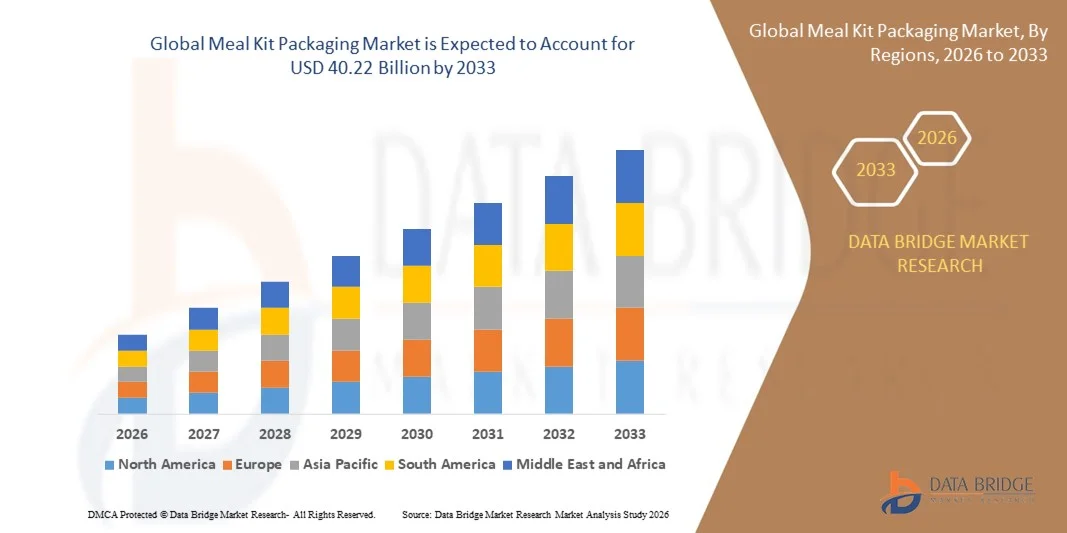
- As per Data Bridge Market Research Analysis the global meal kit packaging market size was valued at USD 13.15 billion in 2025 and is expected to reach USD 40.22 billion by 2033, at a CAGR of 15.0% during the forecast period
- The rapid urbanization across the globe acts as one of the major factors driving the growth of meal kit packaging market. The surge in the working class population seeking for nutritious yet home cooked food and changing food habits, and rise in consumer awareness regarding fitness and nutrition, requiring readymade balanced diet accelerate the market growth
Market Size & Forecast
- Global Market Value (2025): USD 13.15 Billion
- Expected Market Value (2033): USD 40.22 Billion
- Forecast CAGR (2026–2033): 15.0%
What are the Major Takeaways of Meal Kit Packaging Market?
- The increase in demand for meal kit as it is considered a one-stop solution for virtually all players across the entire food and beverage ecosystem, consisting of retailers, e-tailers, FMCG brand owners, and restaurants, and rise in preference for meal kits as availability of meal kits has made homemade meals more time-saving in comparison to takeouts and home deliveries further influence the market. Additionally, improved lifestyle, urbanization, and rise in spending on food and beverages positively affect the meal kit packaging market
- North America dominated the meal kit packaging market with a 42.05% revenue share in 2025, driven by the strong penetration of subscription-based meal kit services, high consumer demand for convenient home-cooked meals, and well-established cold-chain logistics across the U.S. and Canada
- Asia-Pacific is projected to register the fastest CAGR of 8.24%% from 2026 to 2033, driven by rapid urbanization, rising disposable incomes, and growing adoption of online food delivery and meal kit services across China, Japan, India, South Korea, and Southeast Asia
- The Plastic segment dominated the market with a 45.6% share in 2025, owing to its superior flexibility, lightweight nature, cost-effectiveness, and excellent barrier properties against moisture, oxygen, and contaminants
Report Scope and Meal Kit Packaging Market Segmentation
|
Attributes |
Meal Kit Packaging Key Market Insights |
|
Segments Covered |
|
|
Countries Covered |
North America
Europe
Asia-Pacific
Middle East and Africa
South America
|
|
Key Market Players |
|
|
Market Opportunities |
|
|
Value Added Data Infosets |
In addition to the insights on market scenarios such as market value, growth rate, segmentation, geographical coverage, and major players, the market reports curated by the Data Bridge Market Research also include in-depth expert analysis, pricing analysis, brand share analysis, consumer survey, demography analysis, supply chain analysis, value chain analysis, raw material/consumables overview, vendor selection criteria, PESTLE Analysis, Porter Analysis, and regulatory framework. |
What is the Key Trend in the Meal Kit Packaging Market?
Increasing Shift Toward Sustainable, Smart, and Convenience-Driven Meal Kit Packaging Solutions
- The Meal Kit Packaging market is witnessing strong adoption of sustainable, lightweight, and recyclable packaging formats designed to preserve food freshness, extend shelf life, and support temperature-controlled logistics
- Manufacturers are introducing multi-compartment, tamper-evident, and insulation-enhanced packaging that improves portion control, prevents leakage, and enhances consumer convenience
- Growing demand for eco-friendly, space-efficient, and easy-to-dispose packaging is driving adoption across subscription meal kit providers, foodservice operators, and direct-to-consumer brands
- For instance, companies such as Amcor, Huhtamaki, WestRock, Sealed Air, and Berry Global have expanded their portfolios with recyclable paperboard trays, compostable films, and high-barrier flexible packaging
- Increasing focus on cold-chain efficiency, smart labeling, and packaging optimization is accelerating innovation in meal kit packaging designs
- As meal kit consumption continues to rise globally, Meal Kit Packagings will remain critical for food safety, sustainability, and last-mile delivery efficiency
What are the Key Drivers of Meal Kit Packaging Market?
- Rising demand for convenient, ready-to-cook meals driven by urban lifestyles, dual-income households, and time-constrained consumers
- For instance, in 2024–2025, leading meal kit providers and packaging manufacturers increased investments in recyclable insulation, molded fiber trays, and mono-material packaging solutions
- Rapid growth of online food delivery platforms and subscription-based meal services across the U.S., Europe, and Asia-Pacific is boosting packaging demand
- Advancements in barrier coatings, insulation materials, and moisture-resistant packaging technologies have improved durability and food protection
- Increasing emphasis on sustainability regulations, plastic reduction targets, and circular economy initiatives is accelerating adoption of eco-friendly packaging
- Supported by expanding e-commerce food channels and innovation in packaging materials, the Meal Kit Packaging market is expected to witness strong long-term growth
Which Factor is Challenging the Growth of the Meal Kit Packaging Market?
- High costs associated with sustainable materials, biodegradable films, and advanced insulation solutions restrict adoption among small meal kit startups
- For instance, during 2024–2025, volatility in raw material prices, paper pulp costs, and bio-polymer supply chains increased packaging production expenses
- Complexity in balancing sustainability, insulation performance, and cost efficiency creates design and scalability challenges
- Limited recycling infrastructure and inconsistent waste management systems in emerging markets slow adoption of eco-friendly packaging
- Competition from traditional food packaging formats and bulk delivery models creates pricing pressure and limits differentiation
- To overcome these challenges, companies are focusing on material innovation, lightweighting strategies, supply chain optimization, and scalable sustainable packaging solutions to expand global adoption of Meal Kit Packagings
How is the Meal Kit Packaging Market Segmented?
The market is segmented on the basis of material, products, and application.
- By Material
On the basis of material, the meal kit packaging market is segmented into Paper, Metal, Plastic, and Glass. The Plastic segment dominated the market with a 45.6% share in 2025, owing to its superior flexibility, lightweight nature, cost-effectiveness, and excellent barrier properties against moisture, oxygen, and contaminants. Plastic materials such as PET, PP, and multilayer films are widely used in meal kits for pouches, trays, and insulation liners, ensuring extended shelf life and safe transportation in cold-chain logistics. Their compatibility with vacuum sealing and modified atmosphere packaging further strengthens adoption across meal kit providers.
The Paper segment is expected to grow at the fastest CAGR from 2026 to 2033, driven by rising sustainability concerns, regulatory pressure on single-use plastics, and increasing consumer preference for recyclable and compostable packaging. Advancements in coated paperboard, molded fiber trays, and barrier-enhanced paper solutions are expanding their application in meal kit packaging, particularly for cartons and secondary packaging formats.
- By Products
On the basis of products, the meal kit packaging market is segmented into Cartons, Thermoform Trays, Pouches, Films, and Others. The Thermoform Trays segment dominated the market with a 38.9% share in 2025, supported by their structural rigidity, portion control capability, and suitability for chilled and frozen food applications. Thermoform trays are extensively used for packaging meats, vegetables, and pre-prepared ingredients, offering leak resistance and compatibility with sealing films. Their ability to withstand temperature variations during transit makes them a preferred choice among meal kit providers.
The Pouches segment is projected to grow at the fastest CAGR from 2026 to 2033, driven by rising demand for lightweight, space-efficient, and flexible packaging solutions. Stand-up pouches and vacuum-sealed pouches reduce material usage, lower transportation costs, and support extended shelf life. Increasing adoption of recyclable mono-material pouches and high-barrier flexible films further accelerates growth in this segment.
- By Application
On the basis of application, the meal kit packaging market is segmented into Food and Beverages. The Food segment dominated the market with over 85.0% share in 2025, as meal kits primarily consist of fresh produce, meats, seafood, grains, sauces, and ready-to-cook ingredients requiring robust packaging solutions. Packaging plays a critical role in maintaining freshness, preventing cross-contamination, and supporting cold-chain distribution. High demand for portioned ingredients, insulated packaging, and leak-proof containers continues to drive growth across this segment.
The Beverages sub-segment within meal kits is expected to grow steadily from 2026 to 2033, supported by increasing inclusion of ready-to-drink beverages, smoothies, broths, and functional drinks in premium meal kits. Growing consumer interest in complete meal solutions and value-added offerings is encouraging meal kit companies to expand beverage inclusions, supporting incremental packaging demand.
Which Region Holds the Largest Share of the Meal Kit Packaging Market?
- North America dominated the meal kit packaging market with a 42.05% revenue share in 2025, driven by the strong penetration of subscription-based meal kit services, high consumer demand for convenient home-cooked meals, and well-established cold-chain logistics across the U.S. and Canada. Widespread adoption of insulated packaging, portion-controlled containers, and sustainable materials continues to support market growth across the region
- Leading packaging manufacturers and meal kit providers in North America are investing in recyclable, lightweight, and high-barrier packaging solutions to improve shelf life, reduce food waste, and enhance customer experience, reinforcing regional market leadership
- High consumer purchasing power, strong e-commerce infrastructure, and continuous innovation in sustainable packaging materials further strengthen North America’s dominance
U.S. Meal Kit Packaging Market Insight
The U.S. is the largest contributor in North America, supported by the presence of major meal kit companies, high adoption of online food delivery services, and strong demand for premium and customized meal offerings. Increasing focus on eco-friendly packaging, insulated liners, and leak-proof containers drives continuous innovation. Advanced logistics networks, urban lifestyles, and growing preference for convenience foods further accelerate market growth.
Canada Meal Kit Packaging Market Insight
Canada contributes significantly to regional growth, driven by rising demand for ready-to-cook meals, expanding urban populations, and growing awareness of sustainable packaging. Meal kit providers increasingly adopt recyclable paper-based cartons, compostable trays, and insulated packaging to meet environmental regulations. Strong cold-chain infrastructure and rising e-commerce penetration support steady market expansion.
Asia-Pacific Meal Kit Packaging Market
Asia-Pacific is projected to register the fastest CAGR of 8.24%% from 2026 to 2033, driven by rapid urbanization, rising disposable incomes, and growing adoption of online food delivery and meal kit services across China, Japan, India, South Korea, and Southeast Asia. Expanding middle-class populations and increasing demand for convenient, hygienic food packaging fuel strong growth across the region.
China Meal Kit Packaging Market Insight
China is the largest contributor in Asia-Pacific due to rapid expansion of food e-commerce platforms, growing preference for ready-to-cook meals, and strong domestic packaging manufacturing capabilities. High demand for flexible packaging, insulated containers, and portioned food packs supports large-scale adoption across urban centers.
Japan Meal Kit Packaging Market Insight
Japan shows steady growth supported by high demand for premium, portion-controlled meal kits and strong focus on food safety and packaging quality. Advanced packaging technologies, compact designs, and sustainability-driven innovation drive adoption across the market.
India Meal Kit Packaging Market Insight
India is emerging as a key growth market, driven by expanding urban lifestyles, increasing working populations, and rapid growth of food delivery platforms. Rising demand for affordable, durable, and hygienic packaging accelerates market penetration.
South Korea Meal Kit Packaging Market Insight
South Korea contributes significantly due to strong adoption of online grocery services, premium meal kits, and innovative packaging formats. High consumer awareness of food quality and sustainability supports sustained market growth.
Which are the Top Companies in Meal Kit Packaging Market?
The meal kit packaging industry is primarily led by well-established companies, including:
- Amcor plc (Switzerland)
- Bemis Company, Inc. (U.S.)
- Dow (U.S.)
- WestRock Company (U.S.)
- Ball Corporation (U.S.)
- Huhtamaki (Finland)
- Sealed Air (U.S.)
- Berry Global Inc. (U.S.)
- Reynolds (U.S.)
- International Paper (U.S.)
- DS Smith (U.K.)
- Genpak, LLC (U.S.)
- Dart Products Europe (U.K.)
- Anchor Packaging Inc. (U.S.)
- Vegware Ltd (U.K.)
- Sabert Corporation (U.S.)
- Fabri-Kal (U.S.)
- BSIbio (U.K.)
- London Bio Packaging (U.K.)
- Hefei Hengxin Environmental Science & Technology Co., Ltd (China)
- King Yuan Fu Packaging Co., Ltd (China)
- Excellent Packaging & Supply (U.S.)

- Interactive Data Analysis Dashboard
- Company Analysis Dashboard for high growth potential opportunities
- Research Analyst Access for customization & queries
- Competitor Analysis with Interactive dashboard
- Latest News, Updates & Trend analysis
- Harness the Power of Benchmark Analysis for Comprehensive Competitor Tracking
Global Meal Kit Packaging Market, Supply Chain Analysis and Ecosystem Framework
To support market growth and help clients navigate the impact of geopolitical shifts, DBMR has integrated in-depth supply chain analysis into its Global Meal Kit Packaging Market research reports. This addition empowers clients to respond effectively to global changes affecting their industries. The supply chain analysis section includes detailed insights such as Global Meal Kit Packaging Market consumption and production by country, price trend analysis, the impact of tariffs and geopolitical developments, and import and export trends by country and HSN code. It also highlights major suppliers with data on production capacity and company profiles, as well as key importers and exporters. In addition to research, DBMR offers specialized supply chain consulting services backed by over a decade of experience, providing solutions like supplier discovery, supplier risk assessment, price trend analysis, impact evaluation of inflation and trade route changes, and comprehensive market trend analysis.
Data collection and base year analysis are done using data collection modules with large sample sizes. The stage includes obtaining market information or related data through various sources and strategies. It includes examining and planning all the data acquired from the past in advance. It likewise envelops the examination of information inconsistencies seen across different information sources. The market data is analysed and estimated using market statistical and coherent models. Also, market share analysis and key trend analysis are the major success factors in the market report. To know more, please request an analyst call or drop down your inquiry.
The key research methodology used by DBMR research team is data triangulation which involves data mining, analysis of the impact of data variables on the market and primary (industry expert) validation. Data models include Vendor Positioning Grid, Market Time Line Analysis, Market Overview and Guide, Company Positioning Grid, Patent Analysis, Pricing Analysis, Company Market Share Analysis, Standards of Measurement, Global versus Regional and Vendor Share Analysis. To know more about the research methodology, drop in an inquiry to speak to our industry experts.
Data Bridge Market Research is a leader in advanced formative research. We take pride in servicing our existing and new customers with data and analysis that match and suits their goal. The report can be customized to include price trend analysis of target brands understanding the market for additional countries (ask for the list of countries), clinical trial results data, literature review, refurbished market and product base analysis. Market analysis of target competitors can be analyzed from technology-based analysis to market portfolio strategies. We can add as many competitors that you require data about in the format and data style you are looking for. Our team of analysts can also provide you data in crude raw excel files pivot tables (Fact book) or can assist you in creating presentations from the data sets available in the report.













