


What is the Meal Replacement Market Size and Overview?
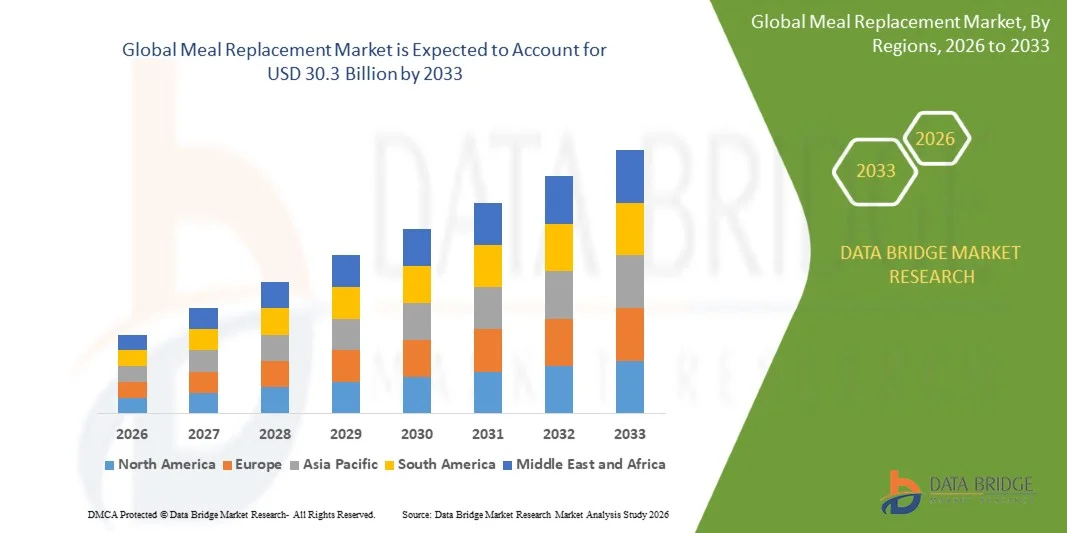
As per Data Bridge Market Research Analysis the meal replacement market was valued at USD 17.98 billion in 2025 and is projected to reach USD 30.3 billion by 2033, growing at a CAGR of 6.81% from 2026 to 2033. The market is experiencing strong growth as consumers increasingly seek convenient, nutritionally balanced, and time-saving food solutions that align with busy lifestyles and evolving dietary preferences. Growing awareness of preventive healthcare, rising obesity rates, and increasing interest in weight management have accelerated the adoption of meal replacement products among working professionals, fitness enthusiasts, and health-conscious consumers. In addition, manufacturers are continuously expanding their portfolios with high-protein, plant-based, clean-label, and functional formulations to meet changing consumer expectations.
The rapid expansion of e-commerce platforms, coupled with wider product availability across supermarkets, pharmacies, and specialty nutrition stores, has significantly improved market accessibility. Furthermore, continuous innovation in ready-to-drink shakes, nutrition bars, and meal replacement powders, along with increasing demand for personalized nutrition and fortified food products, is expected to sustain long-term market growth across both developed and emerging economies.
Market Size & Forecast
- Global Market Value (2025): USD 17.98 Billion
- Expected Market Value (2033): USD 30.3 Billion
- Forecast CAGR (2026–2033): 6.81%
- Leading Region in 2025: North America
- Fastest Growing Region: Asia-Pacific
Key Market Trends & Insights
- North America dominated the global meal replacement market with the largest 44.6% revenue share in 2025 and continues to maintain its leadership, supported by high consumer awareness of weight management, strong demand for functional nutrition products, and the presence of established brands with extensive retail and e-commerce distribution networks.
- Asia-Pacific is projected to be the fastest-growing regional market, supported by a 8.1% CAGR through the forecast period. Rapid urbanization, rising disposable incomes, and increasing demand for convenient nutrition products are accelerating market expansion across China, India, Japan, and Southeast Asia.
- The meal replacement powders segment accounted for the largest product share of 63.8% in 2025, owing to its longer shelf life, cost-effectiveness, customizable serving sizes, and widespread adoption among weight management consumers and fitness enthusiasts.
- The ready-to-drink (RTD) shakes segment is expected to record the fastest growth, expanding at a CAGR of 9.7% during the forecast period. Increasing consumer preference for on-the-go nutrition, coupled with continuous innovation in high-protein and functional beverage formulations, is driving demand for RTD products.
- The supermarkets & hypermarkets segment remained the leading distribution channel in 2023, benefiting from strong consumer preference for purchasing nutritional products through supermarkets, hypermarkets, pharmacies, and specialty nutrition stores. At the same time, the online retail segment is witnessing the fastest growth due to expanding e-commerce platforms, subscription-based nutrition services, and direct-to-consumer brand strategies.
- The online retail segment is expected to record the fastest growth among distribution channels as manufacturers increasingly adopt direct-to-consumer strategies and subscription-based nutrition services, while consumers continue shifting toward digital purchasing platforms for health and wellness products.
Report Scope and Meal Replacement Market Segmentation
Attributes |
Meal Replacement Key Market Insights |
|
Segments Covered |
|
|
Countries Covered |
North America
Europe
Asia-Pacific
Middle East and Africa
South America
|
|
Key Market Players |
|
|
Market Opportunities |
|
|
Value Added Data Infosets |
In addition to the insights on market scenarios such as market value, growth rate, segmentation, geographical coverage, and major players, the market reports curated by the Data Bridge Market Research also include in-depth expert analysis, pricing analysis, brand share analysis, consumer survey, demography analysis, supply chain analysis, value chain analysis, raw material/consumables overview, vendor selection criteria, PESTLE Analysis, Porter Analysis, and regulatory framework. |
What is the Key Trend in the Meal Replacement Market?
Trend: Rising Demand for Personalized and Functional Nutrition
The meal replacement market is witnessing a strong shift toward personalized and functional nutrition, as consumers increasingly seek products tailored to specific health goals such as weight management, muscle recovery, digestive health, and healthy aging. Manufacturers are expanding their portfolios with high-protein, plant-based, fiber-enriched, and vitamin-fortified formulations, while incorporating clean-label ingredients to meet evolving consumer preferences. This trend is reflected in ongoing product innovation, with Abbott introducing its PROTALITY high-protein nutrition shake in January 2024 to support healthy weight loss while preserving muscle mass, highlighting the industry's increasing focus on science-backed and personalized nutrition solutions. The growing popularity of ready-to-drink (RTD) products, combined with continuous innovation in taste, texture, and nutritional value, is further broadening the appeal of meal replacements beyond traditional weight-loss applications. In parallel, brands are strengthening their digital presence through e-commerce, subscription-based nutrition programs, and direct-to-consumer channels, making personalized nutrition solutions more accessible to a wider consumer base.
Meal Replacement Market Dynamics
Key Market Driver: Rising Demand for Convenient and Nutritionally Balanced Meal Solutions
The increasing demand for convenient and nutritionally balanced food products is a key driver of the meal replacement market. Busy lifestyles, longer working hours, and changing dietary habits have encouraged consumers to seek complete meal solutions that deliver proteins, vitamins, minerals, dietary fiber, and other essential nutrients in convenient formats. The growing focus on weight management, preventive healthcare, and active lifestyles is further accelerating product adoption among working professionals, fitness enthusiasts, and health-conscious consumers. Reflecting this trend, Abbott launched PROTALITY in 2024, a high-protein nutrition shake specifically designed to support healthy weight loss while helping preserve muscle mass, highlighting manufacturers' increasing emphasis on scientifically formulated meal replacement products that address evolving consumer health and wellness needs.
Key Restraint/Challenge: Premium Pricing and Consumer Preference for Conventional Foods
The relatively high cost of meal replacement products compared to conventional home-cooked meals and packaged foods remains a significant challenge for market growth. Premium formulations containing high-quality proteins, functional ingredients, vitamins, minerals, probiotics, and plant-based ingredients increase manufacturing costs, resulting in higher retail prices that may discourage adoption among price-sensitive consumers. In addition, consumer preference for freshly prepared meals and limited awareness of the long-term nutritional benefits of meal replacement products continue to restrict market penetration, particularly across developing economies.
Key Market Opportunity: Expansion of Personalized Nutrition and Digital Health Platforms
The growing adoption of personalized nutrition presents a significant opportunity for the meal replacement market. Consumers are increasingly seeking products tailored to specific health goals, including weight management, muscle recovery, healthy aging, and metabolic wellness, encouraging manufacturers to develop customized formulations and functional nutrition products. This opportunity is further supported by companies such as Huel, which continues to expand its direct-to-consumer subscription model and personalized product portfolio, demonstrating the growing integration of digital health platforms with personalized meal replacement solutions. The increasing use of nutrition apps, subscription-based meal plans, and digital wellness platforms is expected to strengthen consumer engagement while enabling manufacturers to deliver more personalized and convenient nutrition solutions.
How is the Meal Replacement Market Segmented?
The meal replacement market is segmented on the basis of product type, ingredient type, application, distribution channel, and end user.
- By Product Type
On the basis of product type, the market is segmented into meal replacement powders, ready-to-drink (RTD) shakes, nutrition bars, ready-to-eat meal replacements, and other meal replacement products.
The meal replacement powders segment is expected to dominate the market in 2026, accounting for 63.8% of the global market share. The segment's leadership is attributed to its cost-effectiveness, longer shelf life, flexible serving options, and ability to deliver customized nutritional formulations with proteins, vitamins, minerals, and functional ingredients. Its widespread adoption among fitness enthusiasts, weight management consumers, and sports nutrition users continues to strengthen its market position.
The ready-to-drink (RTD) shakes segment is projected to register the fastest CAGR of 7.5% during the forecast period from 2026 to 2033. Growth is primarily driven by increasing consumer preference for convenient, ready-to-consume nutrition products that fit busy lifestyles. Product innovation, premium formulations, and expanding availability across supermarkets, convenience stores, and e-commerce platforms are further accelerating the adoption of RTD meal replacement beverages.
- By Ingredient Type
On the basis of ingredient type, the market is segmented into protein, carbohydrates, fats, vitamins & minerals, fiber, and others.
The protein segment is expected to dominate the market in 2026, accounting for 32.28% of the global market share. The segment's leadership is driven by the increasing use of protein-rich meal replacements for muscle maintenance, weight management, and prolonged satiety. Consumers are increasingly choosing protein-based formulations as part of active lifestyles, while manufacturers continue to introduce products featuring whey, soy, pea, and other high-quality protein sources to meet evolving nutritional preferences.
The protein segment is also projected to register the fastest CAGR of 7.7% during the forecast period from 2026 to 2033. Growing participation in fitness and sports activities, rising demand for functional nutrition, and continuous innovation in plant-based and blended protein formulations are expected to sustain strong segment growth. The increasing incorporation of protein-enriched meal replacements into daily wellness routines is further supporting market expansion.
- By Application
The weight management segment is expected to dominate the market in 2026, supported by the growing prevalence of obesity and lifestyle-related disorders, which have significantly increased consumer demand for calorie-controlled and nutritionally balanced meal solutions. The global meal replacement products market is projected to grow at a CAGR of 7.2% from 2026 to 2033, reflecting sustained demand for products that support healthy weight management and balanced nutrition. Increasing participation in structured diet programs and preventive healthcare initiatives continues to strengthen the leadership of this segment.
The sports nutrition segment is anticipated to register the fastest growth during the forecast period, driven by increasing participation in fitness activities, expanding gym memberships, and rising demand for protein-rich nutritional products. The broader sports nutrition market is projected to expand at a CAGR of 7.7% from 2026 to 2033, creating significant opportunities for meal replacement products formulated for muscle recovery, endurance, and performance nutrition.
- By Distribution Channel
On the basis of distribution channel, the market is segmented into supermarkets & hypermarkets, online retail, pharmacies & drug stores, specialty stores, convenience stores, and others.
The supermarkets & hypermarkets segment is expected to dominate the market in 2026, accounting for 42.16% of the global market share. The segment's leadership is attributed to extensive retail networks, broad product assortments, and strong consumer preference for comparing nutritional products before purchase. The availability of promotional offers, in-store nutrition guidance, and multiple domestic and international brands further strengthens the position of supermarkets and hypermarkets as the primary sales channel for meal replacement products.
The online retail segment is projected to register the fastest CAGR of 7.7% during the forecast period from 2026 to 2033. Growth is being driven by the rapid expansion of e-commerce platforms, increasing adoption of direct-to-consumer business models, and rising consumer preference for subscription-based nutrition services. The convenience of home delivery, competitive pricing, personalized product recommendations, and access to a wider portfolio of premium and specialty meal replacement brands are further accelerating the growth of this segment.
- By End User
On the basis of end user, the market is segmented into adults, fitness & sports enthusiasts, busy professionals, elderly population, and medical nutrition consumers.
The adults segment dominated the market in 2025, supported by the growing adoption of meal replacement products for daily nutrition, weight management, and convenient meal consumption. Increasing work commitments, busy lifestyles, and rising awareness of balanced nutrition continue to encourage adult consumers to incorporate meal replacements into their everyday diets.
The fitness & sports enthusiasts segment is expected to witness the fastest growth during the forecast period, driven by increasing participation in fitness activities, growing demand for high-protein nutrition, and the expanding use of meal replacement products for muscle recovery, endurance, and performance optimization.
Meal Replacement Market Analysis
North America accounted for the largest share of 44.6% of the global meal replacement market in 2025 and is projected to expand at a CAGR of 6.9% during the forecast period. The region's leadership is supported by a well-established health and wellness industry, high penetration of sports nutrition products, and strong consumer demand for convenient meal solutions. Continuous product innovation, extensive retail and e-commerce distribution networks, and the presence of leading manufacturers have further strengthened market growth. In addition, increasing adoption of personalized nutrition and functional food products continues to create opportunities across the U.S. and Canada.
U.S. Meal Replacement Market Insight
The U.S. remains the largest contributor to the North American market, supported by high consumer spending on health and wellness products and strong demand for functional nutrition. The country's mature retail infrastructure, widespread adoption of meal replacement products, and continuous product launches by leading companies such as Abbott, Herbalife, and Soylent continue to support market growth. Increasing demand for high-protein, plant-based, and ready-to-drink nutrition products is further driving product innovation.
Europe Butter Substitutes Market Insight
Germany represents one of Europe's leading markets for meal replacement products, supported by strong consumer preference for functional foods, high-protein nutrition, and clean-label products. The country's advanced food manufacturing industry, well-developed retail sector, and increasing demand for plant-based nutritional products continue to support market expansion. Manufacturers are also focusing on sustainable packaging and premium product formulations to strengthen their competitive position.
Asia Pacific Meal Replacement Market Insight
Asia-Pacific is expected to register the fastest CAGR of 7.7% from 2026 to 2033, driven by rapid urbanization, rising disposable incomes, and changing dietary patterns across major economies. The expanding middle-class population, increasing participation in fitness and wellness activities, and growing demand for convenient nutritional products are accelerating market expansion. Manufacturers are also increasing investments in localized product development and digital sales channels to strengthen their presence across China, India, Japan, and Southeast Asia.
China Meal Replacement Market Insight
China is emerging as one of the fastest-growing markets due to increasing health awareness, rising disposable incomes, and rapid expansion of modern retail and e-commerce platforms. Growing demand for weight management products, sports nutrition, and convenient meal solutions is encouraging both domestic and international manufacturers to expand their product portfolios. The country's digital-first retail ecosystem and growing fitness culture continue to accelerate market adoption.
Meal Replacement Market Share
The meal replacement market is primarily led by well-established companies, including:
- Abbott (U.S.)
- Herbalife International of America, Inc. (U.S.)
- Amway(U.S.)
- Glanbia plc (Ireland)
- Atkins Nutritionals, Inc. (U.S.)
- Soylent (U.S.)
- Unilever(U.K.)
- Nestlé S.A. (Switzerland)
- KeHE Distributors, LLC. (U.S.)
- Blue Diamond Growers (U.S.)
- General Mills, Inc. (U.S.)
- BellRing Brands, Inc. (BRBR) (U.S.)
- Orgain, Inc. (U.S.)
- Huel LimiteId (U.K.)
- Arla Foods amba (Denmark)
- Kate Farms, Inc. (U.S.)
- Truefit Nutrition(U.S.)
- Saturo Foods GmbH (Austria)
- Garden of Life LLC (U.S.)
- Premier Nutrition Company LLC (U.S.)
- Cie Gervais Danone. (Canada)
Latest Developments in Meal Replacement Market
- In January 2025, Ferrero Group announced the acquisition of the Power Crunch protein snacks brand from Bio-Nutritional Research Group Inc., strengthening its presence in the better-for-you snacks segment and expanding its portfolio of protein-rich nutrition products to address growing consumer demand for convenient and functional meal solutions.
- In February 2025, Quest Nutrition launched Quest Protein Milkshakes, featuring 45 g of protein in a 14 oz ready-to-drink bottle with only 230 calories, expanding its high-protein meal replacement portfolio and catering to consumers seeking convenient nutrition for fitness and active lifestyles.
- In September 2024, Arla Foods introduced a new range of milk-based meal replacement drinks in Denmark, with plans to expand the portfolio into the Netherlands and the United Kingdom. The launch supports the company's strategy to strengthen its presence in the convenient nutrition and functional dairy beverages segment.
- In January 2024, Abbott Laboratories launched PROTALITY, a high-protein nutrition shakes specifically formulated to support healthy weight loss while preserving muscle mass in adults. The product expands Abbott's science-based nutrition portfolio and addresses the growing demand for clinically supported meal replacement solutions

- Interactive Data Analysis Dashboard
- Company Analysis Dashboard for high growth potential opportunities
- Research Analyst Access for customization & queries
- Competitor Analysis with Interactive dashboard
- Latest News, Updates & Trend analysis
- Harness the Power of Benchmark Analysis for Comprehensive Competitor Tracking
Global Meal Replacement Market, Supply Chain Analysis and Ecosystem Framework
To support market growth and help clients navigate the impact of geopolitical shifts, DBMR has integrated in-depth supply chain analysis into its Global Meal Replacement Market research reports. This addition empowers clients to respond effectively to global changes affecting their industries. The supply chain analysis section includes detailed insights such as Global Meal Replacement Market consumption and production by country, price trend analysis, the impact of tariffs and geopolitical developments, and import and export trends by country and HSN code. It also highlights major suppliers with data on production capacity and company profiles, as well as key importers and exporters. In addition to research, DBMR offers specialized supply chain consulting services backed by over a decade of experience, providing solutions like supplier discovery, supplier risk assessment, price trend analysis, impact evaluation of inflation and trade route changes, and comprehensive market trend analysis.
Data collection and base year analysis are done using data collection modules with large sample sizes. The stage includes obtaining market information or related data through various sources and strategies. It includes examining and planning all the data acquired from the past in advance. It likewise envelops the examination of information inconsistencies seen across different information sources. The market data is analysed and estimated using market statistical and coherent models. Also, market share analysis and key trend analysis are the major success factors in the market report. To know more, please request an analyst call or drop down your inquiry.
The key research methodology used by DBMR research team is data triangulation which involves data mining, analysis of the impact of data variables on the market and primary (industry expert) validation. Data models include Vendor Positioning Grid, Market Time Line Analysis, Market Overview and Guide, Company Positioning Grid, Patent Analysis, Pricing Analysis, Company Market Share Analysis, Standards of Measurement, Global versus Regional and Vendor Share Analysis. To know more about the research methodology, drop in an inquiry to speak to our industry experts.
Data Bridge Market Research is a leader in advanced formative research. We take pride in servicing our existing and new customers with data and analysis that match and suits their goal. The report can be customized to include price trend analysis of target brands understanding the market for additional countries (ask for the list of countries), clinical trial results data, literature review, refurbished market and product base analysis. Market analysis of target competitors can be analyzed from technology-based analysis to market portfolio strategies. We can add as many competitors that you require data about in the format and data style you are looking for. Our team of analysts can also provide you data in crude raw excel files pivot tables (Fact book) or can assist you in creating presentations from the data sets available in the report.













