


Meat Speciation Testing Market Overview
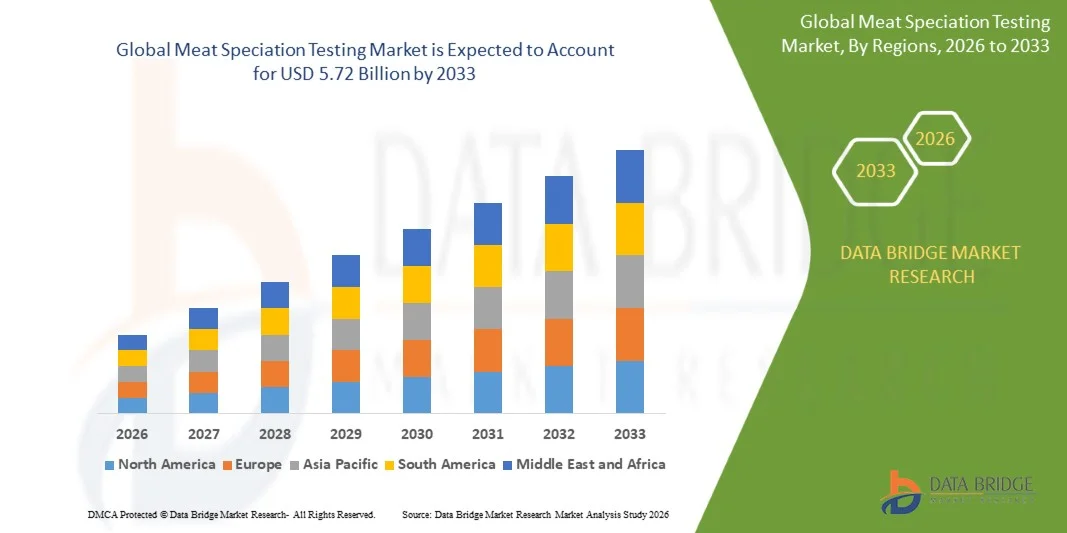
As per Data Bridge Market Research analysis the global meat speciation testing market was valued at USD 2.89 billion in 2025 and is projected to reach USD 5.72 billion by 2033, growing at a CAGR of 8.90% from 2026 to 2033. The market is experiencing steady growth driven by increasing concerns over food authenticity and labeling accuracy, stringent food safety regulations, and rising demand for advanced testing technologies across the meat processing and food manufacturing industries.
The growing incidence of meat adulteration and food fraud, coupled with stricter regulatory oversight regarding product traceability and labeling compliance, is encouraging food manufacturers, testing laboratories, and regulatory agencies to adopt advanced meat speciation testing methods. Technologies such as polymerase chain reaction (PCR), enzyme-linked immunosorbent assay (ELISA), and next-generation sequencing (NGS) are increasingly being utilized to accurately identify animal species in meat products, ensuring regulatory compliance, consumer confidence, and supply chain transparency. Furthermore, rising international trade in processed meat products, increasing consumer preference for certified halal, kosher, and premium meat products, and continuous advancements in molecular diagnostics are further supporting the expansion of the global meat speciation testing market throughout the forecast period.
Market Size & Forecast
- Global Market Value (2025): USD 2.89 Billion
- Expected Market Value (2033): USD 5.72 Billion
- Forecast CAGR (2026–2033): 8.90%
- Leading Region in 2025: North America
- Fastest Growing Region: Asia-Pacific
Key Market Trends & Insights
- North America dominated the meat speciation testing market with the largest market revenue share in 2025, supported by stringent food safety regulations, a well-established food testing infrastructure, and growing consumer demand for food authenticity and transparent labeling.
- Asia-Pacific meat speciation testing market is expected to witness the fastest growth rate from 2026 to 2033, supported by increasing meat consumption, expanding food processing industries, and rising awareness regarding food safety across developing economies.
- The raw segment held the largest market revenue share in 2025, driven by the extensive testing of raw meat at slaughterhouses, meat processing facilities, and import-export inspection points to verify species authenticity before further processing. Growing regulatory requirements for food traceability, increasing international meat trade, and rising demand for quality assurance are supporting the widespread adoption of meat speciation testing for raw meat products.
- The processed segment is expected to witness the fastest growth during the forecast period of 2026 to 2033, driven by the increasing incidence of meat adulteration in processed food products, expanding consumption of ready-to-eat and convenience foods, and stricter labeling regulations requiring accurate species identification in processed meat products.
- The PCR segment held the largest market revenue share of 45.01% in 2025, owing to its high sensitivity, accuracy, rapid turnaround time, and ability to detect trace amounts of species-specific DNA in raw and processed meat products. PCR technology has become the preferred testing method across regulatory laboratories, food manufacturers, and commercial testing facilities due to its reliability and broad regulatory acceptance.
- The molecular diagnostic segment is expected to witness the fastest growth during the forecast period of 2026 to 2033, driven by continuous advancements in real-time PCR, digital PCR, and next-generation sequencing technologies. Increasing automation, multiplex testing capabilities, and growing demand for rapid, high-throughput testing solutions are accelerating segment expansion.
Report Scope and Meat Speciation Testing Market Segmentation
|
Attributes |
Meat Speciation Testing Key Market Insights |
|
Segments Covered |
|
|
Countries Covered |
North America
Europe
Asia-Pacific
Middle East and Africa
South America
|
|
Key Market Players |
|
|
Market Opportunities |
|
|
Value Added Data Infosets |
In addition to the insights on market scenarios such as market value, growth rate, segmentation, geographical coverage, and major players, the market reports curated by the Data Bridge Market Research also include in-depth expert analysis, pricing analysis, brand share analysis, consumer survey, demography analysis, supply chain analysis, value chain analysis, raw material/consumables overview, vendor selection criteria, PESTLE Analysis, Porter Analysis, and regulatory framework. |
Meat Speciation Testing Market Trends
Trend: Growing Adoption Of DNA-Based Molecular Testing For Food Authentication
Increasing concerns regarding food fraud, meat adulteration, and product mislabeling are accelerating the adoption of advanced molecular testing technologies across the global meat industry. Conventional protein-based identification methods often face limitations when analyzing highly processed meat products, encouraging food manufacturers, regulatory agencies, and accredited laboratories to adopt DNA-based technologies such as polymerase chain reaction (PCR), real-time PCR, and next-generation sequencing (NGS). These technologies offer high sensitivity, rapid detection, and reliable species identification, strengthening food authenticity and regulatory compliance.
For instance, in September 2023, Thermo Fisher Scientific, together with Nestlé Research and SGS Molecular, announced the successful validation of its Thermo Scientific NGS Food Authenticity Workflow for detecting meat, fish, and plant species in mixed food samples. The workflow accurately identified 100% of meat species at concentrations of 5% or higher, demonstrating improved capabilities for food authenticity testing and helping laboratories simplify multi-species identification while strengthening traceability across global food supply chains. This advancement supports broader adoption of next-generation sequencing technologies within the meat speciation testing market.
The growing demand for certified halal and kosher products, expansion of international meat trade, and increasing regulatory scrutiny regarding food labeling are expected to further accelerate adoption of molecular meat speciation testing. Continuous innovation in automated DNA analysis and sequencing technologies will continue improving testing efficiency, supporting sustained growth of the global meat speciation testing market.
Meat Speciation Testing Market Dynamics
Key Market Driver: Rising Incidence Of Food Fraud And Stringent Food Labeling Regulations
The increasing incidence of meat adulteration and economically motivated food fraud is encouraging governments and food safety authorities worldwide to strengthen food authenticity regulations. Food manufacturers, retailers, exporters, and regulatory laboratories are increasingly investing in advanced analytical technologies capable of accurately identifying animal species in processed and fresh meat products. Growing consumer demand for transparency and traceability is further supporting the adoption of DNA-based meat speciation testing.
For instance, following the European horsemeat scandal, Eurofins significantly expanded its DNA-based meat species testing capacity and introduced enhanced analytical traceability services to help food manufacturers rapidly verify meat authenticity and comply with regulatory requirements. The initiative enabled faster identification of adulterated meat products and strengthened confidence across the European food supply chain, contributing to wider adoption of molecular meat testing technologies.
As food fraud regulations continue to evolve and international meat trade expands, investment in advanced meat speciation testing technologies is expected to increase significantly, strengthening food safety, regulatory compliance, and consumer confidence throughout the forecast period.
Key Restraint/Challenge: High Testing Costs And Limited Laboratory Infrastructure
Despite continuous technological advancements, meat speciation testing remains relatively expensive due to the high cost of molecular diagnostic instruments, laboratory accreditation, specialized reagents, and skilled technical personnel. Advanced techniques including real-time PCR and next-generation sequencing require sophisticated laboratory infrastructure, making implementation challenging for small food manufacturers and laboratories operating in developing economies.
For instance, Thermo Fisher Scientific highlights that implementing comprehensive food authenticity workflows based on NGS, PCR, and high-resolution mass spectrometry requires dedicated instrumentation, specialized software, bioinformatics capabilities, and trained laboratory professionals. While these technologies significantly improve analytical accuracy, they also increase operational costs and create barriers for smaller laboratories seeking to implement advanced meat speciation testing programs.
Although automation and technological innovation continue to improve testing efficiency, high implementation costs and limited laboratory infrastructure are expected to remain key factors restricting wider adoption of advanced meat speciation testing technologies, particularly across emerging markets.
Key Market Opportunity: Expansion Of Rapid Molecular Diagnostics And Food Traceability Programs
Increasing emphasis on food traceability, transparent labeling, and rapid quality assurance is creating substantial opportunities for advanced meat speciation testing technologies. Food manufacturers, retailers, and regulatory authorities increasingly require rapid analytical methods capable of verifying species authenticity throughout increasingly complex global supply chains. The integration of automated molecular diagnostics and digital laboratory management systems is improving testing efficiency while reducing reporting times.
For instance, Thermo Fisher Scientific launched an international multi-laboratory study involving government laboratories from Germany, Italy, Austria, Nestlé Research, and Barilla to validate its NGS Food Authenticity Workflow for multi-species detection. The initiative aims to establish a standardized workflow capable of providing consistent, highly accurate meat species identification across laboratories, supporting regulatory harmonization and accelerating adoption of next-generation molecular testing within the global food industry.
Continuous advancements in rapid molecular diagnostics, automation, and standardized food authenticity testing workflows are expected to create significant opportunities for market participants while improving regulatory compliance, food traceability, and consumer trust across the global meat speciation testing market.
Meat Speciation Testing Market Scope
The market is segmented on the basis of form, technology, species, testing mode, application, and end use.
- By Form
On the basis of form, the meat speciation testing market is segmented into raw, cooked, and processed. The raw segment held the largest market revenue share in 2025, driven by the extensive testing of raw meat at slaughterhouses, meat processing facilities, and import-export inspection points to verify species authenticity before further processing. Growing regulatory requirements for food traceability, increasing international meat trade, and rising demand for quality assurance are supporting the widespread adoption of meat speciation testing for raw meat products.
The processed segment is expected to witness the fastest growth during the forecast period of 2026 to 2033, driven by the increasing incidence of meat adulteration in processed food products, expanding consumption of ready-to-eat and convenience foods, and stricter labeling regulations requiring accurate species identification in processed meat products.
- By Technology
On the basis of technology, the meat speciation testing market is segmented into PCR, ELISA, and molecular diagnostic. The PCR segment held the largest market revenue share of 45.01% in 2025, owing to its high sensitivity, accuracy, rapid turnaround time, and ability to detect trace amounts of species-specific DNA in raw and processed meat products. PCR technology has become the preferred testing method across regulatory laboratories, food manufacturers, and commercial testing facilities due to its reliability and broad regulatory acceptance.
The molecular diagnostic segment is expected to witness the fastest growth during the forecast period of 2026 to 2033, driven by continuous advancements in real-time PCR, digital PCR, and next-generation sequencing technologies. Increasing automation, multiplex testing capabilities, and growing demand for rapid, high-throughput testing solutions are accelerating segment expansion.
- By Species
On the basis of species, the meat speciation testing market is segmented into Bos taurus, Sus scrofa, Gallus, Equus caballus, Ovis aries, and others. The Bos taurus segment held the largest market revenue share in 2025, driven by the high global consumption of beef products, stringent labeling regulations, and increasing verification requirements for premium, halal, and export-oriented beef products. Growing concerns regarding beef adulteration continue to support demand for species authentication testing.
The Equus caballus segment is projected to witness the fastest growth during the forecast period of 2026 to 2033, driven by increasing regulatory surveillance following previous horsemeat adulteration incidents and growing emphasis on detecting unauthorized equine meat in processed food products across international markets.
- By Testing Mode
On the basis of testing mode, the meat speciation testing market is segmented into lab testing and testing kits. The lab testing segment held the largest market revenue share of 88.05% in 2025, supported by the availability of accredited laboratories, advanced molecular testing infrastructure, and highly trained technical personnel. Regulatory agencies and food manufacturers continue to rely on laboratory-based testing for highly accurate and legally accepted species identification.
The testing kits segment is expected to witness the fastest growth during the forecast period of 2026 to 2033, driven by increasing demand for rapid on-site testing, technological advancements in portable diagnostic solutions, and growing adoption by food manufacturers for routine quality assurance and preliminary screening.
- By Application
On the basis of application, the meat speciation testing market is segmented into food safety testing, authenticity testing, traceability, and regulatory compliance. The food safety testing segment held the largest market revenue share in 2025, driven by stringent food safety regulations, increasing implementation of HACCP and food quality management systems, rising surveillance of meat products for contamination and adulteration, and growing demand from food manufacturers and regulatory authorities to ensure product safety, labeling compliance, and consumer protection.
The authenticity testing segment is expected to witness the fastest growth during the forecast period of 2026 to 2033, supported by increasing incidents of meat fraud and species substitution, growing consumer demand for transparent food labeling, expanding international meat trade, and stricter regulatory requirements for verifying species origin, halal and kosher certification, and overall supply chain traceability.
- By End Use
On the basis of end use, the meat speciation testing market is segmented into food industry, agriculture, research laboratories, and government agencies. The food industry segment held the largest market revenue share in 2025, driven by increasing regulatory compliance requirements, growing investments in food quality assurance, and rising consumer demand for accurately labeled meat products. Food manufacturers and processors remain the primary users of meat speciation testing to ensure product authenticity and maintain brand reputation.
The government agencies segment is expected to witness the fastest growth during the forecast period of 2026 to 2033, driven by strengthening food safety regulations, increasing surveillance programs, and greater investment in food fraud prevention initiatives. Expanding regulatory monitoring and enforcement activities are expected to accelerate the adoption of meat speciation testing across public laboratories and inspection authorities.
Meat Speciation Testing Market Regional Analysis
North America Meat Speciation Testing Market Insight
North America dominated the meat speciation testing market with the largest market revenue share in 2025, supported by stringent food safety regulations, a well-established food testing infrastructure, and growing consumer demand for food authenticity and transparent labeling. The region has witnessed increasing adoption of DNA-based testing technologies by food manufacturers, regulatory agencies, and commercial laboratories to detect meat adulteration and ensure compliance with labeling standards. Strong regulatory oversight by organizations such as the FDA and USDA, coupled with rising investments in food quality assurance, continues to drive market growth across North America.
U.S. Meat Speciation Testing Market Insight
The U.S. meat speciation testing market captured the largest market revenue share in 2025 within North America, fueled by increasing regulatory emphasis on food authenticity, rising consumer awareness regarding meat fraud, and widespread adoption of molecular diagnostic technologies. Food manufacturers and testing laboratories are increasingly implementing PCR- and sequencing-based methods to verify species identity and maintain compliance with food labeling regulations. The presence of leading food testing laboratories and continuous technological advancements further strengthen the market.
Canada Meat Speciation Testing Market Insight
The Canada meat speciation testing market is expected to witness a significant growth rate from 2026 to 2033, driven by the country's stringent food safety regulations, increasing focus on food authenticity, and growing demand for transparent meat labeling. Rising consumer awareness regarding food fraud and species adulteration is encouraging food manufacturers, processors, and testing laboratories to adopt advanced DNA-based testing technologies, particularly polymerase chain reaction (PCR), to ensure regulatory compliance and product integrity. Furthermore, Canada's expanding meat export industry, strong regulatory oversight by the Canadian Food Inspection Agency (CFIA), and increasing investments in food quality assurance and traceability programs are expected to continue supporting the growth of the meat speciation testing market.
Europe Meat Speciation Testing Market Insight
The Europe meat speciation testing market is expected to witness the fastest growth rate from 2026 to 2033, primarily driven by stringent food labeling regulations, increasing surveillance against food fraud, and growing demand for certified meat products. The region has significantly strengthened meat authentication practices following previous food adulteration incidents, encouraging food manufacturers and regulatory agencies to adopt advanced species identification technologies. Rising demand for traceability and supply chain transparency continues to support market expansion.
U.K. Meat Speciation Testing Market Insight
The U.K. meat speciation testing market is expected to witness the fastest growth rate from 2026 to 2033, driven by strong regulatory oversight, increasing consumer demand for food transparency, and growing investments in food authenticity testing. The country's emphasis on accurate food labeling, quality assurance, and traceability is encouraging food manufacturers and retailers to implement advanced molecular testing technologies. Continued monitoring of imported and domestically produced meat products is expected to further support market growth.
Germany Meat Speciation Testing Market Insight
The Germany meat speciation testing market is expected to witness the fastest growth rate from 2026 to 2033, fueled by a highly developed food processing industry, stringent food safety standards, and increasing adoption of advanced laboratory technologies. Growing focus on preventing food fraud, ensuring product authenticity, and maintaining compliance with European Union food regulations is accelerating the use of DNA-based meat speciation testing. Continuous investment in analytical research and laboratory infrastructure further supports market expansion.
Asia-Pacific Meat Speciation Testing Market Insight
The Asia-Pacific meat speciation testing market is expected to witness the fastest growth rate from 2026 to 2033, supported by increasing meat consumption, expanding food processing industries, and rising awareness regarding food safety across developing economies. Governments are strengthening food quality regulations while food manufacturers increasingly invest in modern testing technologies to improve product authenticity and export compliance. Rapid industrialization and growing international meat trade continue to create significant growth opportunities across the region.
Japan Meat Speciation Testing Market Insight
The Japan meat speciation testing market is expected to witness the fastest growth rate from 2026 to 2033 due to the country's stringent food quality standards, advanced laboratory capabilities, and strong consumer preference for premium and accurately labeled food products. Growing adoption of molecular diagnostic technologies and increasing focus on imported meat verification are supporting market growth. Rising demand for traceability and food authenticity across retail and food service sectors is further contributing to the expansion of meat speciation testing in Japan.
China Meat Speciation Testing Market Insight
The China meat speciation testing market accounted for the largest market revenue share in Asia-Pacific in 2025, attributed to the country's large meat processing industry, increasing food safety concerns, and strengthening regulatory framework for food quality and labeling. Rising consumer awareness regarding meat authenticity, expanding exports of meat products, and increasing adoption of PCR-based testing technologies by food manufacturers and regulatory laboratories are key factors driving market growth. Government initiatives to enhance food safety and traceability are further accelerating the adoption of meat speciation testing across China.
Meat Speciation Testing Market Share
The Meat Speciation Testing industry is primarily led by well-established companies, including:
- SGS SA (Switzerland)
- Bureau Veritas S.A. (France)
- Eurofins Scientific SE (Luxembourg)
- Intertek Group plc (U.K.)
- Mérieux NutriSciences Corporation (U.S.)
- ALS Limited (Australia)
- Neogen Corporation (U.S.)
- AsureQuality Limited (New Zealand)
- Charm Sciences, Inc. (U.S.)
- IEH Laboratories & Consulting Group (U.S.)
- EMSL Analytical, Inc. (U.S.)
- Thermo Fisher Scientific Inc. (U.S.)
- QIAGEN N.V. (Netherlands)
- bioMérieux SA (France)
- TÜV SÜD AG (Germany)
Latest Developments in Meat Speciation Testing Market
- In March 2025, Spore.Bio secured USD 23 million in Series A funding led by Singular to accelerate the commercialization of its AI-powered microbiological testing platform for the food industry. The investment will support international expansion, technology development, and deployment across food manufacturing facilities. Faster microbial screening and improved laboratory automation are expected to strengthen food quality monitoring and complement advanced food authenticity and testing solutions, benefiting the broader meat testing ecosystem.
- In October 2024, Mérieux NutriSciences announced the acquisition of Bureau Veritas' global food testing business for an enterprise value of EUR 360 million. The acquisition significantly expanded its worldwide laboratory network and strengthened capabilities in food safety, authenticity testing, microbiology, and meat species identification across more than 30 countries. The transaction enhances global testing capacity, improves analytical services, and supports increasing demand for reliable meat speciation testing worldwide.
- In October 2024, Bureau Veritas entered into an agreement to divest its global food testing business as part of its LEAP | 28 strategic portfolio optimization plan. The transaction allows the company to focus on core Testing, Inspection, and Certification services while enabling the transferred food testing laboratories and technical teams to expand under Mérieux NutriSciences. The development is expected to strengthen global food authenticity and meat species testing capabilities through an enlarged specialized laboratory network.

- Interactive Data Analysis Dashboard
- Company Analysis Dashboard for high growth potential opportunities
- Research Analyst Access for customization & queries
- Competitor Analysis with Interactive dashboard
- Latest News, Updates & Trend analysis
- Harness the Power of Benchmark Analysis for Comprehensive Competitor Tracking
Global Meat Speciation Testing Market, Supply Chain Analysis and Ecosystem Framework
To support market growth and help clients navigate the impact of geopolitical shifts, DBMR has integrated in-depth supply chain analysis into its Global Meat Speciation Testing Market research reports. This addition empowers clients to respond effectively to global changes affecting their industries. The supply chain analysis section includes detailed insights such as Global Meat Speciation Testing Market consumption and production by country, price trend analysis, the impact of tariffs and geopolitical developments, and import and export trends by country and HSN code. It also highlights major suppliers with data on production capacity and company profiles, as well as key importers and exporters. In addition to research, DBMR offers specialized supply chain consulting services backed by over a decade of experience, providing solutions like supplier discovery, supplier risk assessment, price trend analysis, impact evaluation of inflation and trade route changes, and comprehensive market trend analysis.
Data collection and base year analysis are done using data collection modules with large sample sizes. The stage includes obtaining market information or related data through various sources and strategies. It includes examining and planning all the data acquired from the past in advance. It likewise envelops the examination of information inconsistencies seen across different information sources. The market data is analysed and estimated using market statistical and coherent models. Also, market share analysis and key trend analysis are the major success factors in the market report. To know more, please request an analyst call or drop down your inquiry.
The key research methodology used by DBMR research team is data triangulation which involves data mining, analysis of the impact of data variables on the market and primary (industry expert) validation. Data models include Vendor Positioning Grid, Market Time Line Analysis, Market Overview and Guide, Company Positioning Grid, Patent Analysis, Pricing Analysis, Company Market Share Analysis, Standards of Measurement, Global versus Regional and Vendor Share Analysis. To know more about the research methodology, drop in an inquiry to speak to our industry experts.
Data Bridge Market Research is a leader in advanced formative research. We take pride in servicing our existing and new customers with data and analysis that match and suits their goal. The report can be customized to include price trend analysis of target brands understanding the market for additional countries (ask for the list of countries), clinical trial results data, literature review, refurbished market and product base analysis. Market analysis of target competitors can be analyzed from technology-based analysis to market portfolio strategies. We can add as many competitors that you require data about in the format and data style you are looking for. Our team of analysts can also provide you data in crude raw excel files pivot tables (Fact book) or can assist you in creating presentations from the data sets available in the report.













