


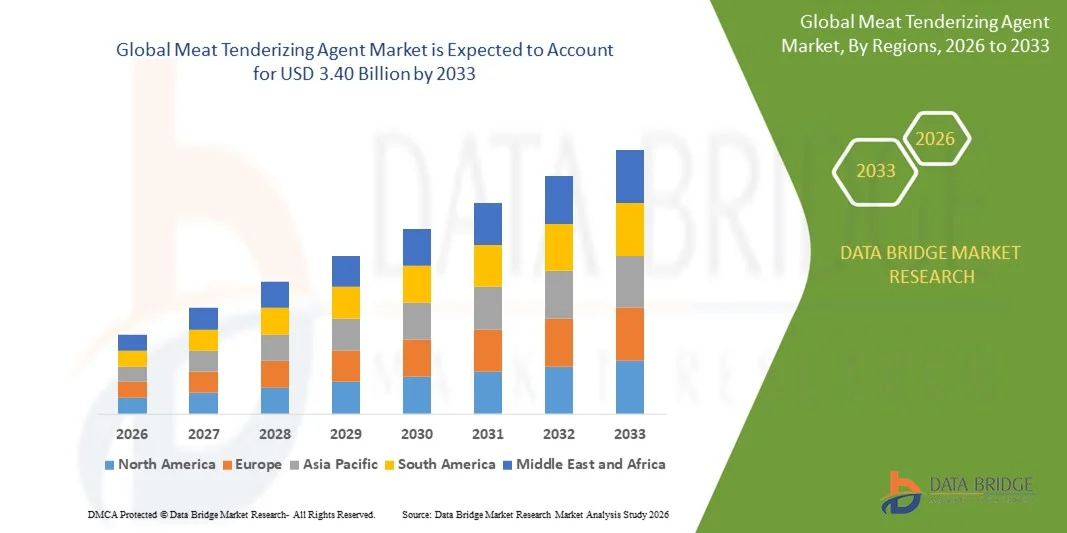
Meat Tenderizing Agent Market Size
- The global meat tenderizing agent market size was valued at USD 2.37 billion in 2025 and is expected to reach USD 3.40 billion by 2033, at a CAGR of 4.60% during the forecast period
- The market growth is largely fueled by the rising demand for ready-to-cook, pre-marinated, and processed meat products across residential and commercial sectors, leading to increased adoption of enzyme-, salt-, and acid-based tenderizing agents
- Furthermore, growing consumer preference for high-quality, tender, and flavorful meat products is establishing meat tenderizing agents as essential ingredients in both industrial and retail meat processing. These converging factors are accelerating the uptake of tenderizing solutions, thereby significantly boosting the industry’s growth
Meat Tenderizing Agent Market Analysis
- Meat tenderizing agents, including enzymes, salts, and acids, are increasingly vital in modern meat processing due to their ability to improve tenderness, enhance flavor absorption, and reduce preparation time in both fresh and processed meat products
- The escalating demand for meat tenderizing agents is primarily fueled by the growing consumption of ready-to-cook and marinated meat, increasing awareness of food quality and texture, and the rising preference for convenient, value-added meat options among consumers
- North America dominated the meat tenderizing agent market with a share of 31.5% in 2025, due to the rising demand for convenient and ready-to-cook meat products, as well as increased awareness of food quality and texture enhancement
- Asia-Pacific is expected to be the fastest growing region in the meat tenderizing agent market during the forecast period due to rapid urbanization, rising disposable incomes, and increasing consumption of processed and ready-to-cook meat products in countries such as China, Japan, and India
- Enzymes segment dominated the market with a market share of 45.8% in 2025, due to its strong efficiency in breaking down connective tissues to deliver consistent tenderness across beef, poultry, and pork. Enzymatic tenderizers such as papain, bromelain, and ficin are widely adopted due to their natural origin and superior compatibility with clean-label processed meat products. Industrial processors prefer enzyme-based solutions because they accelerate marination and enhance texture without compromising moisture retention. Increased consumption of packaged and ready-to-cook meat products further strengthens the need for reliable enzymatic tenderization. A well-established supply chain for plant-derived enzymes also supports their dominant position across global markets
Report Scope and Meat Tenderizing Agent Market Segmentation
|
Attributes |
Meat Tenderizing Agent Key Market Insights |
|
Segments Covered |
|
|
Countries Covered |
North America
Europe
Asia-Pacific
Middle East and Africa
South America
|
|
Key Market Players |
|
|
Market Opportunities |
|
|
Value Added Data Infosets |
In addition to the insights on market scenarios such as market value, growth rate, segmentation, geographical coverage, and major players, the market reports curated by the Data Bridge Market Research also include in-depth expert analysis, pricing analysis, brand share analysis, consumer survey, demography analysis, supply chain analysis, value chain analysis, raw material/consumables overview, vendor selection criteria, PESTLE Analysis, Porter Analysis, and regulatory framework. |
Meat Tenderizing Agent Market Trends
Growing Demand for Ready-to-Cook and Marinated Meat
- The rising urbanization and hectic lifestyles are significantly increasing the demand for ready-to-cook and marinated meat products, which is directly fueling the adoption of meat tenderizing agents across industrial and retail meat processing. Consumers are seeking convenience and faster meal preparation while expecting high-quality tenderness and flavor in meat products
- For instance, McCormick’s launch of its TenderGlow enzyme-based tenderizer in 2025 has enabled the production of pre-marinated meats with consistent tenderness and flavor. This development highlights how major companies are responding to the convenience-driven consumer demand and encouraging other processors to adopt enzymatic tenderizers
- Increasing awareness regarding meat quality, tenderness, and enhanced flavor is encouraging processors to integrate enzymatic, salt, and acid-based tenderizers into their operations. This trend ensures uniform texture across different meat cuts while improving overall eating experience for consumers
- The integration of tenderizing agents into ready-to-cook and processed meat products allows meat companies to reduce preparation time and improve operational efficiency. High-volume commercial kitchens and industrial meat processors benefit from faster production cycles while maintaining product consistency
- Consumer preference for high-quality meat that provides a premium eating experience at home and in restaurants is driving processors to adopt tenderizing solutions. These solutions allow meat producers to meet the rising expectations for flavor, texture, and tenderness in all product categories
- The continued expansion of processed, marinated, and value-added meat products is expected to sustain demand for meat tenderizing agents. Manufacturers are focusing on consistent product quality, flavor infusion, and convenience, solidifying tenderizing agents as essential ingredients in modern meat processing
Meat Tenderizing Agent Market Dynamics
Driver
Rising Adoption of Enzyme- and Acid-Based Tenderizers
- The increasing demand to improve meat tenderness, enhance flavor absorption, and reduce cooking time is a significant driver for the rising adoption of enzyme- and acid-based tenderizing agents. These solutions are becoming essential for both industrial and retail meat processors seeking consistent product quality
- For instance, Novozymes’ collaboration with Tyson Foods in 2025 to develop enzyme-based tenderizers demonstrates how strategic partnerships are driving innovation and encouraging broader adoption in large-scale meat processing operations. Such initiatives show the growing industry focus on delivering high-quality, convenient meat products
- Rising consumer preference for clean-label, natural, and minimally processed ingredients is prompting meat processors to replace traditional mechanical tenderization methods with enzymatic and acid-based solutions. This trend ensures uniform meat texture while satisfying consumer demand for natural and high-quality products
- The expanding ready-to-cook and pre-marinated meat market is further supporting demand for tenderizing agents, as these products require uniform tenderness and flavor across different meat types. Meat processors are increasingly integrating tenderizers into their formulations to meet industrial and retail requirements
- Investments by key market players in research and development of advanced tenderizing formulations are enabling more effective and specialized solutions. These developments allow meat processors to optimize product texture, enhance flavor, and improve production efficiency, ultimately supporting sustained market growth
Restraint/Challenge
High Cost and Complexity of Enzymatic Tenderization
- The relatively high cost of enzyme- and acid-based tenderizers compared to mechanical methods remains a challenge for small-scale meat processors and price-sensitive markets. This cost factor may limit adoption despite the benefits of improved tenderness and flavor
- For instance, smaller meat processing companies may hesitate to adopt Novozymes or Enzyme Development Corporation products due to the initial investment and process optimization requirements. Such cost considerations can constrain market expansion, particularly in developing regions
- Complexity in optimizing enzyme activity, ensuring uniform distribution, and maintaining consistent meat texture is another barrier for industrial implementation. These challenges require skilled personnel, careful monitoring, and sometimes additional equipment to ensure product consistency
- Limited awareness and technical knowledge regarding enzymatic tenderization in emerging markets can further slow adoption. Meat processors in these regions may rely on conventional mechanical methods to manage cost and operational simplicity
- Overcoming cost and complexity challenges through process optimization, training, and development of cost-effective formulations will be crucial for wider adoption. These solutions will enable sustained growth of the meat tenderizing agent market while ensuring consistent quality and efficiency in meat processing
Meat Tenderizing Agent Market Scope
The market is segmented on the basis of type, source, form, and end use.
- By Type
On the basis of type, the meat tenderizing agent market is segmented into enzymes, salts and acids, and others. The enzymes segment dominated the market in 2025 with the largest market revenue share of 45.8%, driven by its strong efficiency in breaking down connective tissues to deliver consistent tenderness across beef, poultry, and pork. Enzymatic tenderizers such as papain, bromelain, and ficin are widely adopted due to their natural origin and superior compatibility with clean-label processed meat products. Industrial processors prefer enzyme-based solutions because they accelerate marination and enhance texture without compromising moisture retention. Increased consumption of packaged and ready-to-cook meat products further strengthens the need for reliable enzymatic tenderization. A well-established supply chain for plant-derived enzymes also supports their dominant position across global markets.
The salts and acids segment is anticipated to witness the fastest growth rate from 2026 to 2033, fueled by rising demand for cost-effective tenderizing blends across household and foodservice applications. Salt-based and acid-based tenderizers improve flavor infusion and moisture retention, making them suitable for quick-preparation meat categories. Growing consumer preference for sharp flavor tones and faster cooking processes accelerates adoption across marinades and seasoning mixes. Manufacturers increasingly create blended formulations using citric acid, vinegar derivatives, and mineral salts to meet evolving flavor and texture expectations. Their versatility across poultry, red meat, and seafood applications strengthens rapid penetration in emerging markets. Increasing retail sales of dry mixes and convenient tenderizing powders further support this segment’s high-growth outlook.
- By Source
On the basis of source, the meat tenderizing agent market is segmented into plant, fungal, bacterial, and others. The plant segment dominated the market in 2025, driven by the widespread use of plant-derived enzymes such as papain and bromelain, which offer natural, safe, and efficient tenderization. Food processors rely heavily on plant-based tenderizers due to consumer preference for clean-label ingredients and minimal chemical processing. The scalability of papaya and pineapple extract production ensures steady supply availability for large meat-processing facilities. Their ability to deliver predictable texture enhancement across fresh, frozen, and marinated meats strengthens their dominant position. Rising demand for natural ingredients in packaged meat further contributes to their widespread acceptance.
The fungal segment is expected to witness the fastest growth from 2026 to 2033, supported by advancements in biotechnological fermentation and the high specificity of fungal proteases. Fungal-derived enzymes provide consistent tenderizing performance with controlled enzymatic activity, making them ideal for large-scale industrial applications. Their growing use in processed meats and ready-to-cook products reflects demand for uniform texture and minimal variability. Manufacturers increasingly invest in high-purity fungal protease production to meet stringent quality standards. Improved cost-efficiency of fermentation processes enhances adoption across global markets. Demand for standardized solutions in mass meat production further accelerates the segment’s rapid expansion.
- By Form
On the basis of form, the meat tenderizing agent market is segmented into liquid and powder. The liquid segment held the largest market revenue share in 2025, driven by its strong solubility and fast penetration into meat fibers, which makes it ideal for industrial marination and tumbling operations. Liquid tenderizers allow uniform distribution across bulk meat batches, enhancing texture consistency in large-scale production. Foodservice operators increasingly prefer liquid formats owing to ease of handling and compatibility with automated dosing systems. Their usage in marinated poultry, beef, and seafood lines significantly supports dominance. Rising consumption of ready-to-cook products further fuels reliance on liquid formulations.
The powder segment is projected to grow at the fastest CAGR from 2026 to 2033, driven by rising demand for dry rubs, seasoning blends, and convenient retail marinade mixes. Powder tenderizers offer longer shelf life and easy storage, making them popular among home cooks and small-scale processors. Their compatibility with dehydrated spices supports use in multifunctional tenderizing blends. Growing adoption of pre-packaged seasoning kits boosts powdered format penetration across retail channels. Their stability during transportation strengthens preference among global distributors. The increasing trend of at-home cooking contributes significantly to this segment’s accelerated growth.
- By End Use
On the basis of end use, the meat tenderizing agent market is segmented into ready to cook meat, marinades, and others. The ready to cook meat segment dominated the market in 2025, supported by strong demand for packaged marinated meats that offer convenience and consistent texture. Meat processors depend heavily on tenderizers to standardize quality across variable meat cuts and enhance consumer satisfaction. Growth of urban lifestyles and rising preference for quick-preparation protein meals fuel higher usage in ready-to-cook formats. The segment benefits from natural enzyme-based formulations that ensure tenderness while maintaining juiciness. The widespread availability of pre-seasoned poultry and red meat products boosts its leading position.
The marinades segment is anticipated to witness the fastest growth rate from 2026 to 2033, driven by the rising popularity of flavored and seasoned meat options. Tenderizing agents play a crucial role in improving marinade absorption and reducing preparation time, appealing to both retail consumers and foodservice operators. Manufacturers invest in new global flavor blends, expanding marinade applications across poultry, beef, and seafood categories. The growth of grilling culture and quick-service restaurants supports the rising need for tenderizer-infused marinades. Enzyme-enhanced marinades also enable premiumization in processed meat offerings. Expansion of portion-controlled and pre-marinated meats strongly contributes to this segment’s high-growth trajectory.
Meat Tenderizing Agent Market Regional Analysis
- North America dominated the meat tenderizing agent market with the largest revenue share of 31.5% in 2025, driven by the rising demand for convenient and ready-to-cook meat products, as well as increased awareness of food quality and texture enhancement
- Consumers in the region highly value products that improve meat tenderness, marination efficiency, and overall palatability, supporting the widespread adoption of enzymatic and plant-based tenderizing agents
- This strong adoption is further supported by high disposable incomes, increasing preference for pre-marinated meat, and the growth of processed meat consumption, establishing meat tenderizing agents as a key ingredient in both retail and foodservice sectors
U.S. Meat Tenderizing Agent Market Insight
The U.S. meat tenderizing agent market captured the largest revenue share in 2025 within North America, fueled by the high demand for ready-to-cook meat, convenience foods, and processed meat products. Consumers are increasingly prioritizing meat quality, flavor infusion, and consistency in texture, which drives the use of enzyme-based and acid-based tenderizers. Rising popularity of marinated and pre-seasoned meats, combined with robust retail and foodservice channels, further propels market growth. In addition, the integration of natural and clean-label tenderizing agents aligns with consumer preference for healthier and minimally processed ingredients.
Europe Meat Tenderizing Agent Market Insight
The Europe meat tenderizing agent market is projected to expand at a steady CAGR during the forecast period, primarily driven by increasing urbanization, growing demand for processed and marinated meat products, and regulatory support for safe food additives. Rising awareness regarding food quality and enhanced taste profiles is fostering adoption across residential and commercial sectors. European consumers show strong preference for plant-derived and natural tenderizers due to clean-label trends. The region is experiencing significant growth in ready-to-cook and convenience meat products, with tenderizing agents incorporated into both traditional and modern culinary applications.
U.K. Meat Tenderizing Agent Market Insight
The U.K. meat tenderizing agent market is anticipated to grow at a noteworthy CAGR during the forecast period, supported by the increasing consumption of ready-to-cook and marinated meat products. Consumers and foodservice operators are opting for enzyme- and acid-based tenderizers to ensure consistent tenderness and flavor across meat offerings. Rising demand for convenient meal solutions, combined with robust retail infrastructure and growing culinary experimentation at home, further stimulates market growth.
Germany Meat Tenderizing Agent Market Insight
The Germany meat tenderizing agent market is expected to expand at a considerable CAGR during the forecast period, fueled by growing awareness of food quality and the demand for premium and convenience meat products. Germany’s focus on innovation and sustainability promotes the adoption of plant-based and enzymatic tenderizing agents. Integration of tenderizers in industrial meat processing for ready-to-cook and marinated products is becoming increasingly prevalent, aligning with consumer expectations for texture, flavor, and overall product quality.
Asia-Pacific Meat Tenderizing Agent Market Insight
The Asia-Pacific meat tenderizing agent market is poised to grow at the fastest CAGR during the forecast period of 2026 to 2033, driven by rapid urbanization, rising disposable incomes, and increasing consumption of processed and ready-to-cook meat products in countries such as China, Japan, and India. The region's growing preference for convenient, flavor-rich meat, supported by modernization of food processing and retail sectors, is fueling adoption. Furthermore, APAC is emerging as a key manufacturing hub for enzymes, salts, and acid-based tenderizers, improving affordability and accessibility for industrial and retail consumers.
Japan Meat Tenderizing Agent Market Insight
The Japan meat tenderizing agent market is growing due to increasing urbanization, high consumption of marinated and processed meat products, and consumer demand for improved taste and tenderness. Adoption is driven by a strong culinary culture, the popularity of ready-to-cook meals, and demand for high-quality meat with consistent texture. Enzyme- and plant-based tenderizers are increasingly preferred due to their natural origin and suitability for premium meat applications.
China Meat Tenderizing Agent Market Insight
The China meat tenderizing agent market accounted for the largest revenue share in Asia-Pacific in 2025, attributed to rising disposable incomes, rapid urbanization, and growing consumption of marinated and ready-to-cook meat. China is one of the largest markets for processed meat products, and tenderizing agents are widely used across industrial, retail, and foodservice segments. Expansion of the domestic meat processing industry, coupled with the availability of cost-effective enzyme and salt-based tenderizers, is driving market growth.
Meat Tenderizing Agent Market Share
The meat tenderizing agent industry is primarily led by well-established companies, including:
- AB Enzymes (Germany)
- Amano Enzyme Inc. (Japan)
- Aumenzymes (India)
- Enzyme Bioscience (U.S.)
- Enzyme Development Corporation (U.S.)
- Enzyme Innovation (U.S.)
- Enzyme Solutions (U.S.)
- ENZYBEL GROUP (Belgium)
- Fuji Foods Corporation (Japan)
- LFI (UK) Ltd (U.K.)
- MAK WOOD, INC. (U.S.)
- McCormick Philippines, Inc. (Philippines)
- PHOSET FOODS PVT LTD (India)
- RAJVI ENTERPRISE (India)
- Specialty Enzymes & Probiotics (U.S.)
- Tampico Spices (U.S.)
- The Basque Company (U.S.)
Latest Developments in Global Meat Tenderizing Agent Market
- In July 2025, McCormick launched a new enzyme‑based meat tenderizer under its “TenderGlow” line, expanding its portfolio for both processed and fresh meat products. This launch is expected to drive innovation in enzyme-based tenderizers for retail and foodservice applications, offering consistent texture and enhanced flavor. By providing a clean-label solution, it addresses growing consumer demand for natural and minimally processed ingredients. The product’s introduction also strengthens McCormick’s competitive positioning, enabling it to capture a larger share of the rapidly growing ready-to-cook and pre-marinated meat segment, while encouraging broader adoption of enzymatic tenderization in industrial meat processing
- In March 2025, Novozymes entered into a strategic collaboration with Tyson Foods to co-develop enzyme-based tenderizers specifically for surface treatment of beef cuts. This partnership aims to shorten meat aging time, improve tenderness, and enhance flavor absorption, making large-scale meat processing more efficient. The collaboration also supports increased adoption of enzymatic tenderization in commercial meat operations and reinforces the trend toward clean-label, high-quality meat products. The initiative is likely to boost productivity, reduce processing costs, and enable Tyson Foods to differentiate its products in both retail and foodservice channels
- In 2025, Novozymes emphasized its microbial-enzyme solutions for meat protein hydrolysis, focusing on extracting high-value proteins from by-products and trimmings. This development promotes sustainable meat processing by converting waste into functional ingredients while improving yield and texture. Processors can leverage these enzymes to create ready-to-cook or value-added meat products with enhanced tenderness and flavor. The solution supports the growing market trend of sustainability and circular economy practices in the meat industry, while helping companies achieve efficiency in production and expand their product portfolios
- In November 2024, Cargill acquired Vigora’s meat-tenderizing enzyme business, significantly strengthening its portfolio in value-added protein and meat-processing solutions. The acquisition allows Cargill to offer more customized tenderizers for industrial meat applications, enhancing meat texture, moisture retention, and flavor. It also positions Cargill to meet rising demand from processed meat manufacturers and retail-ready meat segments. By expanding technological capabilities and market reach, this move supports growth in both North American and global meat tenderizing agent markets
- In 2024, Enzyme Development Corporation launched Enzeco Ficin Liquid 50K, a ficin-based tenderizer suitable for temperature-sensitive meat applications. The product enables precise proteolysis, improving meat tenderness while preserving juiciness and flavor. Its flexibility makes it suitable for both industrial processing and retail-ready products, offering consistent results across various meat types. This launch supports the growing adoption of enzyme-based tenderizers in ready-to-cook, pre-marinated, and processed meat segments, strengthening the market for natural and efficient meat processing solutions

- Interactive Data Analysis Dashboard
- Company Analysis Dashboard for high growth potential opportunities
- Research Analyst Access for customization & queries
- Competitor Analysis with Interactive dashboard
- Latest News, Updates & Trend analysis
- Harness the Power of Benchmark Analysis for Comprehensive Competitor Tracking
Global Meat Tenderizing Agent Market, Supply Chain Analysis and Ecosystem Framework
To support market growth and help clients navigate the impact of geopolitical shifts, DBMR has integrated in-depth supply chain analysis into its Global Meat Tenderizing Agent Market research reports. This addition empowers clients to respond effectively to global changes affecting their industries. The supply chain analysis section includes detailed insights such as Global Meat Tenderizing Agent Market consumption and production by country, price trend analysis, the impact of tariffs and geopolitical developments, and import and export trends by country and HSN code. It also highlights major suppliers with data on production capacity and company profiles, as well as key importers and exporters. In addition to research, DBMR offers specialized supply chain consulting services backed by over a decade of experience, providing solutions like supplier discovery, supplier risk assessment, price trend analysis, impact evaluation of inflation and trade route changes, and comprehensive market trend analysis.
Data collection and base year analysis are done using data collection modules with large sample sizes. The stage includes obtaining market information or related data through various sources and strategies. It includes examining and planning all the data acquired from the past in advance. It likewise envelops the examination of information inconsistencies seen across different information sources. The market data is analysed and estimated using market statistical and coherent models. Also, market share analysis and key trend analysis are the major success factors in the market report. To know more, please request an analyst call or drop down your inquiry.
The key research methodology used by DBMR research team is data triangulation which involves data mining, analysis of the impact of data variables on the market and primary (industry expert) validation. Data models include Vendor Positioning Grid, Market Time Line Analysis, Market Overview and Guide, Company Positioning Grid, Patent Analysis, Pricing Analysis, Company Market Share Analysis, Standards of Measurement, Global versus Regional and Vendor Share Analysis. To know more about the research methodology, drop in an inquiry to speak to our industry experts.
Data Bridge Market Research is a leader in advanced formative research. We take pride in servicing our existing and new customers with data and analysis that match and suits their goal. The report can be customized to include price trend analysis of target brands understanding the market for additional countries (ask for the list of countries), clinical trial results data, literature review, refurbished market and product base analysis. Market analysis of target competitors can be analyzed from technology-based analysis to market portfolio strategies. We can add as many competitors that you require data about in the format and data style you are looking for. Our team of analysts can also provide you data in crude raw excel files pivot tables (Fact book) or can assist you in creating presentations from the data sets available in the report.













