


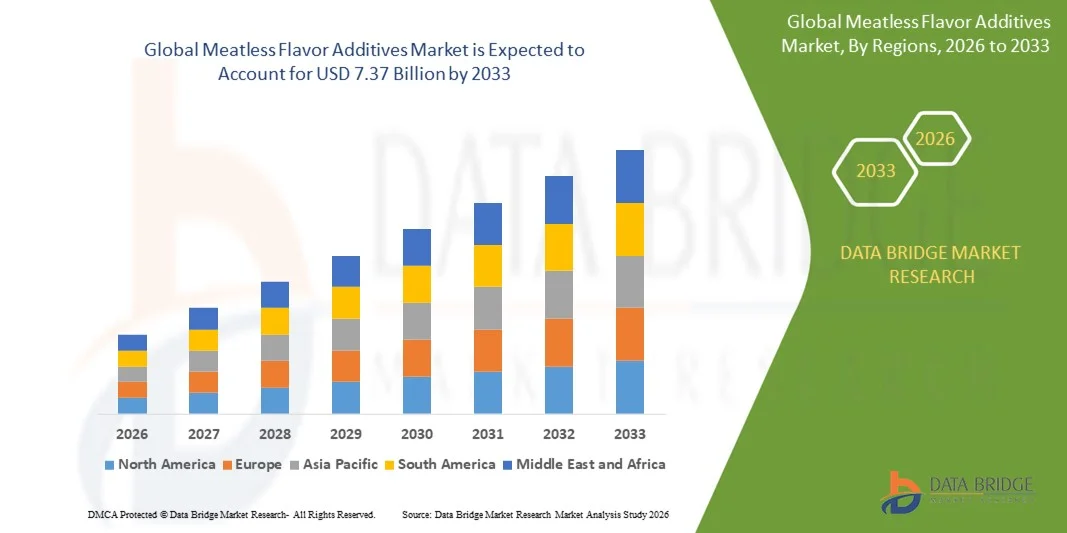
Meatless Flavor Additives Market Size
- The global meatless flavor additives market size was valued at USD 4.04 billion in 2025 and is expected to reach USD 7.37 billion by 2033, at a CAGR of 7.80% during the forecast period
- The Meatless Flavor Additives Market is primarily driven by the rapidly expanding plant-based food industry, where manufacturers are increasingly focused on improving taste, aroma, and overall sensory experience to match traditional meat products
- Rising consumer demand for clean-label, sustainable, and healthier food alternatives is further accelerating the use of natural yeast extracts, botanical flavor enhancers, and fermentation-derived ingredients that enhance meaty notes without relying on animal sources. These converging factors are pushing food producers to adopt advanced flavor technologies, thereby strengthening market growth
Meatless Flavor Additives Market Analysis
- Meatless flavor additives, consisting of yeast extracts, amino acids, natural flavors, and fermentation-based compounds, are becoming essential components in plant-based meats, vegan ready meals, soups, seasonings, and snacks due to their ability to deliver umami depth, savory intensity, and authentic meat-like sensory profiles
- The rising adoption of these ingredients is a direct result of increasing consumer preference for plant-based diets, advancements in flavor science, and manufacturers’ heightened focus on creating more realistic and appealing meat-alternative products, which collectively support the market’s robust expansion
- North America dominated the meatless flavor additives market with a share of 30.46% in 2025, due to rising consumer demand for plant-based diets, clean-label products, and high-protein meat alternatives
- Asia-Pacific is expected to be the fastest growing region in the meatless flavor additives market during the forecast period due to increasing urbanization, rising disposable incomes, and rapid adoption of plant-based diets in countries such as China, Japan, and India
- Savories and snacks segment dominated the market with a market share of 41.5% in 2025, due to the high demand for plant-based chips, meat alternatives, and savory snack products where authentic taste is crucial for consumer acceptance. The segment benefits from continuous innovation in flavor development to mimic traditional meat, cheese, and seasoning profiles, and from manufacturers’ efforts to cater to the growing flexitarian and vegan consumer base. Savories and snacks applications often integrate multiple flavor types, which enhances their complexity and market attractiveness, making this segment the primary revenue contributor
Report Scope and Meatless Flavor Additives Market Segmentation
|
Attributes |
Meatless Flavor Additives Key Market Insights |
|
Segments Covered |
|
|
Countries Covered |
North America
Europe
Asia-Pacific
Middle East and Africa
South America
|
|
Key Market Players |
|
|
Market Opportunities |
|
|
Value Added Data Infosets |
In addition to the insights on market scenarios such as market value, growth rate, segmentation, geographical coverage, and major players, the market reports curated by the Data Bridge Market Research also include in-depth expert analysis, pricing analysis, brand share analysis, consumer survey, demography analysis, supply chain analysis, value chain analysis, raw material/consumables overview, vendor selection criteria, PESTLE Analysis, Porter Analysis, and regulatory framework. |
Meatless Flavor Additives Market Trends
Growing Integration of Fermentation-Derived Umami Enhancers
- A significant trend in the meatless flavor additives market is the rising incorporation of fermentation-derived compounds that strengthen savory depth and natural umami perception in plant-based meats. This shift is driven by the growing need to enhance authenticity and sensory appeal for diverse consumer groups across global markets
- For instance, companies such as Givaudan are expanding their precision-fermentation ingredient portfolios to support richer umami complexity in vegan formulations. This enables brands to achieve meat-like flavor depth through clean-label enhancers sourced from microbial processes
- Fermentation-derived umami additives are becoming essential in plant-based product development as they offer improved flavor stability and higher aroma impact. These additives also help mask vegetal notes that commonly challenge plant protein bases
- This trend is accelerating as plant-based meat producers invest in advanced ingredient technologies that create fuller and more layered flavor profiles. These systems allow manufacturers to craft natural savory tones without relying on artificial enhancers
- The demand for natural and label-friendly umami solutions is strengthening as consumers expect plant-based meats to deliver a gratifying and realistic taste experience. Producers are responding by adopting sustainable and biologically efficient fermentation methods that elevate flavor depth
- These advancements collectively reinforce the shift toward sophisticated fermentation-enabled flavor systems that elevate the sensory realism of plant-based meats. This concludes the growing relevance of umami-focused innovation in the market
Meatless Flavor Additives Market Dynamics
Driver
Rising Demand for Clean-Label and Plant-Based Meat Alternatives
- The rapid consumer shift toward clean-label and plant-based foods is driving the adoption of meatless flavor additives that offer natural taste enhancement. This demand is fueled by rising awareness around health, sustainability, and ingredient transparency in global food markets
- For instance, companies such as Ingredion are expanding clean-label ingredient solutions that support natural flavor impact without compromising formulation simplicity. These offerings help manufacturers achieve desired taste profiles while maintaining transparent and consumer-friendly labels
- The demand for minimally processed ingredients is increasing as consumers prioritize plant-based sourcing and recognizable components in meat alternatives. This shift encourages brands to adopt natural flavor enhancers that complement the sensory characteristics of plant proteins
- The rising emphasis on ethical and environmentally conscious consumption further boosts the market for natural flavor systems that reinforce health-oriented purchasing behavior. This driver continues to strengthen as clean-label attributes become a mandatory requirement in the plant-based segment
- These developments collectively highlight the pivotal role of clean-label demand in shaping the direction of the meatless flavor additives market. This concludes the importance of this driver in influencing long-term industry growth
Restraint/Challenge
High Formulation Complexity in Replicating Authentic Meat Profiles
- The market faces significant challenges due to the difficulty of mimicking the layered and dynamic flavor structure of real meat using plant-based ingredients. Recreating savory, fatty, smoky, and aromatic elements requires precise formulation and advanced sensory expertise
- For instance, companies such as ADM have emphasized the difficulty of masking inherent off-notes from plant proteins while recreating the flavor release associated with cooked meat. This challenge intensifies as producers work to achieve desired authenticity without artificial flavor aids
- Manufacturers struggle to deliver consistent results across different plant protein bases because each source carries its own distinctive sensory limitations. These limitations require additional formulation adjustments to balance aroma, taste, and mouthfeel
- Efforts to replicate meat profiles also demand harmonization of flavor compounds that perform differently under various cooking conditions. Achieving stable performance across applications such as grilling, roasting, and frying adds to the formulation difficulty
- These factors collectively make meat flavor replication a highly technical and resource-intensive process requiring continuous innovation and specialized ingredient solutions. This concludes the ongoing challenge of achieving true meat-like authenticity in plant-based products
Meatless Flavor Additives Market Scope
The market is segmented on the basis of product type and application.
- By Product Type
On the basis of product type, the meatless flavor additives market is segmented into brown, dairy, herbs and botanicals, fruits and vegetables, and others. The brown segment dominated the market with the largest market revenue share of 38.6% in 2025, driven by its widespread use in plant-based meat analogs and savory products to provide umami richness and depth of flavor. Manufacturers often prioritize brown flavor additives for their versatility and ability to closely replicate the taste profile of cooked meats, which is highly valued by consumers seeking realistic plant-based alternatives. The segment also benefits from strong adoption in ready-to-eat meals and processed foods where authentic flavor enhancement is critical, and continuous innovation in extraction and formulation technologies further strengthens its market position.
The herbs and botanicals segment is anticipated to witness the fastest growth rate of 22.4% from 2026 to 2033, fueled by rising consumer demand for clean-label, natural flavor solutions in plant-based products. Herbs and botanical additives offer flavor enhancement and also potential health benefits, which resonate strongly with health-conscious and vegan consumers. For instance, companies such as Symrise are expanding their portfolio of botanical extracts specifically tailored for meatless and plant-based applications, supporting rapid adoption across savory snacks, ready meals, and dairy alternatives. The growing focus on sustainability, organic sourcing, and multifunctional ingredients further drives the segment’s popularity in the global market.
- By Application
On the basis of application, the meatless flavor additives market is segmented into beverages, dairy and frozen desserts, bakery and confectionery products, and savories and snacks. The savories and snacks segment dominated the market with the largest market revenue share of 41.5% in 2025, driven by the high demand for plant-based chips, meat alternatives, and savory snack products where authentic taste is crucial for consumer acceptance. The segment benefits from continuous innovation in flavor development to mimic traditional meat, cheese, and seasoning profiles, and from manufacturers’ efforts to cater to the growing flexitarian and vegan consumer base. Savories and snacks applications often integrate multiple flavor types, which enhances their complexity and market attractiveness, making this segment the primary revenue contributor.
The bakery and confectionery products segment is expected to witness the fastest CAGR from 2026 to 2033, fueled by the increasing incorporation of meatless and plant-based flavors into bread, pastry, and confectionery applications. These additives allow bakers and manufacturers to provide unique, savory-sweet profiles without using animal-derived ingredients, meeting the rising demand for innovative plant-based offerings. For instance, Firmenich has introduced natural and plant-based flavor solutions specifically designed for bakery applications, enabling manufacturers to enhance taste while maintaining clean-label positioning. The growing interest in indulgent yet sustainable baked goods further accelerates the adoption of meatless flavor additives in this segment.
Meatless Flavor Additives Market Regional Analysis
- North America dominated the meatless flavor additives market with the largest revenue share of 30.46% in 2025, driven by rising consumer demand for plant-based diets, clean-label products, and high-protein meat alternatives
- Consumers in the region highly value authentic taste replication, nutritional quality, and versatility offered by meatless flavor additives in applications such as beverages, bakery, snacks, and dairy alternatives
- This widespread adoption is further supported by increasing health consciousness, strong disposable incomes, and growing awareness of sustainable and eco-friendly food choices, establishing meatless flavor additives as a preferred solution for food manufacturers and retailers
U.S. Meatless Flavor Additives Market Insight
The U.S. meatless flavor additives market captured the largest revenue share in 2025 within North America, fueled by a strong shift towards plant-based diets and the expanding trend of meat alternatives. Consumers are increasingly prioritizing authentic flavor experiences and nutritional value in plant-based foods. The growing demand for ready-to-eat meals, snacks, and dairy alternatives that mimic traditional meat flavors, combined with innovations in natural and clean-label additives, further propels the market. Moreover, leading ingredient manufacturers are introducing specialty flavor solutions tailored for U.S. consumer preferences, significantly contributing to market growth.s
Europe Meatless Flavor Additives Market Insight
The Europe meatless flavor additives market is projected to expand at a substantial CAGR throughout the forecast period, primarily driven by increasing adoption of plant-based diets and stringent food labeling regulations. The growth is supported by rising urbanization, higher disposable incomes, and increasing consumer awareness regarding health and sustainability. European food manufacturers are focusing on enhancing product taste and authenticity, fostering the integration of meatless flavor additives across bakery, snacks, and ready-to-eat meal segments. The market is experiencing strong uptake in Germany, France, and the Netherlands due to progressive consumer preferences and government support for plant-based initiatives.
U.K. Meatless Flavor Additives Market Insight
The U.K. meatless flavor additives market is anticipated to grow at a noteworthy CAGR during the forecast period, driven by rising health awareness, ethical consumption trends, and demand for sustainable food solutions. Concerns regarding environmental impact and animal welfare are encouraging both manufacturers and consumers to choose plant-based alternatives. The U.K.’s mature retail infrastructure and e-commerce penetration support the distribution and adoption of meatless flavor additives across beverages, bakery, snacks, and dairy applications.
Germany Meatless Flavor Additives Market Insight
The Germany meatless flavor additives market is expected to expand at a considerable CAGR during the forecast period, fueled by increasing preference for natural and clean-label ingredients in plant-based products. Germany’s emphasis on sustainability, innovation, and high-quality food standards promotes adoption across dairy alternatives, savory snacks, and frozen foods. Manufacturers are increasingly integrating advanced flavor solutions to replicate traditional meat and dairy taste profiles, aligning with local consumer expectations for authentic plant-based foods.
Asia-Pacific Meatless Flavor Additives Market Insight
The Asia-Pacific meatless flavor additives market is poised to grow at the fastest CAGR during the forecast period of 2026 to 2033, driven by increasing urbanization, rising disposable incomes, and rapid adoption of plant-based diets in countries such as China, Japan, and India. Government initiatives promoting healthier food options and sustainable agriculture are accelerating market growth. Furthermore, APAC is emerging as a manufacturing hub for flavor ingredients, increasing affordability and accessibility of meatless flavor additives to a broader consumer base.
Japan Meatless Flavor Additives Market Insight
The Japan meatless flavor additives market is gaining momentum due to the country’s health-conscious culture, increasing vegetarian and flexitarian populations, and strong preference for authentic flavors. Japanese consumers are highly focused on product safety, nutritional quality, and taste fidelity, driving demand across dairy alternatives, bakery, and savory snacks. Integration of advanced flavor technologies to replicate traditional meat and seafood taste profiles is significantly supporting market expansion.
China Meatless Flavor Additives Market Insight
The China meatless flavor additives market accounted for the largest market revenue share in Asia-Pacific in 2025, attributed to rising urbanization, increasing disposable incomes, and a growing middle-class population with a preference for plant-based diets. China is becoming a significant market for ready-to-eat plant-based foods and snacks, with meatless flavor additives playing a key role in enhancing taste and product acceptance. The development of domestic flavor ingredient manufacturers and the push towards innovative, sustainable food solutions are key factors propelling market growth in China.
Meatless Flavor Additives Market Share
The meatless flavor additives industry is primarily led by well-established companies, including:
- Biospringer (France)
- ADM (U.S.)
- Adani Group (India)
- Sensient Technologies (U.S.)
- Tate & Lyle (U.K.)
- The Kraft Heinz Company (U.S.)
- Palsgaard (Denmark)
- Lonza (Switzerland)
- DSM (Netherlands)
- Ingredion (U.S.)
- Givaudan (Switzerland)
- Eastman Chemical Company (U.S.)
- Corbion (Netherlands)
- DuPont (U.S.)
- Novozymes (Denmark)
- Chr. Hansen Holding A/S (Denmark)
- Cargill, Incorporated (U.S.)
Latest Developments in Global Meatless Flavor Additives Market
- In May 2025, T. Hasegawa USA launched its advanced PLANTREACT flavor system designed to deliver highly realistic meat and dairy taste profiles for plant-based foods. This technology uses controlled fermentation and reaction-flavor methods to replicate savory notes found in beef, chicken, pork, and milk. The launch significantly impacts the meatless flavor additives market by addressing the long-standing challenge of achieving authentic taste in plant-based products, enabling manufacturers to produce more convincing meat alternatives. This advancement strengthens the shift toward clean-label, natural, and sensory-rich flavor solutions that boost consumer acceptance
- In 2024, Givaudan expanded its global network of innovation hubs focused on plant-based flavor development and advanced sensory research. These centers support co-creation with food manufacturers, rapid prototyping, and deep flavor analysis tailored for vegan, vegetarian, and flexitarian consumers. The expansion elevates innovation capacity in the meatless flavor additives market by accelerating the development of high-performance flavor systems and improving the authenticity of meat-like aromas and textures in plant-based foods. This investment also enhances global availability of next-generation flavor technologies
- In March 2023, Kerry Group introduced its SucculencePB flavor and moisture-retention technology tailored for plant-based meats. This solution enhances juiciness, mouthfeel, and cooked stability, addressing the dryness and flavor loss commonly associated with meat alternatives. Its introduction strengthens the meatless flavor additives market by enabling manufacturers to produce higher-quality plant-based burgers, sausages, and ready meals with improved eating experience. By delivering richer sensory performance, this innovation supports greater consumer acceptance of meat-free products

- Interactive Data Analysis Dashboard
- Company Analysis Dashboard for high growth potential opportunities
- Research Analyst Access for customization & queries
- Competitor Analysis with Interactive dashboard
- Latest News, Updates & Trend analysis
- Harness the Power of Benchmark Analysis for Comprehensive Competitor Tracking
Global Meatless Flavor Additives Market, Supply Chain Analysis and Ecosystem Framework
To support market growth and help clients navigate the impact of geopolitical shifts, DBMR has integrated in-depth supply chain analysis into its Global Meatless Flavor Additives Market research reports. This addition empowers clients to respond effectively to global changes affecting their industries. The supply chain analysis section includes detailed insights such as Global Meatless Flavor Additives Market consumption and production by country, price trend analysis, the impact of tariffs and geopolitical developments, and import and export trends by country and HSN code. It also highlights major suppliers with data on production capacity and company profiles, as well as key importers and exporters. In addition to research, DBMR offers specialized supply chain consulting services backed by over a decade of experience, providing solutions like supplier discovery, supplier risk assessment, price trend analysis, impact evaluation of inflation and trade route changes, and comprehensive market trend analysis.
Data collection and base year analysis are done using data collection modules with large sample sizes. The stage includes obtaining market information or related data through various sources and strategies. It includes examining and planning all the data acquired from the past in advance. It likewise envelops the examination of information inconsistencies seen across different information sources. The market data is analysed and estimated using market statistical and coherent models. Also, market share analysis and key trend analysis are the major success factors in the market report. To know more, please request an analyst call or drop down your inquiry.
The key research methodology used by DBMR research team is data triangulation which involves data mining, analysis of the impact of data variables on the market and primary (industry expert) validation. Data models include Vendor Positioning Grid, Market Time Line Analysis, Market Overview and Guide, Company Positioning Grid, Patent Analysis, Pricing Analysis, Company Market Share Analysis, Standards of Measurement, Global versus Regional and Vendor Share Analysis. To know more about the research methodology, drop in an inquiry to speak to our industry experts.
Data Bridge Market Research is a leader in advanced formative research. We take pride in servicing our existing and new customers with data and analysis that match and suits their goal. The report can be customized to include price trend analysis of target brands understanding the market for additional countries (ask for the list of countries), clinical trial results data, literature review, refurbished market and product base analysis. Market analysis of target competitors can be analyzed from technology-based analysis to market portfolio strategies. We can add as many competitors that you require data about in the format and data style you are looking for. Our team of analysts can also provide you data in crude raw excel files pivot tables (Fact book) or can assist you in creating presentations from the data sets available in the report.













