


What is the Global Medical Carts Market Size and Growth Rate?
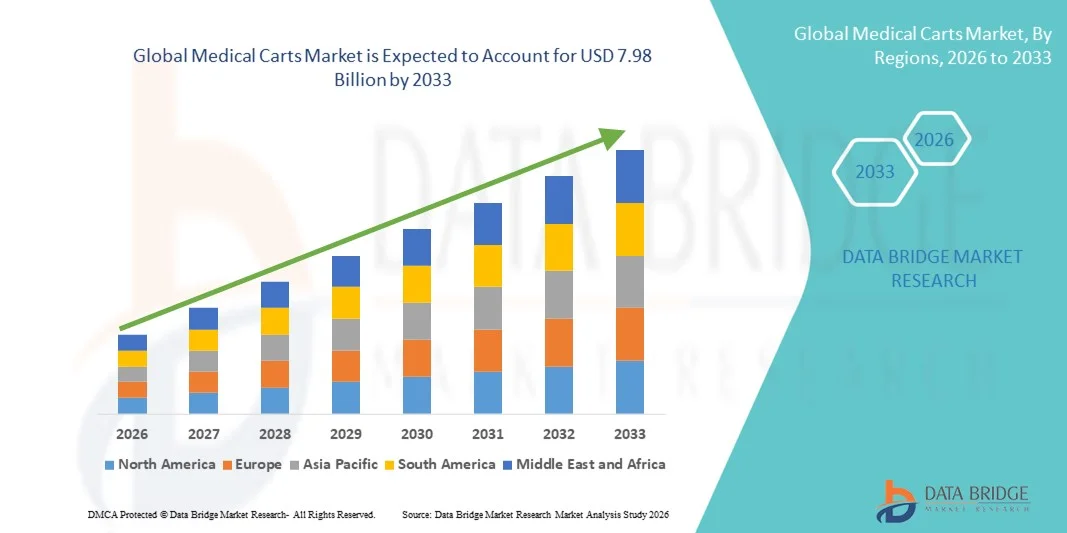
- As per Data Bridge Market Research analysis, the global medical carts market size was valued at USD 2.94 billion in 2025 and is expected to reach USD 7.98 billion by 2033, at a CAGR of 13.3% during the forecast period
- The market growth is largely driven by the increasing demand for efficient healthcare delivery, workflow optimization, and the need for mobile storage and transport solutions within hospitals, clinics, and other healthcare facilities
- Furthermore, rising adoption of smart and ergonomic medical carts equipped with advanced features such as integrated charging stations, electronic medical record (EMR) access, and infection control measures is positioning medical carts as essential tools in modern healthcare settings. These factors are collectively propelling the adoption of medical cart solutions, thereby accelerating the industry’s growth
Market Size & Forecast
- Global Market Value (2025): USD 2.94 Billion
- Expected Market Value (2033): USD 7.98 Billion
- Forecast CAGR (2026–2033): 13.3%
What are the Major Takeaways of Medical Carts Market?
- Medical carts, providing mobile storage and transport solutions for medical equipment, medications, and supplies, are increasingly vital components of modern healthcare facilities in hospitals, clinics, and ambulatory centers due to their ability to streamline workflows, improve patient care efficiency, and support integration with electronic health record (EHR) systems
- The escalating demand for medical carts is primarily fueled by the growing adoption of smart and ergonomic healthcare equipment, rising focus on infection control and patient safety, and increasing need for efficient point-of-care solutions that enhance clinical productivity
- North America dominated the medical carts market with the largest revenue share of 38.7% in 2025, characterized by advanced healthcare infrastructure, high adoption of digital healthcare solutions, and a strong presence of key industry players, with the U.S. experiencing substantial growth in computer medical cart and emergency cart installations across hospitals and surgical centers, driven by innovations in modular design, integrated charging stations, and EHR-enabled systems
- Asia-Pacific is expected to be the fastest-growing region in the medical carts market during the forecast period due to increasing healthcare investments, expanding hospital networks, and rising demand for technologically advanced and mobile medical solutions
- Medication Carts segment dominated the medical carts market with a market share of 42.1% in 2025, driven by their critical role in secure bedside medication administration, storage efficiency, and workflow optimization in healthcare settings
Report Scope and Medical Carts Market Segmentation
|
Attributes |
Medical Carts Key Market Insights |
|
Segments Covered |
|
|
Countries Covered |
North America
Europe
Asia-Pacific
Middle East and Africa
South America
|
|
Key Market Players |
|
|
Market Opportunities |
|
|
Value Added Data Infosets |
In addition to the insights on market scenarios such as market value, growth rate, segmentation, geographical coverage, and major players, the market reports curated by the Data Bridge Market Research also include in-depth expert analysis, patient epidemiology, pipeline analysis, pricing analysis, and regulatory framework |
What is the Key Trend in the Medical Carts Market?
Integration of Smart and IoT-Enabled Features
- A significant and accelerating trend in the global medical carts market is the integration of smart and IoT-enabled technologies, allowing real-time monitoring of inventory, medication administration, and equipment usage across healthcare facilities
- For instance, the Capsa Healthcare smart medication cart integrates RFID tracking and IoT connectivity, enabling hospitals to monitor stock levels, reduce errors, and track usage patterns efficiently
- Smart medical carts with digital displays and connectivity facilitate seamless integration with electronic health record (EHR) systems, providing healthcare staff with instant access to patient data and medication information at the point of care
- This integration also allows predictive maintenance alerts, automated notifications for low supplies, and enhanced workflow optimization, reducing delays in patient care and operational inefficiencies
- This trend toward intelligent, connected, and workflow-optimized medical carts is reshaping healthcare delivery expectations, driving manufacturers such as Ergotron to develop modular, IoT-enabled carts with integrated charging and data management solutions
- The demand for smart, connected medical carts is growing rapidly across hospitals, clinics, and ambulatory surgical centers, as healthcare providers increasingly prioritize operational efficiency, safety, and real-time data access
- Integration of AI-powered analytics in some advanced carts is providing actionable insights on usage patterns, maintenance needs, and workflow optimization, further enhancing operational effectiveness
What are the Key Drivers of Medical Carts Market?
Driver
Rising Need for Workflow Efficiency and Patient Safety
- The increasing focus on improving clinical workflow efficiency and patient safety is a major driver for the growing adoption of medical carts across healthcare facilities
- For instance, in March 2025, Capsa Healthcare introduced smart medication carts with integrated EHR access to streamline bedside medication administration and reduce errors
- Healthcare facilities are adopting medical carts to support point-of-care operations, enabling staff to deliver faster and safer patient care while minimizing movement and delays
- The growing use of modular, multi-functional carts allows hospitals to consolidate supplies, monitor medications, and access equipment efficiently, improving overall productivity and care quality
- Enhanced mobility, accessibility to real-time patient data, and ergonomic designs further propel the adoption of medical carts in hospitals, clinics, and ambulatory surgical centers, aligning with modern healthcare efficiency goals
- Increasing demand for automated medication dispensing and inventory management capabilities in medical carts is driving adoption in large hospital networks, improving compliance and safety
- Growing awareness of infection control and the role of specialized medical carts in minimizing cross-contamination is further encouraging healthcare providers to invest in advanced cart solutions
Restraint/Challenge
High Initial Costs and Maintenance Requirements
- The relatively high upfront cost of advanced medical carts, particularly those equipped with IoT and smart features, poses a significant challenge to wider adoption, especially in smaller healthcare facilities
- For instance, hospitals in developing regions may face budget constraints when procuring smart medication or computer medical carts with integrated EHR and charging solutions
- In addition, ongoing maintenance, software updates, and technical support requirements for connected medical carts increase operational expenses, which can limit adoption in cost-sensitive settings
- While traditional carts are more affordable, the lack of smart functionality reduces workflow optimization and patient safety benefits, creating a trade-off for healthcare providers
- Overcoming these challenges through cost-effective product designs, leasing models, and training for staff on efficient utilization of smart carts is crucial for sustained market growth
- Limited interoperability with existing hospital IT infrastructure and EHR systems can slow adoption of smart medical carts in some healthcare facilities, requiring additional investment in integration
- Concerns about potential system downtime, battery failures, or technical glitches in smart carts may create hesitation among hospital administrators, emphasizing the need for reliable support and robust designs
How is the Medical Carts Market Segmented?
The market is segmented on the basis of product, type, application, material type, payload, end user, and distribution channel.
- By Product
On the basis of product, the global medical carts market is segmented into mobile computing carts, medical storage columns, cabinets and accessories, medication carts, wall-mounted workstations, and others. Medication Carts dominated the market with the largest revenue share of 42.1% in 2025, driven by their critical role in secure bedside medication administration and workflow optimization. Hospitals and clinics increasingly prefer medication carts to minimize errors, improve patient safety, and streamline staff efficiency during routine rounds. These carts often come with built-in locks, drawers, and compartments tailored to medical workflows, enhancing operational convenience. Integration with electronic health record (EHR) systems and RFID tracking further increases their adoption across healthcare facilities. The strong demand is also supported by rising hospital automation initiatives and the need for mobile, point-of-care solutions.
Mobile Computing Carts are anticipated to witness the fastest growth from 2026 to 2033 due to the increasing need for bedside access to EHRs, telemedicine applications, and point-of-care documentation. Their ability to combine mobility with digital access, charging stations, and connectivity to healthcare IT systems makes them essential in modern hospitals. Growing investments in smart hospital infrastructure and AI-enabled medical solutions further accelerate their adoption across clinics, surgical centers, and large hospital networks. These carts enhance workflow efficiency, reduce patient wait times, and improve staff productivity. Hospitals are also adopting them to support telehealth services and real-time clinical data entry.
- By Type
On the basis of type, the market is segmented into computer medical cart, emergency cart, procedure cart, anesthesia cart, medical laboratory utility cart, and others. Computer Medical Carts held the largest market share in 2025 due to their pivotal role in enabling healthcare providers to access patient records, input data, and perform medication checks at the point of care. These carts enhance efficiency, reduce workflow delays, and improve data accuracy while supporting integration with EHR and hospital IT systems. Hospitals and clinics prioritize these carts for their ergonomic designs, mobility, and multifunctional capabilities. The strong presence of IT-enabled healthcare solutions in North America and Europe further drives market dominance. Computer medical carts also allow integration with barcode scanning, automated alerts, and digital documentation, making them indispensable in modern hospital workflows.
Emergency Carts are projected to be the fastest-growing type from 2026 to 2033, propelled by increasing hospital focus on critical care readiness and rapid response capabilities. Emergency carts provide organized storage of emergency medications, equipment, and supplies, enabling clinicians to respond promptly during high-pressure scenarios. Adoption is being fueled by rising investments in trauma centers, ICUs, and surgical units, along with increasing awareness of patient safety protocols. Hospitals are also upgrading emergency carts with IoT-enabled monitoring for inventory and expiration management. The rising prevalence of chronic diseases and emergency care requirements is further driving adoption.
- By Application
On the basis of application, the market is segmented into medical, medical imaging, laboratory, and others. Medical application dominated in 2025, accounting for the largest revenue share due to widespread use in hospitals, clinics, and surgical centers. These carts support routine care, medication administration, and point-of-care documentation, improving overall efficiency and patient outcomes. Their demand is further supported by increasing hospital automation, healthcare digitization, and a focus on clinical workflow optimization. Hospitals increasingly use medical carts to support bedside care, emergency response, and nursing rounds efficiently. They are also integrating carts with EHR systems and wireless networks to enhance staff productivity.
Laboratory application is expected to witness the fastest growth during the forecast period, driven by rising adoption of medical laboratory utility carts for sample transport, storage of reagents, and safe handling of laboratory equipment. Growth in diagnostic services, biotechnology research, and pathology labs is fueling the need for specialized laboratory carts. These carts help maintain bio-safety standards and reduce cross-contamination risks. Automated lab carts with IoT connectivity further enhance inventory monitoring and operational efficiency. Rising outsourcing of lab services also boosts demand for mobile and modular lab carts.
- By Material Type
On the basis of material, the market is segmented into plastic, wood, stainless steel, metal, and others. Metal carts dominated the market in 2025 due to their durability, hygiene compliance, and suitability for heavy-duty medical and laboratory applications. Hospitals prefer metal carts for long-term usage, ease of cleaning, and compatibility with infection control protocols. They can withstand frequent disinfection, heavy equipment loads, and high-traffic hospital environments. Metal carts also support modular designs and integration with smart technologies. Their structural reliability makes them ideal for emergency, procedure, and anesthesia carts.
Plastic carts are expected to be the fastest-growing rate from 2026 to 2033 due to their lightweight design, mobility, and cost-effectiveness. They are particularly popular in clinics and ambulatory centers where portability and ease of handling are critical. Plastic medical carts are easy to clean, chemically resistant, and suitable for moderate payload applications. Their flexibility in design allows customization for specific medical workflows. Lightweight construction reduces staff fatigue and enhances ergonomics during patient care rounds.
- By Payload
On the basis of payload, the market is segmented into 50 kg, 65 kg, 80 kg, 150 kg, 180 kg, and Others. 80 kg payload carts dominated the market in 2025, balancing mobility and storage capacity for typical point-of-care applications. Their adoption is widespread in hospitals and surgical centers for medication, equipment, and documentation purposes. 80 kg carts allow sufficient storage without compromising staff ergonomics or mobility in hospital corridors. They are compatible with modular drawer systems, EHR devices, and monitoring tools. Their durability and ease of use contribute to their dominant share. Hospitals also prefer them for rounds, emergency response, and routine care delivery.
150 kg payload carts are anticipated to witness the fastest growth during the forecast period, as heavier carts can accommodate more medical devices, monitors, and critical care equipment, meeting the increasing needs of modern hospitals. High-payload carts are particularly suitable for ICUs, operating rooms, and large surgical centers. They support multiple devices, oxygen tanks, and complex monitoring equipment without compromising mobility. Growing adoption of telehealth and mobile diagnostic solutions further fuels demand. Advanced materials and ergonomic design improvements make these carts manageable despite their heavier payload.
- By End User
On the basis of end user, the market is segmented into hospitals, clinics, ambulatory surgical centers, trauma centers, and others. Hospitals dominated the market in 2025 due to large-scale deployment of various medical cart types to support patient care, emergency readiness, and workflow optimization. Hospitals invest in advanced computer medical carts, emergency carts, and medication carts to improve staff efficiency and patient safety. High patient volumes and the need for real-time data access contribute to strong demand. Hospitals are also early adopters of IoT-enabled and AI-integrated carts to support modern healthcare operations. Their ability to deploy carts across departments enhances operational efficiency.
Ambulatory Surgical Centers are expected to be the fastest-growing end-user segment during the forecast period, driven by the rising number of outpatient procedures, need for mobile medical solutions, and focus on operational efficiency in smaller healthcare facilities. These centers prefer compact, lightweight, and multifunctional carts for surgical prep, medication delivery, and documentation. The growing adoption of telemedicine and outpatient care trends also accelerates demand. Integration with mobile IT systems and EHRs supports workflow optimization and staff productivity.
- By Distribution Channel
On the basis of distribution channel, the market is segmented into Direct Tender, Third Party Distributors, and Others. Direct Tender dominated the market in 2025, particularly in large hospitals and healthcare networks that prefer direct procurement from manufacturers to ensure customization, compliance, and post-sales support. Hospitals benefit from tailored cart solutions, bulk procurement discounts, and reliable after-sales service. Direct tenders also allow integration with hospital IT systems, EHRs, and inventory management tools. Long-term contracts support maintenance and upgrade programs for advanced carts. Strong manufacturer relationships further strengthen this channel’s dominance.
Third Party Distributors are expected to witness the fastest growth during the forecast period, as small clinics, surgical centers, and emerging healthcare facilities increasingly rely on distributors for easier access to medical carts, competitive pricing, and faster delivery. Distributors provide a variety of product options, including modular, lightweight, and IoT-enabled carts. Their presence allows access to emerging markets and smaller healthcare providers who may not have direct manufacturer ties. The growing network of regional distributors enhances accessibility and adoption. Flexible delivery, installation, and post-sales support services further drive growth in this channel.
Which Region Holds the Largest Share of the Medical Carts Market?
- North America dominated the medical carts market with the largest revenue share of 38.7% in 2025, characterized by advanced healthcare infrastructure, high adoption of digital healthcare solutions, and a strong presence of key industry players
- Healthcare facilities in the region prioritize mobile medical solutions that enhance patient care efficiency, support point-of-care documentation, and improve medication administration, making medical carts a critical operational tool
- This strong adoption is further supported by high healthcare spending, early implementation of smart and IoT-enabled carts, and increasing investments in hospital automation and patient safety programs, establishing medical carts as an essential component of modern healthcare operations
U.S. Medical Carts Market Insight
The U.S. medical carts market captured the largest revenue share of 79% in 2025 within North America, fueled by the widespread adoption of digital healthcare solutions and smart hospital infrastructure. Healthcare providers are increasingly prioritizing workflow optimization, bedside care efficiency, and integration with electronic health record (EHR) systems. The growing demand for mobile computing carts, emergency carts, and medication carts further propels market growth. In addition, hospitals and large clinics are investing in IoT-enabled and AI-integrated carts to enhance patient safety, streamline operations, and reduce medical errors. Strong healthcare spending and early adoption of technology-driven solutions continue to drive market expansion.
Europe Medical Carts Market Insight
The Europe medical carts market is projected to expand at a substantial CAGR throughout the forecast period, primarily driven by the increasing focus on patient safety, hospital automation, and regulatory compliance. Rising adoption of smart medical carts in hospitals, clinics, and surgical centers is facilitating better workflow management and inventory tracking. Countries such as Germany, France, and Italy are witnessing growth in digital healthcare infrastructure and mobile point-of-care solutions. European healthcare providers also value ergonomic, durable, and connected medical carts that support medication administration and clinical documentation. Expansion across both new healthcare facilities and retrofitted hospitals is contributing to market growth.
U.K. Medical Carts Market Insight
The U.K. medical carts market is anticipated to grow at a noteworthy CAGR during the forecast period, driven by the increasing adoption of smart hospital solutions and demand for efficient, mobile healthcare equipment. Hospitals and clinics are focusing on enhancing patient care, reducing staff workload, and improving operational efficiency through computer medical carts and emergency carts. In addition, the integration of medical carts with EHR systems, RFID tracking, and IoT-enabled devices supports better inventory management and bedside care. The U.K.’s emphasis on patient safety, digital healthcare initiatives, and robust hospital infrastructure is expected to continue stimulating market growth.
Germany Medical Carts Market Insight
The Germany medical carts market is expected to expand at a considerable CAGR during the forecast period, fueled by increasing healthcare digitization, patient safety initiatives, and workflow optimization in hospitals. German healthcare providers prioritize durable, modular, and connected medical carts for efficient point-of-care medication administration, documentation, and emergency response. Adoption of smart and AI-enabled carts is rising, enabling real-time inventory monitoring and data integration with hospital IT systems. Germany’s focus on innovation, technology-driven healthcare, and stringent regulatory standards supports the deployment of advanced medical cart solutions across both hospitals and clinics.
Asia-Pacific Medical Carts Market Insight
The Asia-Pacific medical carts market is poised to grow at the fastest CAGR of 23% during the forecast period of 2026 to 2033, driven by expanding hospital networks, increasing healthcare investments, and rising adoption of smart and IoT-enabled healthcare equipment in countries such as China, Japan, and India. Rapid urbanization, growing patient populations, and rising demand for operational efficiency in healthcare facilities are driving adoption. The increasing trend of digital healthcare and telemedicine solutions further supports the market. Furthermore, APAC is emerging as a manufacturing hub for smart medical carts, making advanced and affordable solutions more accessible to a wider range of healthcare providers.
Japan Medical Carts Market Insight
The Japan medical carts market is gaining momentum due to the country’s technologically advanced healthcare infrastructure, emphasis on patient safety, and the need for efficient point-of-care solutions. Hospitals and clinics are adopting computer medical carts, mobile computing carts, and emergency carts to improve workflow efficiency and support EHR integration. Integration with IoT devices, automated inventory management, and ergonomic designs is fueling market growth. Moreover, Japan’s aging population increases the demand for mobile and easy-to-use medical carts in both residential care and hospital settings, driving adoption in private and public healthcare facilities.
India Medical Carts Market Insight
The India medical carts market accounted for the largest market revenue share in Asia-Pacific in 2025, attributed to rapid urbanization, growing hospital infrastructure, and increasing technological adoption across healthcare facilities. Hospitals, clinics, and ambulatory surgical centers are investing in mobile computing carts, medication carts, and emergency carts to improve workflow efficiency and patient care. Government initiatives toward smart hospitals and digital healthcare infrastructure support market growth. The availability of cost-effective solutions and the presence of domestic manufacturers further accelerate adoption. Rising awareness of patient safety, hospital automation, and point-of-care efficiency continue to drive market expansion in India.
Which are the Top Companies in Medical Carts Market?
The Medical Carts industry is primarily led by well-established companies, including:
- Ergotron (U.S.)
- Capsa Healthcare (U.S.)
- TouchPoint Medical (U.S.)
- ITD GmbH (Germany)
- Advantech Co., Ltd (Taiwan)
- AFC Industries (U.S.)
- Midmark Corporation (U.S.)
- Harloff Manufacturing Co. (U.S.)
- JACO, Inc. (U.S.)
- Enovate Medical (U.S.)
- Bytec Group (U.K.)
- InterMetro Industries Corporation (U.S.)
- Parity Medical (U.K.)
- The Bergmann Group (U.S.)
- GCX Corporation (U.S.)
- Lakeside Manufacturing (U.S.)
- Medline Industries, LP (U.S.)
- Scott Clark Medical (U.S.)
- Cygnus Inc (U.S.)
- KbPort Healthcare (U.S.)
What are the Recent Developments in Global Medical Carts Market?
- In September 2024, Capsa Healthcare unveiled its new Tryten P‑Series tablet and monitor carts designed for enhanced telehealth and bedside care, featuring improved articulating arms, stability, and cable management to support virtual patient care and EHR workflows across hospitals
- In August 2024, TAGCarts® and Inpro officially launched the TAG‑X® Smart Rail, a wireless, contactless charging solution for medical carts and mobile medical equipment that eliminates hazardous cords, optimizes battery health, and enhances efficiency and safety in healthcare environments
- In November 2022, Capsa Healthcare announced the NexsysADC automated system’s extension to support ambulance and EMS medical services, allowing controlled medication storage and inventory tracking for first responders during emergency care
- In March 2022, Capsa Healthcare expanded its NexsysADC automated dispensing platform by adding larger controlled access module (CAM) drawers capable of storing bulk medications and supplies, enhancing secure medication management across various healthcare settings
- In August 2021, Ergotron introduced its updated CareFit™ Pro medical cart, designed to improve caregiver well‑being and streamline clinical workflow with customizable drawers and accessories, setting a new standard in ergonomic medical cart design for healthcare environments

- Interactive Data Analysis Dashboard
- Company Analysis Dashboard for high growth potential opportunities
- Research Analyst Access for customization & queries
- Competitor Analysis with Interactive dashboard
- Latest News, Updates & Trend analysis
- Harness the Power of Benchmark Analysis for Comprehensive Competitor Tracking
Data collection and base year analysis are done using data collection modules with large sample sizes. The stage includes obtaining market information or related data through various sources and strategies. It includes examining and planning all the data acquired from the past in advance. It likewise envelops the examination of information inconsistencies seen across different information sources. The market data is analysed and estimated using market statistical and coherent models. Also, market share analysis and key trend analysis are the major success factors in the market report. To know more, please request an analyst call or drop down your inquiry.
The key research methodology used by DBMR research team is data triangulation which involves data mining, analysis of the impact of data variables on the market and primary (industry expert) validation. Data models include Vendor Positioning Grid, Market Time Line Analysis, Market Overview and Guide, Company Positioning Grid, Patent Analysis, Pricing Analysis, Company Market Share Analysis, Standards of Measurement, Global versus Regional and Vendor Share Analysis. To know more about the research methodology, drop in an inquiry to speak to our industry experts.
Data Bridge Market Research is a leader in advanced formative research. We take pride in servicing our existing and new customers with data and analysis that match and suits their goal. The report can be customized to include price trend analysis of target brands understanding the market for additional countries (ask for the list of countries), clinical trial results data, literature review, refurbished market and product base analysis. Market analysis of target competitors can be analyzed from technology-based analysis to market portfolio strategies. We can add as many competitors that you require data about in the format and data style you are looking for. Our team of analysts can also provide you data in crude raw excel files pivot tables (Fact book) or can assist you in creating presentations from the data sets available in the report.













