


Medical Device Cybersecurity Solutions Market Size
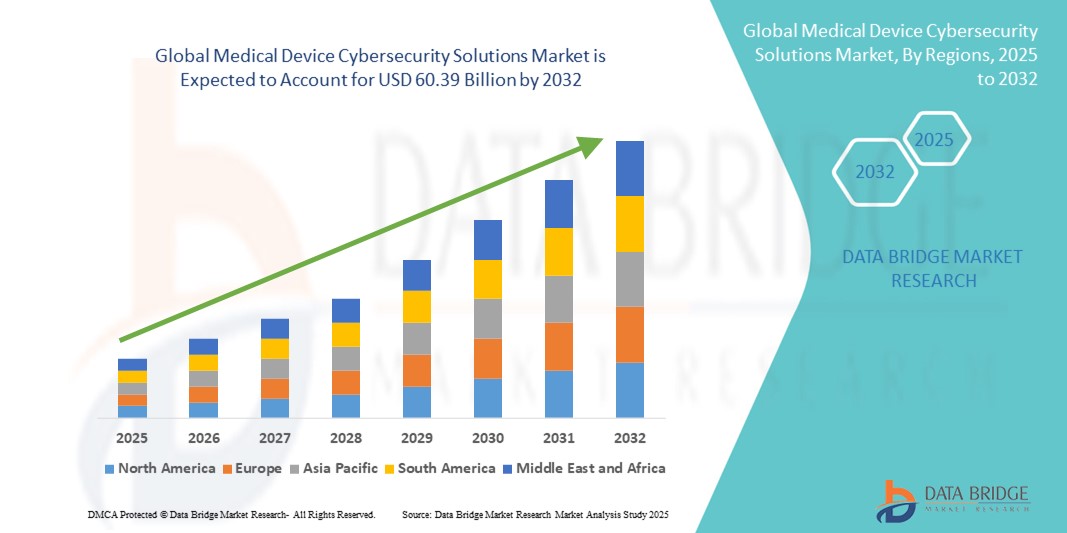
- The global medical device cybersecurity solutions market size was valued at USD 12.22 billion in 2024 and is expected to reach USD 60.39 billion by 2032, at a CAGR of 22.10% during the forecast period
- The market growth is largely fueled by the increasing adoption of connected medical devices, digital health technologies, and telemedicine platforms, leading to higher integration of medical equipment with hospital networks and cloud-based systems. This digital transformation across healthcare is creating a strong demand for robust cybersecurity solutions to safeguard patient data and ensure device integrity
- Furthermore, rising concerns over data breaches, ransomware attacks, and unauthorized access to critical medical devices are establishing cybersecurity solutions as an essential component of modern healthcare infrastructure. These converging factors are accelerating the uptake of medical device cybersecurity solutions, thereby significantly boosting the industry’s growth
Medical Device Cybersecurity Solutions Market Analysis
- Medical device cybersecurity solutions are increasingly critical to safeguarding connected medical devices from cyber threats, ensuring patient safety, data protection, and compliance with stringent regulatory requirements. The rapid digitalization of healthcare, growing adoption of IoMT (Internet of Medical Things), and increasing sophistication of cyberattacks are driving the demand for advanced cybersecurity solutions in this market
- The rising demand for medical device cybersecurity solutions is primarily fueled by the surge in connected medical devices, heightened vulnerability to ransomware and data breaches, and stricter enforcement of compliance standards such as HIPAA, FDA guidelines, and GDPR
- North America dominated the medical device cybersecurity solutions market with the largest revenue share of 40.5% in 2024, characterized by advanced healthcare infrastructure, high adoption of digital health technologies, and a strong regulatory environment. The U.S. in particular is experiencing substantial growth due to significant investments in cybersecurity for healthcare institutions, rising awareness of cyber risks, and innovations from both established players and startups focusing on AI-driven and automated security platforms
- Asia-Pacific is expected to be the fastest growing region in the medical device cybersecurity solutions market during the forecast period, projected to grow at a CAGR of 9.5% from 2025 to 2032, driven by rapid urbanization, rising adoption of connected healthcare systems, and increasing government initiatives to strengthen medical cybersecurity. Countries such as China, India, Japan, and South Korea are witnessing accelerated investments in healthcare IT infrastructure, which is expected to significantly boost market expansion
- The hospital medical devices segment dominated the medical device cybersecurity solutions market with the largest market revenue share of 41.5% in 2024, as critical care equipment—such as ventilators, infusion pumps, imaging scanners, and surgical robots—require continuous uptime and secure operation
Report Scope and Medical Device Cybersecurity Solutions Market Segmentation
|
Attributes |
Medical Device Cybersecurity Solutions Key Market Insights |
|
Segments Covered |
|
|
Countries Covered |
North America
Europe
Asia-Pacific
Middle East and Africa
South America
|
|
Key Market Players |
|
|
Market Opportunities |
|
|
Value Added Data Infosets |
In addition to the insights on market scenarios such as market value, growth rate, segmentation, geographical coverage, and major players, the market reports curated by the Data Bridge Market Research also include in-depth expert analysis, pricing analysis, brand share analysis, consumer survey, demography analysis, supply chain analysis, value chain analysis, raw material/consumables overview, vendor selection criteria, PESTLE Analysis, Porter Analysis, and regulatory framework. |
Medical Device Cybersecurity Solutions Market Trends
Enhanced Protection Through Regulatory Compliance and Advanced Security Integration
- A significant and accelerating trend in the global medical device cybersecurity solutions market is the increasing emphasis on compliance with international regulations and security frameworks such as HIPAA, GDPR, and FDA cybersecurity guidelines. Healthcare providers and device manufacturers are prioritizing robust cybersecurity protocols to avoid penalties, safeguard patient data, and ensure uninterrupted clinical operations
- For instance, leading solution providers are introducing cybersecurity platforms that embed compliance-ready frameworks, allowing hospitals and clinics to meet evolving regulatory requirements. Companies are offering solutions with real-time monitoring, encryption, and patch management to align with global cybersecurity standards, thereby enhancing adoption among healthcare institutions
- The growing interconnectedness of medical devices within the Internet of Medical Things (IoMT) ecosystem has amplified the need for secure communication channels, intrusion detection, and risk assessment tools. Advanced cybersecurity solutions now include continuous vulnerability scanning and device authentication systems to prevent unauthorized access and protect sensitive patient information
- The seamless integration of medical device cybersecurity with broader hospital IT infrastructure facilitates centralized monitoring of threats, streamlined risk management, and incident response. Through a single platform, healthcare organizations can manage both clinical data security and device functionality, ensuring reliability and patient safety
- This trend towards more regulated, secure, and interconnected medical device environments is fundamentally reshaping healthcare cybersecurity priorities. Consequently, companies such as MedCrypt and Cynerio are developing specialized solutions for real-time monitoring, zero-trust security models, and device-specific protection frameworks
- The demand for medical device cybersecurity solutions is growing rapidly across both developed and emerging healthcare markets, as hospitals, clinics, and research institutions increasingly prioritize regulatory compliance, patient safety, and resilience against cyberattacks
Medical Device Cybersecurity Solutions Market Dynamics
Driver
Growing Need Due to Rising Security Concerns in Healthcare and Rapid Digitalization
- The increasing prevalence of cyberattacks targeting healthcare providers and medical devices, coupled with the accelerating adoption of digital health ecosystems, is a significant driver for the heightened demand for medical device cybersecurity solutions
- For instance, in April 2024, the U.S. Food and Drug Administration (FDA) introduced updated cybersecurity guidance for medical device manufacturers, emphasizing stronger premarket security testing and postmarket monitoring. Such initiatives by regulators and collaborations with industry players are expected to drive the Medical Device Cybersecurity Solutions industry growth in the forecast period
- As healthcare providers become more aware of potential security threats and seek enhanced protection for patient data, advanced cybersecurity solutions offer critical features such as threat detection, data encryption, intrusion prevention, and tamper alerts—providing a compelling upgrade over traditional IT security systems
- Furthermore, the growing popularity of connected medical devices, cloud-based platforms, and AI-driven healthcare systems is making cybersecurity an integral component of healthcare IT, offering seamless integration with hospital information systems and remote patient monitoring platforms
- The convenience of centralized monitoring, compliance management, and the ability to secure sensitive data across multiple device types are key factors propelling the adoption of medical device cybersecurity solutions in both healthcare provider and manufacturer sectors. The trend toward digital health adoption and the increasing availability of user-friendly, regulatory-compliant cybersecurity options further contribute to market growth
Restraint/Challenge
Concerns Regarding Cybersecurity Vulnerabilities and High Implementation Costs
- Concerns surrounding the cybersecurity vulnerabilities of connected medical devices and healthcare IT systems pose a significant challenge to broader market penetration. As medical devices rely on network connectivity and software, they are susceptible to hacking attempts, ransomware attacks, and data breaches, raising anxieties among healthcare organizations about patient safety and compliance
- For instance, high-profile reports of ransomware attacks on hospital systems and breaches of patient health records have made some institutions hesitant to adopt advanced connected medical technologies without robust cybersecurity safeguards
- Addressing these concerns through robust encryption, secure authentication protocols, vulnerability assessments, and regular software updates is crucial for building trust among stakeholders. Companies such as IBM, Cisco, and Fortinet emphasize their advanced threat detection and compliance management capabilities in their solutions to reassure healthcare providers and device manufacturers
- In addition, the relatively high initial cost of advanced medical device cybersecurity systems compared to traditional IT security can be a barrier to adoption for smaller hospitals and healthcare facilities, particularly in developing regions with limited budgets. While cloud-based security solutions have made cybersecurity more accessible, premium features such as AI-driven analytics and advanced endpoint protection often come with a higher price tag
- While costs are gradually decreasing due to technological advancements, the perceived premium for robust cybersecurity can still hinder widespread adoption, especially for budget-conscious healthcare providers. Overcoming these challenges through enhanced regulatory frameworks, industry collaboration, and the development of more affordable medical device cybersecurity solutions will be vital for sustained market growth
Medical Device Cybersecurity Solutions Market Scope
The market is segmented on the basis of solutions, type, device type, and end-user.
- By Solutions
On the basis of solutions, the medical device cybersecurity solutions market is segmented into Identity and Access Management Solutions, Antivirus/Antimalware Solutions, Encryption Solutions, Data Loss Prevention Solutions, Risk and Compliance Management, Intrusion Detection Systems/Intrusion Prevention Systems, Disaster Recovery Solutions, Distributed Denial of Service Solutions, and Other Solutions. The Identity and Access Management (IAM) solutions segment dominated the largest market revenue share of 27.0% in 2024, underpinned by its critical role in enforcing secure user authentication, multi-factor authentication, and role-based access control in healthcare networks. IAM solutions are pivotal in maintaining integrity of patient data and preventing unauthorized access across interconnected device ecosystems. Integration of IAM with biometric authentication, centralized identity platforms, and real-time session monitoring further strengthens institutional trust and compliance. Regulatory mandates such as HIPAA, GDPR, and FDA cybersecurity guidance continue to drive adoption, as IAM assists in audit trails and governance. Healthcare organizations increasingly rely on IAM to manage staff, device, and third-party user access in hospitals, clinics, and telehealth platforms. Investment in IAM is being further fueled by the need for scalable and interoperable security platforms in expanding Internet of Medical Things (IoMT) deployments.
The intrusion detection systems/intrusion prevention systems (IDS/IPS) segment is anticipated to witness the fastest CAGR of 20.1% from 2025 to 2032, driven by a significant rise in cyber threats targeting medical infrastructure, including ransomware and network intrusions. IDS/IPS solutions provide hospitals and clinics with real-time monitoring, anomaly detection, and automated response capabilities, which are vital for early threat mitigation. The integration of behavioral analytics, machine learning-powered detection, and centralized threat intelligence enhances detection accuracy and lowers false positive rates. Rapid proliferation of telemedicine services, remote monitoring devices, and cloud-hosted systems increases the attack surface, necessitating advanced IDS/IPS deployment. Furthermore, regulatory expectations for proactive threat defense and incident response planning elevate the importance of these systems. Healthcare cybersecurity strategy now often begins with robust IDS/IPS layers to protect device integrity and ensure continuity of clinical services during cyber incidents.
- By Type
On the basis of type, the medical device cybersecurity solutions market is segmented into Network Security, Endpoint Security, Application Security, Cloud Security, and Other Security Types. The Network Security segment dominated the largest market revenue share of 35.3% in 2024, because healthcare organizations operate complex networks connecting imaging systems, infusion pumps, EHR platforms, and clinical workstations that require secure data transmission. Network security measures—including next-generation firewalls, secure gateways, and intrusion prevention—are integral to preventing lateral movement of threats within hospital infrastructure. The centralized network defense also streamlines compliance and monitoring for regulatory audits. As specialized medical devices often lack built-in security, network security solutions act as critical control points to detect and block malicious activity. Hospitals and healthcare IT departments favor network-level measures for their broad vehicle coverage across multiple departments and ability to intercept threats before they reach critical endpoints. Investment in secure segmentation, encrypted VPNs, and zero-trust network architecture continues to reinforce dominance of network security investments.
The cloud security segment is projected to witness the fastest CAGR of 19.9% during 2025–2032, spurred by the growing shift to cloud-based platforms for EHRs, telehealth, medical imaging archives, and remote diagnostic tools. Cloud security solutions—such as cloud access security brokers (CASBs), secure API gateways, and cloud workload protection—are increasingly essential for safeguarding healthcare data in transit and at rest. Providers are investing in cloud-native encryption, identity-based access controls, and real-time breach detection to maintain compliance, especially with cross-border data storage requirements. The rise of hybrid cloud architectures and distributed patient monitoring systems further amplifies need for dynamic cloud security. Rapid digital transformation, including AI-driven analytics and big data initiatives in healthcare, relies on secure cloud frameworks. The ability to scale cloud security rapidly makes it attractive for both large hospital systems and smaller clinics transitioning to cloud-based infrastructure.
- By Device Type
On the basis of device type, the medical device cybersecurity solutions market is segmented into Hospital Medical Devices, Wearable and External Medical Devices, and Internally Embedded Medical Devices. The Hospital Medical Devices segment dominated the largest market revenue share of 41.5% in 2024, as critical care equipment—such as ventilators, infusion pumps, imaging scanners, and surgical robots—require continuous uptime and secure operation. These devices operate within high-risk environments, making them prime targets for cyber threats that could endanger patient safety. Cybersecurity solutions tailored to hospital devices must ensure patch management, integrity checking, and secure firmware updates within clinical workflows. Hospitals allocate a significant portion of cybersecurity budgets toward safeguarding these devices due to their complexity and regulatory implications. Integration with hospital network defenses and centralized monitoring systems further enhances protection of interconnected medical infrastructure. As healthcare systems expand connected device inventories, hospital-focused cybersecurity remains foundational.
The wearable and external medical devices segment is projected to witness the fastest CAGR of 18.4% from 2025 to 2032, driven by explosive growth in consumer-facing and clinical wearable devices—including continuous glucose monitors, remote cardiac trackers, and telehealth sensors. These devices generate sensitive personal health data that must be transmitted securely to healthcare providers, amplifying demand for encryption, secure wireless protocols, and device authentication. The shift toward remote patient monitoring and home-based care, especially post-pandemic, increases reliance on wearable security. Patients demand privacy and assurance that their data is protected from interception. Device manufacturers, recognizing this, are embedding cybersecurity features at design stage, including tamper detection, secure pairing, and OTA (over-the-air) encryption. With the rise of 5G and edge computing enabling real-time monitoring, wearables must maintain strong defenses against network-based attacks—thus catalyzing growth of security solutions in this segment.
- By End-User
On the basis of end-user, the medical device cybersecurity solutions market is segmented into Healthcare Providers, Medical Device Manufacturers, and Healthcare Payers. The Healthcare Providers segment dominated the largest market revenue share of 38.2% in 2024, given that hospitals, clinics, and ambulatory centers deploy vast arrays of connected devices integral to patient diagnosis, treatment, and data management. Providers are high-value targets for cybercriminals due to the availability of patient records, operational disruption potential, and the presence of lifesaving devices. In response, healthcare providers invest heavily in layered cybersecurity strategies, including access control, network segmentation, and incident response systems, to maintain continuity and comply with regulatory standards. Recurring ransomware threats and increasing regulatory fines for data breaches further drive spending. Collaboration with cybersecurity vendors to tailor solutions for clinical environments reinforces the dominant role of the provider segment.
The medical device manufacturers segment is expected to witness the fastest CAGR of 17.8% through 2025–2032, as manufacturers face increasing regulatory expectations (such as FDA documentation requirements and the EU’s MDR guidelines) compelling security-by-design implementations. Manufacturers embed cybersecurity through secure firmware updates, hardware encryption, and threat testing within their product development lifecycle. As supply chain attacks rise, OEMs are under pressure to secure not only device functionality but also chain-of-custody and software provenance. In addition, manufacturers engage in post-market surveillance and vulnerability disclosure programs, collaborating with cybersecurity firms to release patches and updates—making them dynamic adopters of cybersecurity platforms optimized for medical hardware. Market demand is further supported by healthcare customers requiring validated cybersecurity as a condition of procurement for their device fleets.
Medical Device Cybersecurity Solutions Market Regional Analysis
- North America dominated the medical device cybersecurity solutions market with the largest revenue share of 40.5% in 2024, characterized by advanced healthcare infrastructure, high adoption of digital health technologies, and a strong regulatory environment
- Healthcare providers and device manufacturers in the region are prioritizing cybersecurity to protect patient data and ensure regulatory compliance, particularly in light of increasing ransomware and phishing attacks on hospitals and connected devices
- The market is also supported by the presence of leading cybersecurity firms, robust cloud adoption, and continuous investments in AI-driven and automated security solutions tailored for healthcare environments
U.S. Medical Device Cybersecurity Solutions Market Insight
The U.S. medical device cybersecurity solutions market captured the largest revenue in 2024 within North America, fueled by significant investments from healthcare institutions, growing awareness of cyber risks, and supportive federal policies. The U.S. is witnessing accelerated adoption of advanced cybersecurity platforms that provide real-time threat detection, network segmentation, and compliance monitoring. Moreover, the rising number of connected medical devices, combined with FDA’s updated cybersecurity guidelines for manufacturers, is driving hospitals, clinics, and device companies to implement comprehensive security frameworks.
Europe Medical Device Cybersecurity Solutions Market Insight
The Europe medical device cybersecurity solutions market is projected to expand at a substantial CAGR throughout the forecast period, primarily driven by stringent data protection regulations such as GDPR and the EU Medical Device Regulation (MDR). The growing digitalization of healthcare systems and the adoption of telemedicine and cloud-based platforms are increasing the need for robust cybersecurity safeguards across the region. Europe is experiencing significant demand for secure medical device connectivity, endpoint protection, and regulatory-compliant solutions to ensure both patient safety and institutional resilience against cyberattacks.
U.K. Medical Device Cybersecurity Solutions Market Insight
The U.K. medical device cybersecurity solutions market is anticipated to grow at a noteworthy CAGR during the forecast period, supported by the rapid digital transformation of the National Health Service (NHS) and increasing integration of connected devices into healthcare. Rising concerns about ransomware incidents and data breaches are compelling healthcare providers to invest in cybersecurity platforms offering encryption, intrusion detection, and compliance management. The U.K.’s strong health IT ecosystem and government-backed initiatives for digital health security are expected to further stimulate market growth.
Germany Medical Device Cybersecurity Solutions Market Insight
The Germany medical device cybersecurity solutions market is expected to expand at a considerable CAGR during the forecast period, fueled by the country’s emphasis on data protection, technological innovation, and regulatory compliance. Germany’s healthcare sector is actively adopting secure cloud-based infrastructures and advanced endpoint security to manage growing cyber risks. The demand for privacy-focused, AI-enabled security platforms is gaining traction, aligning with local consumer expectations for data safety and institutional trust. The government’s strong stance on cybersecurity compliance across critical infrastructure further reinforces market adoption.
Asia-Pacific Medical Device Cybersecurity Solutions Market Insight
The Asia-Pacific medical device cybersecurity solutions market is poised to grow at the fastest CAGR of 9.5% during the forecast period of 2025 to 2032, driven by rapid urbanization, rising adoption of connected healthcare systems, and increasing government initiatives to strengthen medical cybersecurity. Countries such as China, India, Japan, and South Korea are witnessing accelerated investments in healthcare IT infrastructure, cloud-based hospital systems, and telemedicine platforms, all of which require advanced cybersecurity safeguards. The affordability of cybersecurity solutions, coupled with growing domestic vendors and international collaborations, is expected to significantly boost market expansion across the region.
Japan Medical Device Cybersecurity Solutions Market Insight
The Japan medical device cybersecurity solutions market is gaining momentum due to the country’s high-tech healthcare infrastructure, rapid digital adoption, and strong emphasis on patient safety. Hospitals and healthcare providers in Japan are increasingly prioritizing cybersecurity as the number of connected devices and telehealth platforms continues to rise. The aging population, along with government policies promoting secure digital health systems, is further spurring demand for medical device cybersecurity solutions. The market is also witnessing growth in AI-driven, automated platforms designed to detect and mitigate sophisticated cyber threats in real time.
China Medical Device Cybersecurity Solutions Market Insight
The China medical device cybersecurity solutions market accounted for the largest market revenue share in Asia-Pacific in 2024, supported by the country’s expanding healthcare infrastructure, strong digitalization initiatives, and rapid growth of connected medical devices. China’s push toward “smart hospitals” and government-backed data security laws are accelerating the adoption of advanced cybersecurity solutions. Local vendors, alongside global players, are contributing to competitive pricing and widespread deployment of security systems across both public and private healthcare facilities. The rising frequency of cyberattacks on healthcare institutions is further compelling hospitals and device manufacturers to integrate comprehensive cybersecurity solutions.
Medical Device Cybersecurity Solutions Market Share
The medical device cybersecurity solutions industry is primarily led by well-established companies, including:
- Cisco (U.S.)
- IBM Corporation (U.S.)
- General Electric Company (U.S.)
- Koninklijke Philips N.V. (Netherlands)
- Broadcom (U.S.)
- McAfee, LLC (U.S.)
- Check Point Software Technologies Ltd. (Israel)
- Palo Alto Networks. (U.S.)
- ClearDATA (U.S.)
- DXC Technology Company (U.S.)
- Sophos Ltd. (U.K.)
- Fortinet, Inc. (U.S.)
- Zscaler, Inc. (U.S.)
- FireEye, Inc. (U.S.)
Latest Developments in Global Medical Device Cybersecurity Solutions Market
- In December 2022, Palo Alto Networks announced its Medical IoT Security offering — a dedicated solution to discover, segment, and protect connected medical devices in healthcare environments
- In August 2023, MedCrypt expanded its platform capabilities (including enhancements to Helm and Guardian) to provide SBOM vulnerability management, runtime protections, and product-security intelligence targeted at medical-device OEMs
- In September 2023, the U.S. Food and Drug Administration (FDA) issued final guidance titled “Cybersecurity in Medical Devices: Quality System Considerations and Content of Premarket Submissions,” clarifying expectations for embedding cybersecurity into device quality systems and premarket submissions
- In March 2024, the FDA released draft “Select Updates for the Premarket Cybersecurity Guidance: Section 524B of the FD&C Act” proposing clarifications for cyber-device definitions and premarket expectations, prompting manufacturers to accelerate compliance work
- In February 2024, a major ransomware incident involving Change Healthcare (part of UnitedHealth Group) disrupted services and highlighted systemic supply-chain exposure in healthcare IT — an event that substantially increased focus on vendor and device security
- In June 2024, a ransomware attack on Synnovis (a pathology/testing services provider) caused broad disruption to NHS services in southeast London; subsequent investigations linked the incident to critical service failures and reported at least one patient fatality related to the disruption. The incident renewed regulatory and provider urgency on operational resilience and cyber protections for critical healthcare services
- In January 2025, the FDA and CISA publicly identified cybersecurity vulnerabilities in certain patient monitors (e.g., Contec/Epsimed models), warning healthcare providers of potential unauthorized access and urging mitigations — underscoring continuing device-level risk
- In June 2025, the FDA issued an updated/replaced iteration of its premarket cybersecurity guidance (continuing the 2023–2024 regulatory momentum), further clarifying manufacturer obligations for premarket and postmarket cybersecurity controls for medical devices

- Interactive Data Analysis Dashboard
- Company Analysis Dashboard for high growth potential opportunities
- Research Analyst Access for customization & queries
- Competitor Analysis with Interactive dashboard
- Latest News, Updates & Trend analysis
- Harness the Power of Benchmark Analysis for Comprehensive Competitor Tracking
Table of Content
1 INTRODUCTION
1.1 OBJECTIVES OF THE STUDY
1.2 MARKET DEFINITION
1.3 OVERVIEW OF GLOBAL MEDICAL DEVICE CYBERSECURITY SOLUTIONS MARKET
1.4 CURRENCY AND PRICING
1.5 LIMITATION
1.6 MARKETS COVERED
2 MARKET SEGMENTATION
2.1 KEY TAKEAWAYS
2.2 ARRIVING AT THE GLOBAL MEDICAL DEVICE CYBERSECURITY SOLUTIONS MARKET SIZE
2.2.1 VENDOR POSITIONING GRID
2.2.2 TECHNOLOGY LIFE LINE CURVE
2.2.3 TRIPOD DATA VALIDATION MODEL
2.2.4 MARKET GUIDE
2.2.5 MULTIVARIATE MODELLING
2.2.6 TOP TO BOTTOM ANALYSIS
2.2.7 CHALLENGE MATRIX
2.2.8 APPLICATION COVERAGE GRID
2.2.9 STANDARDS OF MEASUREMENT
2.2.10 VENDOR SHARE ANALYSIS
2.2.11 DATA POINTS FROM KEY PRIMARY INTERVIEWS
2.2.12 DATA POINTS FROM KEY SECONDARY DATABASES
2.3 GLOBAL MEDICAL DEVICE CYBERSECURITY SOLUTIONS MARKET: RESEARCH SNAPSHOT
2.4 ASSUMPTIONS
3 MARKET OVERVIEW
3.1 DRIVERS
3.2 RESTRAINTS
3.3 OPPORTUNITIES
3.4 CHALLENGES
4 EXECUTIVE SUMMARY
5 PREMIUM INSIGHTS
5.1 PESTEL ANALYSIS
5.2 PORTER’S FIVE FORCES MODEL
5.3 SURGERIES/PROCEDURES IN VOLUMES
5.4 HOSPITALS AND UROLOGIST IN MIDDLE EAST REGION
6 INDUSTRY INSIGHTS
6.1 MICRO AND MACRO ECONOMIC FACTORS
6.2 PENETRATION AND GROWTH PROSPECT MAPPING
6.3 KEY PRICING STRATEGIES
6.4 INTERVIEWS WITH SPECIALIST
6.5 ANALYIS AND RECOMMENDATION
7 INTELLECTUAL PROPERTY (IP) PORTFOLIO
7.1 PATENT QUALITY AND STRENGTH
7.2 PATENT FAMILIES
7.3 LICENSING AND COLLABORATIONS
7.4 COMPETITIVE LANDSCAPE
7.5 IP STRATEGY AND MANAGEMENT
7.6 OTHER
8 COST ANALYSIS BREAKDOWN
9 TECHNONLOGY ROADMAP
10 INNOVATION TRACKER AND STRATEGIC ANALYSIS
10.1 MAJOR DEALS AND STRATEGIC ALLIANCES ANALYSIS
10.1.1 JOINT VENTURES
10.1.2 MERGERS AND ACQUISITIONS
10.1.3 LICENSING AND PARTNERSHIP
10.1.4 TECHNOLOGY COLLABORATIONS
10.1.5 STRATEGIC DIVESTMENTS
10.2 NUMBER OF PRODUCTS IN DEVELOPMENT
10.3 STAGE OF DEVELOPMENT
10.4 TIMELINES AND MILESTONES
10.5 INNOVATION STRATEGIES AND METHODOLOGIES
10.6 RISK ASSESSMENT AND MITIGATION
10.7 FUTURE OUTLOOK
11 REGULATORY COMPLIANCE
11.1 REGULATORY AUTHORITIES
11.2 REGULATORY CLASSIFICATIONS
11.2.1 CLASS I
11.2.2 CLASS II
11.2.3 CLASS III
11.3 REGULATORY SUBMISSIONS
11.4 INTERNATIONAL HARMONIZATION
11.5 COMPLIANCE AND QUALITY MANAGEMENT SYSTEMS
11.6 REGULATORY CHALLENGES AND STRATEGIES
12 REIMBURSEMENT FRAMEWORK
13 OPPUTUNITY MAP ANALYSIS
14 INSTALLED BASE DATA
15 VALUE CHAIN ANALYSIS
16 HEALTHCARE ECONOMY
16.1 HEALTHCARE EXPENDITURE
16.2 CAPITAL EXPENDITURE
16.3 CAPEX TRENDS
16.4 CAPEX ALLOCATION
16.5 FUNDING SOURCES
16.6 INDUSTRY BENCHMARKS
16.7 GDP RATION IN OVERALL GDP
16.8 HEALTHCARE SYSTEM STRUCTURE
16.9 GOVERNMENT POLICIES
16.1 ECONOMIC DEVELOPMENT
17 GLOBAL MEDICAL DEVICE CYBERSECURITY SOLUTIONS MARKET, BY OFFERINGS
17.1 OVERVIEW
17.2 SOLUTIONS
17.2.1 IDENTITY & ACCESS MANAGEMENT SOLUTIONS
17.2.2 ANTIVIRUS/ANTIMALWARE SOLUTIONS
17.2.3 ENCRYPTION SOLUTIONS
17.2.4 DATA LOSS PREVENTION SOLUTIONS
17.2.5 RISK & COMPLIANCE MANAGEMENT
17.2.6 INTRUSION DETECTION SYSTEMS/INTRUSION PREVENTION SYSTEMS
17.2.7 DISASTER RECOVERY SOLUTIONS
17.2.8 DISTRIBUTED DENIAL OF SERVICE SOLUTIONS
17.2.9 OTHER SOLUTIONS
17.3 SERVICES
17.3.1 MANAGED SERVICES
17.3.2 PROFESSIONAL SERVICES
18 GLOBAL MEDICAL DEVICE CYBERSECURITY SOLUTIONS MARKET, BY TYPE
18.1 OVERVIEW
18.2 NETWORK SECURITY
18.3 ENDPOINT SECURITY
18.4 APPLICATION SECURITY
18.5 CLOUD SECURITY
18.6 OTHER SECURITY TYPES
19 GLOBAL MEDICAL DEVICE CYBERSECURITY SOLUTIONS MARKET, BY DEPLOYMENT
19.1 OVERVIEW
19.2 CLOUD
19.2.1 PRIVATE CLOUD
19.2.2 PUBLIC CLOUD
19.2.3 HYBRID CLOUD
19.3 ON-PREMISES
20 GLOBAL MEDICAL DEVICE CYBERSECURITY SOLUTIONS MARKET, BY DEVICES CLASS
20.1 OVERVIEW
20.2 CLASS 1
20.3 CLASS 2
20.4 CLASS 3
21 GLOBAL MEDICAL DEVICE CYBERSECURITY SOLUTIONS MARKET, BY DEVICE THERAPEUTIC SPECIALITIES
21.1 OVERVIEW
21.2 ORTHOPEDICS
21.3 CARDIOVASCULAR
21.4 WOUND CARE & DERMATOLOGY
21.5 GENERAL & PLASTIC SURGERY
21.6 SPINE
21.7 BIOLOGICS & COMBINATION PRODUCTS
21.8 NEUROLOGY & NEUROSURGERY
21.9 IMAGING
21.1 DENTAL
21.11 DIGITAL HEALTH
21.12 IN-VITRO DIAGNOSTICS
21.13 ANESTHESIA
21.14 OTHERS
22 GLOBAL MEDICAL DEVICE CYBERSECURITY SOLUTIONS MARKET, BY DEVICE TYPE
22.1 OVERVIEW
22.2 HOSPITAL MEDICAL DEVICES
22.2.1 VITAL SIGNS MONITORING DEVICES
22.2.1.1. BLOOD GLUCOSE MONITORS
22.2.1.2. ECGS/HEART RATE MONITORS
22.2.1.3. BLOOD PRESSURE MONITORS
22.2.1.4. MULTIPARAMETER MONITORS
22.2.1.5. OTHERS
22.2.2 IMAGING SYSTEMS
22.2.3 SMART INFUSION PUMP
22.2.4 FETAL MONITORING DEVICES
22.2.5 OTHERS
22.3 WEARABLE AND EXTERNAL MEDICAL DEVICES
22.3.1 DIABETES CARE
22.3.2 FITNESS MONITORING
22.3.3 SLEEP TRACKING
22.3.4 OTHERS
22.4 INTERNALLY EMBEDDED MEDICAL DEVICES
22.4.1 PACEMAKER
22.4.2 IMPLANTABLE CARDIAC MONITORS
22.4.3 NEUROLOGICAL DEVICES
22.4.4 HEARING DEVICES
22.4.5 OTHERS
22.5 OTHERS
23 GLOBAL MEDICAL DEVICE CYBERSECURITY SOLUTIONS MARKET, BY ENTERPRIZE SIZE
23.1 OVERVIEW
23.2 LARGE ENTERPRIZE
23.3 MID SIZE ENTERPRIZE
23.4 SMALL SIZE ENTERPRIZE
24 GLOBAL MEDICAL DEVICE CYBERSECURITY SOLUTIONS MARKET, BY END-USER
24.1 OVERVIEW
24.2 CONTRACT RESEARCH ORGANIZATION
24.3 COMPONENTS MANUFACTURERS
24.4 OEMS
24.5 MEDICAL DEVICE MANUFACTURERS
24.6 HEALTHCARE PAYERS
24.7 OTHERS
25 GLOBAL MEDICAL DEVICE CYBERSECURITY SOLUTIONS MARKET, COMPANY LANDSCAPE
25.1 COMPANY SHARE ANALYSIS: GLOBAL
25.2 COMPANY SHARE ANALYSIS: NORTH AMERICA
25.3 COMPANY SHARE ANALYSIS: EUROPE
25.4 COMPANY SHARE ANALYSIS: ASIA PACIFIC
25.5 MERGERS & ACQUISITIONS
25.6 NEW PRODUCT DEVELOPMENT & APPROVALS
25.7 EXPANSIONS
25.8 REGULATORY CHANGES
25.9 PARTNERSHIP AND OTHER STRATEGIC DEVELOPMENTS
26 GLOBAL MEDICAL DEVICE CYBERSECURITY SOLUTIONS MARKET, BY GEOGRAPHY
GLOBAL MEDICAL DEVICE CYBERSECURITY SOLUTIONS MARKET, (ALL SEGMENTATION PROVIDED ABOVE IS REPRESENTED IN THIS CHAPTER BY COUNTRY)
26.1 NORTH AMERICA
26.1.1 U.S.
26.1.2 CANADA
26.1.3 MEXICO
26.2 EUROPE
26.2.1 GERMANY
26.2.2 FRANCE
26.2.3 U.K.
26.2.4 HUNGARY
26.2.5 LITHUANIA
26.2.6 AUSTRIA
26.2.7 IRELAND
26.2.8 NORWAY
26.2.9 POLAND
26.2.10 ITALY
26.2.11 SPAIN
26.2.12 RUSSIA
26.2.13 TURKEY
26.2.14 NETHERLANDS
26.2.15 SWITZERLAND
26.2.16 REST OF EUROPE
26.3 ASIA-PACIFIC
26.3.1 JAPAN
26.3.2 CHINA
26.3.3 SOUTH KOREA
26.3.4 INDIA
26.3.5 AUSTRALIA
26.3.6 SINGAPORE
26.3.7 THAILAND
26.3.8 MALAYSIA
26.3.9 INDONESIA
26.3.10 PHILIPPINES
26.3.11 VIETNAM
26.3.12 REST OF ASIA-PACIFIC
26.4 SOUTH AMERICA
26.4.1 BRAZIL
26.4.2 ARGENTINA
26.4.3 PERU
26.4.4 COLOMBIA
26.4.5 VENEZUELA
26.4.6 REST OF SOUTH AMERICA
26.5 MIDDLE EAST AND AFRICA
26.5.1 SOUTH AFRICA
26.5.2 SAUDI ARABIA
26.5.3 UAE
26.5.4 EGYPT
26.5.5 KUWAIT
26.5.6 ISRAEL
26.5.7 REST OF MIDDLE EAST AND AFRICA
26.6 KEY PRIMARY INSIGHTS: BY MAJOR COUNTRIES
27 GLOBAL MEDICAL DEVICE CYBERSECURITY SOLUTIONS MARKET, SWOT AND DBMR ANALYSIS
28 GLOBAL MEDICAL DEVICE CYBERSECURITY SOLUTIONS MARKET, COMPANY PROFILE
29 COMPANY PROFILE FOR WIRELESS TECHNOLOGY BASED DEVICES
29.1 ORDR
29.1.1 COMPANY OVERVIEW
29.1.2 REVENUE ANALYSIS
29.1.3 GEOGRAPHIC PRESENCE
29.1.4 PRODUCT PORTFOLIO
29.1.5 RECENT DEVELOPMENTS
29.2 TRIMEDX.
29.2.1 COMPANY OVERVIEW
29.2.2 REVENUE ANALYSIS
29.2.3 GEOGRAPHIC PRESENCE
29.2.4 PRODUCT PORTFOLIO
29.2.5 RECENT DEVELOPMENTS
29.3 DXC TECHNOLOGY COMPANY
29.3.1 COMPANY OVERVIEW
29.3.2 REVENUE ANALYSIS
29.3.3 GEOGRAPHIC PRESENCE
29.3.4 PRODUCT PORTFOLIO
29.3.5 RECENT DEVELOPMENTS
29.4 ASIMILY
29.4.1 COMPANY OVERVIEW
29.4.2 REVENUE ANALYSIS
29.4.3 GEOGRAPHIC PRESENCE
29.4.4 PRODUCT PORTFOLIO
29.4.5 RECENT DEVELOPMENTS
29.5 FORESCOUT
29.5.1 COMPANY OVERVIEW
29.5.2 REVENUE ANALYSIS
29.5.3 GEOGRAPHIC PRESENCE
29.5.4 PRODUCT PORTFOLIO
29.5.5 RECENT DEVELOPMENTS
29.6 TÜV RHEINLAND
29.6.1 COMPANY OVERVIEW
29.6.2 REVENUE ANALYSIS
29.6.3 GEOGRAPHIC PRESENCE
29.6.4 PRODUCT PORTFOLIO
29.6.5 RECENT DEVELOPMENTS
29.7 ATOS SE
29.7.1 COMPANY OVERVIEW
29.7.2 REVENUE ANALYSIS
29.7.3 GEOGRAPHIC PRESENCE
29.7.4 PRODUCT PORTFOLIO
29.7.5 RECENT DEVELOPMENTS
29.8 BROADCOM
29.8.1 COMPANY OVERVIEW
29.8.2 REVENUE ANALYSIS
29.8.3 GEOGRAPHIC PRESENCE
29.8.4 PRODUCT PORTFOLIO
29.8.5 RECENT DEVELOPMENTS
29.9 AT&T INTELLECTUAL PROPERTY.
29.9.1 COMPANY OVERVIEW
29.9.2 REVENUE ANALYSIS
29.9.3 GEOGRAPHIC PRESENCE
29.9.4 PRODUCT PORTFOLIO
29.9.5 RECENT DEVELOPMENTS
29.1 SOPHOS LTD.
29.10.1 COMPANY OVERVIEW
29.10.2 REVENUE ANALYSIS
29.10.3 GEOGRAPHIC PRESENCE
29.10.4 PRODUCT PORTFOLIO
29.10.5 RECENT DEVELOPMENTS
29.11 CLOUDWAVE SENSATO CYBERSECURITY
29.11.1 COMPANY OVERVIEW
29.11.2 REVENUE ANALYSIS
29.11.3 GEOGRAPHIC PRESENCE
29.11.4 PRODUCT PORTFOLIO
29.11.5 RECENT DEVELOPMENTS
29.12 BOOZ ALLEN HAMILTON INC.
29.12.1 COMPANY OVERVIEW
29.12.2 REVENUE ANALYSIS
29.12.3 GEOGRAPHIC PRESENCE
29.12.4 PRODUCT PORTFOLIO
29.12.5 RECENT DEVELOPMENTS
29.13 IBM CORPORATION
29.13.1 COMPANY OVERVIEW
29.13.2 REVENUE ANALYSIS
29.13.3 GEOGRAPHIC PRESENCE
29.13.4 PRODUCT PORTFOLIO
29.13.5 RECENT DEVELOPMENTS
29.14 CROWDSTRIKE HOLDINGS, INC
29.14.1 COMPANY OVERVIEW
29.14.2 REVENUE ANALYSIS
29.14.3 GEOGRAPHIC PRESENCE
29.14.4 PRODUCT PORTFOLIO
29.14.5 RECENT DEVELOPMENTS
29.15 IMPRIVATA, INC.
29.15.1 COMPANY OVERVIEW
29.15.2 REVENUE ANALYSIS
29.15.3 GEOGRAPHIC PRESENCE
29.15.4 PRODUCT PORTFOLIO
29.15.5 RECENT DEVELOPMENTS
29.16 PALO ALTO NETWORKS
29.16.1 COMPANY OVERVIEW
29.16.2 REVENUE ANALYSIS
29.16.3 GEOGRAPHIC PRESENCE
29.16.4 PRODUCT PORTFOLIO
29.16.5 RECENT DEVELOPMENTS
29.17 IMPERVA
29.17.1 COMPANY OVERVIEW
29.17.2 REVENUE ANALYSIS
29.17.3 GEOGRAPHIC PRESENCE
29.17.4 PRODUCT PORTFOLIO
29.17.5 RECENT DEVELOPMENTS
29.18 CISCO SYSTEMS, INC
29.18.1 COMPANY OVERVIEW
29.18.2 REVENUE ANALYSIS
29.18.3 GEOGRAPHIC PRESENCE
29.18.4 PRODUCT PORTFOLIO
29.18.5 RECENT DEVELOPMENTS
29.19 ABSOLUTE SOFTWARE CORPORATION
29.19.1 COMPANY OVERVIEW
29.19.2 REVENUE ANALYSIS
29.19.3 GEOGRAPHIC PRESENCE
29.19.4 PRODUCT PORTFOLIO
29.19.5 RECENT DEVELOPMENTS
29.2 FORTRA, LLC
29.20.1 COMPANY OVERVIEW
29.20.2 REVENUE ANALYSIS
29.20.3 GEOGRAPHIC PRESENCE
29.20.4 PRODUCT PORTFOLIO
29.20.5 RECENT DEVELOPMENTS
29.21 ALLCLEAR ID.
29.21.1 COMPANY OVERVIEW
29.21.2 REVENUE ANALYSIS
29.21.3 GEOGRAPHIC PRESENCE
29.21.4 PRODUCT PORTFOLIO
29.21.5 RECENT DEVELOPMENTS
29.22 ARMIS INC
29.22.1 COMPANY OVERVIEW
29.22.2 REVENUE ANALYSIS
29.22.3 GEOGRAPHIC PRESENCE
29.22.4 PRODUCT PORTFOLIO
29.22.5 RECENT DEVELOPMENTS
29.23 CLAROTY
29.23.1 COMPANY OVERVIEW
29.23.2 REVENUE ANALYSIS
29.23.3 GEOGRAPHIC PRESENCE
29.23.4 PRODUCT PORTFOLIO
29.23.5 RECENT DEVELOPMENTS
29.24 TREND MICRO INCORPORATED
29.24.1 COMPANY OVERVIEW
29.24.2 REVENUE ANALYSIS
29.24.3 GEOGRAPHIC PRESENCE
29.24.4 PRODUCT PORTFOLIO
29.24.5 RECENT DEVELOPMENTS
29.25 GE HEALTHCARE
29.25.1 COMPANY OVERVIEW
29.25.2 REVENUE ANALYSIS
29.25.3 GEOGRAPHIC PRESENCE
29.25.4 PRODUCT PORTFOLIO
29.25.5 RECENT DEVELOPMENTS
NOTE: THE COMPANIES PROFILED IS NOT EXHAUSTIVE LIST AND IS AS PER OUR PREVIOUS CLIENT REQUIREMENT. WE PROFILE MORE THAN 100 COMPANIES IN OUR STUDY AND HENCE THE LIST OF COMPANIES CAN BE MODIFIED OR REPLACED ON REQUEST
30 RELATED REPORTS
31 QUESTIONNAIRE
32 ABOUT DATA BRIDGE MARKET RESEARCH

Data collection and base year analysis are done using data collection modules with large sample sizes. The stage includes obtaining market information or related data through various sources and strategies. It includes examining and planning all the data acquired from the past in advance. It likewise envelops the examination of information inconsistencies seen across different information sources. The market data is analysed and estimated using market statistical and coherent models. Also, market share analysis and key trend analysis are the major success factors in the market report. To know more, please request an analyst call or drop down your inquiry.
The key research methodology used by DBMR research team is data triangulation which involves data mining, analysis of the impact of data variables on the market and primary (industry expert) validation. Data models include Vendor Positioning Grid, Market Time Line Analysis, Market Overview and Guide, Company Positioning Grid, Patent Analysis, Pricing Analysis, Company Market Share Analysis, Standards of Measurement, Global versus Regional and Vendor Share Analysis. To know more about the research methodology, drop in an inquiry to speak to our industry experts.
Data Bridge Market Research is a leader in advanced formative research. We take pride in servicing our existing and new customers with data and analysis that match and suits their goal. The report can be customized to include price trend analysis of target brands understanding the market for additional countries (ask for the list of countries), clinical trial results data, literature review, refurbished market and product base analysis. Market analysis of target competitors can be analyzed from technology-based analysis to market portfolio strategies. We can add as many competitors that you require data about in the format and data style you are looking for. Our team of analysts can also provide you data in crude raw excel files pivot tables (Fact book) or can assist you in creating presentations from the data sets available in the report.













