


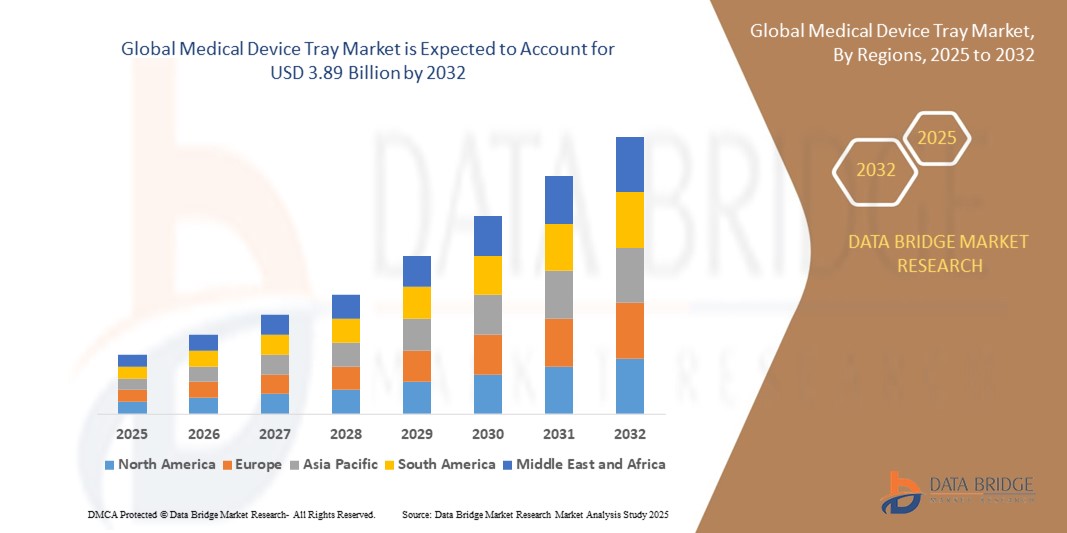
Medical Device Tray Market Size
- The global medical device tray market size was valued at USD 2.61 billion in 2024 and is expected to reach USD 3.89 billion by 2032, at a CAGR of 5.10% during the forecast period
- The market growth is largely fuelled by the rising demand for sterile and disposable packaging in healthcare settings, the increasing number of surgical procedures globally, and the growing emphasis on infection prevention and patient safety in hospitals and clinics
- The expansion of the medical device manufacturing sector, particularly in regions such as Asia-Pacific, coupled with stringent regulatory standards for medical packaging, is further accelerating market growth
Medical Device Tray Market Analysis
- The market is witnessing a steady increase in adoption across hospitals, ambulatory surgical centers, and diagnostic laboratories due to their convenience and hygiene benefits
- Advancements in tray materials and custom-designed packaging for specific medical devices are supporting product innovation and boosting demand across developed and emerging markets
- North America dominated the medical device tray market with the largest revenue share of 38.7% in 2024, driven by the presence of advanced healthcare infrastructure, rising surgical volumes, and increasing demand for sterile packaging solutions in hospitals and surgical centers.
- Asia-Pacific region is expected to witness the highest growth rate in the global medical device tray market, driven by rising medical tourism, increasing procedural demand, and supportive regulatory reforms enhancing medical packaging and sterilization standards across developing economies
- The sterilization trays segment dominated the market with the largest revenue share in 2024, driven by the rising need for infection control and proper sterilization during surgical procedures. These trays offer durable containment for instruments during autoclaving, preventing contamination and ensuring sterility throughout the process. Their demand is also increasing due to regulatory mandates in hospital and surgical settings emphasizing reusable and validated sterile packaging solutions
Report Scope and Medical Device Tray Market Segmentation
|
Attributes |
Medical Device Tray Key Market Insights |
|
Segments Covered |
|
|
Countries Covered |
North America
Europe
Asia-Pacific
Middle East and Africa
South America
|
|
Key Market Players |
|
|
Market Opportunities |
• Rising Adoption of Customized and Procedure-Specific Medical Device Trays |
|
Value Added Data Infosets |
In addition to the insights on market scenarios such as market value, growth rate, segmentation, geographical coverage, and major players, the market reports curated by the Data Bridge Market Research also include import export analysis, production capacity overview, production consumption analysis, price trend analysis, climate change scenario, supply chain analysis, value chain analysis, raw material/consumables overview, vendor selection criteria, PESTLE Analysis, Porter Analysis, and regulatory framework. |
Medical Device Tray Market Trends
Shift Toward Sustainable and Disposable Packaging Solutions
- Growing concerns over hospital-acquired infections (HAIs) and cross-contamination are driving a strong trend toward single-use, disposable medical device trays. These trays provide enhanced sterility, reduce manual handling errors, and help healthcare providers adhere to stringent infection control protocols, especially during surgeries and diagnostic procedures
- The global push for sustainability is influencing tray manufacturers to adopt recyclable, biodegradable, or compostable materials. Hospitals are increasingly favoring trays that reduce environmental impact without compromising strength or barrier protection. This has led to innovation in bio-based polymers and molded fiber solutions
- Rising awareness about environmental regulations is encouraging OEMs to collaborate with packaging suppliers to design eco-friendly, compliant, and cost-effective packaging formats. These partnerships are focused on delivering trays that meet both performance and sustainability goals
- For instance, in 2024, several U.S.-based medical packaging companies launched trays made from recycled PET and molded pulp, receiving FDA approval for use in sterile barrier systems. These products gained quick adoption among outpatient surgical centers seeking to reduce waste
- While disposable and eco-conscious trays are trending, scalability, cost-efficiency, and regulatory clarity will determine their long-term adoption. Manufacturers need to balance performance and environmental compliance while educating end users on tray disposal practices
Medical Device Tray Market Dynamics
Driver
Rising Surgical Volume and Increasing Demand for Sterile Packaging
• A growing number of surgical procedures—both elective and emergency—is fueling the demand for sterile, procedure-specific medical trays. Hospitals and ambulatory surgical centers rely on pre-packed trays to improve efficiency, reduce preparation time, and ensure infection control across diverse specialties
• Advancements in minimally invasive surgeries, especially in orthopedics, cardiology, and gynecology, are creating the need for compact, customized trays tailored to specific instruments. The demand is particularly high in emerging markets where healthcare access is expanding rapidly
• Government mandates on sterilization practices and packaging traceability are further driving the use of validated tray systems. Compliance with ISO and FDA guidelines has become a critical requirement, prompting healthcare providers to upgrade their sterile packaging infrastructure
• For instance, in 2023, the U.K. National Health Service (NHS) introduced procurement guidelines favoring suppliers of validated and sterilized trays, increasing demand for third-party tray providers. This shift has pushed hospitals to reconsider their sourcing models in favor of vendors offering pre-certified solutions. As a result, tray manufacturers with established sterilization and documentation processes are seeing greater contract wins across the public sector
• Although demand is rising, manufacturers must focus on supply chain resilience and cost control, especially in public healthcare environments, to capture long-term market share. The increased need for price-sensitive solutions in government-funded systems requires careful vendor planning. Strategic investments in local production, logistics optimization, and bulk procurement are essential to remain competitive
Restraint/Challenge
Volatility in Raw Material Prices and Regulatory Complexity
• The medical device tray industry is highly sensitive to fluctuations in raw material costs, particularly plastics such as PET, PP, and HDPE. Price volatility impacts the profit margins of tray manufacturers, making it difficult to offer competitive pricing, especially in bulk hospital procurement
• Strict regulatory frameworks surrounding sterilization, labeling, and materials compliance across regions—such as FDA, MDR (EU), and ISO—pose challenges for global tray manufacturers. Ensuring compliance across different jurisdictions increases operational complexity and time to market
• Smaller manufacturers and new entrants often face significant hurdles in certifying their products, slowing innovation and scalability. This becomes particularly limiting when customization is required for unique surgical applications
• For instance, in 2022, regulatory tightening in the European Union under MDR led to delays in the approval of several new tray designs, impacting product availability for regional distributors. This created bottlenecks in product launches and affected supply continuity across multiple markets. Small- and mid-sized players without established regulatory pathways faced increased time-to-market challenges and lost competitive advantage
• To overcome these challenges, industry players must invest in regulatory expertise, localized supply chains, and flexible material sourcing strategies to mitigate cost pressures and compliance risks. Strong partnerships with notified bodies and an agile response to evolving certification standards are now critical. Companies with in-house compliance teams and diversified sourcing networks are better positioned to sustain market growth
Medical Device Tray Market Scope
The market is segmented on the basis of product type, end user, and application.
- By Product Type
On the basis of product type, the medical device tray market is segmented into sterilization trays and procedure trays. The sterilization trays segment dominated the market with the largest revenue share in 2024, driven by the rising need for infection control and proper sterilization during surgical procedures. These trays offer durable containment for instruments during autoclaving, preventing contamination and ensuring sterility throughout the process. Their demand is also increasing due to regulatory mandates in hospital and surgical settings emphasizing reusable and validated sterile packaging solutions.
The procedure trays segment is expected to witness the fastest growth rate from 2025 to 2032, owing to the growing preference for pre-packaged, ready-to-use trays that save preparation time and enhance workflow efficiency. Hospitals and clinics are increasingly opting for custom procedure trays tailored to specific surgical or diagnostic needs, helping reduce error rates and inventory management complexity. This shift toward procedural efficiency and standardized care delivery is accelerating the adoption of procedure trays globally.
- By End User
On the basis of end user, the market is segmented into hospitals and clinics, ambulatory, dental clinics, and surgical centers. The hospitals and clinics segment held the largest revenue share in 2024, driven by the high volume of surgical procedures and stringent sterilization protocols required in inpatient environments. These facilities rely heavily on both sterilization and procedure trays to streamline surgical workflows, improve safety, and comply with hygiene regulations. The consistent investments in surgical infrastructure and rising patient intake further support this segment’s dominance.
The ambulatory and surgical centers segment is expected to witness the fastest growth rate from 2025 to 2032, fueled by the increasing number of outpatient procedures and demand for rapid turnaround of sterilized equipment. These centers benefit from compact, cost-effective tray solutions that align with limited space and quick-patient-throughput operations. The shift toward day surgeries and minimally invasive procedures is further driving demand for optimized tray solutions in these facilities.
- By Application
On the basis of application, the market is segmented into surgical trays, diagnostic trays, and dental trays. The surgical trays segment accounted for the largest share in 2024 due to the high frequency of surgical interventions across specialties and the need for efficient, sterile instrument organization. Hospitals and surgical centers favor custom surgical trays for improving operating room efficiency, minimizing preparation time, and enhancing patient safety. Moreover, rising surgical volumes due to chronic diseases and trauma care are contributing to this segment’s continued growth.
The dental trays segment is expected to witness the fastest growth rate from 2025 to 2032, supported by the rising number of dental procedures and increasing awareness of infection prevention in oral care practices. Dental clinics are adopting disposable and sterilizable tray formats tailored for various dental interventions, including restorative, surgical, and orthodontic procedures. The growing demand for cost-effective, compliant, and organized instrument setups is further supporting adoption in this segment.
Medical Device Tray Market Regional Analysis
• North America dominated the medical device tray market with the largest revenue share of 38.7% in 2024, driven by the presence of advanced healthcare infrastructure, rising surgical volumes, and increasing demand for sterile packaging solutions in hospitals and surgical centers.
• The widespread adoption of customized and procedure-specific trays across hospitals and ambulatory surgical centers in the region is further boosting market growth.
• In addition, regulatory compliance requirements and heightened focus on infection control protocols are contributing to the increased demand for high-quality, sterilized medical trays across both public and private healthcare institutions.
U.S. Medical Device Tray Market Insight
The U.S. medical device tray market held the largest revenue share in 2024 within North America, driven by a high frequency of surgical procedures, especially in orthopedics, cardiology, and general surgery. Growing reliance on pre-assembled and ready-to-use procedure trays to improve surgical efficiency and reduce turnaround time is a major growth factor. Moreover, the market benefits from stringent FDA regulations, which encourage the use of validated, sterilized trays across all surgical and diagnostic settings.
Europe Medical Device Tray Market Insight
The Europe medical device tray market is expected to witness the fastest growth rate from 2025 to 2032, supported by rising healthcare expenditure and increased awareness about hospital-acquired infections. Demand for efficient and disposable surgical packaging solutions is rising in both public hospitals and private clinics. In addition, the implementation of MDR regulations is prompting a shift toward standardized, traceable, and compliant tray solutions to ensure patient safety and procedural consistency.
Germany Medical Device Tray Market Insight
The Germany medical device tray market is projected to witness significant growth during the forecast period, owing to its strong medical device manufacturing base and widespread adoption of advanced surgical tools. Hospitals and outpatient centers are increasingly investing in pre-sterilized, procedure-specific trays to streamline workflows. Furthermore, growing support for environmentally conscious packaging materials and recycling initiatives is shaping tray design trends across the region.
U.K. Medical Device Tray Market Insight
The U.K. medical device tray market is expected to witness the fastest growth rate from 2025 to 2032, driven by a rising demand for efficient surgical tools and standardization in hospitals. The NHS and private healthcare providers are prioritizing the adoption of cost-effective, pre-validated trays to reduce surgical delays and improve patient outcomes. Government-led procurement reforms also support centralized sourcing of sterilized trays, boosting demand for trusted third-party tray providers.
Asia-Pacific Medical Device Tray Market Insight
The Asia-Pacific medical device tray market is expected to witness the fastest growth rate from 2025 to 2032, fueled by growing healthcare investments, expanding medical tourism, and increasing numbers of surgeries in countries such as China, India, and Japan. Rising awareness about infection control, along with an expanding middle class, is propelling the demand for safe and reliable surgical packaging solutions. In addition, the shift toward single-use medical trays is gaining traction to minimize contamination risks and improve hospital efficiency.
China Medical Device Tray Market Insight
The China medical device tray market accounted for the largest revenue share in Asia-Pacific in 2024, driven by a surge in hospital construction, rising procedural volumes, and domestic manufacturing advancements. The government's push for healthcare modernization and localized production of medical disposables supports market expansion. As regulatory standards tighten, the use of validated sterilized trays in diagnostic and surgical settings is becoming increasingly mandatory.
Japan Medical Device Tray Market Insight
The Japan medical device tray market is expected to witness the fastest growth rate from 2025 to 2032, supported by the country’s aging population and rising demand for minimally invasive surgeries. Hospitals are focusing on pre-packaged, ready-to-use trays that reduce preparation time and enhance procedural consistency. Furthermore, Japan’s emphasis on quality assurance and healthcare efficiency is fostering innovation in sterile tray design, with strong integration of automation and precision in hospital settings.
Medical Device Tray Market Share
The Medical Device Tray industry is primarily led by well-established companies, including:
- Placon (U.S.)
- Boston Scientific (U.S.)
- GY Packaging (Canada)
- Nelipak Healthcare Packaging (Ireland)
- Sterizign Precision Technologies (U.S.)
- Instrusafe (U.S.)
- Baxter International (U.S.)
- Cardinal Health (U.S.)
- Covidien Medtronic (Ireland)
- 3M (U.S.)
- B Braun Melsungen AG (Germany)
- BD (Becton, Dickinson and Company) (U.S.)
- Hogy Medical (Hungary)
- Molnlycke Health Care AB (Sweden)
- Medline Industries (U.S.)
Latest Developments in Global Medical Device Tray Market
- In April 2022, Merit Medical Systems, Inc. has launched the ReSolve Thoracostomy Tray, designed for efficient and minimally invasive thoracostomy procedures, helping patients avoid open surgery for chest fluid or air drainage. The tray includes all necessary components in a stepwise order, enhancing procedural ease. Thoracic damage, a common result of traumatic injuries, contributes significantly to patient mortality. The tray, developed in collaboration with physicians, aims to simplify urgent thoracostomy procedures, potentially saving lives and improving patient comfort. Merit Medical continues to advance healthcare technology with a commitment to enhancing patient care

- Interactive Data Analysis Dashboard
- Company Analysis Dashboard for high growth potential opportunities
- Research Analyst Access for customization & queries
- Competitor Analysis with Interactive dashboard
- Latest News, Updates & Trend analysis
- Harness the Power of Benchmark Analysis for Comprehensive Competitor Tracking
Global Medical Device Tray Market, Supply Chain Analysis and Ecosystem Framework
To support market growth and help clients navigate the impact of geopolitical shifts, DBMR has integrated in-depth supply chain analysis into its Global Medical Device Tray Market research reports. This addition empowers clients to respond effectively to global changes affecting their industries. The supply chain analysis section includes detailed insights such as Global Medical Device Tray Market consumption and production by country, price trend analysis, the impact of tariffs and geopolitical developments, and import and export trends by country and HSN code. It also highlights major suppliers with data on production capacity and company profiles, as well as key importers and exporters. In addition to research, DBMR offers specialized supply chain consulting services backed by over a decade of experience, providing solutions like supplier discovery, supplier risk assessment, price trend analysis, impact evaluation of inflation and trade route changes, and comprehensive market trend analysis.
Data collection and base year analysis are done using data collection modules with large sample sizes. The stage includes obtaining market information or related data through various sources and strategies. It includes examining and planning all the data acquired from the past in advance. It likewise envelops the examination of information inconsistencies seen across different information sources. The market data is analysed and estimated using market statistical and coherent models. Also, market share analysis and key trend analysis are the major success factors in the market report. To know more, please request an analyst call or drop down your inquiry.
The key research methodology used by DBMR research team is data triangulation which involves data mining, analysis of the impact of data variables on the market and primary (industry expert) validation. Data models include Vendor Positioning Grid, Market Time Line Analysis, Market Overview and Guide, Company Positioning Grid, Patent Analysis, Pricing Analysis, Company Market Share Analysis, Standards of Measurement, Global versus Regional and Vendor Share Analysis. To know more about the research methodology, drop in an inquiry to speak to our industry experts.
Data Bridge Market Research is a leader in advanced formative research. We take pride in servicing our existing and new customers with data and analysis that match and suits their goal. The report can be customized to include price trend analysis of target brands understanding the market for additional countries (ask for the list of countries), clinical trial results data, literature review, refurbished market and product base analysis. Market analysis of target competitors can be analyzed from technology-based analysis to market portfolio strategies. We can add as many competitors that you require data about in the format and data style you are looking for. Our team of analysts can also provide you data in crude raw excel files pivot tables (Fact book) or can assist you in creating presentations from the data sets available in the report.













