


Medical Foods for Inborn Errors of Metabolism Market Analysis
A rise in the number of incidences of Inborn Errors of Metabolism (IEM) and the preference for dietary supplements over Enzyme Replacement Therapy (ERT) are expected to drive the market growth. The lack of reimbursement facilities for these medical foods and also their high cost, potentially restraining the market growth.
Medical Foods for Inborn Errors of Metabolism Market Size
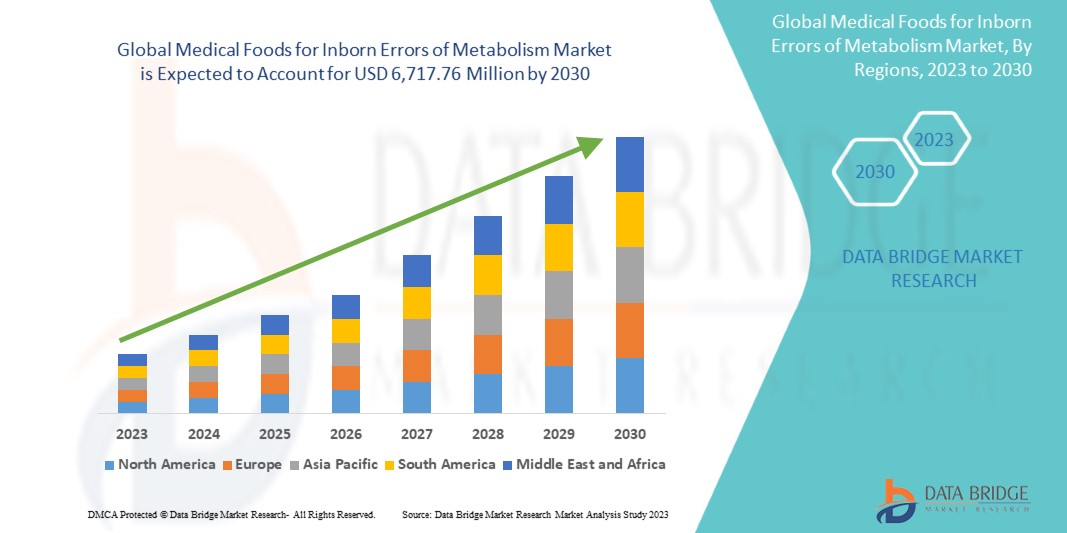
The global Medical Foods for Inborn Errors of Metabolism size was valued at USD 3.12 billion in 2024 and is projected to reach USD 9.14 billion by 2032, with a CAGR of 14.39 % during the forecast period of 2025 to 2032. In addition to the insights on market scenarios such as market value, growth rate, segmentation, geographical coverage, and major players, the market reports curated by the Data Bridge Market Research also include depth expert analysis, patient epidemiology, pipeline analysis, pricing analysis, and regulatory framework.
Report Scope and Medical Foods for Inborn Errors of Metabolism Market Segmentation
|
Attributes |
Medical Foods for Inborn Errors of Metabolism Key Market Insights |
|
Segments Covered |
|
|
Countries Covered |
U.S., Canada and Mexico in North America, Germany, France, U.K., Netherlands, Switzerland, Belgium, Russia, Italy, Spain, Turkey, Rest of Europe in Europe, China, Japan, India, South Korea, Singapore, Malaysia, Australia, Thailand, Indonesia, Philippines, Rest of Asia-Pacific (APAC) in the Asia-Pacific (APAC), Saudi Arabia, U.A.E., South Africa, Egypt, Israel, Rest of Middle East and Africa (MEA) as a part of Middle East and Africa (MEA), Brazil, Argentina and Rest of South America as part of South America |
|
Key Market Players |
Nutricia, Abbott, Baxter, Nestlé Health Science, Meiji Holdings Co., Ltd., Hexagon Nutrition Ltd, Kate Farms, Primus Pharmaceuticals, inc., Promin, Ajinomoto Cambrooke, Inc., Galen Limited, Piam Farmaceutici S.P.A., Orpharma Pty Ltd., PKU-Mdmil.com, B. Braun SE, Pristine Organics Pvt Ltd., Mead Johnson & Company, LLC., EBM Medical, Biovencer Healthcare Pvt Ltd, and Solace Nutrition |
|
Market Opportunities |
|
|
Value Added Data Infosets |
In addition to the insights on market scenarios such as market value, growth rate, segmentation, geographical coverage, and major players, the market reports curated by the Data Bridge Market Research also include depth expert analysis, patient epidemiology, pipeline analysis, pricing analysis, and regulatory framework. |
Medical Foods for Inborn Errors of Metabolism Market Definition
Inborn Errors of Metabolism (IEM) are a group of disorders in which the body fails to convert food into energy. Due to mutations in genes, there is less or no production of specific enzymes, these enzymes are responsible for breaking down certain substances. This breakdown leads to the accumulation of some toxic substances and results in severe complications. To treat these disorders, the concerned patients are given specific diets which are also known as medical foods under the supervision of physicians. For instance, Phenylketonuria (PKU) is a disease in which there is an accumulation of an amino acid which is known as phenylalanine. This can cause intellectual disability, seizures, and many other mental disorders. To treat this, they are given IEM diets such as Phenylketonuria (PKU)-1 manufactured by Pristine Organics Pvt Ltd.
Medical Foods for Inborn Errors of Metabolism Market Dynamics
Drivers
- Rising Incidences of Inborn Errors of Metabolism (IEM)
Advanced diagnostic methods play an essential role in the increasing acceptance of IEM. In the past, these disorders were often misdiagnosed or overlooked due to limited information and diagnostic tools. However, advances in medical technology and genetic testing have changed our ability to accurately diagnose IEM. Advanced technologies such as next-generation sequencing and biochemical analysis allow healthcare professionals to identify specific genetic mutations or abnormalities in metabolic pathways associated with these disorders. This improved diagnostic accuracy has contributed to the increased incidence of IEM. For instance, advances in next-generation sequencing technology have made it possible to identify rare IEM variants that were previously difficult to locate. This enabled a more accurate and comprehensive diagnosis of these disorders.
- Rising Preference for Dietary Supplements Over Enzyme Replacement Therapy (ERT)
The rising preference for dietary supplements over Enzyme Replacement Therapy (ERT) in the treatment of IEM may be due to several factors. First, dietary supplements offer a non-invasive and convenient approach to treatment. Unlike ERT, which often involves an injection or infusion, supplements can be taken orally, making them more attractive to patients who want a less invasive option. In addition, food supplements provide comprehensive nutritional support, as they contain various nutrients, cofactors, and substrates necessary for optimal metabolism. This broader spectrum of support addresses several metabolic deficits associated with specific IEM, which can lead to more effective management of the condition.
The increased popularity of nutritional supplements has led to a growing demand for specialty medical foods that meet the unique nutritional needs of IEM patients. This expanded the size of the market and led manufacturers to develop a wider range of products to meet this demand. In addition, the preference for dietary supplements encouraged R&D to improve the composition and effectiveness of medical foods, which led to the use of new and better alternatives. Thus, the rising preference for dietary supplements over ERT in the management of IEM is expected to drive market growth.
Opportunities
- Government Initiatives and Programs for Creating Awareness About Inborn Errors of Metabolism
Governments around the world have recognized the importance of raising awareness about IEM and have implemented various initiatives and programs to address this need. These initiatives aim to educate healthcare professionals, individuals and families affected by IEM, and the general public. Here are some government initiatives and programs to raise awareness of IEM. Government initiatives and programs aimed at increasing awareness of IEM act as market opportunities, driving demand for diagnostic tools, therapeutic procedures, and specialty products. These initiatives also promote R&D, facilitate market expansion through international collaboration and provide funding and support to companies in the field. Thus, government initiative and programs for creating awareness about IEM is expected to provide an opportunity for market growth.
Restraints/Challenges
- High Cost of Medical Foods
The high cost of medical foods is due to many factors that affect the cost of their production, development, and distribution. Firstly, special medical foods require extensive R&D. Manufacturers invest in scientific research and clinical trials to find the optimal combination of nutrients, bioactive compounds, and therapeutic agents to treat specific health conditions. This study involves the expertise of nutritionist’s food and health professionals, which increases the total cost. The high cost of medical foods is a market constraint because it limits affordability and market reach. Expensive price tags put these specialty nutritional products out of reach for many people. Thus, the high cost of medical foods is expected to restraint market growth.
This market report provides details of new recent developments, trade regulations, import-export analysis, production analysis, value chain optimization, market share, impact of domestic and localized market players, analyses opportunities in terms of emerging revenue pockets, changes in market regulations, strategic market growth analysis, market size, category market growths, application niches and dominance, product approvals, product launches, geographic expansions, technological innovations in the market. To gain more info on the market contact Data Bridge Market Research for an Analyst Brief, our team will help you take an informed market decision to achieve market growth.
Medical Foods for Inborn Errors of Metabolism Market Scope
The market is segmented on the basis of products, diseases, age group, forms, packaging, and distribution channel. The growth amongst these segments will help you analyse meagre growth segments in the industries and provide the users with a valuable market overview and market insights to help them make strategic decisions for identifying core market applications.
Products
- Amino Acid
- Low Protein Food
- Glytactin with GMP Amino Acid-Modified Infant Formula with Iron
- Low-Calcium/Vitamin D-Free Infant Formula with Iron
- Others
Diseases
- Phenylketonuria (PKU)
- Tyrosinemia Types I and II
- Maple Syrup Urine Disease (MSUD)
- Homocystinuria
- Glutaric Acidemia Type I
- Urea Cycle Disorders
- Methylmalonic Acidemia
- Isovaleric Acidemia
- Organic Acidurias
- Renal Disease
- Propionic Acidemia
- Disorders of Leucine Metabolism
- Others
Age Group
- Infants
- Weanings
- Adolescent
- Adults
Forms
- Powder
- Liquid
- Tablets
- Gels
- Others
Packaging
- Can
- Packets
- Bottle
- Jar
- Others
Distribution Channel
- Hospital Pharmacy
- Retail Pharmacy
- Drug Stores
- Online Pharmacy
- Others
Medical Foods for Inborn Errors of Metabolism Market Regional Analysis
The market is analysed and market size insights and trends are provided by country, products, diseases, age group, forms, packaging, and distribution channel as referenced above.
The countries covered in the market report are U.S., Canada and Mexico in North America, Germany, France, U.K., Netherlands, Switzerland, Belgium, Russia, Italy, Spain, Turkey, Rest of Europe in Europe, China, Japan, India, South Korea, Singapore, Malaysia, Australia, Thailand, Indonesia, Philippines, Rest of Asia-Pacific (APAC) in the Asia-Pacific (APAC), Saudi Arabia, U.A.E., South Africa, Egypt, Israel, Rest of Middle East and Africa (MEA) as a part of Middle East and Africa (MEA), Brazil, Argentina and Rest of South America as part of South America.
North America is expected to dominate the global medical foods for inborn errors of metabolism market due to its cutting-edge healthcare infrastructure, intensive research endeavors, stringent regulatory oversight, heightened public awareness about these conditions, widespread access to comprehensive insurance coverage, and proactive governmental policies. U.S. is expected to dominate the North America region due to the manufacturers providing innovative solutions for managing rare genetic disorders and hence, the revenue is highly generated in this region. China is expected to dominate the Asia-Pacific region due to its competitive advantage in production efficiency and cost-effectiveness. Germany is expected to dominate the Europe region as many improved and advanced products are being launched in this market by the manufacturers.
The country section of the report also provides individual market impacting factors and changes in regulation in the market domestically that impacts the current and future trends of the market. Data points such as down-stream and upstream value chain analysis, technical trends and porter's five forces analysis, case studies are some of the pointers used to forecast the market scenario for individual countries. Also, the presence and availability of global brands and their challenges faced due to large or scarce competition from local and domestic brands, impact of domestic tariffs and trade routes are considered while providing forecast analysis of the country data.
Medical Foods for Inborn Errors of Metabolism Market Share
The market competitive landscape provides details by competitor. Details included are company overview, company financials, revenue generated, market potential, investment in research and development, new market initiatives, global presence, production sites and facilities, production capacities, company strengths and weaknesses, product launch, product width and breadth, application dominance. The above data points provided are only related to the companies' focus related to market.
Medical Foods for Inborn Errors of Metabolism Market Leaders Operating in the Market Are:
- Nutricia
- Abbott
- Baxter
- Nestlé Health Science
- Meiji Holdings Co., Ltd.
- Hexagon Nutrition Ltd
- Kate Farms
- Primus Pharmaceuticals, Inc.
- Promin
- Ajinomoto Cambrooke, Inc.
- Galen Limited
- Piam Farmaceutici S.P.A.
- Orpharma Pty Ltd.
- PKU-Mdmil.com
- B. Braun SE
- Pristine Organics Pvt Ltd.
- Mead Johnson & Company, LLC.
- EBM Medical
- Biovencer Healthcare Pvt Ltd
- Solace Nutrition
Latest Developments in Medical Foods for Inborn Errors of Metabolism Market
- In October 2023, Nestlé Health Science and Amwell announced a collaboration to help health organizations improve patients’ overall health through innovative digital solutions focused on nutrition. Together the companies are developing a portfolio of novel solutions to help improve clinical and financial outcomes. This will enhance the brand image for both the companies
- In March 2021, Meiji Co., Ltd. launched formula milk in tablet format under Danone's Aptamil brand in the UK. The tablets, featuring pre-measured tabs, aim to provide convenience for parents. Production began in Wexford, Ireland, combining Meiji's technology with Danone's recipes. Danone plans to expand the product to other European countries starting in 2022. Meiji aims to increase overseas sales to 10% by FY 2026

- Interactive Data Analysis Dashboard
- Company Analysis Dashboard for high growth potential opportunities
- Research Analyst Access for customization & queries
- Competitor Analysis with Interactive dashboard
- Latest News, Updates & Trend analysis
- Harness the Power of Benchmark Analysis for Comprehensive Competitor Tracking
Data collection and base year analysis are done using data collection modules with large sample sizes. The stage includes obtaining market information or related data through various sources and strategies. It includes examining and planning all the data acquired from the past in advance. It likewise envelops the examination of information inconsistencies seen across different information sources. The market data is analysed and estimated using market statistical and coherent models. Also, market share analysis and key trend analysis are the major success factors in the market report. To know more, please request an analyst call or drop down your inquiry.
The key research methodology used by DBMR research team is data triangulation which involves data mining, analysis of the impact of data variables on the market and primary (industry expert) validation. Data models include Vendor Positioning Grid, Market Time Line Analysis, Market Overview and Guide, Company Positioning Grid, Patent Analysis, Pricing Analysis, Company Market Share Analysis, Standards of Measurement, Global versus Regional and Vendor Share Analysis. To know more about the research methodology, drop in an inquiry to speak to our industry experts.
Data Bridge Market Research is a leader in advanced formative research. We take pride in servicing our existing and new customers with data and analysis that match and suits their goal. The report can be customized to include price trend analysis of target brands understanding the market for additional countries (ask for the list of countries), clinical trial results data, literature review, refurbished market and product base analysis. Market analysis of target competitors can be analyzed from technology-based analysis to market portfolio strategies. We can add as many competitors that you require data about in the format and data style you are looking for. Our team of analysts can also provide you data in crude raw excel files pivot tables (Fact book) or can assist you in creating presentations from the data sets available in the report.












