


What is the Medical Imaging Displays and Post-Processing Software Market Size and Growth Rate ?
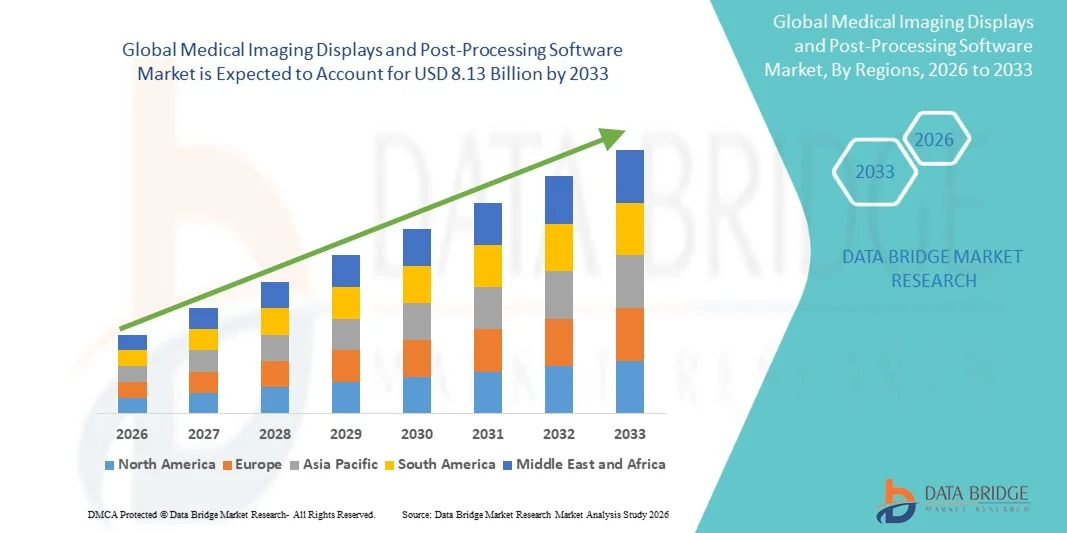
As per Data Bridge Market Research Analysis the Medical Imaging Displays and Post-Processing Software Market was valued at USD 4.05 billion in 2025 and is projected to reach USD 8.13 billion by 2033, growing at a CAGR of 9.10% from 2026 to 2033. Market growth is driven by the increasing adoption of advanced diagnostic imaging technologies, rising demand for high-resolution visualization in radiology and surgical applications, and growing integration of artificial intelligence into imaging workflows. Expanding healthcare infrastructure, particularly in emerging economies, coupled with the proliferation of telemedicine and remote diagnostic consultations, is accelerating demand for medical-grade displays and sophisticated post-processing software.
Ongoing technological advancements in display resolution, color accuracy, and AI-driven image analysis are creating new opportunities for stakeholders across hospitals, diagnostic imaging centers, and research laboratories. In addition, regulatory support for digital healthcare transformation and the increasing prevalence of chronic diseases requiring accurate diagnostic imaging are further driving market expansion over the forecast period.
Market Size & Forecast
- Global Market Value (2025): USD 4.05 Billion
- Expected Market Value (2033): USD 8.13 Billion
- Forecast CAGR (2026–2033): 9.10%
- Leading Region in 2025: North America
- Fastest Growing Region: Asia-Pacific
What are the Major Takeaways of Medical Imaging Displays and Post-Processing Software ?
- North America dominated the Medical Imaging Displays and Post-Processing Software Market with the largest revenue share of 39.2% in 2025, supported by high healthcare expenditure, early adoption of digital imaging technologies, and a strong presence of key display and software manufacturers.
- Asia-Pacific is expected to be the fastest-growing region at a CAGR of 11.8% from 2026 to 2033, driven by expanding healthcare infrastructure, increasing diagnostic imaging volumes, and rising adoption of AI-enabled imaging solutions.
- The Integrated segment led the market with a 58.4% market share in 2025, reflecting strong demand for comprehensive imaging workstations that combine display and software capabilities within unified platforms.
- The CT segment dominated the technology category with a 37.2% market share in 2025, supported by widespread utilization in oncology, cardiology, and emergency diagnostics.
- The 3D Image segment accounted for the largest share of the image category with a market share of 48.6% in 2025, driven by increasing adoption of volumetric imaging for surgical planning and complex diagnostics.
- The Radiology segment dominated the indications category with a 52.3% market share in 2025, reflecting the central role of radiological imaging in disease detection, staging, and treatment monitoring across healthcare settings.
Report Scope and Medical Imaging Displays and Post-Processing Software Market Segmentation
|
Attributes |
Medical Imaging Displays and Post-Processing Software Key Market Insights |
|
Segments Covered |
|
|
Countries Covered |
North America
Europe
Asia-Pacific
Middle East and Africa
Rest of Middle East and Africa
|
|
Key Market Players |
|
|
Market Opportunities |
|
|
Value Added Data Infosets |
In addition to the insights on market scenarios such as market value, growth rate, segmentation, geographical coverage, and major players, the market reports curated by the Data Bridge Market Research also include depth expert analysis, patient epidemiology, pipeline analysis, pricing analysis, and regulatory framework. |
What is the Key Trend in the Medical Imaging Displays and Post-Processing Software Market ?
Trend: Integration of AI-Powered Imaging Workflows and Cloud-Based Post-Processing Platforms
Clinical workflows are increasingly incorporating artificial intelligence and machine learning algorithms into medical imaging displays and post-processing software to enhance diagnostic accuracy, reduce interpretation time, and improve patient outcomes. Healthcare providers are adopting cloud-based platforms that enable seamless image sharing, remote consultations, and centralized data management across distributed care networks.
For instance,
Leading vendors such as GE Healthcare, Siemens Healthineers, and Philips Healthcare have expanded their AI-enabled imaging portfolios, integrating advanced algorithms for automated lesion detection, organ segmentation, and workflow prioritization into their display and software solutions.
In addition, the adoption of hybrid display systems combining high-resolution OLED and LED technologies is improving visualization quality for complex imaging modalities, supporting faster and more accurate diagnoses in radiology, cardiology, and neurology applications.
Medical Imaging Displays and Post-Processing Software Market Dynamics
Key Market Driver: Rising Demand for High-Resolution Diagnostic Imaging and Digital Healthcare Transformation
The increasing prevalence of chronic diseases, aging populations, and the growing need for accurate and timely diagnostics are driving demand for advanced medical imaging displays and post-processing software. Healthcare systems worldwide are investing in digital transformation initiatives, replacing legacy analog systems with high-resolution, networked imaging solutions that support integrated care delivery and remote diagnostics.
Key Restraint/Challenge: High Cost of Medical Display Devices and Software Integration
The high acquisition and maintenance costs associated with medical-grade displays and advanced post-processing software remain significant barriers to adoption, particularly in resource-constrained healthcare settings. Additionally, the complexity of integrating new imaging systems with existing hospital information systems and PACS infrastructure can delay implementation and increase total cost of ownership.
Key Market Opportunity: Expansion of Telemedicine and Remote Diagnostic Imaging Services
The rapid growth of telemedicine and remote consultations is creating significant opportunities for medical imaging display and software vendors. Cloud-based post-processing platforms and portable imaging solutions are enabling healthcare providers to extend diagnostic services to underserved and rural populations, improving access and patient outcomes.
How is the Medical Imaging Displays and Post-Processing Software Market Segmented ?
The Medical Imaging Displays and Post-Processing Software market is segmented on the basis of types, technology, image, and indications.
- By Types
On the basis of types, the Medical Imaging Displays and Post-Processing Software Market is segmented into integrated and standalone. The integrated segment dominated the market with a 58.4% market share in 2025, supported by strong demand for comprehensive imaging workstations that combine high-resolution displays and advanced post-processing software within unified platforms. Integrated solutions offer streamlined workflows, reduced integration complexity, and improved interoperability with hospital PACS and RIS systems, making them the preferred choice for large hospitals and diagnostic imaging centers seeking end-to-end imaging capabilities.
The standalone segment is expected to witness the fastest growth from 2026 to 2033. Growth in this segment is driven by increasing demand for modular, flexible display and software solutions that can be deployed independently or integrated into existing imaging infrastructure. Standalone solutions are particularly attractive to specialty clinics, outpatient facilities, and emerging markets seeking cost-effective upgrades to their imaging capabilities.
- By Technology
On the basis of technology, the Medical Imaging Displays and Post-Processing Software Market is segmented into X-ray, CT, ultrasound, MRI, SPECT, and PET. The CT segment dominated the market with a 37.2% market share in 2025, reflecting widespread utilization of computed tomography imaging in oncology, cardiology, emergency diagnostics, and routine screening. CT imaging's speed, accuracy, and versatility in detecting a broad range of conditions have driven strong adoption of advanced displays and post-processing software optimized for CT workflows.
The MRI segment is expected to be the fastest-growing technology segment, with a projected CAGR of 10.2% from 2026 to 2033. Growth is driven by increasing demand for high-resolution soft tissue imaging, expanding applications in neurology and musculoskeletal diagnostics, and the integration of AI-powered post-processing tools for automated lesion detection and quantification.
- By Image
On the basis of image, the Medical Imaging Displays and Post-Processing Software Market is segmented into 2D, 3D, and 4D. The 3D image segment dominated the market with a 48.6% market share in 2025, driven by increasing adoption of volumetric imaging for surgical planning, tumor characterization, and complex diagnostics across radiology, cardiology, and neurology applications. Advanced post-processing software enabling 3D reconstruction, multi-planar reformatting, and virtual endoscopy has expanded the clinical utility of 3D imaging and driven demand for high-resolution displays capable of rendering detailed volumetric data.
The 4D image segment is expected to be the fastest-growing segment from 2026 to 2033, with a projected CAGR of 12.5%. Growth is driven by rising adoption of real-time dynamic imaging in cardiology, obstetrics, and interventional radiology, where 4D visualization enables assessment of organ motion, blood flow, and fetal development.
- By Indications
On the basis of indications, the Medical Imaging Displays and Post-Processing Software Market is segmented into neurology, cardiology, and radiology. The radiology segment dominated the market with a 52.3% market share in 2025, reflecting the central role of radiological imaging in disease detection, staging, and treatment monitoring across healthcare settings. Radiology departments utilize a wide range of imaging modalities, including CT, MRI, X-ray, and ultrasound, driving demand for high-resolution displays and advanced post-processing software capable of supporting diverse diagnostic workflows.
The cardiology segment is expected to be the fastest-growing indications segment from 2026 to 2033, with a projected CAGR of 10.8%. Growth is driven by increasing cardiovascular disease prevalence, expanding adoption of cardiac CT and MRI, and the integration of AI-powered tools for automated cardiac function analysis and coronary artery assessment.
Which Region Holds the Largest Share of the Medical Imaging Displays and Post-Processing Software Market ?
North America dominated the medical imaging displays and post-processing software market with a revenue share of 39.2% in 2025, supported by high healthcare expenditure, early adoption of digital imaging technologies, and a strong presence of key display and software manufacturers. Favorable reimbursement for advanced imaging procedures and robust hospital IT infrastructure support rapid integration of AI-enabled imaging solutions.
U.S. Medical Imaging Displays and Post-Processing Software Market Insight
The U.S. medical imaging displays and post-processing software market benefits from significant investments in digital health transformation, widespread adoption of 4K and Ultra Full HD displays, and the integration of AI-driven diagnostic tools across hospitals and imaging centers. Large health systems and academic medical centers are leading the adoption of advanced imaging workstations and cloud-based post-processing platforms, driving market growth and innovation.
Europe Medical Imaging Displays and Post-Processing Software Market Insight
The Europe medical imaging displays and post-processing software market remains a major contributor, with strong hospital-based imaging infrastructure and growing adoption of AI-enabled post-processing tools in public and private healthcare systems. Cross-disciplinary guidelines and regulatory support for digital healthcare are improving interoperability and accelerating the deployment of advanced imaging solutions across the region.
U.K. Medical Imaging Displays and Post-Processing Software Market Insight
The U.K. medical imaging displays and post-processing software market is supported by NHS investments in digital radiology infrastructure, increasing adoption of cloud-based imaging platforms, and growing demand for AI-powered diagnostic support tools in secondary care and community imaging centers.
Germany Medical Imaging Displays and Post-Processing Software Market Insight
Germany's robust radiology and hospital networks facilitate comprehensive imaging and post-processing capabilities, with growing emphasis on standardized imaging protocols, high-resolution display systems, and AI integration for workflow optimization and diagnostic accuracy.
Asia-Pacific Medical Imaging Displays and Post-Processing Software Market Insight
The Asia-Pacific medical imaging displays and post-processing software market is poised for rapid growth with a CAGR of 11.8% during the forecast period, driven by expanding healthcare infrastructure, increasing diagnostic imaging volumes, and rising adoption of AI-enabled imaging solutions. Private hospital networks and specialty imaging centers in China, India, Japan, and South Korea are investing in advanced display systems and cloud-based post-processing platforms to meet growing demand for accurate and efficient diagnostics.
Japan Medical Imaging Displays and Post-Processing Software Market Insight
Japan's advanced imaging infrastructure and high healthcare standards support strong adoption of high-resolution medical displays and AI-powered post-processing software, particularly in oncology, cardiology, and neurology applications.
China Medical Imaging Displays and Post-Processing Software Market Insight
The China medical imaging displays and post-processing software market is experiencing rapid growth in outpatient imaging and AI integration, with government initiatives supporting digital health transformation and expanding access to advanced diagnostic imaging across urban and rural healthcare settings.
Which are the Top Companies in Medical Imaging Displays and Post-Processing Software Market ?
The medical imaging displays and post-processing software industry is primarily led by well-established companies, including:
- GE Healthcare (U.S.)
- Siemens Healthineers AG (Germany)
- Philips Healthcare (Netherlands)
- Canon Medical Systems (Japan)
- Fujifilm Medical Systems (Japan)
- Agfa HealthCare (Belgium)
- EIZO Corporation (Japan)
- Barco (Belgium)
- Hologic Inc. (U.S.)
- Carestream Health (U.S.)
- Shimadzu Corporation (Japan)
- Hitachi Medical Corporation (Japan)
- Samsung Medison (South Korea)
- Esaote S.p.A. (Italy)
- Planmeca Group (Finland)
What are Latest Developments in Medical Imaging Displays and Post-Processing Software Market ?
- In November 2025, Royal Philips announced the launch of Philips Image Management 15, the next-generation evolution of its Vue PACS platform. The solution introduced a zero-footprint web-based diagnostic viewer that enables radiologists to securely access, interpret, and collaborate on medical images through a standard web browser, improving workflow efficiency and enterprise-wide scalability.
- In November 2025, Barco, in collaboration with Avatar Medical, launched Eonis Vision, a new 3D medical imaging visualization solution combining Avatar Medical’s advanced imaging software with Barco’s glasses-free 3D display technology. The platform enhances patient consultations, surgical planning, and clinical collaboration through immersive three-dimensional visualization of medical images.
- In July 2025, Royal Philips received U.S. FDA 510(k) clearance for its SmartSpeed Precise dual-AI MRI software. The technology delivers up to three times faster MRI scanning and significantly improved image sharpness, enhancing image processing, diagnostic confidence, and workflow efficiency across Philips’ MRI portfolio.
- In April 2025, Royal Philips launched the AI-enabled Elevate Platform upgrade for its EPIQ Elite ultrasound imaging system. The enhancement incorporates advanced artificial intelligence capabilities designed to improve diagnostic accuracy, streamline imaging workflows, and support remote clinical collaboration.
- In February 2025, Royal Philips unveiled new AI-enabled radiology software, intelligent imaging solutions, and cloud-based imaging services at the European Congress of Radiology (ECR 2025). The portfolio was designed to streamline radiology workflows, accelerate clinical insights, and expand access to cloud-based post-processing and image management capabilities.

- Interactive Data Analysis Dashboard
- Company Analysis Dashboard for high growth potential opportunities
- Research Analyst Access for customization & queries
- Competitor Analysis with Interactive dashboard
- Latest News, Updates & Trend analysis
- Harness the Power of Benchmark Analysis for Comprehensive Competitor Tracking
Data collection and base year analysis are done using data collection modules with large sample sizes. The stage includes obtaining market information or related data through various sources and strategies. It includes examining and planning all the data acquired from the past in advance. It likewise envelops the examination of information inconsistencies seen across different information sources. The market data is analysed and estimated using market statistical and coherent models. Also, market share analysis and key trend analysis are the major success factors in the market report. To know more, please request an analyst call or drop down your inquiry.
The key research methodology used by DBMR research team is data triangulation which involves data mining, analysis of the impact of data variables on the market and primary (industry expert) validation. Data models include Vendor Positioning Grid, Market Time Line Analysis, Market Overview and Guide, Company Positioning Grid, Patent Analysis, Pricing Analysis, Company Market Share Analysis, Standards of Measurement, Global versus Regional and Vendor Share Analysis. To know more about the research methodology, drop in an inquiry to speak to our industry experts.
Data Bridge Market Research is a leader in advanced formative research. We take pride in servicing our existing and new customers with data and analysis that match and suits their goal. The report can be customized to include price trend analysis of target brands understanding the market for additional countries (ask for the list of countries), clinical trial results data, literature review, refurbished market and product base analysis. Market analysis of target competitors can be analyzed from technology-based analysis to market portfolio strategies. We can add as many competitors that you require data about in the format and data style you are looking for. Our team of analysts can also provide you data in crude raw excel files pivot tables (Fact book) or can assist you in creating presentations from the data sets available in the report.













