


What is the Medical Manifolds Market Size and Growth Rate?
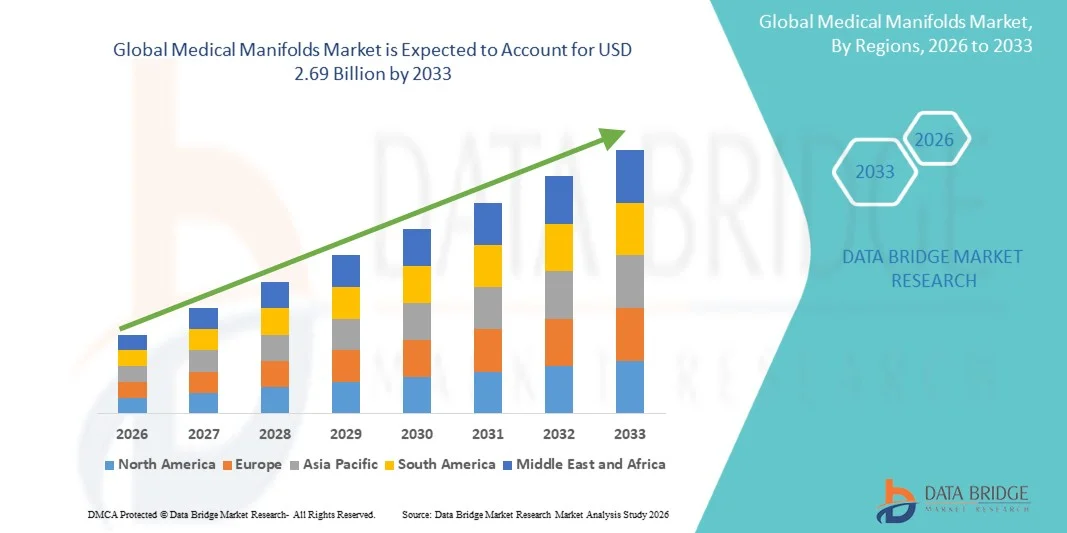
- As per Data Bridge Market Research analysis, the medical manifolds market was valued at USD 1.36 billion in 2025 and is projected to reach USD 2.69 billion by 2033, growing at a CAGR of 8.92% from 2026 to 2033.
- The market is experiencing consistent growth driven by rising demand for minimally invasive and precision fluid management systems, increasing integration of manifolds in diagnostic and respiratory care equipment, and the growing burden of chronic diseases requiring advanced medical devices such as ventilators, dialysis systems, infusion pumps, and patient monitoring equipment.
- The increasing adoption of microfluidic-compatible manifold architectures for diagnostic platforms, combined with the customization of multi-channel fluid routing systems for respiratory and infusion applications, is supporting the deployment of medical manifolds across healthcare applications. Medical manifolds enable precise fluid and gas control in diagnostic devices, drug delivery systems, dialysis equipment, respiratory care devices, and surgical and patient monitoring systems.
Market Size & Forecast
- Global Market Value (2025): USD 1.36 Billion
- Expected Market Value (2033): USD 2.69 Billion
- Forecast CAGR (2026–2033): 8.92%
- Leading Region in 2025: North America
- Fastest Growing Region: Asia Pacific
What are the Major Takeaways of the Medical Manifolds Market?
- North America dominated the medical manifolds market with the largest revenue share of 41.3% in 2025, supported by an established medical device manufacturing ecosystem and increasing automation of diagnosis, infusion, and respiration systems
- Asia-Pacific is expected to be the fastest-growing region at a CAGR of 5.66% from 2026 to 2033, fueled by fast-growing diagnostics infrastructure and testing for infectious diseases in India and China, alongside increasing adoption of decentralized testing and medical device technologies.
- The 3-gang manifold segment led the market with a 60% share in 2025, driven by their widespread use in procedures requiring multiple fluid and pressure connections.
- 2-gang manifold are the fastest-growing type, projected to register a CAGR of 7.3%, reflecting the surge in demand for compact, efficient, and easy-to-integrate fluid and gas management systems across minimally invasive medical procedures and diagnostic applications.
- The fluid manifolds segment dominated the product type category with a 46.2% revenue share in 2025, led by extensive adoption in diagnostic analyzers, infusion pumps, dialysis machines, and minimally invasive surgical devices.
- Polycarbonate accounted for 34.8% of the market share in 2025, preferred by the high impact strength, dimensional stability, optical clarity, and sterilization compatibility.
- The interventional cardiology segment is the fastest-growing application category, with a CAGR of 8.2%, driven by the rising prevalence of cardiovascular diseases, increasing adoption of minimally invasive catheter-based procedures.
Report Scope and Medical Manifolds Market Segmentation
|
Attributes |
Medical Manifolds Key Market Insights |
|
Segments Covered |
|
|
Countries Covered |
North America
Europe
Asia-Pacific
Middle East and Africa
South America
|
|
Key Market Players |
|
|
Market Opportunities |
|
|
Value Added Data Infosets |
In addition to the insights on market scenarios such as market value, growth rate, segmentation, geographical coverage, and major players, the market reports curated by the Data Bridge Market Research also include in-depth expert analysis, patient epidemiology, pipeline analysis, pricing analysis, and regulatory framework. |
What is the Key Trend in the Medical Manifolds Market?
- Medical manifold manufacturers are increasingly developing miniaturized, multi-channel, and microfluidic-compatible architectures to support accurate fluid handling in point-of-care diagnostics, cartridge-based molecular testing, and portable medical instruments.
- For instance, in June 2025, HCLTech published research on fluidic manifolds for disposable diagnostic devices, highlighting their use in advanced in-vitro diagnostics and blood-gas analyzers, with manifold designs focused on minimizing leakage, improving fluid handling, and saving space compared with tubing.
- Real-time pressure, flow, and temperature monitoring is increasingly being integrated into manifold-based fluid management systems to improve precision and enable automated monitoring across diagnostic, respiratory, and infusion applications.
- Medical device manufacturers are also increasing the use of sensor-enabled fluid-management architectures to improve monitoring accuracy and patient safety in automated healthcare equipment.
- For instance, in March 2026, AFP Life Sciences introduced COC/COP diffusion-bonded manifold technology for next-generation diagnostic instruments, using chemically resistant materials and adhesive-free bonding to improve fluidic reliability and reduce sample carryover in sensitive IVD workflows.
- As diagnostic platforms become increasingly miniaturized, decentralized, automated, and sensor-enabled, demand for precision multi-port manifolds is expected to accelerate, reinforcing advanced fluid routing as a core component of next-generation medical devices.
What are the Key Drivers of the Medical Manifolds Market?
- The increasing adoption of minimally invasive and precision fluid-management systems is significantly increasing demand for medical manifolds capable of accurately distributing fluids and gases across multiple channels in modern medical equipment.
- For instance, in September 2024, IDEX Health & Science highlighted integrated manifold assemblies for fluid-management systems, stating that they streamline reagent flow, reduce plumbing complexity and leak points, and provide consistent fluidic performance in diagnostic instruments.
- Diagnostic laboratories, hospitals, and medical device manufacturers are increasingly integrating automated fluid-handling systems to improve diagnostic accuracy, reduce contamination, and support high-throughput testing.
- For instance, in December 2025, Keyto introduced custom integrated fluidic manifold modules for IVD, point-of-care testing, biopharma, and laboratory automation, consolidating valves, pumps, tubing, and fittings into a single manifold to reduce leak-risk interfaces and improve system-level consistency.
- The expansion of decentralized diagnostics and automated medical equipment is increasing the need for compact, multi-port manifolds capable of precise fluid distribution, particularly in molecular diagnostics and point-of-care testing.
- With healthcare increasingly relying on automated diagnostics, respiratory systems, infusion equipment, and precision fluid management, medical manifolds will remain essential components for improving fluid-control accuracy and supporting next-generation medical devices.
Which Factors are Challenging the Growth of the Medical Manifolds Market?
- Complex regulatory compliance for medical-grade components increases development requirements, documentation needs, quality controls, and compliance costs for manufacturers supplying manifolds for regulated medical applications.
- In February 2026, the U.S. FDA’s Quality Management System Regulation (QMSR) became effective, incorporating ISO 13485:2016 into the U.S. medical-device quality framework and introducing updated inspection requirements, increasing compliance obligations for manufacturers of regulated medical-device components.
- These regulatory requirements can increase development timelines and manufacturing complexity, particularly for customized manifolds incorporated into diagnostic, respiratory, infusion, and other safety-critical medical devices.
- Manufacturers supplying the European market must In addition comply with the Medical Devices Regulation (EU) 2017/745, which places greater emphasis on risk classification, notified-body oversight, clinical data, and post-market surveillance.
- For instance, in May 2024, the European Commission published updated guidance on the EU Medical Devices Regulation (MDR), emphasizing manufacturers’ obligations for clinical evaluation, post-market surveillance, vigilance, and quality management, increasing the regulatory and compliance burden for medical-device component manufacturers supplying the European market.
- The combination of regulatory requirements, quality-system obligations, traceability, and high customization costs continues to challenge medical manifold manufacturers, particularly those developing complex components for highly regulated diagnostic and therapeutic equipment
How is the Medical Manifolds Market Segmented?
The medical manifolds market is segmented on the basis of type, product type, material, application, and end user.
- By Type
On the basis of type, the medical manifolds market is segmented into 2-gang manifold, 3-gang manifold, 4-gang manifold, 5-gang manifold, and others. The 3-Gang segment dominated the market with a share of 60% in 2025, driven by their widespread use in procedures requiring multiple fluid and pressure connections. These configurations provide multiple access points while maintaining a compact architecture. They are widely utilized for fluid and pressure management during interventional procedures. Their multi-port design enables healthcare professionals to connect several medical lines through a single manifold. Increasing adoption of minimally invasive procedures is supporting demand for multi-port configurations. Their flexibility and efficient fluid management continue to support their strong market position
The 2-gang manifold segment is projected to register the fastest growth at a CAGR of 7.3% from 2026 to 2033. These manifolds provide a simplified configuration for applications requiring fewer connection points. Their compact structure supports convenient integration into medical equipment and procedural systems. Increasing demand for efficient fluid and gas management is supporting their utilization across healthcare applications. The segment also benefits from growing adoption of compact medical devices and minimally invasive procedures. Rising demand for convenient and efficient manifold configurations is expected to support continued segment expansion.
- By Product Type
On the basis of product type, the medical manifolds market is segmented into fluid manifolds, gas manifolds, and integrated valve manifolds. The fluid manifolds segment dominated the market with a 46.2% share in 2025, driven by extensive adoption in diagnostic analyzers, infusion pumps, dialysis machines, and minimally invasive surgical devices. These manifolds provide controlled fluid distribution through multiple channels. Their compact architecture supports miniaturization of medical equipment and automated fluid-management systems. Increasing demand for molecular diagnostic systems and point-of-care testing is further supporting adoption. They also simplify tubing arrangements and enable efficient fluid routing within medical devices. Their broad application across diagnostic and therapeutic equipment continues to strengthen their market position.
The integrated valve manifolds segment is projected to register the fastest growth at a CAGR of 8.9% from 2026 to 2033. These systems integrate multiple valves and fluid pathways into a consolidated assembly. This configuration can reduce tubing, fittings, and potential leak points within medical devices. Increasing automation in diagnostic, drug-delivery, and fluid-management equipment is strengthening demand for integrated solutions. Growing customization of manifold assemblies is also supporting their adoption among medical-device manufacturers. Increasing demand for compact and efficient fluid-control architectures is expected to accelerate segment growth.
- By Material
On the basis of material, the medical manifolds market is segmented into polycarbonate, polypropylene, silicone, stainless steel, and others. The polycarbonate segment dominated the market with a 34.8% share in 2025, supported by high impact strength, dimensional stability, optical clarity, and sterilization compatibility. Polycarbonate is widely suitable for complex manifold geometries requiring precision molding. Its optical clarity enables visualization of fluid movement within medical systems. The material can also withstand commonly used medical sterilization processes. Increasing demand for lightweight and durable medical components is supporting its adoption. Its combination of mechanical performance, manufacturing flexibility, and sterilization compatibility continues to strengthen its market position.
The polypropylene segment is expected to witness the fastest growth at a CAGR of 8.3% from 2026 to 2033. Polypropylene provides chemical resistance, lightweight characteristics, and cost-efficient manufacturing. It can be molded into complex manifold structures required for fluid-management applications. Its resistance to numerous chemicals supports applications involving diagnostic fluids and drug-delivery systems. Increasing demand for disposable and single-use medical components is creating additional growth opportunities. The increasing adoption of automated diagnostic and fluid-handling equipment is further supporting demand for polypropylene-based manifold components.
- By Application
On the basis of application, the medical manifolds market is segmented into interventional radiology, interventional cardiology, diagnostic devices, drug delivery systems, dialysis equipment, respiratory care devices, surgical and patient monitoring systems, and others. The diagnostic devices segment dominated the market with a 38.6% share in 2025, driven by increasing adoption of automated molecular diagnostics, point-of-care testing, and high-throughput analysis instruments. Medical manifolds enable accurate fluid and reagent transfer within diagnostic equipment. Their multi-channel configurations support automated sample-handling and testing workflows. Increasing adoption of cartridge-based diagnostic platforms is strengthening demand for precision fluid-management components. Expansion of decentralized diagnostics and laboratory automation is further supporting market growth
The interventional cardiology segment is projected to register the fastest growth at a CAGR of 8.2% from 2026 to 2033. Medical manifolds are widely used to manage contrast media, saline, and pressure-monitoring lines during cardiovascular procedures. Their multi-port configuration allows clinicians to connect multiple devices through a single system. Rising cardiovascular disease prevalence is increasing demand for diagnostic and therapeutic catheter-based procedures. Growing investment in catheterization laboratories is further supporting manifold utilization. Increasing preference for minimally invasive cardiovascular interventions is expected to accelerate demand for medical manifolds in this application
- By End User
On the basis of end user, the medical manifolds market is segmented into hospitals and clinics, diagnostic laboratories, ambulatory surgical centers, medical device manufacturers, and others. The hospitals and clinics segment dominated the market with a share of 40.2% in 2025, driven by extensive manifold utilization across diagnostic, surgical, respiratory, infusion, and critical-care applications. Hospitals perform large numbers of procedures requiring controlled fluid and gas management. Their adoption of advanced medical equipment generates recurring demand for manifold components. Increasing healthcare infrastructure investment is supporting deployment of sophisticated medical devices. Rising volumes of minimally invasive procedures are further increasing manifold utilization. Their broad application across multiple hospital departments continues to support their dominant market position.
The ambulatory surgical centers segment is projected to register the fastest growth at a CAGR of 7.1% from 2026 to 2033. These facilities increasingly require compact and efficient fluid-management systems to streamline procedural workflows. Single-use manifold configurations can support sterile procedures and reduce reprocessing requirements. The shift toward outpatient and minimally invasive procedures is creating additional demand for specialized medical components. Increasing preference for cost-efficient surgical care and expansion of ambulatory facilities are expected to further support manifold adoption
Which Region Holds the Largest Share of the Medical Manifolds Market?
- North America dominated the medical manifolds market with the largest revenue share of 41.3% in 2025, supported by an established medical device manufacturing ecosystem and increasing automation of diagnosis, infusion, and respiration systems
- The region also benefits from the presence of major OEMs manufacturing molecular diagnostic analyzers, minimally invasive surgical systems, dialysis machines, and ICU respiratory-care devices, alongside increasing investments in hospital automation and point-of-care testing. The growing demand for smaller and disposable fluid pathways for automated healthcare equipment, combined with the expansion of decentralized diagnostics and precision fluid-management systems, continues to strengthen North America's leadership position in the global medical manifolds market.
U.S. Medical Manifolds Market Insight
The U.S. medical manifolds market is witnessing strong growth due to the country’s highly developed medical-device manufacturing ecosystem, advanced diagnostic infrastructure, and increasing adoption of minimally invasive and automated medical technologies. The country has a strong presence of medical-device manufacturers developing diagnostic analyzers, infusion systems, dialysis equipment, respiratory-care devices, and minimally invasive technologies. Increasing demand for automated diagnostic systems and precision fluid-management technologies is supporting manifold adoption across medical equipment. In addition, the growing use of point-of-care testing and laboratory automation is increasing demand for compact fluidic components. These factors are strengthening the U.S. position in the global medical manifolds market.
Asia-Pacific Medical Manifolds Market Insight
The Asia-Pacific medical manifolds market is expected to witness rapid growth, driven by expanding healthcare infrastructure, increasing diagnostic capacity, and rising adoption of automated medical equipment across countries such as China, India, and Japan. Asia Pacific is a key region for medical manifolds, supported by rapidly developing diagnostic infrastructure and increasing infectious-disease testing in India and China. Growing adoption of molecular diagnostics, point-of-care testing, and laboratory automation is creating additional demand for precision fluid-management components. Increasing healthcare expenditure and expansion of hospitals and diagnostic laboratories are further supporting regional development. The growing medical-device manufacturing base across the region is also strengthening demand for locally manufactured components
Japan Medical Manifolds Market Insight
The Japan medical manifolds market is witnessing consistent growth due to the country’s advanced healthcare system, aging population, and increasing demand for sophisticated diagnostic and therapeutic equipment. Japan has a well-established medical-device and diagnostics industry, with manufacturers increasingly adopting advanced technologies for healthcare applications. The country’s aging population is contributing to rising demand for diagnostic, cardiovascular, dialysis, and respiratory-care equipment. Increasing prevalence of chronic and lifestyle-related diseases is further supporting utilization of medical technologies. Growing adoption of minimally invasive procedures is creating additional demand for precise fluid-management systems. These developments are supporting the use of medical manifolds across diagnostic and therapeutic equipment
China Medical Manifolds Market Insight
The China medical manifolds market is growing rapidly, driven by expanding healthcare infrastructure, increasing medical-device production, and rising adoption of advanced diagnostic and therapeutic technologies. China has a large and rapidly developing medical-equipment manufacturing ecosystem supported by government initiatives aimed at strengthening domestic medical-device innovation. The country's healthcare sector is increasingly adopting automated diagnostic systems, advanced imaging technologies, and high-end medical equipment. Growing demand for respiratory-care, dialysis, infusion, and diagnostic equipment is creating additional opportunities for fluid-management components. Increasing investment in healthcare technology and medical-device manufacturing is further supporting manifold adoption. These developments are positioning China as an important growth market for medical manifolds in Asia Pacific
U.K. Medical Manifolds Market Insight
The U.K. medical manifolds market is experiencing steady growth, supported by a well-established medical-technology ecosystem, continued healthcare investment, and increasing adoption of advanced diagnostic and medical technologies. The U.K. has a strong medical-technology industry spanning diagnostics, surgical equipment, patient monitoring, and other healthcare applications. The NHS is also a major purchaser and user of medical technologies, supporting demand for advanced healthcare equipment. Increasing adoption of laboratory automation and diagnostic technologies is creating opportunities for precision fluid-management components. Growing emphasis on minimally invasive procedures and efficient healthcare delivery is further supporting medical-device demand. These factors are contributing to continued utilization of medical manifolds across hospitals, laboratories, and medical-device manufacturing applications
Germany Medical Manifolds Market Insight
The Germany medical manifolds market is expanding steadily due to the country’s strong medical-technology manufacturing base, advanced healthcare infrastructure, and extensive diagnostic and medical-device capabilities. Germany has one of Europe’s largest medical-technology industries and a strong concentration of manufacturers producing diagnostic, surgical, cardiovascular, and other medical equipment. The country’s established healthcare system supports continuous adoption of advanced medical technologies. Increasing demand for minimally invasive procedures and automated diagnostic systems is supporting the use of precision fluid-management components. Strong research and development capabilities are also encouraging innovation in medical-device technologies. These factors continue to support demand for medical manifolds across German healthcare facilities and medical-device manufacturing application
Which are the Top Companies in Medical Manifolds Market?
The medical manifolds industry is primarily led by well-established companies, including:
- Merit Medical Systems (U.S.)
- ICU Medical, Inc. (U.S.)
- Argon Medical Devices, Inc. (U.S.)
- B. Braun SE (Germany)
- Fresenius Kabi AG (Germany)
- Elcam Medical ACAL Ltd. (Israel)
- Vygon (France)
- Nordson Corporation (U.S.)
- Amico Group of Companies (Canada)
- Genstar Technologies Co., Inc. (U.S.)
- Precision UK (U.K.)
- AMCAREMED TECHNOLOGY CO., LIMITED (China)
- Inspital Medical Technology GmbH (Germany)
- Gascon Systems Pty Ltd (Australia)
- Demax Medical (China)
- Bicakcilar (Turkey)
- Medicop (Slovenia)
- Delta P Srl (Italy)
- BD (U.S.)
- Teleflex Incorporated (U.S.)
What are Latest Developments in Medical Manifolds Market?
- In July 2025, AFP introduced an advanced diffusion-bonded manifold manufacturing process for high-precision fluid control in laboratory instruments and diagnostic systems. The development is designed to produce bonded fluidic manifolds for applications requiring precise fluid management and complex flow paths. AFP highlighted the technology at the ADLM 2025 Press Program, demonstrating continued innovation in manifold manufacturing for diagnostic and laboratory equipment.
- In February 2025, GCE Healthcare announced the launch of its PNP100 Gas Manifold, designed for hospitals, clinics, and other healthcare facilities. The manifold is intended to support medical-gas supply applications, reflecting continued development of reliable gas-distribution equipment for healthcare environments. The launch also expands GCE Healthcare’s medical-gas product portfolio and addresses the need for dependable gas-management systems in clinical settings.
- In March 2024, a U.S. patent application was filed for “Stackable Manifolds for Medical Fluids,” describing a modular manifold design for communicating medical fluids to patients. The design uses connectors that can be engaged with complementary connectors to form a manifold, providing greater flexibility than conventional rigid manifolds with fixed valve positions. The development addresses limitations associated with fixed-size and fixed-port manifold configurations and supports more adaptable medical-fluid delivery systems. The patent specifically identifies the application as relating to manifolds used for communication of medical fluids to patients.
- In July 2023, BeaconMedaes announced the launch of its next-generation MAT-S Automatic Manifold Changeover System, incorporating a smart operating system and a 7-inch touchscreen color display. The system was designed to provide continuous medical-gas supply while improving reliability and operational efficiency. Its dome-bias regulator design reduces connections by 50%, helping reduce potential leakage points. The system also allows individual regulators to be serviced without interrupting gas supply, supporting continuous patient care
- In February 2022, Nordson MEDICAL highlighted its CYLINDRAFlow Manifolds as a solution for simplifying fluid-transfer applications. The manifold design was developed to simplify assembly and operation compared with traditional arrangements involving ganged stopcocks and multiple-leg manifold assemblies. The system provides a cleaner and simpler approach to fluid transfer while reducing assembly complexity. This development demonstrates the industry's movement toward integrated manifold designs for more efficient fluid-management applications.

- Interactive Data Analysis Dashboard
- Company Analysis Dashboard for high growth potential opportunities
- Research Analyst Access for customization & queries
- Competitor Analysis with Interactive dashboard
- Latest News, Updates & Trend analysis
- Harness the Power of Benchmark Analysis for Comprehensive Competitor Tracking
Data collection and base year analysis are done using data collection modules with large sample sizes. The stage includes obtaining market information or related data through various sources and strategies. It includes examining and planning all the data acquired from the past in advance. It likewise envelops the examination of information inconsistencies seen across different information sources. The market data is analysed and estimated using market statistical and coherent models. Also, market share analysis and key trend analysis are the major success factors in the market report. To know more, please request an analyst call or drop down your inquiry.
The key research methodology used by DBMR research team is data triangulation which involves data mining, analysis of the impact of data variables on the market and primary (industry expert) validation. Data models include Vendor Positioning Grid, Market Time Line Analysis, Market Overview and Guide, Company Positioning Grid, Patent Analysis, Pricing Analysis, Company Market Share Analysis, Standards of Measurement, Global versus Regional and Vendor Share Analysis. To know more about the research methodology, drop in an inquiry to speak to our industry experts.
Data Bridge Market Research is a leader in advanced formative research. We take pride in servicing our existing and new customers with data and analysis that match and suits their goal. The report can be customized to include price trend analysis of target brands understanding the market for additional countries (ask for the list of countries), clinical trial results data, literature review, refurbished market and product base analysis. Market analysis of target competitors can be analyzed from technology-based analysis to market portfolio strategies. We can add as many competitors that you require data about in the format and data style you are looking for. Our team of analysts can also provide you data in crude raw excel files pivot tables (Fact book) or can assist you in creating presentations from the data sets available in the report.













