


What is the Medical Micro-Injection Molding Market Size and Growth Rate?
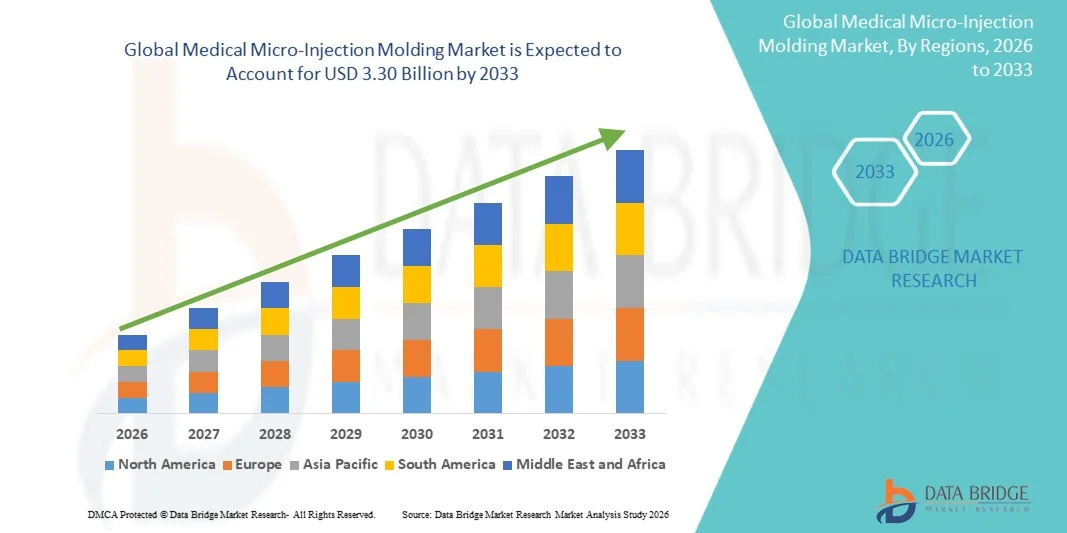
- As per Data Bridge Market Research analysis, the medical micro-injection molding market was valued at USD 1.70 billion in 2025 and is projected to reach USD 3.30 billion by 2033, growing at a CAGR of 8.66% from 2026 to 2033.
- The market is experiencing consistent growth driven by increasing demand for minimally invasive medical devices, rising adoption of microfluidic devices, and growing use of micro-injection molding for producing complex and precise medical components.
- The increasing demand for miniaturized medical devices, combined with the need for high-precision, cost-effective, and scalable manufacturing, is encouraging medical device manufacturers to adopt micro-injection molding technologies. The technology enables the production of small, complex components with tight tolerances and high dimensional accuracy, supporting applications across diagnostic devices, drug delivery devices, surgical instruments, microfluidic devices, and implantable components.
Market Size & Forecast
- Global Market Value (2025): USD 1.70 Billion
- Expected Market Value (2033): USD 3.30 Billion
- Forecast CAGR (2026–2033): 8.66%
- Leading Region in 2025: North America
- Fastest Growing Region: Asia Pacific
What are the Major Takeaways of the Medical Micro-Injection Molding Market?
- North America dominated the medical micro-injection molding market with an estimated 39.6% share in 2025, supported by mature healthcare infrastructure, strong technical expertise, and the existence of a medical device manufacturers' ecosystem.
- Asia-Pacific is expected to be the fastest-growing region at a CAGR of 9.1% from 2026 to 2033, fueled by increasing government investment in domestic medical manufacturing, growing localization of medical device production, and developing precision engineering capabilities across China, India, Japan, and South Korea.
- The thermoplastics segment led the market with a 47.5% share in 2025, driven by their biocompatibility, chemical resistance, sterilization properties, and ability to produce dimensionally precise and complex medical micro parts.
- Bioabsorbable materials are the fastest-growing material type, projected to register a CAGR of 8.9%, reflecting the surge in interest in implantable and minimally invasive medical technologies.
- The microfluidic components segment dominated the component type category with a 59.3% revenue share in 2025, led by extensive use of micro-injection molding for miniature fluid-handling structures used in diagnostic and laboratory technologies
- Drug delivery devices accounted for 31.8% of the market share in 2025, preferred by escalating demand for minimally invasive therapies, self-injection devices, and precision medicine.
- The microfluidic devices segment is the fastest-growing application category, with a CAGR of 9.4%, driven by increasing implementation of point-of-care diagnostics, lab-on-chip technologies, and miniature testing platforms.
Report Scope and Medical Micro-Injection Molding Market Segmentation
|
Attributes |
Medical Micro-Injection Molding Key Market Insights |
|
Segments Covered |
|
|
Countries Covered |
North America
Europe
Asia-Pacific
Middle East and Africa
South America
|
|
Key Market Players |
|
|
Market Opportunities |
|
|
Value Added Data Infosets |
In addition to the insights on market scenarios such as market value, growth rate, segmentation, geographical coverage, and major players, the market reports curated by the Data Bridge Market Research also include in-depth expert analysis, patient epidemiology, pipeline analysis, pricing analysis, and regulatory framework. |
What is the Key Trend in the Medical Micro-Injection Molding Market?
- Medical device manufacturers are increasingly adopting micro-injection molding to produce miniaturized, complex, and high-precision components for minimally invasive devices, diagnostics, drug delivery systems, and microfluidic applications.
- For instance, in September 2025, researchers published a study demonstrating mass fabrication of PDMS microfluidic devices through injection molding, showing its suitability for producing medical/life-science microfluidic devices at scale and applying them to 3D spheroid and explant culture. The study reported throughput exceeding 10,000 parts per week per machine.
- Increasing miniaturization is driving demand for micro-molded components with micron-level dimensional accuracy, tight tolerances, complex geometries, and high surface quality for advanced medical applications.
- Medical manufacturers are increasingly applying micro-injection molding to microfluidic chips, implantable components, surgical devices, diagnostic systems, and precision drug-delivery components requiring repeatable high-volume production.
- For instance, in April 2024, researchers demonstrated rapid tooling for micro-injection molding of a proof-of-concept microfluidic device, validating resin inserts as a method for producing microfluidic structures and supporting faster development of miniaturized medical devices.
- As medical device designs continue shifting toward smaller, more complex, and minimally invasive architectures, the adoption of precision micro-injection molding is expected to accelerate, strengthening its role in scalable manufacturing of next-generation medical components.
What are the Key Drivers of the Medical Micro-Injection Molding Market?
- The rapid miniaturization of medical devices has significantly increased demand for micro-injection molding capable of producing complex polymer components with micron-level tolerances and high dimensional precision.
- For instance, in September 2023, researchers published a study on ultrasonic micro-injection molding of microneedles, demonstrating how process parameters such as mold temperature and injection force can be optimized to improve microneedle replication and achieve repeatable manufacturing supporting the use of micro-injection molding for miniature drug-delivery devices.
- Medical device manufacturers are integrating micro-molding into minimally invasive, diagnostic, drug delivery, and microfluidic applications to achieve precise geometries, repeatable production, and scalable manufacturing of miniature components.
- For instance, in October 2023, researchers demonstrated injection molding of functional nanofluidic devices with critical structures below 30 nm, showing the potential of molding technologies to manufacture extremely small structures for single-molecule detection and in-vitro diagnostic applications.
- With medical technologies increasingly requiring smaller, precise, and high-volume components, micro-injection molding will remain important for scalable manufacturing of advanced diagnostic, therapeutic, surgical, and implantable medical devices.
Which Factors are Challenging the Growth of the Medical Micro-Injection Molding Market?
- Micro-injection molding requires specialized machinery, precision tooling, and advanced process control because miniature cavities and components are highly sensitive to material behavior, temperature, pressure, and injection conditions.
- For instance, in July 2022, researchers published a study showing that micro-injection molding requires careful optimization of melting temperature, holding pressure, mold temperature, injection speed, and holding time because these parameters affect part weight and flash formation.
- These technical requirements increase tooling, equipment, validation, and process-development costs, particularly when manufacturers produce low-volume or highly customized medical micro-components.
- Process variability also creates challenges because changes in melt temperature, mold temperature, injection speed, and material properties can affect filling behavior, replication quality, dimensional accuracy, and surface finish.
- For instance, in September 2022, researchers reported that quality evaluation of micro-injection-molded products is complex because conventional contact-based measurement instruments may not fit extremely narrow micro-features, highlighting the specialized quality-control requirements of the process.
- The need for specialized tooling, highly controlled processing, skilled personnel, and stringent quality requirements therefore continues to constrain adoption, particularly for manufacturers producing small batches or highly complex medical micro-components.
How is the Medical Micro-Injection Molding Market Segmented?
The medical micro-injection molding market is segmented on the basis of material type, component type, application, and end user.
- By Material Type
On the basis of material type, the medical micro-injection molding market is segmented into thermoplastics, liquid silicone rubber (LSR), bioabsorbable materials, and others. The thermoplastics segment dominated the market with a 47.5% share in 2025, owing to biocompatibility, chemical resistance, sterilization properties, and the ability to produce dimensionally precise and complex medical micro parts. Thermoplastics such as polypropylene, polyethylene, and polycarbonate are widely used in catheter systems, diagnostic cartridges, wearable devices, and drug delivery systems. Their adaptability to disposable and minimally invasive medical devices further supports their widespread adoption. Cost-effectiveness and suitability for high-volume production also strengthen their position in medical micro molding.
The bioabsorbable materials segment is projected to be one of the fastest-growing material categories at a CAGR of 8.9% from 2026 to 2033, supported by increasing demand for implantable and minimally invasive medical technologies. These materials provide temporary structural support before being absorbed by the body, potentially reducing the need for additional removal procedures. Their application potential includes bioabsorbable implants and miniature medical components requiring controlled degradation. Growing development of advanced medical devices is encouraging research into materials that combine precision molding with biological compatibility. Micro-injection molding can produce complex miniature geometries from polymeric materials, supporting their use in sophisticated medical applications.
- By Component Type
On the basis of component type, the medical micro-injection molding market is segmented into microfluidic components, micro-optical components, micromechanical components, and micro-medical components. The microfluidic components segment dominated the market with a 59.3% share in 2025, supported by extensive use of micro-injection molding for miniature fluid-handling structures used in diagnostic and laboratory technologies. Microfluidic devices require accurate replication of very small channels and features to maintain fluid-flow functionality. Injection molding enables these structures to be produced repeatedly and at high volumes once appropriate tooling is established. The technology can integrate channels, valves, wells, and other microstructures into compact components. Growing use of microfluidics in diagnostics and life-science applications therefore supports demand for precision micro-molded components.
The micro-optical components segment is projected to be the fastest-growing component type at a CAGR of 9.8% from 2026 to 2033, driven by increasing demand for miniaturized optical components in medical imaging, diagnostic, sensing, and photonic applications. Micro-injection molding enables the production of miniature lenses, optical elements, light guides, and other components with complex geometries and precise surface characteristics. The technology supports high-volume replication while maintaining dimensional consistency. Increasing integration of optical functions into compact medical devices is creating additional opportunities for micro-optical components. Advances in precision tooling and polymer optical materials are further improving the manufacturability of miniature optical components.
- By Application
On the basis of application, the medical micro-injection molding market is segmented into drug delivery devices, diagnostic devices, surgical instruments, microfluidic devices, and implantable components. The drug delivery devices segment dominated the market with a 31.8% share in 2025, driven by escalating demand for minimally invasive therapies, self-injection devices, and precision medicine. Insulin pens, wearable injectors, inhalers, implantable pumps, and other drug delivery systems require miniature, high-precision, low-tolerance, and highly repetitive components. Micro-injection molding enables the production of these miniature components with high dimensional accuracy and repeatability. Increasing patient-centric approaches and self-administration technologies are further supporting demand for precision micro-molded parts.
The microfluidic devices segment is expected to register the fastest growth at a CAGR of 9.4% from 2026 to 2033, supported by increasing implementation of point-of-care diagnostics, lab-on-chip technologies, and miniature testing platforms. Microfluidic devices require highly precise channels and complex microstructures that can be replicated using injection molding. The technology supports high-volume production while maintaining consistency across miniature components. Growing demand for portable and rapid diagnostic technologies is creating new applications for molded microfluidic devices. Micro-injection molding can also integrate multiple microfeatures into a single component, reducing assembly requirements.
- By End User
On the basis of end user, the medical micro-injection molding market is segmented into medical device manufacturers, pharmaceutical and biotechnology companies, hospitals and healthcare facilities, research institutes, and others. The medical device manufacturers segment dominated the market with a 54.2% share in 2025, owing to sustained requirements for high-precision and miniature components used in implantable devices, diagnostic devices, surgical instruments, and wearable medical devices. Micro-injection molding enables high dimensional accuracy, complicated shapes, continuous mass production, and adherence to stringent medical quality requirements. Increasing use of minimally invasive surgical procedures is further driving demand for precision micro-molded components. Medical device manufacturers also require repeatable production of miniature components at commercial volumes.
The pharmaceutical and biotechnology companies segment is expected to register strong growth at a CAGR of 10.2% from 2026 to 2033, driven by increasing use of micro-molded components in drug delivery systems, microfluidic platforms, and advanced biotechnology applications. Micro-injection molding can provide precision components required for miniature drug delivery devices and laboratory platforms. Growing development of biologics and self-administration technologies is creating demand for compact and reliable drug delivery components. Biotechnology applications are also increasingly using microfluidic devices for cell analysis, sample preparation, and other laboratory processes. Research has demonstrated the suitability of micro-injection molding for high-volume production of microfluidic components.
Which Region Holds the Largest Share of the Medical Micro-Injection Molding Market?
- North America dominated the medical micro-injection molding market with an estimated 39.6% share in 2025, supported by mature healthcare infrastructure, strong technical expertise, and the existence of a medical device manufacturers' ecosystem.
- The region also benefits from increasing adoption of minimally invasive medical devices, diagnostic technologies, microfluidic devices, and precision medical components, while established medical device manufacturers continue to drive demand for high-precision micro-molded components. Growing healthcare expenditure, technological advancements, and increasing requirements for miniaturized medical devices are expected to further strengthen North America's leadership position in the global market.
U.S. Medical Micro-Injection Molding Market Insight
The U.S. medical micro-injection molding market is witnessing strong growth due to its mature medical-device manufacturing infrastructure, advanced technical expertise, and stringent quality requirements. The country has a large ecosystem of medical-device manufacturers requiring miniature, high-precision components for implants, surgical devices, diagnostics, and drug-delivery systems. Increasing adoption of minimally invasive medical devices and miniaturized technologies is supporting demand for precision micro-molded components. The presence of major medical-device companies and specialized micro-molding suppliers further strengthens the country's manufacturing capabilities. The U.S. FDA's Quality System Regulation requires medical-device manufacturers to establish and maintain validated production processes, supporting demand for controlled and precision-oriented manufacturing technologies.
Asia-Pacific Medical Micro-Injection Molding Market Insight
The Asia-Pacific medical micro-injection molding market is expected to witness rapid growth, driven by increasing medical-device manufacturing, expanding healthcare infrastructure, and growing adoption of precision manufacturing technologies across China, Japan, India, and South Korea. The region benefits from expanding domestic production of medical devices and increasing localization of healthcare-component manufacturing. Growing healthcare expenditure and increasing demand for minimally invasive and disposable medical devices are creating additional applications for micro-molded components. Japan's Ministry of Health, Labour and Welfare has identified medical-device innovation and strengthening the domestic medical-device industry as important policy priorities, supporting the development of advanced healthcare manufacturing
Japan Medical Micro-Injection Molding Market Insight
The Japan medical micro-injection molding market is witnessing consistent growth due to its advanced precision-manufacturing capabilities, medical-device innovation, and high-tech manufacturing infrastructure. Japanese companies possess established expertise in ultra-precision manufacturing, microfluidics, optical components, robotics, and advanced polymer processing. These capabilities are particularly relevant to micro-molded medical components requiring tight dimensional tolerances and complex geometries. Japan's Ministry of Health, Labour and Welfare has highlighted innovation and strengthening the domestic medical-device industry as key policy objectives, supporting development of advanced medical technologies and manufacturing capabilities.
China Medical Micro-Injection Molding Market Insight
The China medical micro-injection molding market is growing rapidly, driven by expanding medical-device manufacturing, high-volume precision plastic production, and increasing localization of healthcare-component manufacturing. China's large medical-device manufacturing base is creating demand for miniature components used in diagnostic, therapeutic, surgical, and disposable healthcare products. The country's large patient population and expanding healthcare infrastructure are also supporting demand for medical technologies. China's State Council issued the 14th Five-Year Plan for the Development of the Medical Equipment Industry in January 2023, targeting higher levels of innovation and development of the domestic medical-equipment industry.
U.K. Medical Micro-Injection Molding Market Insight
The U.K. medical micro-injection molding market is experiencing steady growth, supported by its established medical-technology, life-science, and precision-engineering capabilities. Demand is increasing for micro-molded components used in medical devices, diagnostics, ophthalmic products, pharmaceutical applications, and drug-delivery systems. Increasing demand for miniaturized medical devices and microfluidic technologies is creating additional opportunities for specialized micro-molding manufacturers. Investment in precision tooling, validation, metrology, and controlled production environments is further supporting market development. Micro Systems' U.K. operation provides medical micro-molding services under ISO 13485 quality management and operates controlled cleanroom manufacturing environments for medical, pharmaceutical, ophthalmic, and diagnostic applications
Germany Medical Micro-Injection Molding Market Insight
The Germany medical micro-injection molding market is expanding steadily due to its strong precision-engineering base, advanced polymer-processing capabilities, and established medical-device research ecosystem. Germany's capabilities in advanced manufacturing, automation, high-precision machinery, and medical technology support demand for complex micro-molded components. Strong collaboration between research organizations and the medical-technology industry is supporting technological development. In October 2021, researchers in Germany demonstrated rapid tooling for micro-injection molding of micro medical devices using digital light processing, showing the application of advanced tooling technology to medical micro-manufacturing
Which are the Top Companies in Medical Micro-Injection Molding Market?
The medical micro-injection molding industry is primarily led by well-established companies, including:
- Makuta, Inc. (U.S.)
- MTD Micro Molding (U.S.)
- Accu-Mold LLC (U.S.)
- Micro Systems UK (U.K.)
- Mikrotech, Inc. (U.S.)
- Rapidwerks, Inc. (U.S.)
- Sovrin Plastics Ltd (U.K.)
- Polymermedics Ltd (U.K.)
- BMP Medical (U.S.)
- Stack Plastics, Inc. (U.S.)
- American Precision Products (U.S.)
- D&M Plastics, LLC (U.S.)
- Veejay Plastic Injection Molding Company (U.S.)
- Pexco LLC (U.S.)
- Gerresheimer AG (Germany)
- Parker Hannifin Corporation (U.S.)
- TEAM Technologies, Inc. (U.S.)
- Nolato AB (Sweden)
- Rosti Group AB (Sweden)
- SMC Corporation (Japan)
What are Latest Developments in Medical Micro-Injection Molding Market?
- In May 2025, Wirthwein Medical launched a specially developed, fully electric 2K injection molding machine for the production of high-precision and ultra-small multi-component parts. The machine was customized for Wirthwein Medical's requirements and combines precision, automation, and two-component injection molding. Its applications include container closure systems and components for pharmaceutical primary packaging, making it directly relevant to precision medical and pharmaceutical molding.
- In May 2025, ENGEL reported the production of precision contact trays for laboratory diagnostics by Röchling Medical using an all-electric e-motion injection molding machine. The specialized polystyrene contact trays incorporate a three-point snap-fit mechanism that improves sample handling and transport safety. The development demonstrates the use of highly precise injection molding for laboratory diagnostic components and reflects increasing demand for reliable, automated production of medical consumables
- In January 2025, ENGEL announced that its iQ weight control digital assistance system had successfully completed validation according to EN-ISO, MDR, and FDA requirements for medical injection molding. The system is used in manufacturing the precision roller-clamp housing for B. Braun's Intrafix Safeset infusion device, a component produced in high volumes that requires stable and highly repeatable manufacturing. The development highlights the growing integration of digital process-control technologies into medical injection molding.
- In September 2024, researchers published a machine-learning approach for automated defect detection in injection-molded microwell-based medical devices. The research applied a convolutional neural network to analyze large numbers of microwells produced by injection molding, addressing the limitations of manual inspection. The automated approach increased the number of images that could be analyzed and was designed to improve quality-control consistency for high-throughput medical microfluidic devices.
- In May 2024, ENGEL demonstrated LSR micro-injection molding of extremely small medical components at NPE 2024. The company reported production of silicone valves weighing only 0.001 grams using a 32-cavity precision mold, a micro-injection unit, an all-electric e-motion 30 TL machine, robotic handling, optical inspection, and iQ weight control. The development demonstrates the industry's ability to manufacture ultra-small components with highly consistent shot weights and automated quality control.

- Interactive Data Analysis Dashboard
- Company Analysis Dashboard for high growth potential opportunities
- Research Analyst Access for customization & queries
- Competitor Analysis with Interactive dashboard
- Latest News, Updates & Trend analysis
- Harness the Power of Benchmark Analysis for Comprehensive Competitor Tracking
Data collection and base year analysis are done using data collection modules with large sample sizes. The stage includes obtaining market information or related data through various sources and strategies. It includes examining and planning all the data acquired from the past in advance. It likewise envelops the examination of information inconsistencies seen across different information sources. The market data is analysed and estimated using market statistical and coherent models. Also, market share analysis and key trend analysis are the major success factors in the market report. To know more, please request an analyst call or drop down your inquiry.
The key research methodology used by DBMR research team is data triangulation which involves data mining, analysis of the impact of data variables on the market and primary (industry expert) validation. Data models include Vendor Positioning Grid, Market Time Line Analysis, Market Overview and Guide, Company Positioning Grid, Patent Analysis, Pricing Analysis, Company Market Share Analysis, Standards of Measurement, Global versus Regional and Vendor Share Analysis. To know more about the research methodology, drop in an inquiry to speak to our industry experts.
Data Bridge Market Research is a leader in advanced formative research. We take pride in servicing our existing and new customers with data and analysis that match and suits their goal. The report can be customized to include price trend analysis of target brands understanding the market for additional countries (ask for the list of countries), clinical trial results data, literature review, refurbished market and product base analysis. Market analysis of target competitors can be analyzed from technology-based analysis to market portfolio strategies. We can add as many competitors that you require data about in the format and data style you are looking for. Our team of analysts can also provide you data in crude raw excel files pivot tables (Fact book) or can assist you in creating presentations from the data sets available in the report.













