


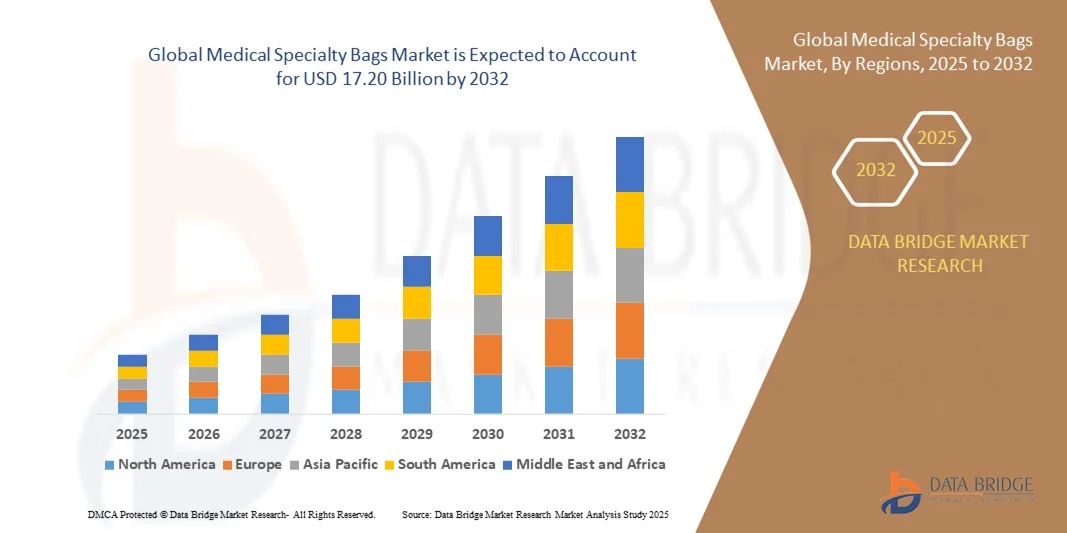
Medical Specialty Bags Market Size
- The global medical specialty bags market size was valued at USD 10.99 billion in 2024 and is expected to reach USD 17.20 billion by 2032, at a CAGR of 5.75% during the forecast period
- The market growth is largely fueled by increasing prevalence of chronic diseases, rising surgical procedures, and expanding home healthcare services, which are driving higher demand for medical specialty bags such as IV fluid, blood, dialysis, and urinary collection bags
- Furthermore, the growing focus on patient safety, infection control, and the adoption of advanced, sterile, and PVC-free materials is encouraging healthcare providers to upgrade to more reliable and efficient medical specialty bags. These converging factors are accelerating the uptake of innovative and safer bag solutions, thereby significantly boosting the industry’s growth
Medical Specialty Bags Market Analysis
- Medical specialty bags are designed for storing, transporting, or administering fluids, medications, and biological products, and include IV bags, blood bags, dialysis bags, enteral feeding bags, and other specialty products. They are manufactured using materials such as PVC, polypropylene, polyethylene, and EVA, often incorporating features that enhance safety, stability, and ease of use
- The escalating demand for medical specialty bags is primarily fueled by increasing hospital admissions, growing chronic and lifestyle-related health conditions, rising elderly populations, and the expanding adoption of home-based and ambulatory care services
- North America dominated the medical specialty bags market with a share of 38.3% in 2024, due to a growing prevalence of chronic diseases, rising hospitalization rates, and the expansion of home healthcare services
- Asia-Pacific is expected to be the fastest growing region in the medical specialty bags market during the forecast period due to rising healthcare expenditures, increasing hospitalization, and growing prevalence of chronic diseases across emerging economies
- 501 - 1000 ml segment dominated the market with a market share of 43.2% in 2024, due to its extensive usage across intravenous fluid therapy, urinary collection, and enteral feeding applications. This capacity range offers a balance between convenience and adequate volume, making it the preferred choice for hospitals and home healthcare. With a growing patient pool requiring medium-duration treatments, the 501–1000 ml bags ensure ease of handling while minimizing the need for frequent replacements, strengthening their dominance in the segment
Report Scope and Medical Specialty Bags Market Segmentation
|
Attributes |
Medical Specialty Bags Key Market Insights |
|
Segments Covered |
|
|
Countries Covered |
North America
Europe
Asia-Pacific
Middle East and Africa
South America
|
|
Key Market Players |
|
|
Market Opportunities |
|
|
Value Added Data Infosets |
In addition to the insights on market scenarios such as market value, growth rate, segmentation, geographical coverage, and major players, the market reports curated by the Data Bridge Market Research also include import export analysis, production capacity overview, production consumption analysis, price trend analysis, climate change scenario, supply chain analysis, value chain analysis, raw material/consumables overview, vendor selection criteria, PESTLE Analysis, Porter Analysis, and regulatory framework. |
Medical Specialty Bags Market Trends
Rise of PVC-Free and Eco-Friendly Medical Bags
- A key trend shaping the medical specialty bags market is the growing adoption of PVC-free and eco-friendly alternatives, as sustainability concerns and patient safety requirements drive changes in hospital procurement policies and healthcare systems. Manufacturers are developing bags made from materials such as polypropylene and polyethylene to replace conventional PVC, which carries risks from plasticizers such as DEHP
- For instance, Baxter International has introduced a line of IV and dialysis bags that are PVC- and DEHP-free, designed to reduce environmental impact while improving patient safety. Similarly, Fresenius Medical Care has been adopting eco-friendly alternatives in its blood and dialysis bag portfolios, showcasing how top companies are integrating sustainability into medical packaging innovation strategies
- The movement towards eco-friendly medical bags also addresses the increasing awareness of health risks linked to traditional PVC bags, as certain plasticizers may leach into medical fluids. PVC-free bags offer safety advantages for sensitive patient groups, including neonates, oncology patients, and those undergoing long-term treatments requiring continuous fluid therapies
- Hospitals and healthcare providers are increasingly emphasizing green procurement strategies by sourcing recyclable, lightweight, and safer medical bags. This trend is also in alignment with worldwide regulatory shifts that encourage lower reliance on harmful plastics and promote safer medical device manufacturing standards
- Advancements in multilayer film technology are enhancing the performance of PVC-free bags, allowing them to provide superior barrier properties while remaining lightweight and recyclable. In addition, these sustainable bags are being designed to maintain durability and compatibility with sterilization processes essential for medical safety standards
- The transition toward eco-friendly and PVC-free medical specialty bags is not just a response to regulatory pressure but also a strategic alignment with broader healthcare goals of patient safety and environmental sustainability. This ensures that the eco-friendly segment will lead future innovation and competitive differentiation in the global medical specialty bags market
Medical Specialty Bags Market Dynamics
Driver
Increasing Chronic Diseases and Hospitalizations
- The growing prevalence of chronic diseases such as diabetes, kidney disorders, and cancer is a central driver of demand for medical specialty bags, as these conditions require frequent hospitalizations and long-term medical therapies. Rising patient populations are placing ongoing pressure on healthcare systems, thereby increasing the need for reliable and safe specialty bag solutions
- For instance, Fresenius Kabi has significantly expanded its production of enteral feeding and dialysis bags to meet the increasing needs of patients with kidney and gastrointestinal disorders. Such initiatives by global manufacturers highlight how the rising burden of chronic illness is accelerating adoption of specialty medical bags across treatment facilities worldwide
- Dialysis procedures and chemotherapy treatments require a continuous supply of medical bags for fluid transfer, storage, and disposal of waste, which positions these products as critical consumables in hospital settings. The growing geriatric population, who are more prone to chronic diseases, further fuels this demand globally
- The expansion of modern healthcare infrastructure in emerging economies is boosting hospital admissions, thereby generating parallel growth in the utilization of IV bags, colostomy bags, and other specialty products. In addition, the rising focus on home healthcare therapies is further strengthening the demand for portable and durable bag solutions
- As chronic conditions remain on the rise, specialty medical bags are increasingly seen as indispensable medical devices that ensure effective therapy delivery, patient comfort, and operational convenience. This ongoing dependence highlights the long-term growth path of the medical specialty bags market, cementing its integral role within healthcare supply chains
Restraint/Challenge
Disposal of Non-Biodegradable PVC Medical Bags
- A major challenge facing the medical specialty bags market is the disposal of non-biodegradable PVC bags, as they generate significant medical waste and create environmental hazards. Hospitals and clinics worldwide struggle with the accumulation of used PVC-based products that cannot be easily recycled and contribute to landfill volumes and incineration risks
- For instance, the World Health Organization (WHO) has highlighted growing concerns regarding the disposal of single-use PVC medical products such as colostomy and IV bags, raising pressure on manufacturers and hospitals to adopt safer and more sustainable alternatives. Companies such as B. Braun have responded by developing PVC-free IV and irrigation bags to reduce disposal challenges
- The chlorine content of PVC makes it environmentally hazardous, as incineration of PVC waste can release toxic compounds such as dioxins. In addition, improper disposal practices in developing regions amplify environmental risks, making waste management one of the most pressing obstacles for healthcare packaging sustainability
- The lack of widespread infrastructure for recycling medical-grade plastics further compounds the issue, as collection, segregation, and sterilization of medical waste require advanced facilities that are often limited or cost-prohibitive. This creates added challenges for hospitals, particularly in emerging markets with constrained waste management systems
- To address this challenge, stakeholders across the market must develop strategies that prioritize eco-friendly materials, invest in recycling technologies, and implement stricter hospital waste segregation processes. Moving toward biodegradable and PVC-free alternatives represents the most viable solution to ensure long-term sustainability and compliance with global environmental guidelines
Medical Specialty Bags Market Scope
The market is segmented on the basis of product, material type, and capacity.
- By Product
On the basis of product, the medical specialty bags market is segmented into anesthesia breathing bags, urinary collection bags, bile collection bags, sterile packaging bags, blood bags, ostomy collection bags, enteral feeding bags, cadaver bags, resuscitation bags, continuous ambulatory peritoneal dialysis (CAPD) bags, intravenous fluid bags, enema bags, and ice bags. The urinary collection bags segment accounted for the largest revenue share in 2024, primarily due to the high prevalence of urinary incontinence, rising number of surgical procedures, and increasing use in elderly patient care. Hospitals, nursing homes, and long-term care facilities generate consistent demand for urinary collection bags, making them an essential consumable in healthcare. The availability of different types such as leg bags and bedside bags, coupled with infection-control features such as anti-reflux valves, reinforces their dominance in the global market.
The intravenous (IV) fluid bags segment is expected to register the fastest growth rate from 2025 to 2032, driven by rising hospitalization rates, growing prevalence of chronic illnesses, and increasing demand for intravenous therapies. IV fluid bags are extensively used in delivering medications, electrolytes, and nutrition, making them indispensable in critical and routine care settings. With growing awareness around safe infusion practices, there is a strong shift toward non-PVC and eco-friendly IV fluid bags, further fueling growth. The segment also benefits from the expansion of home healthcare and ambulatory infusion services, accelerating adoption over the forecast period.
- By Material Type
On the basis of material type, the market is categorized into polypropylene (PP), polyethylene (PE), polyvinyl chloride (PVC), ethylene-vinyl acetate (EVA), and others. The PVC segment held the largest revenue share in 2024, owing to its long-standing use in manufacturing medical bags, cost-effectiveness, and durability. PVC-based bags are widely utilized in blood storage, IV fluids, and urinary collection due to their strength, flexibility, and transparency. Despite rising environmental concerns, PVC’s established supply chain and high barrier properties against contamination keep it in strong demand across hospitals and diagnostic facilities.
The polypropylene (PP) segment is projected to witness the fastest CAGR from 2025 to 2032, propelled by the increasing demand for lightweight, eco-friendly, and chemically resistant materials. PP bags are gaining traction as healthcare providers shift toward safer alternatives to PVC, particularly for infusion and dialysis applications. Their resistance to high sterilization temperatures, reduced leachability, and recyclability make them highly preferred in modern healthcare environments. The growing push toward sustainable medical packaging and the rising adoption of single-use medical devices further support the rapid expansion of PP in the market.
- By Capacity
On the basis of capacity, the medical specialty bags market is segmented into 250 ml, 251–500 ml, 501–1000 ml, and above 1000 ml. The 501–1000 ml segment dominated the market with a share of 43.2% in 2024, supported by its extensive usage across intravenous fluid therapy, urinary collection, and enteral feeding applications. This capacity range offers a balance between convenience and adequate volume, making it the preferred choice for hospitals and home healthcare. With a growing patient pool requiring medium-duration treatments, the 501–1000 ml bags ensure ease of handling while minimizing the need for frequent replacements, strengthening their dominance in the segment.
The above 1000 ml segment is anticipated to record the fastest growth rate from 2025 to 2032, attributed to rising demand in dialysis, continuous peritoneal therapy, and long-term fluid management. These high-capacity bags are increasingly adopted for chronic disease management, especially in renal care and oncology. The shift toward home-based dialysis treatment has further expanded the demand for larger-capacity medical bags, enabling patients to undergo therapy with fewer interruptions. In addition, technological advancements in bag materials to improve durability and safety have enhanced adoption, supporting robust growth in this segment.
Medical Specialty Bags Market Regional Analysis
- North America dominated the medical specialty bags market with the largest revenue share of 38.3% in 2024, driven by a growing prevalence of chronic diseases, rising hospitalization rates, and the expansion of home healthcare services
- The region’s well-established healthcare infrastructure ensures consistent demand for products such as IV fluid bags, urinary collection bags, and blood bags
- The adoption of advanced, sterile, and eco-friendly materials is further accelerating market penetration, with strong procurement from hospitals and specialty clinics
U.S. Medical Specialty Bags Market Insight
The U.S. medical specialty bags market captured the largest revenue share in 2024 within North America, fueled by the country’s high surgical volumes, significant aging population, and advanced medical care standards. Strong emphasis on infection prevention and safe disposal methods has reinforced the demand for high-quality urinary, ostomy, and CAPD bags. Moreover, the rapid expansion of home-based treatment options, particularly dialysis and enteral feeding, alongside the presence of key manufacturers, is contributing to market growth.
Europe Medical Specialty Bags Market Insight
The Europe medical specialty bags market is projected to expand at a substantial CAGR throughout the forecast period, primarily driven by an increasing number of surgical procedures and the adoption of eco-friendly materials due to regulatory pressures. The region’s aging population, coupled with the prevalence of lifestyle-related disorders, has heightened the demand for blood, IV, and ostomy bags. Growing focus on sustainability and the replacement of PVC with safer alternatives are shaping procurement decisions across hospitals and outpatient centers.
U.K. Medical Specialty Bags Market Insight
The U.K. medical specialty bags market is anticipated to grow at a noteworthy CAGR during the forecast period, supported by the rising demand for urinary and ostomy collection bags in elderly and post-surgical care. Strong government focus on improving healthcare infrastructure, coupled with patient preference for home-based care solutions, is fueling market adoption. In addition, growing awareness of eco-friendly medical consumables is driving the shift toward polypropylene and EVA-based bags.
Germany Medical Specialty Bags Market Insight
The Germany medical specialty bags market is expected to expand at a considerable CAGR during the forecast period, driven by a strong emphasis on high-quality, technologically advanced medical consumables. Germany’s highly structured healthcare system, combined with its preference for safe, sterile, and sustainable materials, has made IV fluid and blood bags essential consumables. The adoption of innovative dialysis and enteral feeding solutions is also rising, supported by the country’s leadership in medical device innovation and sustainability initiatives.
Asia-Pacific Medical Specialty Bags Market Insight
The Asia-Pacific medical specialty bags market is poised to grow at the fastest CAGR during the forecast period of 2025 to 2032, fueled by rising healthcare expenditures, increasing hospitalization, and growing prevalence of chronic diseases across emerging economies. Rapid urbanization and government investments in healthcare infrastructure are boosting demand for IV fluid, blood, and dialysis bags. Moreover, the cost-effective manufacturing base in countries such as China and India is expanding access to affordable specialty bags, making the region highly attractive for global suppliers.
Japan Medical Specialty Bags Market Insight
The Japan medical specialty bags market is gaining momentum due to the country’s rapidly aging population and strong demand for dialysis and urinary care solutions. The widespread use of CAPD bags, coupled with government support for home healthcare, is significantly boosting adoption. Japan’s focus on technologically advanced and sterile products, along with consumer preference for eco-friendly alternatives, is further supporting market growth.
China Medical Specialty Bags Market Insight
The China medical specialty bags market accounted for the largest revenue share in Asia-Pacific in 2024, supported by a rising number of hospital admissions, expanding middle-class population, and rapid improvements in healthcare facilities. Domestic manufacturing capabilities and the availability of cost-effective IV fluid, blood, and urinary bags have strengthened China’s market dominance. The government’s emphasis on healthcare modernization, alongside the rising adoption of home-based treatment options, is fueling consistent demand for medical specialty bags across the country.
Medical Specialty Bags Market Share
The medical specialty bags industry is primarily led by well-established companies, including:
- Coloplast Corp (Denmark)
- Pall Corporation. (U.S.)
- Medline Industries, Inc. (U.S.)
- Baxter (U.S.)
- TERUMO BCT, INC. (U.S.)
- B. Braun Melsungen AG (Germany)
- BD (U.S.)
- WESTFIELD MEDICAL LIMITED (U.K.)
- Nolato AB (Sweden)
- Specialty Bags Inc. (U.S.)
- UNIFLEX HEALTHCARE (U.S.)
- ArmandMFG.com (U.S.)
- Macopharma (France)
- International Plastics Inc. (U.S.)
- Sippex IV bag (MEDIPPEX Sippex) (France)
- Maco PKG. (U.S.)
- Persico S.p.a. (Italy)
- DuPont. (U.S.)
- Versapak International Ltd (U.K.)
Latest Developments in Global Medical Specialty Bags Market
- In July 2025, B. Braun Medical Inc. introduced new heparin sodium premixed infusion bags, expanding its U.S. portfolio to include 25,000-unit bags at 50 units/mL and 100 units/mL concentrations. This launch strengthens B. Braun’s position in the U.S. medical specialty bags market, particularly in the anticoagulant segment, by offering healthcare providers ready-to-use, standardized solutions that reduce preparation time, improve dosing accuracy, and enhance patient safety. The availability of multiple concentrations also caters to diverse clinical requirements, driving broader adoption across hospitals and emergency care settings
- In May 2025, Endo, Inc. launched ADRENALIN (epinephrine in 0.9% sodium chloride) 8 mg/250 mL premixed bags targeting emergency medicine channels. This innovation addresses the critical demand for pre-prepared emergency medication solutions, enabling faster response times in acute care settings. By providing ready-to-use bags, Endo enhances operational efficiency in hospitals and emergency services, positioning itself as a key player in the emergency infusion market and stimulating overall growth in the premixed specialty bags segment
- In February 2024, Xheme, a company specializing in innovative medical technologies, collaborated with the Vitalant Research Institute to develop a new type of non-toxic, PVC-free blood bag technology. This partnership is a major advancement in blood storage and transfusion, addressing longstanding health and safety concerns associated with traditional PVC-based blood bags. The development is expected to drive adoption of safer blood storage solutions globally, boosting demand for next-generation medical bags that comply with stricter regulatory and sustainability standards
- In June 2022, Gufic Biosciences launched a dual-chamber drug delivery bag made of polypropylene, free from DEHP, and featuring peelable aluminum foil. This innovation allows unstable medications to be stored safely and reconstituted immediately before infusion, improving drug stability and patient safety. The launch positions Gufic as a competitive player in advanced drug delivery systems and encourages adoption of more versatile and safe medical specialty bags in hospitals and infusion centers
- In January 2022, Vonco Products LLC acquired Flex-Pak Packaging Products, Inc., enhancing its manufacturing capabilities in medical devices, fluid bags, biohazard transport, and infection protection products. This strategic move broadens Vonco’s market reach and strengthens its presence in the medical specialty bags sector by enabling expanded product offerings, higher production efficiency, and improved customer service, driving growth in both domestic and international markets

- Interactive Data Analysis Dashboard
- Company Analysis Dashboard for high growth potential opportunities
- Research Analyst Access for customization & queries
- Competitor Analysis with Interactive dashboard
- Latest News, Updates & Trend analysis
- Harness the Power of Benchmark Analysis for Comprehensive Competitor Tracking
Global Medical Specialty Bags Market, Supply Chain Analysis and Ecosystem Framework
To support market growth and help clients navigate the impact of geopolitical shifts, DBMR has integrated in-depth supply chain analysis into its Global Medical Specialty Bags Market research reports. This addition empowers clients to respond effectively to global changes affecting their industries. The supply chain analysis section includes detailed insights such as Global Medical Specialty Bags Market consumption and production by country, price trend analysis, the impact of tariffs and geopolitical developments, and import and export trends by country and HSN code. It also highlights major suppliers with data on production capacity and company profiles, as well as key importers and exporters. In addition to research, DBMR offers specialized supply chain consulting services backed by over a decade of experience, providing solutions like supplier discovery, supplier risk assessment, price trend analysis, impact evaluation of inflation and trade route changes, and comprehensive market trend analysis.
Data collection and base year analysis are done using data collection modules with large sample sizes. The stage includes obtaining market information or related data through various sources and strategies. It includes examining and planning all the data acquired from the past in advance. It likewise envelops the examination of information inconsistencies seen across different information sources. The market data is analysed and estimated using market statistical and coherent models. Also, market share analysis and key trend analysis are the major success factors in the market report. To know more, please request an analyst call or drop down your inquiry.
The key research methodology used by DBMR research team is data triangulation which involves data mining, analysis of the impact of data variables on the market and primary (industry expert) validation. Data models include Vendor Positioning Grid, Market Time Line Analysis, Market Overview and Guide, Company Positioning Grid, Patent Analysis, Pricing Analysis, Company Market Share Analysis, Standards of Measurement, Global versus Regional and Vendor Share Analysis. To know more about the research methodology, drop in an inquiry to speak to our industry experts.
Data Bridge Market Research is a leader in advanced formative research. We take pride in servicing our existing and new customers with data and analysis that match and suits their goal. The report can be customized to include price trend analysis of target brands understanding the market for additional countries (ask for the list of countries), clinical trial results data, literature review, refurbished market and product base analysis. Market analysis of target competitors can be analyzed from technology-based analysis to market portfolio strategies. We can add as many competitors that you require data about in the format and data style you are looking for. Our team of analysts can also provide you data in crude raw excel files pivot tables (Fact book) or can assist you in creating presentations from the data sets available in the report.













