


What is the Medical Specimen Tracking System Market Size and Growth Rate?
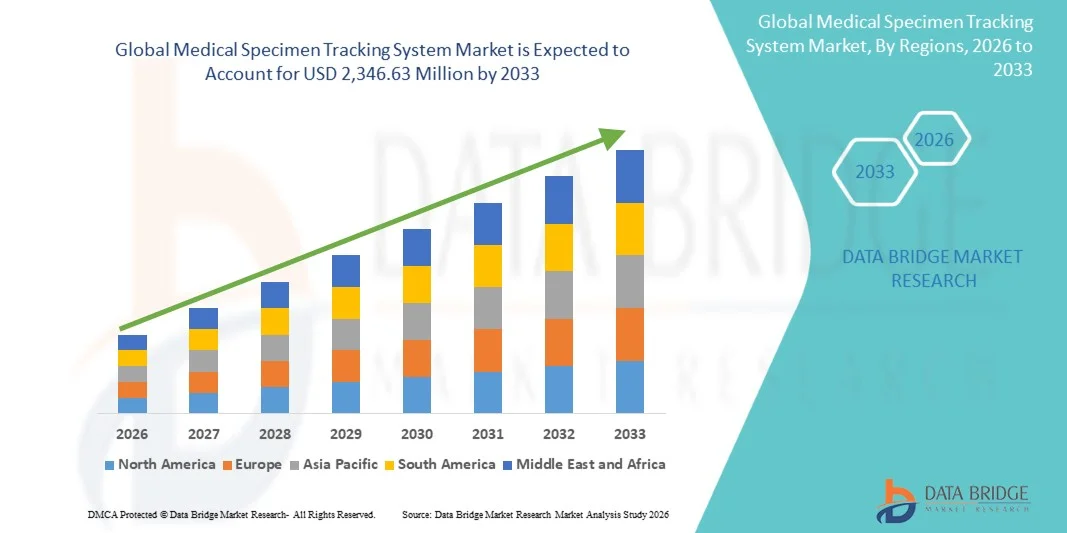
- As per Data Bridge Market Research analysis, the medical specimen tracking system market was valued at USD 927.70 million in 2025 and is projected to reach USD 2,346.63 million by 2033, growing at a CAGR of 12.30% from 2026 to 2033.
- The market is experiencing significant growth driven by the increasing need for accuracy and efficiency in laboratory operations, technological advancements such as Radio-Frequency Identification (RFID) and barcode systems, and the growing demand for robust tracking solutions that improve workflow efficiency and patient safety.
- The increasing complexity of medical specimen handling and rising volume of specimens collected annually, combined with the need for efficient inventory management, streamlined workflows, enhanced compliance, and improved patient experiences, are driving healthcare facilities to adopt medical specimen tracking systems. These solutions enable tracking from collection to analysis, improving efficiency while supporting regulatory compliance and patient safety.
Market Size & Forecast
- Global Market Value (2025): USD 927.70 Million
- Expected Market Value (2033): USD 2,346.63 Million
- Forecast CAGR (2026–2033): 12.30%
- Leading Region in 2025: North America
- Fastest Growing Region: Asia Pacific
What are the Major Takeaways of the Medical Specimen Tracking System Market?
- North America dominated the medical specimen tracking system market with the largest revenue share of 39.8% in 2025, supported by well-established healthcare infrastructure, rigorous regulatory compliance for patient safety and data privacy, and the presence of leading technology providers
- Asia-Pacific is expected to be the fastest-growing region at a CAGR of 22.4% from 2026 to 2033, fueled by rapid digital transformation of the healthcare sector, growing patient volumes, and favorable government policies to modernize healthcare systems and enhance patient care services
- The hardware segment led the market with a 56.3% share in 2025, driven by its portability and reusability, with barcoding scanners, RFID readers, printers, and portable storage devices enabling easy tracking of specimens collected from multiple locations and patients.
- Consumables are the fastest-growing product type, projected to register a CAGR of 11.0%, reflecting the surge in specimen volumes and recurring requirements for specimen identification and tracking materials.
- The patient testing segment dominated the type category with a 68% revenue share in 2025, led by the high volume of diagnostic tests conducted in hospitals, clinics, and diagnostic laboratories.
- Barcode systems accounted for 50.7% of the market share in 2025, preferred by healthcare facilities because of widespread standardization, low-cost and user-friendly barcode printers and scanners, and compatibility with existing IT infrastructure.
- The radio frequency identification (RFID) segment is the fastest-growing technology category, with a CAGR of 13.0%, driven by real-time tracking capabilities, the ability to track multiple specimens simultaneously, reduced manual scanning requirements, and increasing demand for improved specimen visibility and patient safety.
Report Scope and Medical Specimen Tracking System Market Segmentation
|
Attributes |
Medical Specimen Tracking System Key Market Insights |
|
Segments Covered |
|
|
Countries Covered |
North America
Europe
Asia-Pacific
Middle East and Africa
South America
|
|
Key Market Players |
|
|
Market Opportunities |
|
|
Value Added Data Infosets |
In addition to the insights on market scenarios such as market value, growth rate, segmentation, geographical coverage, and major players, the market reports curated by the Data Bridge Market Research also include in-depth expert analysis, patient epidemiology, pipeline analysis, pricing analysis, and regulatory framework. |
What is the Key Trend in the Medical Specimen Tracking System Market?
- Healthcare organizations are increasingly shifting from manual specimen handling toward digital traceability, automated tracking, and integrated laboratory workflows, using barcode and RFID technologies to improve specimen identification, chain-of-custody visibility, workflow efficiency, and patient safety across hospitals and pathology laboratories.
- For instance, in January 2023, an article published in Sensors described a smart specimen transport system integrating RFID and NB-IoT technologies, enabling specimen identification, temperature and humidity monitoring, GPS-based tracking, and cloud-based monitoring during laboratory specimen transportation.
- RFID-enabled tracking is gaining importance because it supports real-time data management and specimen visibility during transportation and storage, while reducing dependence on manual scanning and strengthening monitoring of high-value biological samples requiring accurate chain-of-custody documentation.
- Cloud-based specimen management platforms are increasingly being integrated with laboratory information systems, enabling healthcare providers to maintain centralized specimen records, improve data accessibility, and monitor specimen movement across collection, transportation, storage, and testing stages.
- The growing adoption of AI and machine learning is creating more intelligent specimen tracking workflows, with predictive analytics supporting exception detection, workflow prioritization, delayed-transport identification, labeling discrepancy detection, and improved operational decision-making across high-throughput laboratory environments.
- For instance, in August 2022, an article published in Frontiers in Medicine reported RFID tracking of 1,173 surgical pathology cases and more than 30 staff members, capturing specimen movement and workflow timing to improve case traceability and identify bottlenecks within cellular pathology workflows.
- Increasing volumes of molecular diagnostics, genomic testing, personalized medicine, and biobanking are strengthening demand for end-to-end specimen traceability, temperature visibility, accurate metadata capture, and secure chain-of-custody documentation throughout increasingly complex diagnostic and research workflows.
What are the Key Drivers of the Medical Specimen Tracking System Market?
- The increasing complexity of medical specimen handling and rising specimen volumes are intensifying demand for efficient inventory management, automated tracking, streamlined workflows, enhanced regulatory compliance, and accurate specimen identification from collection through analysis across healthcare and laboratory environments.
- For instance, in September 2023, an article published in Clinical Chemistry reported that an automated laboratory processing approximately 10,000 specimens daily experienced 200–250 barcode errors per day, resulting in an estimated 320 hours of staff productivity lost per month; improvements to barcode printing and labeling eliminated specific error sources and improved laboratory workflow.
- Growing concerns regarding patient safety and diagnostic accuracy are encouraging hospitals and laboratories to adopt specimen tracking technologies that minimize identification errors, prevent specimen loss, strengthen chain-of-custody management, and improve reliability throughout the laboratory testing process.
- The increasing adoption of barcode and RFID technologies is supporting market growth because these solutions improve specimen identification, provide tracking visibility, reduce manual intervention, and integrate with existing laboratory information technology infrastructure used across healthcare facilities.
- For instance, in February 2024, an article published in Transfusion reported that an RFID tracking system significantly improved blood-bank inventory management and reduced staff work effort, demonstrating the value of automated tracking for improving inventory visibility and operational efficiency in laboratory environments.
- Expanding laboratory automation and digital transformation is accelerating demand for integrated specimen tracking systems, particularly as healthcare organizations seek improved workflow efficiency, centralized data management, faster turnaround times, and stronger compliance with accreditation and patient-safety requirements.
Which Factors are Challenging the Growth of the Medical Specimen Tracking System Market?
- Advanced specimen tracking systems require substantial implementation and integration investments, including RFID and barcode readers, servers, networking equipment, specialized software, system configuration, and data migration, creating financial barriers for smaller healthcare facilities and laboratories.
- For instance, in September 2022, an article published in Transfusion Medicine and Hemotherapy reported that RFID implementation in an 800-bed hospital could require an initial investment ranging from USD 20,000 to USD 1 million, depending on implementation scale and intended use, highlighting the substantial capital requirements that can restrict adoption of RFID-based specimen tracking technologies.
- Integration complexity with existing healthcare infrastructure can slow adoption because organizations must connect new tracking technologies with laboratory information systems, hospital databases, electronic health records, and established specimen workflows without disrupting ongoing laboratory operations.
- Lack of skilled personnel and technical expertise can challenge implementation and maintenance of advanced specimen tracking technologies, as laboratories require trained staff to operate barcode and RFID systems, manage software, troubleshoot equipment, and integrate tracking platforms with existing laboratory workflows.
- Data security and patient privacy concerns can restrict adoption of connected specimen tracking systems, particularly cloud-based platforms, because specimen records may contain sensitive patient information and require secure data transmission, access controls, and compliance with healthcare privacy regulations.
- For instance, in July 2022, an article published in Journal of Pathology Informatics identified increased costs of RFID tags and readers, software requirements, data-security concerns, lack of specific data standards, and potential technological obsolescence as barriers to implementing RFID systems in anatomic pathology and biorepository laboratories.
- Small and medium-sized laboratories may face budget limitations and recurring maintenance costs, including software upgrades, hardware replacement, technical support, and system maintenance, increasing total ownership costs and delaying investment decisions.
How is the Medical Specimen Tracking System Market Segmented?
The medical specimen tracking system market is segmented on the basis of product, type, technology, and end user.
- By Product
On the basis of product, the medical specimen tracking system market is segmented into hardware, software, and consumables. The hardware segment dominated the market with a 56.3% share in 2025, owing to its portability and reusability. Hardware components such as barcoding scanners, RFID readers, printers, and portable storage devices allow tracking of specimens collected from multiple locations and patients. These components provide the physical infrastructure required for specimen identification and tracking across healthcare facilities. Hardware is also less prone to software and technological obsolescence compared with software, ensuring long-term usability. Major hardware manufacturers also offer comprehensive asset maintenance and support contracts to ensure uptime.
The consumables segment is expected to register the fastest growth at 11.0% CAGR from 2026 to 2033, supported by increasing specimen volumes and recurring requirements for specimen identification and tracking materials. Consumables are repeatedly required during specimen collection, labeling, transportation, storage, and laboratory processing. Increasing adoption of barcode and RFID tracking systems supports demand for compatible labels, tags, containers, and other consumable materials. Growing diagnostic testing volumes are expected to increase the recurring requirement for specimen-management products. Hospitals, clinics, and pathology laboratories require continuous supplies as specimen processing expands. The recurring nature of these products creates a continuing revenue opportunity for manufacturers. Increasing automation and the need for accurate specimen identification are expected to further support demand for tracking consumables.
- By Type
On the basis of type, the medical specimen tracking system market is segmented into patient testing and clinical trial tissue specimen. The patient testing segment dominated the market with a 68% in 2025, supported by the large volume of specimens generated through routine diagnostic testing and clinical laboratory operations. Medical specimen tracking systems enable healthcare providers to track specimens from collection through analysis. Accurate specimen identification is essential for improving patient safety and minimizing errors during diagnostic workflows. Increasing diagnostic testing volumes across hospitals, clinics, and laboratories are supporting demand for specimen tracking solutions. The growing need for accuracy and efficiency in laboratory operations is further strengthening adoption. Increasing use of automated tracking technologies is helping healthcare providers improve workflow efficiency and specimen traceability. The large and recurring volume of patient diagnostic specimens supports the segment's dominant position.
The clinical trial tissue specimen segment is expected to register the fastest growth at 12.5% CAGR from 2026 to 2033, driven by increasing clinical research activity and the growing complexity of biological specimen management. Clinical trial tissue specimens require accurate identification, tracking, storage, and retrieval throughout research workflows. Tracking systems can provide greater visibility and support chain-of-custody management for specimens used in clinical research. Increasing clinical trials and biopharmaceutical research are generating additional requirements for reliable specimen management. The development of precision medicine and advanced therapies is also increasing the importance of high-quality biological specimens. Regulatory and quality requirements further strengthen the need for accurate specimen documentation and traceability.
- By Technology
On the basis of technology, the medical specimen tracking system market is segmented into barcode systems, radio frequency identification (RFID), and others. The barcode systems segment dominated the technology category with a 50.7% share in 2025, owing to widespread standardization. Barcode technology is a mature and standardized solution used across laboratories, hospitals, and industries. Barcode printers and scanners are inexpensive, user-friendly, and compatible with existing IT infrastructure in most healthcare facilities. This high level of standardization allows seamless interoperability within and across organizations adopting barcode tracking systems. Barcode systems provide a practical method for specimen identification while reducing manual handling errors. Their established infrastructure and ease of adoption continue to support widespread use across healthcare facilities.
The radio frequency identification (RFID) segment is expected to register the fastest growth at 13.0% CAGR from 2026 to 2033, supported by increasing demand for automated and real-time specimen tracking. RFID technology can identify tagged specimens without requiring direct line-of-sight scanning. This capability can improve visibility of specimen movement across collection, transportation, storage, and laboratory environments. RFID can also support automated inventory management and strengthen chain-of-custody monitoring. Increasing adoption of connected healthcare technologies and smart laboratory infrastructure is creating additional opportunities for RFID-based tracking. Integration with IoT and cloud technologies can further enhance real-time monitoring and data management. These capabilities are expected to support the increasing adoption of RFID in complex and high-volume specimen management environments.
- By End User
On the basis of end user, the medical specimen tracking system market is segmented into hospitals & clinics, pathology laboratories, and others. The hospitals & clinics segment dominated the market with a 56.9% share in 2025, driven by compliance and patient safety needs. Strict regulatory norms, medical accreditation requirements, and litigation risks demand highly accurate specimen identification, labeling, and chain-of-custody management. Larger hospitals also demand enterprise-wide integrated platforms for consolidated sample data access across departments. Hospitals process substantial volumes of specimens generated through diagnostic and clinical procedures, increasing the need for efficient tracking. Specimen tracking systems can improve workflow efficiency while supporting accurate specimen management.
The pathology laboratories segment is expected to register the fastest growth at 12.5% CAGR from 2026 to 2033, driven by the increasing need for accuracy and efficiency in laboratory operations. Pathology laboratories handle substantial volumes of specimens that must be accurately identified, processed, stored, and retrieved. Tracking systems provide greater visibility into specimen location and status throughout laboratory workflows. Increasing laboratory automation is encouraging integration of tracking technologies with laboratory information systems and other digital platforms. The need to reduce specimen handling errors and improve workflow efficiency is further supporting adoption. Growing demand for advanced diagnostic testing is generating additional specimen-management requirements.
Which Region Holds the Largest Share of the Medical Specimen Tracking System Market?
- North America dominated the medical specimen tracking system market with the largest revenue share of 39.8% in 2025, supported by well-established healthcare infrastructure, rigorous regulatory compliance for patient safety and data privacy, and the presence of leading technology providers
- The region also benefits from stringent requirements for accurate specimen identification, labeling, and chain-of-custody management, while hospitals and laboratories increasingly adopt barcode and RFID technologies to improve workflow efficiency and patient safety. The presence of established technology providers and advanced healthcare systems further strengthens North America's market position. Increasing emphasis on regulatory compliance and data privacy continues to support investment in specimen tracking solutions.
U.S. Medical Specimen Tracking System Market Insight
The U.S. medical specimen tracking system market is witnessing strong growth due to advanced laboratory infrastructure, increasing clinical testing volumes, and growing adoption of automated technologies for specimen identification and quality control. The country’s extensive clinical research network is also generating demand for reliable sample tracking and verification systems across molecular diagnostics and biobanking applications. Increasing emphasis on preventing specimen mix-ups and maintaining sample integrity is further supporting adoption. In addition, digital identification technologies are increasingly being incorporated into clinical testing workflows. In March 2024, an article published in BMC Research Notes evaluated genetic sex validation for sample tracking across 25,015 clinical samples in the U.S.-based eMERGE clinical sequencing network and reported no sample-swap errors within the clinical testing laboratories.
Asia-Pacific Medical Specimen Tracking System Market Insight
The Asia-Pacific medical specimen tracking system market is expected to witness rapid growth, driven by expanding laboratory infrastructure, increasing diagnostic testing, healthcare digitalization, and growing use of artificial intelligence for specimen identification and quality management. Countries across the region are increasingly implementing automated technologies to improve laboratory accuracy and reduce pre-analytical errors. Growing specimen volumes are also increasing the need for systems that can identify and detect sample misidentification before results are released. In addition, integration of machine learning with laboratory information systems is creating new opportunities for automated specimen verification. In October 2024, an article published in Clinical Chemistry reported a retrospective multicenter study using machine learning to detect sample misidentification errors in clinical laboratory testing across medical centers in South Korea, demonstrating the application of automated analytics for improving sample identification.
Japan Medical Specimen Tracking System Market Insight
The Japan medical specimen tracking system market is witnessing consistent growth due to advanced laboratory capabilities, increasing demand for molecular diagnostics, and growing emphasis on accurate identification of biological samples. Healthcare and research institutions are increasingly adopting molecular identification approaches to strengthen specimen traceability and prevent sample mix-ups during complex testing workflows. The expansion of genomic and precision-medicine testing is further increasing the importance of reliable sample identification. Moreover, advanced molecular technologies can provide an additional layer of verification alongside conventional specimen labeling systems. In December 2023, an article published in Cancer Genetics described a molecular barcode detection system developed using clinical samples from Yamanashi Central Hospital and Chiba University in Japan, demonstrating the use of molecular barcoding for sensitive identification and analysis of clinical specimens.
China Medical Specimen Tracking System Market Insight
The China medical specimen tracking system market is growing rapidly, driven by increasing laboratory workloads, healthcare informatization, rising diagnostic testing, and growing focus on reducing pre-analytical errors. Hospitals are increasingly using digital tools to monitor specimen submission processes and strengthen verification throughout clinical workflows. Increasing integration of barcode scanning, electronic health records, clinical decision support, and automated compliance monitoring is creating additional opportunities for specimen tracking solutions. The need to improve specimen collection before diagnostic testing is also encouraging hospitals to adopt technology-enabled quality-control processes. An article published in Frontiers in Medicine evaluated an informatization-based intervention at a tertiary hospital in China using dual-verification barcode scanning, AI-driven clinical decision-support alerts, EHR-integrated training, and automated compliance dashboards
U.K. Medical Specimen Tracking System Market Insight
The U.K. medical specimen tracking system market is experiencing steady growth, supported by advanced pathology infrastructure, increasing adoption of digital pathology, and the growing need for efficient management of histopathology specimens. The transition from conventional glass-slide workflows toward digital systems is increasing the importance of accurate specimen identification and reliable traceability between tissue samples, slides, images, and diagnostic reports. Multisite implementation is also demonstrating the scalability of digital technologies across pathology services. In April 2024, an article published in Histopathology reported definitive evidence from a multisite study evaluating digital pathology for reporting histopathology samples, including cancer-screening specimens, supporting the expansion of digitally enabled pathology workflows in the U.K.
Germany Medical Specimen Tracking System Market Insight
The Germany medical specimen tracking system market is expanding steadily due to advanced pathology infrastructure, increasing biobanking activities, and growing emphasis on quality-assured management of tissue specimens. German pathology and biobank institutions are increasingly focusing on integrated workflows that maintain specimen quality while supporting reliable storage, retrieval, documentation, and research use. The growing importance of precision medicine and translational research is further increasing demand for organized biological specimen management. In addition, quality assurance and integration of biobanking infrastructure are becoming increasingly important for research-oriented healthcare institutions. In November 2024, an article published in Pathologie reviewed next-generation tissue biobanking in Germany and highlighted the importance of quality assurance, integration, and sustainable management of tissue specimens across biobank infrastructure.
Which are the Top Companies in Medical Specimen Tracking System Market?
The medical specimen tracking system industry is primarily led by well-established companies, including:
- RMS Omega (U.S.)
- Peak Technologies (U.S.)
- GAO RFID Inc. (Canada)
- Cryoport Inc. (U.S.)
- LabConnect (U.S.)
- Thermo Fisher Scientific Inc. (U.S.)
- Zebra Technologies Corporation (U.S.)
- LabWare (U.S.)
- Agilent Technologies, Inc. (U.S.)
- Bio-Rad Laboratories, Inc. (U.S.)
- Hologic, Inc. (U.S.)
- Taylor Data Systems (U.S.)
- BioIT Solutions, Inc. (U.S.)
- NovoPath Laboratory Information System (U.S.)
- LabLynx (U.S.)
- OpenSpecimen (India)
- CrelioHealth (India)
- Comp Pro Med, Inc. (U.S.)
- Specimen Track LLC (U.S.)
What are Latest Developments in Medical Specimen Tracking System Market?
- In April 2024, Marken announced the launch of Marken INsight, a sample-management and tracking service developed through its partnership with TruLab to provide tube-level visibility across the pharmaceutical and clinical-trial supply chain. The solution is designed to provide greater visibility into individual samples as they move from patient homes to repositories, laboratories, and clinical sites. Marken combined its global logistics network with TruLab’s sample-tracking technology to provide end-to-end monitoring of clinical-trial samples.
- In July 2023, Ziath's Ri-Track Mirage was reported as a new cryogenic sample-management solution using a hybrid RFID and barcode approach to identify laboratory sample racks. The system uses an RFID tag attached to each rack, with the rack accommodating up to 96 samples, while the reader scans the associated 2D barcodes. The technology is designed to work with racks directly from vapor-phase liquid-nitrogen storage, eliminating the need to thaw racks before identification. This development improves traceability while helping laboratories maintain the required storage conditions for temperature-sensitive specimens.
- In May 2023, Roche launched navify Sample Tracking, a cloud-based digital solution designed to help laboratories track patient test samples before they reach the laboratory. The solution provides visibility across the pre-pre-analytical phase, covering sample creation, collection, transportation, and laboratory reception. It was introduced to address quality challenges associated with sample handling outside the laboratory and to improve testing traceability. Roche initially made the solution available in European markets, with plans for broader expansion. This launch represents a significant development in cloud-based digital specimen tracking for diagnostic laboratories.
- In May 2023, Ziath launched the Ri-Track Mirage system, a cryogenic sample-management solution combining RFID technology with 2D barcode scanning for automated sample tracking. The system is designed to identify frozen racks and 2D-barcoded tubes directly from cryogenic storage. Its RFID-enabled approach allows racks to be identified without requiring samples to be thawed, helping protect temperature-sensitive biological materials. The system supports automated container identification and tracking within laboratory workflows. This launch demonstrates the increasing integration of RFID and barcode technologies into biological sample-management applications.
- In January 2023, Thermo Fisher Scientific introduced enhanced HL7 messaging capabilities in its SampleManager LIMS software, enabling clinical laboratories to automate workflows and data exchange and allowing samples to be fed directly into the LIMS for tracking and long-term storage. The update supports interoperability between laboratory systems and helps laboratories manage sample information throughout the testing workflow. The enhanced connectivity strengthens digital sample traceability and reduces manual handling of sample-related information.

- Interactive Data Analysis Dashboard
- Company Analysis Dashboard for high growth potential opportunities
- Research Analyst Access for customization & queries
- Competitor Analysis with Interactive dashboard
- Latest News, Updates & Trend analysis
- Harness the Power of Benchmark Analysis for Comprehensive Competitor Tracking
Data collection and base year analysis are done using data collection modules with large sample sizes. The stage includes obtaining market information or related data through various sources and strategies. It includes examining and planning all the data acquired from the past in advance. It likewise envelops the examination of information inconsistencies seen across different information sources. The market data is analysed and estimated using market statistical and coherent models. Also, market share analysis and key trend analysis are the major success factors in the market report. To know more, please request an analyst call or drop down your inquiry.
The key research methodology used by DBMR research team is data triangulation which involves data mining, analysis of the impact of data variables on the market and primary (industry expert) validation. Data models include Vendor Positioning Grid, Market Time Line Analysis, Market Overview and Guide, Company Positioning Grid, Patent Analysis, Pricing Analysis, Company Market Share Analysis, Standards of Measurement, Global versus Regional and Vendor Share Analysis. To know more about the research methodology, drop in an inquiry to speak to our industry experts.
Data Bridge Market Research is a leader in advanced formative research. We take pride in servicing our existing and new customers with data and analysis that match and suits their goal. The report can be customized to include price trend analysis of target brands understanding the market for additional countries (ask for the list of countries), clinical trial results data, literature review, refurbished market and product base analysis. Market analysis of target competitors can be analyzed from technology-based analysis to market portfolio strategies. We can add as many competitors that you require data about in the format and data style you are looking for. Our team of analysts can also provide you data in crude raw excel files pivot tables (Fact book) or can assist you in creating presentations from the data sets available in the report.













