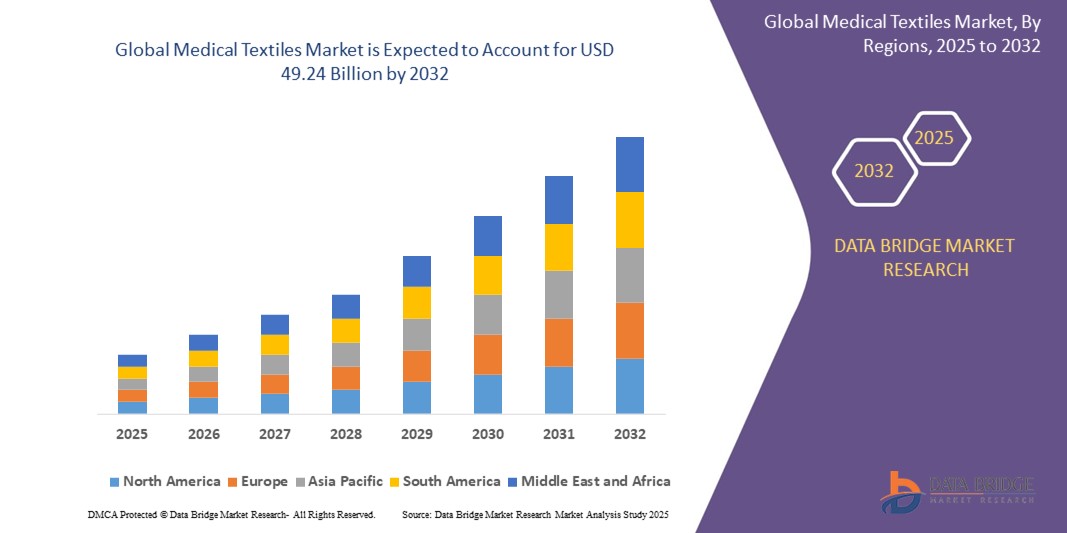
Medical Textiles Market Size
- The Global Medical Textiles Market size was valued at USD 31.35 Billion in 2024 and is expected to reach USD 49.24 Billion by 2032, at a CAGR of 4.3 % during the forecast period
- The market growth is primarily driven by the increasing demand for advanced medical textiles that offer enhanced functionality, safety, and comfort in healthcare applications. Innovations such as antimicrobial fabrics, breathable wound dressings, and biocompatible implantable textiles are gaining significant traction due to their ability to improve patient outcomes, reduce infection risks, and support faster healing. These features align with the growing focus on improving healthcare quality and meeting stringent regulatory standards for medical safety and hygiene
- Furthermore, the expanding use of medical textiles in diverse applications—including surgical gowns, protective clothing, wound care products, and implantable devices—is accelerating market development. This growth is bolstered by rising healthcare expenditure, increasing prevalence of chronic diseases, and an aging global population requiring advanced medical care. Simultaneously, advancements in fiber technology, nanotechnology, and smart textiles are enhancing the performance, customization, and multifunctionality of medical textiles. These technological innovations are fueling strategic partnerships, product innovations, and capacity expansions worldwide, driving greater adoption and deeper penetration across healthcare and medical sectors
Medical Textiles Market Analysis
- Medical textiles consist of specialized fabrics engineered for healthcare applications such as wound care, surgical gowns, implants, and protective apparel. These textiles are designed to provide functionality including antimicrobial protection, breathability, biocompatibility, and durability, essential for enhancing patient safety and treatment outcomes
- The market is experiencing steady growth, driven by rising healthcare expenditure, increasing prevalence of chronic diseases, growing demand for advanced wound care solutions, and heightened awareness of infection control in medical settings. Additionally, technological advancements in smart textiles and nanofiber materials are further propelling market expansion
- North America is expected to dominate the Medical Textiles Market owing to well-established healthcare infrastructure, stringent regulatory standards, and increasing adoption of innovative medical textile products by hospitals and clinics across the region.
- Asia-Pacific is projected to be the fastest-growing region during the forecast period, supported by rapid urbanization, improving healthcare facilities, rising disposable incomes, and expanding medical textile manufacturing capabilities in countries like China and India
- Nonwoven textiles are expected to hold the largest market share due to their cost-effectiveness, versatility, and widespread use in disposable medical products such as surgical masks, gowns, and wound dressings. The demand for eco-friendly and biodegradable nonwoven materials is also gaining momentum, adding to the segment’s growth potential
Report Scope and Medical Textiles Market Segmentation
|
Attributes |
Medical Textiles Key Market Insights |
|
Segments Covered |
|
|
Countries Covered |
North America
Europe
Asia-Pacific
Middle East and Africa
South America
|
|
Key Market Players |
|
|
Market Opportunities |
|
|
Value Added Data Infosets |
In addition to the insights on market scenarios such as market value, growth rate, segmentation, geographical coverage, and major players, the market reports curated by the Data Bridge Market Research also include in-depth expert analysis, pricing analysis, brand share analysis, consumer survey, demography analysis, supply chain analysis, value chain analysis, raw material/consumables overview, vendor selection criteria, PESTLE Analysis, Porter Analysis, and regulatory framework. |
Medical Textiles Market Trends
“Functionality-Driven Innovation and Sustainability Focus in Medical Textiles”
- A prominent and rapidly evolving trend in the Global Medical Textiles Market is the development of advanced textiles with multifunctional properties such as antimicrobial activity, breathability, moisture management, and biocompatibility. These innovations are expanding applications in wound care, surgical apparel, and implantable devices—shifting the market toward higher-performance, patient-centric solutions
- Leading companies like DuPont, Freudenberg Group, and 3M are investing in smart textile technologies, incorporating nanofibers, phase-change materials, and embedded sensors to enhance infection control, real-time monitoring, and comfort in medical environments. This aligns with increasing regulatory demands for improved hygiene standards and patient safety
- Sustainability is gaining significant traction, with growing emphasis on bio-based, biodegradable, and recyclable fibers in disposable medical textiles such as gowns, masks, and wound dressings. Regulatory initiatives targeting medical waste reduction and environmentally responsible healthcare practices are driving adoption of eco-friendly alternatives
- Concurrently, innovations in manufacturing processes such as electrospinning, plasma treatment, and ultrasonic bonding are improving fiber uniformity, durability, and functional performance—enabling tailored solutions for specialized applications like drug delivery systems and tissue engineering scaffolds
- Integration of digital tools and data analytics is becoming more common, allowing manufacturers to optimize material properties, customize textile designs, and predict performance outcomes, thereby accelerating product development cycles and improving clinical efficacy
- This strategic emphasis on combining high functionality with sustainability is reshaping market dynamics. Companies focusing on R&D in biocompatible materials, regulatory compliance, and circular economy principles are poised to lead growth across healthcare sectors that demand innovative, safe, and environmentally responsible medical textile products
Medical Textiles Market Dynamics
Driver
“Rising Demand for Advanced, Safe, and Sustainable Medical Textile Solutions”
- The increasing focus on patient safety, infection control, and healthcare quality is a primary driver fueling growth in the Medical Textiles Market. Healthcare providers are adopting advanced medical textiles with enhanced antimicrobial properties, breathability, and biocompatibility to reduce hospital-acquired infections and improve clinical outcomes.
- For example, in early 2025, Freudenberg Group introduced a new line of antimicrobial nonwoven fabrics designed for surgical masks and gowns that provide superior barrier protection while maintaining comfort and breathability—addressing the heightened hygiene requirements in hospitals and clinics worldwide.
- The growing prevalence of chronic diseases and surgical procedures is accelerating demand for high-performance wound care products such as advanced dressings, implantable textiles, and compression garments, all engineered for improved healing and patient comfort under diverse clinical conditions.
- Sustainability concerns are increasingly influencing purchasing decisions, with healthcare institutions seeking biodegradable, recyclable, and bio-based medical textiles to minimize environmental impact from disposable medical products. This shift is supported by regulatory frameworks promoting medical waste reduction and circular economy initiatives.
- The adoption of innovative manufacturing technologies—such as electrospinning, plasma treatment, and nanofiber integration—is enabling the production of customizable, multifunctional textiles tailored for drug delivery, tissue engineering, and wearable health monitoring, further driving market expansion.
- This convergence of stringent healthcare standards, environmental responsibility, and technological innovation is propelling the widespread adoption of advanced medical textiles. Companies investing in R&D for sustainable materials, regulatory compliance, and smart textile functionalities are positioned to capture long-term growth opportunities in this evolving market
Restraint/Challenge
“High Production Costs and Stringent Regulatory Challenges in Medical Textiles”
- The capital-intensive nature of medical textile manufacturing, combined with the complexity of integrating advanced functionalities such as antimicrobial coatings, biocompatibility, and smart sensors, presents a significant barrier to market growth. High investments in specialized equipment, cleanroom facilities, and quality control systems increase operational costs, especially for emerging manufacturers
- For example, producing surgical-grade or implantable medical textiles requires compliance with rigorous standards such as ISO 13485 and FDA regulations, demanding costly validation processes, biocompatibility testing, and continuous quality assurance—factors that escalate time-to-market and overall expenses
- The highly regulated healthcare environment imposes complex compliance requirements across different regions, including certifications related to safety, efficacy, and environmental impact. Navigating varied regulatory frameworks—such as the U.S. FDA, EU MDR, and Japan’s PMDA—necessitates extensive documentation, testing, and frequent audits, which can delay product launches and increase administrative burdens
- Variability in global regulatory standards also complicates product design and manufacturing, often requiring region-specific modifications that limit economies of scale and hinder seamless international expansion
- Additionally, fluctuations in raw material costs—particularly for specialty fibers like polypropylene, polyethylene, and bio-based polymers—combined with supply chain disruptions from geopolitical tensions and environmental factors, pose a critical challenge. These constraints affect pricing strategies and profitability for manufacturers reliant on specific or imported feedstocks
Medical Textiles Market Scope
The market is segmented on the basis of product, function, type, source, end user, distribution channel.
- By Product
On the basis of product type, the Medical Textiles Market is segmented into Surgical Gowns, Operating Room Drapes, Sterilization Wraps, Face Masks, Staff Uniforms, Hospital Bedding & Curtains, Wipes, and Others
The Surgical Gowns segment dominates the market with the largest revenue share in 2024, driven by rising demand for infection prevention, enhanced barrier protection, and regulatory compliance in hospital and surgical settings. Increasing adoption of disposable, antimicrobial, and fluid-resistant gowns—especially in post-pandemic healthcare environments—is fueling sustained growth as hospitals prioritize hygiene, patient safety, and staff protection
- By Fabric
On the basis of fabric type, the Medical Textiles Market is segmented into Woven, Knitted, Non-Woven, and Others.
The Non-Woven segment holds the largest revenue share in 2024, primarily due to its widespread application in disposable medical products such as surgical masks, gowns, drapes, and sterilization wraps. Its advantages—including cost-effectiveness, high filtration efficiency, and ease of sterilization—make it the preferred choice for single-use healthcare materials, especially in infection-prone environments. The rising focus on hygiene, patient safety, and eco-friendly disposable solutions further reinforces the dominance of non-woven fabrics in the medical textiles sector
- By Application
On the basis of application, the Medical Textiles Market is segmented into Implantable Goods, Non-Implantable Goods, Extracorporeal Devices, Healthcare & Hygiene Products, and Others
The Healthcare & Hygiene Products segment dominates the market with the largest revenue share in 2024, driven by increasing demand for high-performance disposable items such as face masks, gowns, wipes, and sanitary products. The emphasis on infection prevention, personal protection, and hygiene—especially in hospitals, long-term care facilities, and home healthcare settings—is fueling the adoption of advanced medical textiles. Their softness, absorbency, and antimicrobial functionality make them essential across a wide spectrum of daily clinical and consumer health applications
Medical Textiles Market Regional Analysis
- North America dominates the Medical Textiles Market with the largest revenue share of 36.8% in 2024, driven by the growing demand for advanced wound care, surgical garments, and protective medical apparel. The region benefits from strong healthcare infrastructure, high infection control standards, and increased investment in healthcare innovation and safety protocols.
- Manufacturers in North America are prioritizing the development of high-performance, disposable, and antimicrobial textiles to meet the stringent requirements of hospitals and surgical centers. The U.S. leads the region, backed by a well-established medical device industry, continuous product innovation, and government initiatives supporting domestic production of critical healthcare supplies
U.S. Medical Textiles Market Insight
The U.S. Medical Textiles Market captured the largest revenue share of approximately 81% in North America in 2024, fueled by robust demand for PPE, surgical gowns, drapes, and hospital bedding. The COVID-19 pandemic accelerated the adoption of disposable and antimicrobial textiles, a trend that continues amid ongoing infection prevention efforts. Moreover, the presence of key manufacturers and rising R&D activities in smart textiles are bolstering market expansion
Europe Medical Textiles Market Insight
The Europe Medical Textiles Market is projected to expand steadily during the forecast period, driven by increasing awareness of hygiene, infection control, and environmental sustainability. Countries such as Germany, France, and the Netherlands are emphasizing the development and use of biodegradable and reusable medical fabrics in response to EU waste reduction targets and circular economy goals
U.K. Medical Textiles Market Insight
The U.K. market is expected to witness notable growth, supported by heightened focus on infection prevention in hospitals and growing use of medical textiles in elderly and home care. The country’s innovation ecosystem, including collaborations between research institutions and medical textile firms, is fostering advancements in washable antimicrobial fabrics and smart sensing garments for chronic disease monitoring
Germany Medical Textiles Market Insight
Germany remains a key market within Europe, driven by its leadership in high-quality technical textiles and a strong healthcare manufacturing base. The country is investing in smart textile integration for remote patient monitoring and improving the sustainability of hospital textile supply chains through recycling programs and green certifications
Asia-Pacific Medical Textiles Market Insight
The Asia-Pacific Medical Textiles Market is poised to grow at the fastest CAGR of 24.7% from 2025 to 2032, spurred by rapid urbanization, healthcare infrastructure expansion, and growing government investments in public health and hospital modernization. Countries such as China, India, Japan, and South Korea are witnessing a surge in demand for low-cost, high-performance disposable medical textiles
Japan Medical Textiles Market Insight
Japan’s market growth is driven by its aging population and the resulting demand for advanced wound care, hygiene products, and smart healthcare garments. Technological innovations in textile-integrated sensors and antimicrobial treatments, alongside strict product quality standards, are driving the development of high-end medical textile solutions
China Medical Textiles Market Insight
China holds the largest revenue share in Asia-Pacific as of 2024, supported by its vast manufacturing capabilities, rising healthcare spending, and increasing adoption of PPE and hospital linen. The Chinese government’s focus on domestic medical supply self-sufficiency and infection control protocols is accelerating the production of non-woven, disposable, and antibacterial medical textiles
Medical Textiles Market Share
The speciality starches is primarily led by well-established companies, including:
- DuPont de Nemours, Inc. (U.S.)
- Freudenberg Group (Germany)
- 3M Company (U.S.)
- Berry Global, Inc. (U.S.)
- Huntsman Corporation (U.S.)
- Ahlstrom-Munksjö Oyj (Finland)
- Lydall, Inc. (U.S.)
- Toray Industries, Inc. (Japan)
- Nitto Denko Corporation (Japan)
- Mölnlycke Health Care AB (Sweden)
- Kimberly-Clark Corporation (U.S.)
- Avintiv, Inc. (U.S.)
Latest Developments in Global Medical Textiles Market
- In April 2025, Freudenberg Performance Materials launched a next-generation range of antimicrobial nonwoven fabrics designed for advanced wound dressings and surgical drapes. The new line integrates silver-based technologies for enhanced infection control, supporting the growing demand for high-efficacy, single-use medical textiles.
- In March 2025, Ahlstrom announced the expansion of its medical textile production facility in North America to meet the increasing demand for sterile barrier systems, surgical gowns, and sterilization wraps. The investment includes the adoption of sustainable raw materials and energy-efficient processes aligned with the company’s ESG goals.
- In February 2025, Medline Industries, LP introduced a new collection of eco-friendly hospital bedding and reusable staff uniforms made from biodegradable and recyclable fabric blends. This development supports hospitals seeking to reduce textile waste and enhance sustainability in their supply chains.
- In January 2025, DuPont unveiled a new generation of its Tyvek® medical packaging material, engineered to improve microbial barrier protection while maintaining breathability and puncture resistance. This innovation is aimed at supporting safer sterilization and longer shelf life for surgical instruments and implantable devices.
- In January 2025, Texollini partnered with a U.S.-based biotech startup to develop smart medical textiles integrated with biosensors for remote patient monitoring. The collaboration focuses on creating washable, flexible garments capable of tracking vital signs in real time—catering to the growing telemedicine and digital health market

- Interactive Data Analysis Dashboard
- Company Analysis Dashboard for high growth potential opportunities
- Research Analyst Access for customization & queries
- Competitor Analysis with Interactive dashboard
- Latest News, Updates & Trend analysis
- Harness the Power of Benchmark Analysis for Comprehensive Competitor Tracking
Data collection and base year analysis are done using data collection modules with large sample sizes. The stage includes obtaining market information or related data through various sources and strategies. It includes examining and planning all the data acquired from the past in advance. It likewise envelops the examination of information inconsistencies seen across different information sources. The market data is analysed and estimated using market statistical and coherent models. Also, market share analysis and key trend analysis are the major success factors in the market report. To know more, please request an analyst call or drop down your inquiry.
The key research methodology used by DBMR research team is data triangulation which involves data mining, analysis of the impact of data variables on the market and primary (industry expert) validation. Data models include Vendor Positioning Grid, Market Time Line Analysis, Market Overview and Guide, Company Positioning Grid, Patent Analysis, Pricing Analysis, Company Market Share Analysis, Standards of Measurement, Global versus Regional and Vendor Share Analysis. To know more about the research methodology, drop in an inquiry to speak to our industry experts.
Data Bridge Market Research is a leader in advanced formative research. We take pride in servicing our existing and new customers with data and analysis that match and suits their goal. The report can be customized to include price trend analysis of target brands understanding the market for additional countries (ask for the list of countries), clinical trial results data, literature review, refurbished market and product base analysis. Market analysis of target competitors can be analyzed from technology-based analysis to market portfolio strategies. We can add as many competitors that you require data about in the format and data style you are looking for. Our team of analysts can also provide you data in crude raw excel files pivot tables (Fact book) or can assist you in creating presentations from the data sets available in the report.