


Medical Thermometers Market Size
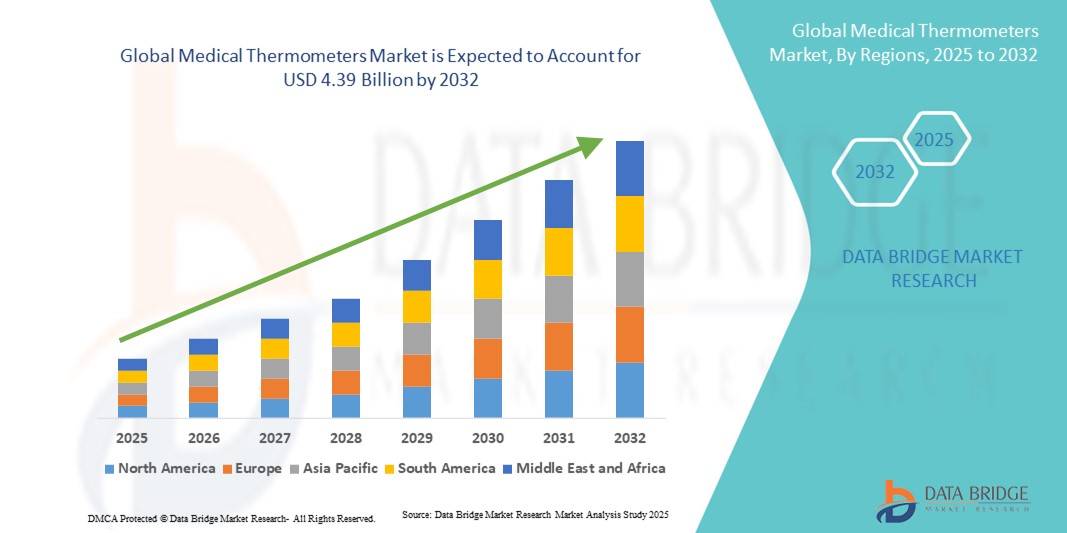
- The global medical thermometers market size was valued at USD 2.35 billion in 2024 and is expected to reach USD 4.39 billion by 2032, at a CAGR of 8.10% during the forecast period
- The market growth is largely driven by the increasing demand for accurate, rapid, and non-invasive temperature monitoring in hospitals, clinics, and home care settings, coupled with technological advancements in digital and infrared thermometer solutions
- Furthermore, rising awareness about health monitoring, preventive care, and early detection of febrile conditions is encouraging both healthcare providers and consumers to adopt innovative thermometer technologies. These converging factors are accelerating the uptake of medical thermometer solutions, thereby significantly boosting the industry's growth
Medical Thermometers Market Analysis
- Medical thermometers, providing accurate measurement of body temperature through digital, infrared, or traditional mercury-based methods, are increasingly essential tools in hospitals, clinics, and home healthcare settings due to their precision, ease of use, and rapid results
- The rising demand for medical thermometers is primarily driven by growing awareness of health monitoring, preventive care, and early detection of fevers and infections, alongside technological advancements in non-contact and wearable thermometer solutions
- North America dominated the medical thermometers market with the largest revenue share of 39% in 2024, characterized by high healthcare expenditure, widespread adoption of advanced diagnostic tools, and strong presence of key market players, with the U.S. witnessing significant growth in both hospital and home-use thermometers, driven by innovations in digital, infrared, and smart connectivity-enabled devices
- Asia-Pacific is expected to be the fastest-growing region in the medical thermometers market during the forecast period due to increasing healthcare infrastructure, rising awareness of personal health monitoring, and higher adoption of advanced medical devices in emerging economies
- Digital thermometers dominated the medical thermometers market with a market share of 46.8% in 2024, driven by their accuracy, fast response time, and ease of use in both clinical and home settings
Report Scope and Medical Thermometers Market Segmentation
|
Attributes |
Medical Thermometers Key Market Insights |
|
Segments Covered |
|
|
Countries Covered |
North America
Europe
Asia-Pacific
Middle East and Africa
South America
|
|
Key Market Players |
|
|
Market Opportunities |
|
|
Value Added Data Infosets |
In addition to the insights on market scenarios such as market value, growth rate, segmentation, geographical coverage, and major players, the market reports curated by the Data Bridge Market Research also include in-depth expert analysis, pricing analysis, brand share analysis, consumer survey, demography analysis, supply chain analysis, value chain analysis, raw material/consumables overview, vendor selection criteria, PESTLE Analysis, Porter Analysis, and regulatory framework. |
Medical Thermometers Market Trends
Advancements in Non-Contact and Wearable Thermometers
- A significant and accelerating trend in the global medical thermometers market is the growing adoption of non-contact infrared and wearable thermometer technologies, enhancing safety, convenience, and continuous monitoring capabilities in both clinical and home settings
- For instance, the Braun No-Touch Forehead Thermometer allows rapid, contactless temperature readings, reducing cross-contamination risk, while wearable devices such as TempTraq provide continuous temperature monitoring for infants and chronic patients
- Integration with mobile apps and cloud platforms enables real-time alerts and data tracking, allowing healthcare providers to monitor patient temperature trends remotely and make informed clinical decisions
- The seamless incorporation of thermometer data into broader digital health platforms facilitates centralized monitoring alongside other vital signs, creating a unified approach to patient care and preventive health
- This trend toward more accurate, intuitive, and connected thermometers is reshaping consumer and healthcare expectations, with companies such as iHealth developing smart thermometers that sync with smartphones and provide historical data analytics for proactive health management
- The demand for connected, non-contact, and wearable thermometers is rising rapidly across hospitals, clinics, and home healthcare markets, as patients and providers increasingly prioritize convenience, safety, and integrated health monitoring solutions
Medical Thermometers Market Dynamics
Driver
Rising Demand Due to Health Awareness and Preventive Care
- The increasing health awareness and the growing emphasis on preventive care are key drivers for the heightened adoption of medical thermometers
- For instance, during flu seasons and viral outbreaks, hospitals and households increasingly rely on accurate and rapid temperature monitoring devices to detect early signs of illness
- Consumers and healthcare providers prefer thermometers offering quick, reliable readings, activity logs, and compatibility with digital health platforms, which provide better insights for monitoring and decision-making
- The growing popularity of home healthcare devices and telemedicine solutions is making connected thermometers an integral part of these systems, offering seamless integration with smartphones and health apps
- Ease of use, rapid readings, non-invasive measurement options, and the ability to monitor temperature trends remotely are key factors propelling the adoption of advanced medical thermometers in hospitals, clinics, and home care settings
Restraint/Challenge
Device Accuracy Concerns and Regulatory Compliance
- Concerns over measurement accuracy, especially in non-contact and low-cost thermometers, pose a challenge for market adoption. Variability due to ambient conditions or improper use can reduce consumer confidence
- For instance, reports highlighting inconsistent readings in some infrared thermometers have made certain consumers and healthcare providers hesitant to rely solely on these devices
- Ensuring compliance with regulatory standards, obtaining certifications, and maintaining device accuracy through calibration and quality assurance are crucial to building trust. Companies such as Omron and Braun emphasize clinically validated accuracy in their products to reassure users
- In addition, while digital and wearable thermometers offer advanced features, their higher cost compared to traditional mercury or basic digital thermometers can limit adoption in price-sensitive regions
- Overcoming these challenges through rigorous testing, consumer education on proper usage, and the development of cost-effective yet accurate thermometers will be vital for sustained market growth
Medical Thermometers Market Scope
The market is segmented on the basis of product type, point of measurement, patient demographic, and application.
- By Product Type
On the basis of product type, the medical thermometers market is segmented into infrared radiation thermometers, mercury thermometers, and digital thermometers. The digital thermometer segment dominated the market with the largest revenue share of 46.8% in 2024, driven by its accuracy, rapid response time, and ease of use. Digital thermometers are widely preferred in hospitals, clinics, and homes due to their user-friendly design and safe operation compared to mercury thermometers. They enable consistent temperature tracking and are compatible with electronic health record systems in clinical settings. Many digital thermometers now offer features such as memory recall, fever alerts, and smartphone connectivity, enhancing usability. Their affordability, availability, and broad adoption across age groups further strengthen their market dominance.
The infrared radiation thermometer segment is anticipated to witness the fastest growth from 2025 to 2032, fueled by the rising need for non-contact temperature measurement in hospitals, clinics, and homes. Infrared thermometers reduce cross-contamination risks and allow rapid readings, which is especially important during infectious disease outbreaks. Continuous improvements in infrared sensor technology have increased measurement accuracy and user convenience. Integration with mobile apps and wearable devices is expanding their applications in remote patient monitoring and telehealth. The convenience, safety, and hygiene benefits offered by infrared devices are driving rapid adoption globally.
- By Point of Measurement
On the basis of point of measurement, the medical thermometers market is segmented into ear, forehead, oral, ambient, and anal thermometers. The forehead thermometer segment dominated the market in 2024 due to its non-invasive nature and quick response. Forehead thermometers are ideal for pediatric and adult use, minimizing discomfort during measurement. They are widely used in clinical triage, hospitals, and public health screenings. Infrared forehead thermometers provide high accuracy and hygiene while being easy to operate. Their ability to provide rapid readings in crowded or high-traffic areas makes them popular. Continuous innovations, such as memory storage and fever alerts, further enhance their appeal.
The ear thermometer segment is expected to witness the fastest growth during the forecast period, driven by precision and convenience. Ear thermometers measure tympanic membrane temperature, which closely reflects core body temperature. They are particularly favored in pediatric care and home use for adults who require accurate readings. Advanced ear thermometers now feature digital displays, memory functions, and rapid reading capabilities. Integration with mobile apps allows users to track temperature trends over time. The combination of accuracy, speed, and ease-of-use is fueling rapid adoption globally.
- By Patient Demographic
On the basis of patient demographic, the medical thermometers market is segmented into adults and pediatrics. The pediatrics segment dominated the market with the largest share in 2024 due to the critical need for accurate and safe temperature measurement in infants and young children. Pediatric thermometers are designed to be non-invasive, fast, and comfortable, reducing stress for both children and caregivers. Hospitals, clinics, and home care settings prioritize these devices for continuous monitoring and early detection of fevers. Wearable and infrared thermometers designed specifically for children have further driven demand. Parents and healthcare providers increasingly prefer devices with digital tracking and alert systems. Safety, hygiene, and reliability are key factors maintaining the dominance of this segment.
The adult segment is projected to witness the fastest growth from 2025 to 2032, driven by rising awareness of personal health monitoring and preventive care. Adults are increasingly adopting digital and wearable thermometers to manage health, monitor chronic conditions, and track fever patterns. Integration with mobile apps and telehealth platforms enables seamless monitoring and record-keeping. Fitness-conscious and tech-savvy users prefer smart thermometers for home use. The trend toward proactive health management and remote care is accelerating adoption in this demographic. Continuous innovations in device accuracy and connectivity are supporting strong growth.
- By Application
On the basis of application, the medical thermometers market is segmented into hospitals, clinics, and homes. The hospital segment dominated the market in 2024 due to the critical need for reliable, accurate, and fast temperature measurement in patient care. Hospitals require high-precision thermometers for multiple departments, ensuring standardized monitoring and safety. Non-contact and digital thermometers reduce infection risks and improve workflow efficiency. The demand is further driven by regulatory requirements and clinical protocols. Integration with hospital information systems allows for better patient data management. The combination of speed, accuracy, and reliability supports the dominance of hospitals in the market.
The home healthcare segment is expected to witness the fastest growth during the forecast period, fueled by increasing awareness of self-monitoring, preventive care, and telemedicine. Consumers prefer digital and infrared thermometers for routine temperature checks for children, adults, and elderly family members. Smart thermometers that sync with mobile apps provide convenience and long-term health tracking. The rise of chronic disease monitoring and wellness-focused lifestyles is accelerating adoption. Advancements in non-contact, wearable, and connected devices make home healthcare more effective. Safety, hygiene, and ease of use are driving rapid growth in this segment.
Medical Thermometers Market Regional Analysis
- North America dominated the medical thermometers market with the largest revenue share of 39% in 2024, characterized by high healthcare expenditure, widespread adoption of advanced diagnostic tools, and strong presence of key market players
- Consumers and healthcare providers in the region prioritize accuracy, speed, and hygiene in temperature measurement, leading to widespread use of digital, infrared, and wearable thermometers in hospitals, clinics, and home care settings
- The market growth is further supported by strong healthcare spending, a tech-savvy population, and the integration of thermometers with telehealth and mobile health monitoring platforms, making them a preferred choice for continuous and preventive health monitoring
U.S. Medical Thermometers Market Insight
The U.S. medical thermometers market captured the largest revenue share of 79% in North America in 2024, driven by advanced healthcare infrastructure, high adoption of digital and infrared thermometers, and growing health awareness. Consumers and healthcare providers increasingly prioritize rapid, accurate, and non-invasive temperature measurement, supporting widespread adoption across hospitals, clinics, and home care settings. The growing trend of telemedicine and remote patient monitoring, combined with the integration of smart thermometers with mobile applications, is further propelling market growth. In addition, government initiatives promoting preventive healthcare and chronic disease management are boosting demand for advanced thermometers. The U.S. market also benefits from the presence of leading global thermometer manufacturers focusing on innovation, accuracy, and connected health solutions.
Europe Medical Thermometers Market Insight
The Europe medical thermometers market is projected to expand at a substantial CAGR during the forecast period, primarily driven by stringent healthcare regulations, high demand for accurate diagnostics, and growing awareness of preventive healthcare. Increasing urbanization, coupled with adoption of connected healthcare devices, is fostering the uptake of digital, infrared, and wearable thermometers. Consumers and healthcare providers in Europe value convenience, hygiene, and precision, leading to high adoption in hospitals, clinics, and home care. The region is witnessing significant growth across adult and pediatric applications, supported by innovation in non-contact and app-enabled thermometers.
U.K. Medical Thermometers Market Insight
The U.K. medical thermometers market is anticipated to grow at a noteworthy CAGR during the forecast period, fueled by rising demand for home healthcare solutions, telehealth services, and preventive care monitoring. Concerns over flu outbreaks and infectious diseases are encouraging households and clinics to adopt reliable digital and infrared thermometers. The market growth is also supported by high healthcare awareness, strong e-commerce penetration, and adoption of connected thermometer devices that allow real-time temperature tracking via smartphones.
Germany Medical Thermometers Market Insight
The Germany medical thermometers market is expected to expand at a considerable CAGR during the forecast period, driven by advanced healthcare infrastructure, technological innovations, and high consumer focus on precision and safety. Digital, infrared, and wearable thermometers are increasingly integrated into hospital and home care systems. Germany’s emphasis on quality healthcare and preventive diagnostics promotes the adoption of high-accuracy thermometers. In addition, growing integration with mobile health applications and connected devices supports continuous monitoring and real-time data sharing, aligning with local consumer expectations.
Asia-Pacific Medical Thermometers Market Insight
The Asia-Pacific medical thermometers market is poised to grow at the fastest CAGR of 23% during the forecast period of 2025 to 2032, fueled by rapid urbanization, rising disposable incomes, and increasing healthcare awareness in countries such as China, Japan, and India. Growing adoption of home healthcare devices and telemedicine services is driving demand for digital, infrared, and wearable thermometers. Government initiatives promoting healthcare infrastructure, smart hospitals, and preventive care are accelerating market expansion. In addition, the region’s manufacturing capabilities are reducing costs and increasing accessibility, making advanced thermometers more affordable for a broader consumer base.
Japan Medical Thermometers Market Insight
The Japan medical thermometers market is gaining momentum due to high healthcare standards, a technology-driven population, and strong focus on preventive care. Hospitals, clinics, and households are increasingly adopting digital and infrared thermometers, particularly in urban areas and smart healthcare facilities. Integration with IoT devices and mobile health applications is driving adoption, allowing real-time temperature tracking. Moreover, Japan’s aging population is expected to boost demand for easy-to-use, accurate, and safe thermometers in both residential and clinical settings.
India Medical Thermometers Market Insight
The India medical thermometers market accounted for the largest market revenue share in Asia-Pacific in 2024, driven by expanding healthcare access, rising awareness of preventive care, and rapid adoption of technology. Digital and infrared thermometers are becoming increasingly common in hospitals, clinics, and homes. Government initiatives promoting smart healthcare, along with availability of affordable thermometer options and domestic manufacturers, are key factors propelling market growth. The expanding middle class, increasing disposable incomes, and the rise of telemedicine services are further supporting the adoption of connected and portable thermometer solutions.
Medical Thermometers Market Share
The medical thermometers industry is primarily led by well-established companies, including:
- Exergen (U.S.)
- BRAUN GMBH Industrie-Elektronik (Germany)
- Koninklijke Philips N.V., (U.S.)
- 3M (U.S.)
- Microlife Corporation (Switzerland)
- American Diagnostic Corporation (U.S.)
- Kinsa Health, Inc. (U.S.)
- iHealth Labs, Inc. (U.S.)
- Welch Allyn, Inc. (U.S.)
- Medisana AG (Germany)
- Withings (France)
- A&D Medical (Japan)
- Nihon Kohden Corporation (Japan)
- Terumo Corporation (Japan)
- Hill-Rom Holdings, Inc. (U.S.)
- GE Healthcare (U.S.)
- Siemens Healthineers AG (Germany)
- Drägerwerk AG & Co. KGaA (Germany)
What are the Recent Developments in Global Medical Thermometers Market?
- In August 2025, Exergen showcased its award-winning Temporal Artery Thermometers at the 53rd China International Medical Equipment (Shandong) Expo 2025. The event provided an opportunity for Exergen to engage with local distributors and medical professionals, highlighting the clinical accuracy and non-invasive approach of its thermometers
- In June 2025, Exergen Corporation announced that its TempoTherm thermometers are now available in thousands of pharmacies across Turkey through its exclusive distributor Mefamed. This expansion aims to enhance accessibility to advanced non-invasive temperature measurement technology in the Marmara and Eastern Mediterranean regions
- In February 2025, Exergen Corporation has entered into a distribution agreement with Caring Med to supply its Temporal Artery Thermometers (TAT) in Chile. This collaboration aims to enhance the availability of Exergen's non-invasive temperature measurement solutions in the Chilean healthcare market, supporting both professional and home healthcare applications
- In January 2025, Otiton Medical introduced its 'Dr. In Home' smart thermometer at CES Unveiled, a pre-event to the official opening of CES 2025. This device marks Otiton Medical's entry into the European market, offering advanced features for home healthcare monitoring
- In October 2023, Wellvii has partnered with Simzo to produce and distribute the Wellvii Temp non-contact thermometer globally, starting in January 2024. This collaboration leverages Simzo's manufacturing capabilities and Wellvii's licensed InstaTemp design, aiming to provide an advanced, non-contact temperature measurement solution to a wider audience

- Interactive Data Analysis Dashboard
- Company Analysis Dashboard for high growth potential opportunities
- Research Analyst Access for customization & queries
- Competitor Analysis with Interactive dashboard
- Latest News, Updates & Trend analysis
- Harness the Power of Benchmark Analysis for Comprehensive Competitor Tracking
Data collection and base year analysis are done using data collection modules with large sample sizes. The stage includes obtaining market information or related data through various sources and strategies. It includes examining and planning all the data acquired from the past in advance. It likewise envelops the examination of information inconsistencies seen across different information sources. The market data is analysed and estimated using market statistical and coherent models. Also, market share analysis and key trend analysis are the major success factors in the market report. To know more, please request an analyst call or drop down your inquiry.
The key research methodology used by DBMR research team is data triangulation which involves data mining, analysis of the impact of data variables on the market and primary (industry expert) validation. Data models include Vendor Positioning Grid, Market Time Line Analysis, Market Overview and Guide, Company Positioning Grid, Patent Analysis, Pricing Analysis, Company Market Share Analysis, Standards of Measurement, Global versus Regional and Vendor Share Analysis. To know more about the research methodology, drop in an inquiry to speak to our industry experts.
Data Bridge Market Research is a leader in advanced formative research. We take pride in servicing our existing and new customers with data and analysis that match and suits their goal. The report can be customized to include price trend analysis of target brands understanding the market for additional countries (ask for the list of countries), clinical trial results data, literature review, refurbished market and product base analysis. Market analysis of target competitors can be analyzed from technology-based analysis to market portfolio strategies. We can add as many competitors that you require data about in the format and data style you are looking for. Our team of analysts can also provide you data in crude raw excel files pivot tables (Fact book) or can assist you in creating presentations from the data sets available in the report.













