


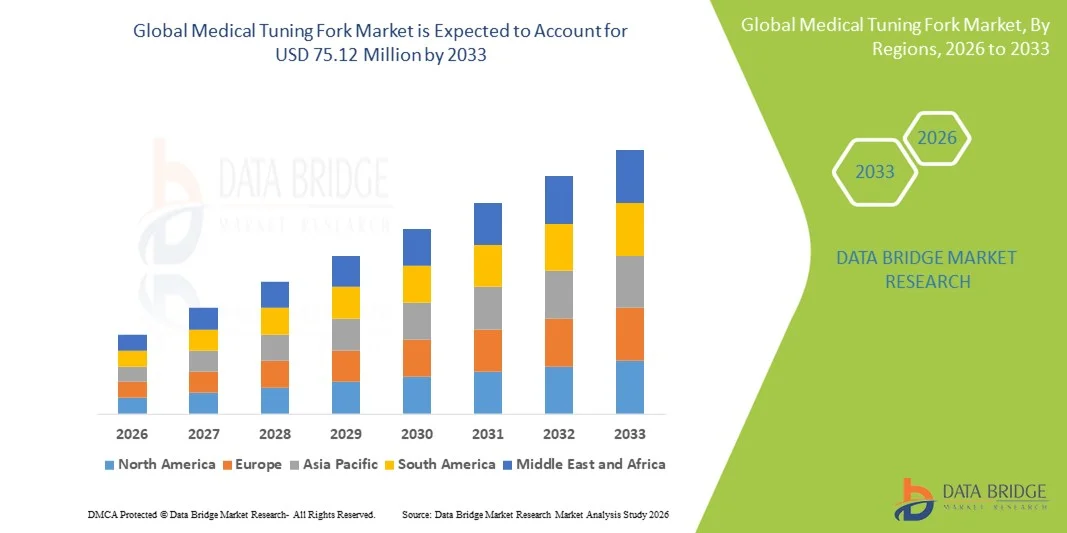
Medical Tuning Fork Market Size
- The global medical tuning fork market size was valued at USD 50.00 Million in 2025 and is expected to reach USD 75.12 Million by 2033, at a CAGR of 5.22% during the forecast period
- The market growth is largely fueled by increasing awareness and adoption of advanced diagnostic tools in audiology and healthcare, driving demand for precise and reliable medical tuning fork devices
- Furthermore, rising prevalence of hearing disorders, expanding audiology clinics, and growing integration of tuning fork tests in routine medical and neurological assessments are accelerating the uptake of Medical Tuning Fork solutions, thereby significantly boosting the industry's growth
Medical Tuning Fork Market Analysis
- Medical tuning forks, essential diagnostic tools for neurological and audiological assessments, are increasingly vital components of modern healthcare and clinical settings due to their accuracy, reliability, ease of use, and role in early detection of hearing and neurological disorders
- The escalating demand for medical tuning forks is primarily fueled by the widespread adoption of advanced diagnostic practices, growing awareness among healthcare providers and patients, and a rising preference for cost-effective and standardized assessment tools
- North America dominated the Medical Tuning Fork market with the largest revenue share of approximately 37.5% in 2025, supported by a well-established healthcare infrastructure, high adoption of audiology diagnostic tools, presence of key medical device manufacturers, and increasing awareness regarding early detection of hearing and neurological disorders
- Asia-Pacific is expected to be the fastest-growing region in the Medical Tuning Fork market during the forecast period, registering an estimated CAGR of around 9.2%, driven by rising prevalence of hearing impairments, expansion of audiology clinics, increasing government healthcare initiatives, and growing investments in medical diagnostic equipment across emerging economies such as China and India
- The Aluminum Alloy Material segment dominated the largest market revenue share of approximately 57.6% in 2025, driven by its lightweight nature, durability, and corrosion resistance, making it ideal for repeated clinical use
Report Scope and Medical Tuning Fork Market Segmentation
|
Attributes |
Medical Tuning Fork Key Market Insights |
|
Segments Covered |
|
|
Countries Covered |
North America
Europe
Asia-Pacific
Middle East and Africa
South America
|
|
Key Market Players |
• Aesculap (Germany) |
|
Market Opportunities |
|
|
Value Added Data Infosets |
In addition to the insights on market scenarios such as market value, growth rate, segmentation, geographical coverage, and major players, the market reports curated by the Data Bridge Market Research also include in-depth expert analysis, patient epidemiology, pipeline analysis, pricing analysis, and regulatory framework. |
Medical Tuning Fork Market Trends
Increasing Adoption of Advanced Diagnostic Tools in Healthcare
- A significant and accelerating trend in the global Medical Tuning Fork market is the rising adoption of advanced diagnostic tools across hospitals, clinics, audiology centers, and rehabilitation facilities
- Medical tuning forks are widely used for auditory testing, neurological assessments, and vibration sense evaluations, and innovations in materials, frequency calibration, and design are enhancing their precision and usability
- For instance, in 2024, several hospitals in Germany and the United States upgraded to high-precision alloy tuning forks with standardized calibration frequencies, enabling healthcare professionals to conduct more accurate hearing and neurological tests. Similarly, clinics in Japan and South Korea have begun integrating ergonomic and lightweight tuning forks to reduce strain during repetitive examinations
- Modern tuning forks now incorporate improvements such as better tonal stability, corrosion resistance, and enhanced resonance, which ensure consistent results in clinical and educational settings
- These innovations allow for more reliable detection of hearing impairments, peripheral neuropathies, and other neurological disorders
- Furthermore, there is a global shift toward preventive healthcare and early diagnosis, with medical institutions increasingly prioritizing tools that provide standardized and reproducible results
- This trend has significantly influenced the development and adoption of premium-quality medical tuning forks, especially in regions emphasizing high standards of patient care
Medical Tuning Fork Market Dynamics
Driver
Rising Prevalence of Hearing and Neurological Disorders
- The global growth of the Medical Tuning Fork market is strongly driven by the increasing prevalence of hearing impairments, neurological disorders, and musculoskeletal conditions. Early diagnosis of these conditions is essential for effective treatment and rehabilitation, driving demand for reliable, standardized diagnostic instruments such as medical tuning forks
- For instances, in 2025, hospitals and ENT clinics in China and India reported increased use of calibrated tuning forks for routine hearing screenings and neurological examinations, due to rising awareness of age-related hearing loss and diabetic neuropathy among aging populations
- In addition, the expansion of geriatric healthcare services, increasing incidence of lifestyle-related neurological disorders, and growing frequency of routine health screenings globally are major factors propelling market demand
- The proliferation of audiology centers, rehabilitation facilities, and medical training institutions further reinforces the need for high-quality diagnostic equipment. Regions with robust healthcare infrastructure, such as North America and Europe, are witnessing higher adoption of precision tuning forks, while emerging markets in Asia-Pacific are gradually increasing investments to standardize diagnostic procedures
- Furthermore, the emphasis on patient-centric care and the demand for more accurate and reproducible diagnostic tools continue to encourage healthcare providers worldwide to upgrade their conventional instruments, directly benefiting the medical tuning fork market
Restraint/Challenge
Limited Technological Advancements and Cost Constraints
- Despite steady demand, the medical tuning fork market faces challenges due to limited technological innovations and cost-related barriers. Traditional tuning forks have remained largely unchanged over decades, which restricts differentiation among manufacturers and limits potential for premium product offerings
- For instance, small clinics and healthcare facilities in Latin America and Africa often prefer standard, low-cost tuning forks over advanced calibrated models, due to budget constraints and limited awareness of the benefits of high-precision instruments
- Furthermore, manufacturing high-quality tuning forks with precise frequency calibration and durable alloys requires specialized materials, skilled labor, and stringent quality control, all of which increase production costs. This higher cost can limit accessibility in price-sensitive regions and reduce adoption among smaller healthcare providers
- In addition, while premium tuning forks offer improved resonance, ergonomic designs, and greater longevity, their perceived value may not always justify the investment for all institutions, especially where basic auditory and neurological testing remains sufficient
- Overcoming these challenges through cost-efficient manufacturing techniques, regional pricing strategies, and increasing awareness of the clinical benefits of high-precision tuning forks will be crucial for sustaining and expanding the market globally
Medical Tuning Fork Market Scope
The market is segmented on the basis of product and end-user.
- By Product
On the basis of product, the Medical Tuning Fork market is segmented into Aluminum Alloy Material and Steel Material. The Aluminum Alloy Material segment dominated the largest market revenue share of approximately 57.6% in 2025, driven by its lightweight nature, durability, and corrosion resistance, making it ideal for repeated clinical use. Its affordability compared to steel variants also encourages adoption across clinics and hospitals. Aluminum alloy tuning forks offer precise acoustic resonance and easy portability, favored by physical therapists and audiologists for routine examinations. High demand in educational and training setups further strengthens the segment’s dominance. Manufacturers prefer aluminum alloys for large-scale production due to lower material costs and simplified machining. The growing focus on patient-friendly devices enhances adoption, while regulatory approvals and standardization of alloy grades support consistent quality. Integration into diagnostic kits for neurological and auditory testing further boosts usage. Hospitals and clinics increasingly rely on aluminum alloy forks due to their balance of cost, durability, and performance. The segment’s robustness against wear and tear also contributes to its sustained preference. Overall, the combination of affordability, reliability, and ease of handling positions aluminum alloy forks as the leading product type globally.
The Steel Material segment is expected to witness the fastest CAGR of 12.8% from 2026 to 2033, driven by its superior durability, precision, and long-term acoustic stability. Steel tuning forks are preferred in high-end diagnostic and research applications where consistent resonance is critical. Increasing adoption in hospitals and specialized physical examination centers accelerates growth. The segment benefits from rising investments in audiology and neurological diagnostics. Technological improvements in alloy treatment and coating enhance corrosion resistance and lifespan, attracting new users. Educational institutions focusing on advanced medical training also contribute to demand. Rising awareness of accurate diagnostic tools in developing regions supports expansion. Customizable steel forks with marked frequencies are increasingly popular. The segment also sees growing penetration in emerging markets due to increased healthcare infrastructure. Overall, demand for steel tuning forks is rising due to precision, durability, and long-term usability.
- By End-User
On the basis of end-user, the Medical Tuning Fork market is segmented into Clinic, Hospital, and Physical Examination Center. The Clinic segment dominated the largest market revenue share of around 48.9% in 2025, driven by high patient footfall and routine diagnostic usage. Clinics often prioritize lightweight and cost-effective instruments such as aluminum alloy forks for neurological and auditory assessments. High accessibility and frequent patient turnover necessitate durable, easy-to-clean forks. Continuous outpatient services and preventive health check-ups increase utilization rates. Growing awareness of early detection and screening programs in private clinics enhances adoption. Clinics prefer standardized tuning forks to meet medical guidelines efficiently. Bulk procurement for multi-clinic networks supports dominance. Rising focus on quality patient care and compliance with local medical standards further boosts demand. Integration of tuning forks in routine audiometric and neurological screening kits is common. Clinics also leverage cost-effective solutions without compromising precision. The segment benefits from expanding clinic networks globally, reinforcing its leadership position.
The Hospital segment is expected to witness the fastest CAGR of 13.4% from 2026 to 2033, driven by increasing investments in advanced diagnostics and comprehensive patient care programs. Hospitals require both aluminum alloy and steel tuning forks for routine and specialized assessments. Expanding hospital infrastructure and rising prevalence of auditory and neurological disorders contribute to growth. Adoption in tertiary and specialized hospitals for precise diagnostics accelerates usage. Hospital laboratories prefer long-lasting and precise steel forks for repeatable results. Integration with training programs for medical professionals also drives demand. Technological improvements in fork calibration ensure higher accuracy, appealing to hospitals. Rising awareness of neurological and hearing disorder diagnostics supports expansion. The growing number of hospital visits in emerging markets increases instrument utilization. Overall, hospitals are rapidly adopting advanced tuning forks to improve diagnostic accuracy and patient outcomes.
Medical Tuning Fork Market Regional Analysis
- North America dominated the medical tuning fork market with the largest revenue share of approximately 37.5% in 2025
- Supported by a well-established healthcare infrastructure, high adoption of audiology diagnostic tools, presence of key medical device manufacturers
- Increasing awareness regarding early detection of hearing and neurological disorders
U.S. Medical Tuning Fork Market Insight
The U.S. medical tuning fork market captured the largest revenue share within North America in 2025, driven by widespread use of audiology diagnostic tools, high awareness of hearing and neurological health, and strong presence of leading manufacturers. The increasing focus on early detection and diagnosis of auditory and neurological disorders further propels market growth.
Europe Medical Tuning Fork Market Insight
The Europe medical tuning fork market is projected to expand at a substantial CAGR throughout the forecast period, driven by rising prevalence of hearing impairments, growing healthcare expenditure, and the adoption of advanced audiology diagnostic equipment.
U.K. Medical Tuning Fork Market Insight
The U.K. medical tuning fork market is anticipated to grow at a notable CAGR during the forecast period, supported by increasing audiology clinics, awareness of hearing disorders, and rising demand for early diagnostic tools.
Germany Medical Tuning Fork Market Insight
The Germany medical tuning fork market is expected to expand at a considerable CAGR, fueled by advanced healthcare infrastructure, high adoption of diagnostic devices, and increasing awareness of neurological and hearing health.
Asia-Pacific Medical Tuning Fork Market Insight
The Asia-Pacific medical tuning fork market is poised to grow at the fastest CAGR of approximately 9.2% during the forecast period of 2026 to 2033, driven by rising prevalence of hearing impairments, expansion of audiology clinics, increasing government healthcare initiatives, and growing investments in medical diagnostic equipment across emerging economies such as China and India.
Japan Medical Tuning Fork Market Insight
The Japan medical tuning fork market is gaining momentum due to rising healthcare awareness, advanced diagnostic infrastructure, and the increasing focus on early detection of hearing and neurological disorders.
China Medical Tuning Fork Market Insight
The China medical tuning fork market accounted for the largest market revenue share in Asia-Pacific in 2025, supported by increasing healthcare investments, expansion of audiology clinics, government healthcare initiatives, and rising prevalence of hearing impairments.
Medical Tuning Fork Market Share
The Medical Tuning Fork industry is primarily led by well-established companies, including:
• Aesculap (Germany)
• Jamar (U.S.)
• Medline Industries (U.S.)
• Riester (Germany)
• Heine Optotechnik (Germany)
• Prestige Medical (U.S.)
• Zhejiang Fangli Medical (China)
• B. Braun (Germany)
• Patterson Medical (U.S.)
• Contec Medical Systems (China)
• LivaNova (Italy)
• Guangdong Huaying Medical (China)
• Cardinal Health (U.S.)
• Shanghai Jingle Medical (China)
• Omron Healthcare (Japan)
• Welch Allyn (U.S.)
• Natus Medical (U.S.)
• Yuwell (China)
• Shenzhen Mindray (China)
• SunMed (U.S.)
Latest Developments in Global Medical Tuning Fork Market
- In 2023, Rudolf Riester GmbH, a leading medical instrument manufacturer, launched a new line of titanium‑based Hartmann tuning forks, designed to offer enhanced durability and precision for audiology and neurological diagnostic applications. These titanium forks provide more consistent resonance and longer service life compared with traditional stainless steel models, helping clinicians improve diagnostic accuracy in Rinne, Weber, and vibration sense tests. The launch underscores ongoing product innovation in the medical tuning fork segment to meet evolving clinical needs and higher performance expectations
- In June 2023, the global medical tuning fork market saw heightened market interest as industry research highlighted rising prevalence of hearing disorders and increased demand for non‑invasive diagnostic tools, supporting broader adoption of tuning forks in clinical and educational settings. Market reports during this period also pointed to growth in standardized diagnostic practices across healthcare facilities, further validating medical tuning forks’ role in routine neurological and auditory assessments
- In March 2024, MDF Instruments expanded its product portfolio to include customizable medical tuning forks for both clinical practice and educational use, offering a wider range of calibrated frequencies and design options tailored to specific diagnostic needs. This expansion allowed audiologists, neurologists, and medical training programs to access more versatile tools, reflecting ongoing diversification in medical tuning fork offerings
- In April 2025, Welch Allyn partnered with ENT and audiology clinics across North America to introduce advanced diagnostic kits featuring integrated Hartmann tuning forks, enhancing comprehensive auditory and neurological assessment solutions for practitioners. These partnerships facilitated wider clinical access to professional‑grade tuning workstations and reinforced the clinical relevance of tuning forks in differential diagnosis

- Interactive Data Analysis Dashboard
- Company Analysis Dashboard for high growth potential opportunities
- Research Analyst Access for customization & queries
- Competitor Analysis with Interactive dashboard
- Latest News, Updates & Trend analysis
- Harness the Power of Benchmark Analysis for Comprehensive Competitor Tracking
Data collection and base year analysis are done using data collection modules with large sample sizes. The stage includes obtaining market information or related data through various sources and strategies. It includes examining and planning all the data acquired from the past in advance. It likewise envelops the examination of information inconsistencies seen across different information sources. The market data is analysed and estimated using market statistical and coherent models. Also, market share analysis and key trend analysis are the major success factors in the market report. To know more, please request an analyst call or drop down your inquiry.
The key research methodology used by DBMR research team is data triangulation which involves data mining, analysis of the impact of data variables on the market and primary (industry expert) validation. Data models include Vendor Positioning Grid, Market Time Line Analysis, Market Overview and Guide, Company Positioning Grid, Patent Analysis, Pricing Analysis, Company Market Share Analysis, Standards of Measurement, Global versus Regional and Vendor Share Analysis. To know more about the research methodology, drop in an inquiry to speak to our industry experts.
Data Bridge Market Research is a leader in advanced formative research. We take pride in servicing our existing and new customers with data and analysis that match and suits their goal. The report can be customized to include price trend analysis of target brands understanding the market for additional countries (ask for the list of countries), clinical trial results data, literature review, refurbished market and product base analysis. Market analysis of target competitors can be analyzed from technology-based analysis to market portfolio strategies. We can add as many competitors that you require data about in the format and data style you are looking for. Our team of analysts can also provide you data in crude raw excel files pivot tables (Fact book) or can assist you in creating presentations from the data sets available in the report.













