


Medical Waste Disposal Services Market Overview
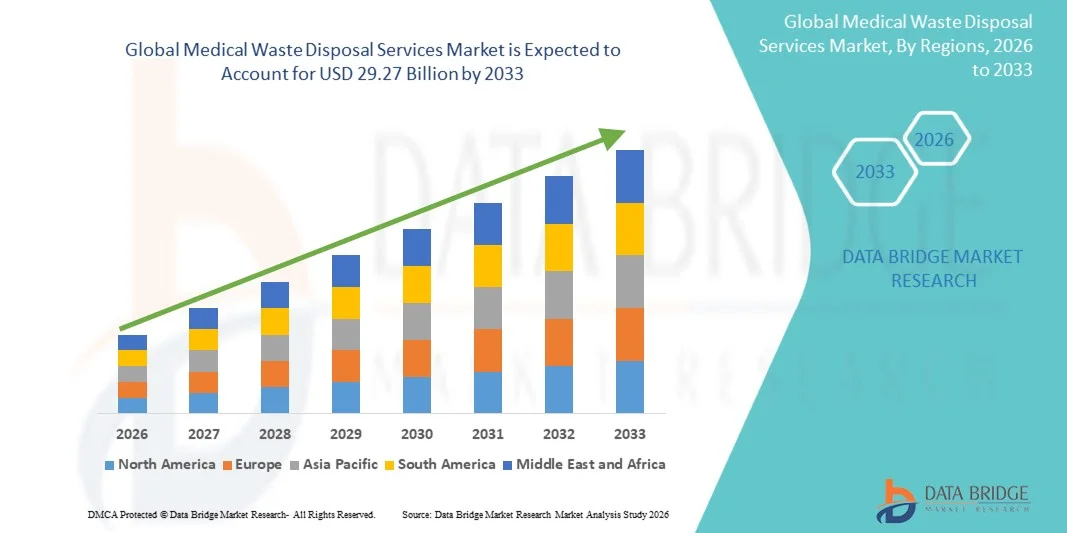
The Medical Waste Disposal Services Market was valued at USD 17.04 billion in 2025 and is projected to reach USD 29.27 billion by 2033, growing at a CAGR of 7.00% from 2026 to 2033. The market is experiencing consistent growth driven by increasing healthcare waste generation, rising awareness regarding infection control and environmental safety, and stringent government regulations for the proper disposal of hazardous medical waste. Growing investments in healthcare infrastructure, expansion of hospitals and diagnostic laboratories, and increasing adoption of sustainable waste management technologies are further supporting market expansion globally.
The rising incidence of chronic diseases, growing number of surgical procedures, and increasing use of disposable medical products are significantly increasing the volume of biomedical waste generated worldwide. In addition, strict regulatory guidelines related to the handling, transportation, treatment, and disposal of infectious and hazardous healthcare waste are compelling hospitals, clinics, pharmaceutical companies, and laboratories to adopt advanced medical waste disposal services. Technologies such as autoclaving, incineration, chemical treatment, and microwave-based disposal systems are increasingly replacing conventional waste handling methods in many markets, offering safer, compliant, and environmentally responsible waste management solutions.
Key Market Trends & Insights
- North America dominated the Medical Waste Disposal Services Market with the largest revenue share of 38.16% in 2025, supported by stringent healthcare waste management regulations, advanced healthcare infrastructure, and high adoption of sustainable waste treatment technologies across hospitals and laboratories.
- The Hazardous Waste segment dominated the market with a share of 61.48% in 2025 due to the increasing generation of infectious, pathological, pharmaceutical, and sharps waste from hospitals, laboratories, and healthcare facilities worldwide
- Asia-Pacific is expected to be the fastest-growing region at a CAGR of 7.6% from 2026 to 2033, fueled by expanding healthcare infrastructure, rising healthcare expenditure, and increasing awareness regarding safe biomedical waste disposal practices across China, India, and Japan.
- The Autoclaving segment is the fastest-growing treatment type, projected to register a CAGR of 7.1%, reflecting growing demand for environmentally safe, non-incineration medical waste treatment technologies.
- The Hospitals segment dominates the waste generator category with a 44.83% revenue share in 2025, led by increasing patient admissions, rising surgical procedures, and growing biomedical waste generation from acute healthcare facilities.
- Offsite treatment accounts for 58.92% of the market, preferred due to centralized waste processing capabilities, regulatory compliance advantages, and cost-effective large-scale disposal operations.
Market Size & Forecast
- Global Market Value (2025): USD 17.04 Billion
- Expected Market Value (2033): USD 29.27 Billion
- Forecast CAGR (2026–2033): 7.00%
- Leading Region in 2025: North America
- Fastest Growing Region: Asia-Pacific
Report Scope and Medical Waste Disposal Services Market Segmentation
|
Attributes |
Medical Waste Disposal Services Key Market Insights |
|
Segments Covered |
|
|
Countries Covered |
North America · U.S. · Canada · Mexico Europe · Germany · France · U.K. · Netherlands · Switzerland · Belgium · Russia · Italy · Spain · Turkey · Rest of Europe Asia-Pacific · China · Japan · India · South Korea · Singapore · Malaysia · Australia · Thailand · Indonesia · Philippines · Rest of Asia-Pacific Middle East and Africa · Saudi Arabia · U.A.E. · South Africa · Egypt · Israel · Rest of Middle East and Africa South America · Brazil · Argentina · Rest of South America |
|
Key Market Players |
• Stericycle, Inc. (U.S.) |
|
Market Opportunities |
· Increasing adoption of environmentally sustainable waste treatment technologies such as autoclaving · Expanding healthcare infrastructure and rising healthcare expenditure across emerging economies · Development of multi-vehicle simulation environments |
|
Value Added Data Infosets |
In addition to the insights on market scenarios such as market value, growth rate, segmentation, geographical coverage, and major players, the market reports curated by the Data Bridge Market Research also include in-depth expert analysis, geographically represented company-wise production and capacity, network layouts of distributors and partners, detailed and updated price trend analysis and deficit analysis of supply chain and demand. |
Medical Waste Disposal Services Market Trends
Trend: Growing Adoption of Sustainable and Non-Incineration Medical Waste Treatment Technologies
Healthcare providers and waste management companies are increasingly adopting environmentally sustainable medical waste disposal technologies to reduce emissions, improve regulatory compliance, and enhance operational efficiency. Advanced autoclaving, microwave treatment, chemical disinfection, and robotic waste segregation systems are gradually replacing conventional incineration methods in many healthcare facilities due to lower environmental impact and improved safety standards. In addition, digital waste tracking platforms and IoT-enabled monitoring systems are helping hospitals and waste disposal operators improve traceability, compliance reporting, and real-time waste handling efficiency.
For instance, in 2024, Stericycle, Inc. expanded its sustainable healthcare waste management initiatives focused on reducing landfill dependency and increasing adoption of alternative treatment technologies across North America. Similarly, several hospitals across Europe are increasingly deploying automated segregation and reusable sharps container programs to minimize hazardous waste generation and improve sustainability performance.
Medical Waste Disposal Services Market Dynamics
Key Market Driver: Rising Volume of Healthcare and Infectious Waste Generation
The growing volume of healthcare waste generated from hospitals, diagnostic laboratories, pharmaceutical manufacturing facilities, and vaccination programs is a major factor driving demand for medical waste disposal services globally. Increasing prevalence of chronic diseases, rising surgical procedures, expanding healthcare infrastructure, and growing use of disposable medical products are significantly increasing biomedical waste generation worldwide. According to the World Health Organization (WHO), healthcare activities generate millions of tons of medical waste annually, with hazardous waste accounting for nearly 15% of total healthcare waste generated globally.
Hospitals, clinics, and research laboratories are increasingly investing in professional waste collection, transportation, treatment, and disposal services to ensure compliance with stringent environmental and public health regulations. In addition, increasing government regulations regarding safe handling of infectious waste in countries such as the United States, Germany, and Japan are accelerating adoption of advanced medical waste disposal solutions.
Key Restraint/Challenge: High Operational and Regulatory Compliance Costs
A significant challenge in the Medical Waste Disposal Services Market is the high operational cost associated with collection, transportation, treatment, and environmentally compliant disposal of hazardous medical waste. Advanced treatment technologies such as incineration systems, autoclaves, chemical disinfection units, and emission control infrastructure require substantial capital investment and ongoing maintenance expenses. In additon, strict environmental regulations related to air pollution control, waste segregation, and hazardous material transportation further increase operational complexity for service providers.
For instance, installation and operation of high-capacity medical waste incineration systems can require multimillion-dollar investments, making market entry difficult for smaller waste management companies. Furthermore, inadequate waste segregation practices and limited healthcare waste management infrastructure in developing regions across Asia-Pacific, Africa, and Latin America continue to create significant compliance and environmental challenges.
Key Market Opportunity: Expansion of Integrated and Digitally Enabled Waste Management Solutions
The increasing integration of digital technologies into healthcare waste management is creating strong growth opportunities for medical waste disposal service providers. Cloud-based waste tracking platforms, barcode-enabled waste monitoring systems, and AI-driven waste segregation technologies are helping healthcare facilities improve operational efficiency, regulatory compliance, and sustainability performance.
The growing focus on environmentally responsible healthcare operations and circular economy initiatives is further supporting adoption of reusable medical waste containers and eco-friendly disposal solutions. In 2024, Daniels Health expanded its reusable sharps container and digitally tracked waste management solutions across hospitals and healthcare facilities to reduce single-use plastic waste and improve compliance visibility. Increasing healthcare investments across emerging economies are expected to further accelerate demand for integrated medical waste management and environmentally sustainable disposal services globally.
Medical Waste Disposal Services Market Scope
The Medical Waste Disposal Services market is segmented on the basis of waste type, treatment type, treatment site, and waste generator.
- By Waste Type
On the basis of waste type, the Medical Waste Disposal Services Market is segmented into hazardous waste and non-hazardous waste. The Hazardous Waste segment dominated the market with a share of 61.48% in 2025 due to the increasing generation of infectious, pathological, pharmaceutical, and sharps waste from hospitals, laboratories, and healthcare facilities worldwide. Rising prevalence of chronic diseases, growing surgical procedures, and increasing vaccination activities are significantly contributing to hazardous biomedical waste generation. Strict government regulations regarding the safe collection, transportation, treatment, and disposal of infectious waste are driving strong demand for professional hazardous waste management services globally. In additon, growing concerns regarding hospital-acquired infections, environmental contamination, and public health safety are encouraging healthcare facilities to adopt advanced disposal and treatment technologies. Increasing investments in high-capacity incineration, autoclaving, and chemical treatment systems are further reinforcing the dominance of this segment across developed and emerging markets.
The Non-Hazardous Waste segment is expected to witness the fastest CAGR of 6.8% from 2026 to 2033, driven by the increasing focus on sustainable waste segregation and recycling practices across healthcare facilities. Rising adoption of eco-friendly waste handling solutions and increasing awareness regarding reduction of landfill waste are accelerating segment growth. In addition, healthcare providers are increasingly implementing waste minimization and recycling programs for non-infectious materials such as packaging waste, paper products, and disposable plastics. Expanding healthcare infrastructure and rising patient admissions across emerging economies are further contributing to growth in non-hazardous medical waste generation globally.
- By Treatment Type
On the basis of treatment type, the Medical Waste Disposal Services Market is segmented into incineration, autoclaving, chemical treatment, irradiative, biological, and others. The Incineration segment dominated the market with a share of 36.27% in 2025 due to its widespread use for the disposal of infectious, pharmaceutical, and pathological waste requiring complete destruction and volume reduction. Incineration remains highly preferred among hospitals and large healthcare facilities because of its effectiveness in eliminating hazardous pathogens and reducing waste volume significantly. Increasing biomedical waste generation from hospitals, pharmaceutical manufacturers, and research laboratories continues to support adoption of advanced incineration systems globally. In additon, technological advancements in emission control systems and waste-to-energy incineration technologies are helping facilities improve environmental compliance and operational efficiency, further reinforcing the dominance of this segment.
The Autoclaving segment is expected to witness the fastest CAGR of 7.1% from 2026 to 2033, driven by increasing demand for environmentally sustainable and non-incineration waste treatment technologies. Autoclaving is gaining strong popularity due to lower emissions, reduced operational costs, and high effectiveness in sterilizing infectious medical waste. Growing environmental concerns regarding air pollution from incineration and rising regulatory pressure for eco-friendly disposal methods are accelerating adoption of autoclave-based treatment systems globally. In addition, increasing investments in decentralized waste treatment facilities and technological advancements in automated steam sterilization systems are further supporting segment expansion.
- By Treatment Site
On the basis of treatment site, the Medical Waste Disposal Services Market is segmented into offsite and onsite. The Offsite segment dominated the market with a share of 58.92% in 2025 due to its cost-effectiveness, centralized processing capabilities, and ability to manage large volumes of biomedical waste efficiently. Healthcare facilities increasingly prefer offsite treatment services because they reduce the burden of maintaining complex waste treatment infrastructure and help ensure regulatory compliance through specialized waste management providers. In additon, established logistics networks, dedicated waste transportation systems, and advanced centralized treatment facilities are supporting the widespread adoption of offsite disposal solutions across hospitals and laboratories globally. Growing partnerships between healthcare institutions and third-party waste disposal companies are further reinforcing the leading position of this segment.
The Onsite segment is expected to witness the fastest CAGR of 6.7% from 2026 to 2033, driven by increasing demand for immediate waste treatment, infection control, and reduced transportation risks. Hospitals and research facilities are increasingly investing in onsite autoclaving and microwave treatment systems to improve operational efficiency and reduce dependency on external service providers. In addition, rising concerns regarding infectious disease outbreaks and stricter waste handling regulations are encouraging healthcare facilities to adopt onsite treatment technologies for better control and compliance. Technological advancements in compact and automated treatment systems are further accelerating segment growth globally.
- By Waste Generator
On the basis of waste generator, the Medical Waste Disposal Services Market is segmented into hospitals, physician offices, clinical laboratories, manufacturers, and reverse distributors. The Hospitals segment dominated the market with a share of 44.83% in 2025 due to the large volume of infectious, pathological, and pharmaceutical waste generated from surgeries, patient care activities, diagnostic procedures, and emergency treatments. Increasing patient admissions, expanding healthcare infrastructure, and rising prevalence of chronic and infectious diseases are significantly increasing biomedical waste generation across hospitals worldwide. In additon, stringent regulatory requirements for safe handling and disposal of healthcare waste are compelling hospitals to adopt professional waste management and disposal services. Growing investments in hospital waste segregation systems, sterilization technologies, and environmentally compliant disposal methods are further reinforcing the dominance of this segment globally.
The Clinical Laboratories segment is expected to witness the fastest CAGR of 7.0% from 2026 to 2033, driven by increasing diagnostic testing volumes, expanding research activities, and rising demand for laboratory-based disease detection services. Clinical laboratories generate substantial quantities of infectious samples, sharps waste, and chemical waste that require specialized treatment and disposal solutions. In addition, rapid growth in molecular diagnostics, pathology testing, and pharmaceutical research activities is accelerating biomedical waste generation from laboratory facilities globally. Increasing regulatory focus on laboratory biosafety and hazardous waste management is further supporting adoption of advanced medical waste disposal services across this segment.
Medical Waste Disposal Services Market Regional Analysis
North America dominated the Medical Waste Disposal Services market and accounted for the largest revenue share of 38.16% in 2025, supported by stringent healthcare waste management regulations, advanced healthcare infrastructure, and high adoption of sustainable waste treatment technologies across hospitals and laboratories. The region also benefits from strong government oversight regarding hazardous waste disposal, increasing biomedical waste generation, and widespread adoption of advanced autoclaving, incineration, and chemical treatment technologies. Rising focus on infection control, environmental safety, and regulatory compliance continues to strengthen North America’s leadership position in the global market.
U.S. Medical Waste Disposal Services Market Insight
The U.S. Medical Waste Disposal Services market is witnessing strong growth due to rising healthcare waste generation, increasing surgical procedures, and growing adoption of environmentally compliant waste treatment technologies. The country’s advanced healthcare infrastructure, strong regulatory framework, and increasing investments in sustainable healthcare operations are driving demand for professional medical waste collection, transportation, and disposal services. In addition, growing emphasis on infection prevention, hazardous waste management, and environmentally sustainable disposal practices is accelerating market expansion across hospitals, laboratories, and pharmaceutical facilities.
Europe Medical Waste Disposal Services Market Insight
The Europe Medical Waste Disposal Services market remains a major contributor to global revenue, driven by strict environmental regulations, strong government support for sustainable healthcare waste management, and increasing adoption of eco-friendly disposal technologies. Healthcare facilities across the region are increasingly investing in non-incineration waste treatment systems, recycling initiatives, and advanced waste segregation solutions to improve environmental compliance and operational efficiency. Additionally, rising biomedical waste generation from aging populations and expanding healthcare services is supporting market growth throughout Europe.
U.K. Medical Waste Disposal Services Market Insight
The U.K. Medical Waste Disposal Services market is experiencing steady growth, supported by rising adoption of simulation technologies in professional driver training, automotive testing, and motorsport applications. Increasing investments in advanced simulator infrastructure and growing demand for cost-effective, risk-free training solutions are contributing to market growth. Furthermore, integration of AI, VR, and data analytics technologies is improving simulator performance and training efficiency, positioning the U.K. as a key innovation hub in the Medical Waste Disposal Services industry.
Germany Medical Waste Disposal Services Market Insight
The Germany Medical Waste Disposal Services market is expanding steadily due to the country’s advanced healthcare infrastructure, strong environmental protection policies, and growing adoption of sustainable waste treatment technologies. Hospitals, pharmaceutical manufacturers, and research laboratories are increasingly utilizing advanced autoclaving, chemical treatment, and waste sterilization systems to ensure regulatory compliance and infection control. Continuous investments in green healthcare initiatives and efficient waste management infrastructure are further driving market growth in Germany.
Asia-Pacific Medical Waste Disposal Services Market Insight
The Asia-Pacific Medical Waste Disposal Services market is expected to witness rapid growth, driven by expanding healthcare infrastructure, rising healthcare expenditure, and increasing awareness regarding safe biomedical waste disposal practices across countries such as China, India, and Japan. Increasing patient admissions, growing pharmaceutical manufacturing activities, and rising prevalence of chronic diseases are significantly contributing to biomedical waste generation across the region. In addition, growing government initiatives focused on infection control and healthcare waste management are supporting rapid market expansion across Asia-Pacific.
Japan Medical Waste Disposal Services Market Insight
The Japan Medical Waste Disposal Services market is witnessing consistent growth due to increasing healthcare waste generation, rising elderly population, and strong government focus on environmentally sustainable waste management practices. Hospitals and healthcare facilities are increasingly adopting advanced sterilization and non-incineration treatment technologies to improve infection control and reduce environmental impact. Moreover, technological advancements in automated waste handling systems and strict healthcare waste disposal regulations are further contributing to market growth in Japan.
China Medical Waste Disposal Services Market Insight
The China Medical Waste Disposal Services market is growing rapidly, driven by expanding healthcare infrastructure, increasing healthcare investments, and rising government focus on safe disposal of infectious biomedical waste. Growing demand for centralized waste treatment facilities, increasing adoption of advanced autoclaving and chemical treatment technologies, and rising awareness regarding environmental safety are significantly boosting market demand. In addition, rapid expansion of hospitals, diagnostic laboratories, and pharmaceutical manufacturing activities is positioning China as one of the fastest-growing markets for medical waste disposal services globally.
Medical Waste Disposal Services Market Share
The Medical Waste Disposal Services industry is primarily led by well-established companies, including:
- Stericycle, Inc. (U.S.)
- Clean Harbors, Inc. (U.S.)
- Veolia Environnement S.A. (France)
- SUEZ Group (France)
- Waste Management, Inc. (U.S.)
- Republic Services, Inc. (U.S.)
- Daniels Health (Australia)
- Sharps Compliance Corp. (U.S.)
- Bertin Technologies (France)
- BioMedical Waste Solutions, LLC (U.S.)
- EcoMed Services (U.S.)
- REMONDIS SE & Co. KG (Germany)
- GIC Medical Disposal (South Africa)
- MedPro Disposal (U.S.)
- SMS Envocare Ltd. (India)
- Ramky Enviro Engineers Ltd. (India)
- Biomedical Waste Solutions Pvt. Ltd. (India)
- Eco Waste Solutions (United Kingdom)
- GRP & Associates, Inc. (U.S.)
- Triumvirate Environmental (U.S.)
Latest Developments in Medical Waste Disposal Services Market
- In May 2021, UPS Healthcare entered into a strategic partnership with Stericycle, Inc. to strengthen medical waste reverse logistics and disposal services across the healthcare sector. The collaboration enabled integrated transportation, categorization, and disposal of healthcare waste while supporting healthcare providers with end-to-end compliance-focused waste management solutions. The agreement reflected the growing industry emphasis on integrated and scalable healthcare waste disposal infrastructure
- In September 2021, Stericycle, Inc. received the 2021 Sustainability Product of the Year award from the Business Intelligence Group for its MedDrop medication disposal program. The initiative provided secure pharmaceutical disposal solutions aimed at reducing improper medication disposal and environmental contamination risks. The recognition reinforced increasing industry focus on sustainability and environmentally responsible medical waste disposal practices
- In April 2021, Aurora Capital Partners acquired Curtis Bay Medical Waste Services, a provider of medical waste collection, treatment, and disposal services. The acquisition was intended to expand healthcare waste management capabilities and strengthen service offerings for hospitals, laboratories, and healthcare facilities across the United States. This development reflected ongoing consolidation activity within the Medical Waste Disposal Services Market
- In April 2022, Stericycle, Inc. announced the launch of its new SafeShield antimicrobial medical waste containers designed for the storage and transportation of regulated medical waste. The new container line incorporated antimicrobial protection technology, improved durability, and enhanced storage configurations to strengthen infection prevention and healthcare waste handling safety across hospitals and clinical facilities. This launch highlighted Stericycle’s focus on advancing safer and more sustainable medical waste management solutions
- In March 2025, Waste Management, Inc. announced progress in integrating Stericycle, Inc. into its healthcare solutions business to expand regulated medical waste collection, transportation, and treatment operations. The company highlighted growing demand from healthcare and home-based care sectors, while ramping up new medical waste treatment facilities and expanding healthcare waste infrastructure. This development underscored the increasing strategic importance of healthcare waste management within the global waste management industry
- In June 2025, Daniels Health launched the 24L SHARPSGUARD eco container, described as the first sharps container manufactured from recycled healthcare waste materials. The product was developed to support circular economy initiatives and reduce single-use plastic waste generated from healthcare operations. The launch highlighted growing innovation and sustainability-driven product development within the medical waste disposal services market

- Interactive Data Analysis Dashboard
- Company Analysis Dashboard for high growth potential opportunities
- Research Analyst Access for customization & queries
- Competitor Analysis with Interactive dashboard
- Latest News, Updates & Trend analysis
- Harness the Power of Benchmark Analysis for Comprehensive Competitor Tracking
Data collection and base year analysis are done using data collection modules with large sample sizes. The stage includes obtaining market information or related data through various sources and strategies. It includes examining and planning all the data acquired from the past in advance. It likewise envelops the examination of information inconsistencies seen across different information sources. The market data is analysed and estimated using market statistical and coherent models. Also, market share analysis and key trend analysis are the major success factors in the market report. To know more, please request an analyst call or drop down your inquiry.
The key research methodology used by DBMR research team is data triangulation which involves data mining, analysis of the impact of data variables on the market and primary (industry expert) validation. Data models include Vendor Positioning Grid, Market Time Line Analysis, Market Overview and Guide, Company Positioning Grid, Patent Analysis, Pricing Analysis, Company Market Share Analysis, Standards of Measurement, Global versus Regional and Vendor Share Analysis. To know more about the research methodology, drop in an inquiry to speak to our industry experts.
Data Bridge Market Research is a leader in advanced formative research. We take pride in servicing our existing and new customers with data and analysis that match and suits their goal. The report can be customized to include price trend analysis of target brands understanding the market for additional countries (ask for the list of countries), clinical trial results data, literature review, refurbished market and product base analysis. Market analysis of target competitors can be analyzed from technology-based analysis to market portfolio strategies. We can add as many competitors that you require data about in the format and data style you are looking for. Our team of analysts can also provide you data in crude raw excel files pivot tables (Fact book) or can assist you in creating presentations from the data sets available in the report.













