


Medication-Assisted Treatment (MAT) Market Overview
As per Data Bridge Market Research analysis The Medication-Assisted Treatment (MAT) Market was valued at USD 11.56 billion in 2025 and is projected to reach USD 23.03 billion by 2033, growing at a CAGR of 9.00% from 2026 to 2033. The market is experiencing steady growth driven by the rising prevalence of opioid and substance use disorders, increasing awareness of evidence-based addiction treatment, and expanding government initiatives aimed at improving access to recovery services.
The growing burden of opioid dependence and alcohol use disorders worldwide, coupled with supportive regulatory frameworks and increased healthcare funding for addiction management, is encouraging healthcare providers, rehabilitation centers, and public health agencies to adopt MAT programs. Medications such as buprenorphine, methadone, and naltrexone are increasingly being integrated with counseling and behavioral therapies, offering effective and comprehensive treatment approaches. In addition, advancements in long-acting formulations, broader insurance coverage, and efforts to reduce stigma associated with addiction treatment are further supporting market expansion across developed and emerging healthcare systems.
Key Market Trends & Insights
- North America dominated the Medication-Assisted Treatment (MAT) Market with the largest revenue share of 42.86% in 2025, supported by high treatment adoption rates, favorable reimbursement policies, and extensive government programs addressing opioid use disorders.
- The Medication segment led the market with a 68.42% share in 2025, driven by its central role in reducing withdrawal symptoms, controlling cravings, and improving long-term recovery outcomes for patients with substance use disorders.
- Asia-Pacific is expected to be the fastest-growing region at a CAGR of 8.1% from 2026 to 2033, fueled by increasing awareness of substance use disorders, improving healthcare infrastructure, and growing government initiatives for addiction management.
- Therapy is the fastest-growing type, projected to register a CAGR of 8.1%, reflecting the surge in increasing recognition of the importance of behavioral interventions in addiction recovery.
- The Generics segment dominated the drug type category with a 62.47% revenue share in 2025, led by affordability and broad accessibility across developed and emerging healthcare systems.
- Immediate Release accounted for 71.26% of the market, preferred by its long-standing use in addiction treatment programs and widespread product availability.
- The Extended Release segment is the fastest-growing dosage form category, with a CAGR of 8.8%, driven by increasing demand for adherence-enhancing treatment options.
Market Size & Forecast
- Global Market Value (2025): USD 11.56 Billion
- Expected Market Value (2033): USD 23.03 Billion
- Forecast CAGR (2026–2033): 9.00%
- Leading Region in 2025: North America
- Fastest Growing Region: Asia Pacific
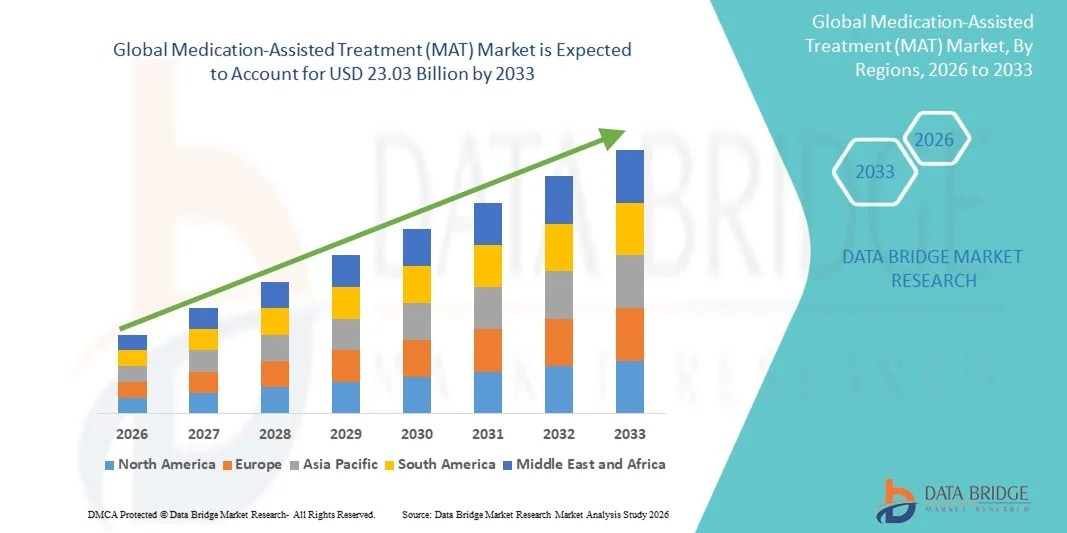
Report Scope and Medication-Assisted Treatment (MAT) Market Segmentation
|
Attributes |
Medication-Assisted Treatment (MAT) Key Market Insights |
|
Segments Covered |
|
|
Countries Covered |
North America · U.S. · Canada · Mexico Europe · Germany · France · U.K. · Netherlands · Switzerland · Belgium · Russia · Italy · Spain · Turkey · Rest of Europe Asia-Pacific · China · Japan · India · South Korea · Singapore · Malaysia · Australia · Thailand · Indonesia · Philippines · Rest of Asia-Pacific Middle East and Africa · Saudi Arabia · U.A.E. · South Africa · Egypt · Israel · Rest of Middle East and Africa South America · Brazil · Argentina · Rest of South America |
|
Key Market Players |
· Indivior PLC (U.K.) · Braeburn Inc. (U.S.) · Alkermes, Inc. (U.S.) · Orexo AB (Sweden) · Camurus AB (Sweden) · Mallinckrodt Pharmaceuticals (Ireland) · Hikma Pharmaceuticals PLC (U.K.) · Viatris Inc. (U.S.) · Teva Pharmaceutical Industries Ltd. (Israel) · Dr. Reddy’s Laboratories Ltd. (India) · Sun Pharmaceutical Industries Ltd. (India) · Amneal Pharmaceuticals LLC (U.S.) · Lupin Limited (India) · Zydus Lifesciences Limited (India) · Apotex Inc. (Canada) · Johnson & Johnson Services, Inc. (U.S.) · Purdue Pharma L.P. (U.S.) · Accord Healthcare Limited (U.K.) · Mundipharma International Limited (U.K.) · Titan Pharmaceuticals, Inc. (U.S.) |
|
Market Opportunities |
· Expansion of MAT services through telehealth and digital care platforms · Growing adoption of long-acting injectable and implantable MAT formulations · Increasing integration of MAT programs within primary care, correctional facilities, and community health centers |
|
Value Added Data Infosets |
In addition to the insights on market scenarios such as market value, growth rate, segmentation, geographical coverage, and major players, the market reports curated by the Data Bridge Market Research also include in-depth expert analysis, patient epidemiology, pipeline analysis, pricing analysis, and regulatory framework. |
Medication-Assisted Treatment (MAT) Market Trends
Trend: Growing Adoption of Long-Acting Treatment Formulations
Healthcare providers are increasingly adopting long-acting medication-assisted treatment formulations to improve patient adherence, reduce treatment discontinuation, and support sustained recovery outcomes without the need for frequent dosing. The integration of extended-release injectables and implants enables consistent therapeutic coverage and minimizes the risk of missed doses. Addiction treatment centers and community health programs are similarly leveraging these therapies to enhance care continuity through standardized, evidence-based treatment pathways, while digital monitoring tools create connected environments that closely support long-term recovery management.
For instance, in March 2025, Indivior continued expanding access initiatives for its extended-release buprenorphine products across multiple treatment networks, highlighting the industry's focus on improving adherence and recovery outcomes through long-acting MAT solutions.
Medication-Assisted Treatment (MAT) Market Dynamics
Key Market Driver: Rising Prevalence of Opioid Use Disorder and Government Treatment Initiatives
The increasing prevalence of opioid use disorder and substance dependence has created substantial demand for medication-assisted treatment programs that can improve recovery outcomes, reduce overdose risks, and support long-term patient stabilization across healthcare systems. Healthcare providers, public health agencies, and rehabilitation organizations are deploying MAT as a core component of addiction management strategies, improving treatment accessibility, enhancing care continuity, and strengthening patient outcomes through integrated behavioral health support.
For instance, in 2024, the Substance Abuse and Mental Health Services Administration continued expanding initiatives aimed at improving access to evidence-based MAT services, reinforcing the growing role of pharmacological treatment in addressing opioid addiction and related public health challenges.
Key Restraint/Challenge: Limited Access to Certified Providers and Treatment Infrastructure
A significant restraint in the global medication-assisted treatment market is the limited availability of certified providers and specialized treatment infrastructure. Many healthcare systems face shortages of addiction medicine professionals, counseling resources, and integrated care facilities, requiring substantial investment in workforce development and service expansion. The challenge extends to regulatory requirements, reimbursement limitations, and social stigma, making treatment access difficult for underserved populations, rural communities, and resource-constrained healthcare organizations.
For instance, despite policy reforms in several countries during 2024, numerous rural regions continued reporting insufficient addiction treatment capacity and provider shortages, reflecting the broader challenge of expanding MAT access beyond well-resourced healthcare networks.
Key Market Opportunity: Integration of Digital Health and Telemedicine-Based Addiction Care Platforms
The integration of digital health technologies in medication-assisted treatment presents a significant market opportunity. Technology-enabled platforms can support remote patient monitoring, improve treatment adherence tracking, and provide real-time engagement tools for recovery management. The development of telemedicine-based addiction care models and mobile health applications is further democratizing access to treatment services, opening growth opportunities across underserved markets in Asia-Pacific, Latin America, and the Middle East.
For instance, in 2025, several healthcare providers and digital health companies expanded virtual MAT programs incorporating teleconsultations, adherence monitoring, and behavioral support services, demonstrating the growing potential of technology-driven addiction treatment delivery models.
Medication-Assisted Treatment (MAT) Market Scope
The medication-assisted treatment (MAT) market is segmented on the basis of type, product, drug type, dosage form, route of administration, population type, end user, and distribution channel.
- By Type
On the basis of type, the Medication-Assisted Treatment (MAT) Market is segmented into medication and therapy. The Medication segment dominated the market with an estimated 68.42% share in 2025, owing to its central role in reducing withdrawal symptoms, controlling cravings, and improving long-term recovery outcomes for patients with substance use disorders. Medications such as buprenorphine, methadone, and naltrexone form the foundation of evidence-based addiction treatment programs worldwide. Increasing regulatory support and broader insurance coverage have further strengthened adoption. Healthcare providers rely on pharmacological interventions to stabilize patients before integrating behavioral support services. The growing opioid crisis continues to drive demand for medication-based treatment approaches. Continuous product innovation and expanded treatment accessibility further support segment leadership.
The Therapy segment is projected to register the fastest growth at a CAGR of 8.1% from 2026 to 2033, driven by increasing recognition of the importance of behavioral interventions in addiction recovery. Counseling, cognitive behavioral therapy, and psychosocial support programs are increasingly integrated into comprehensive treatment plans. Healthcare systems are emphasizing holistic recovery approaches that address both physical dependence and psychological factors. Growing telehealth adoption is improving access to therapy services across underserved regions. Government initiatives promoting integrated care models are further supporting expansion. Rising awareness regarding relapse prevention and long-term recovery management is expected to accelerate segment growth.
- By Product
On the basis of product, the Medication-Assisted Treatment (MAT) Market is segmented into buprenorphine and naloxone, naltrexone, buprenorphine, methadone, naloxone, disulfiram, and acamprosate. The Buprenorphine and Naloxone segment dominated the market with an estimated 31.58% share in 2025 due to its widespread use in opioid use disorder treatment and favorable safety profile. The combination therapy effectively reduces misuse potential while helping patients manage withdrawal symptoms and cravings. Strong clinical evidence supporting treatment effectiveness has encouraged adoption across healthcare facilities. Increasing physician acceptance and expanded prescribing authority have further boosted utilization. The product is widely incorporated into outpatient addiction treatment programs. Growing demand for office-based treatment solutions continues to support segment dominance.
The Naltrexone segment is expected to witness the fastest growth at a CAGR of 8.6% from 2026 to 2033, driven by increasing adoption of extended-release injectable formulations. The medication is used for both opioid and alcohol dependence treatment, broadening its patient base. Rising focus on relapse prevention is encouraging healthcare providers to incorporate long-acting therapies into treatment programs. Improved patient compliance associated with monthly administration schedules supports demand growth. Healthcare organizations are increasingly investing in recovery-focused treatment models utilizing naltrexone. Growing awareness of medication options beyond opioid agonists is further accelerating adoption.
- By Drug Type
On the basis of drug type, the Medication-Assisted Treatment (MAT) Market is segmented into generics and branded. The Generics segment dominated the market with an estimated 62.74% share in 2025, supported by affordability and broad accessibility across developed and emerging healthcare systems. Generic formulations play a crucial role in expanding treatment availability among cost-sensitive patient populations. Governments and public healthcare agencies frequently prioritize generic medications to control healthcare expenditures. Widespread availability through hospitals and rehabilitation centers contributes to market leadership. Generic products maintain therapeutic effectiveness while improving treatment affordability. Their role in supporting large-scale addiction treatment initiatives continues to drive demand.
The Branded segment is projected to grow at the fastest pace with a CAGR of 8.4% from 2026 to 2033, driven by innovation in extended-release and long-acting formulations. Pharmaceutical companies are investing in advanced drug delivery systems designed to improve adherence and treatment outcomes. Branded products often benefit from strong clinical support and differentiated therapeutic advantages. Increasing adoption of injectable and implant-based therapies is supporting segment expansion. Healthcare providers are showing growing interest in premium solutions that reduce relapse risk. Ongoing product development activities are expected to further strengthen growth prospects.
- By Dosage Form
On the basis of dosage form, the Medication-Assisted Treatment (MAT) Market is segmented into immediate release and extended release. The Immediate Release segment dominated the market with an estimated 71.26% share in 2025 owing to its long-standing use in addiction treatment programs and widespread product availability. These formulations are commonly prescribed due to familiarity among healthcare providers and patients. Immediate-release therapies allow flexible dose adjustments based on patient needs and treatment progression. Broad accessibility through healthcare institutions supports high utilization rates. Lower acquisition costs compared to advanced formulations also contribute to market leadership. Their extensive clinical history continues to support widespread adoption.
The Extended Release segment is anticipated to register the fastest growth at a CAGR of 8.8% from 2026 to 2033, driven by increasing demand for adherence-enhancing treatment options. Extended-release formulations reduce the need for frequent dosing and help maintain consistent therapeutic drug levels. Healthcare providers increasingly prefer these products for patients at higher risk of treatment discontinuation. Long-acting formulations are associated with improved compliance and reduced relapse rates. Advances in injectable and implantable technologies are further expanding clinical applications. Growing emphasis on long-term recovery outcomes is accelerating segment growth.
- By Route of Administration
On the basis of route of administration, the Medication-Assisted Treatment (MAT) Market is segmented into oral, parenteral, and others. The Oral segment dominated the market with an estimated 76.18% share in 2025 due to ease of administration, patient familiarity, and widespread availability of oral MAT medications. Oral formulations remain the standard treatment option in many healthcare settings worldwide. Their convenience supports consistent use across outpatient and rehabilitation programs. Lower administration costs compared to injectable therapies further encourage adoption. Physicians commonly prescribe oral products as first-line treatment options. Strong product availability across retail and hospital pharmacies supports segment leadership.
The Parenteral segment is expected to witness the fastest growth at a CAGR of 8.9% from 2026 to 2033, driven by increasing adoption of long-acting injectable therapies. Injectable formulations improve adherence by reducing the frequency of medication administration. Healthcare providers are increasingly recommending these products for patients with relapse risks or adherence challenges. Growing clinical evidence supporting treatment effectiveness is encouraging broader adoption. Technological advancements in sustained-release delivery systems are strengthening market potential. Rising preference for convenient and supervised treatment options is further supporting expansion.
- By Population Type
On the basis of population type, the Medication-Assisted Treatment (MAT) Market is segmented into adults and teenage. The Adults segment dominated the market with an estimated 88.34% share in 2025, primarily due to the higher prevalence of opioid and alcohol use disorders among the adult population. Most MAT programs worldwide are designed and approved for adult patients. Increasing healthcare expenditure on addiction treatment further supports segment growth. Adults account for the majority of rehabilitation admissions and long-term recovery program participation. Government initiatives targeting opioid addiction are heavily focused on adult treatment populations. The large patient pool continues to reinforce segment dominance.
The Teenage segment is projected to grow at the fastest rate with a CAGR of 7.9% from 2026 to 2033, driven by increasing awareness of adolescent substance use disorders and early intervention strategies. Healthcare providers are expanding specialized treatment programs tailored to younger patients. Growing recognition of the long-term consequences of untreated addiction is encouraging earlier treatment initiation. Schools and community organizations are supporting awareness and referral programs. Improvements in mental health and addiction care infrastructure are enhancing treatment access. Rising focus on preventive healthcare approaches is expected to accelerate growth.
- By End User
On the basis of end user, the Medication-Assisted Treatment (MAT) Market is segmented into rehabilitation clinics, hospitals specialty centres, homecare, and others. The Hospitals Specialty Centres segment dominated the market with an estimated 39.85% share in 2025 owing to comprehensive treatment capabilities and access to multidisciplinary healthcare professionals. These facilities provide integrated addiction management services combining medication, counseling, and medical supervision. Patients with complex conditions often require specialized treatment environments. Advanced infrastructure and regulatory compliance support high treatment volumes. Hospitals also play a major role in initiating MAT during acute care episodes. Their ability to provide coordinated care strengthens segment leadership.
The Homecare segment is anticipated to register the fastest growth at a CAGR of 8.7% from 2026 to 2033, driven by increasing adoption of telemedicine and remote patient management solutions. Patients increasingly prefer treatment models that minimize frequent healthcare facility visits. Home-based care improves convenience and supports long-term treatment adherence. Digital health technologies are enabling effective monitoring and follow-up care. Expanding access to virtual counseling services further enhances feasibility. Growing focus on patient-centered care models is expected to drive rapid segment expansion.
- By Distribution Channel
On the basis of distribution channel, the Medication-Assisted Treatment (MAT) Market is segmented into hospital pharmacy, direct tender, retail pharmacy, online pharmacy, and others. The Hospital Pharmacy segment dominated the market with an estimated 36.92% share in 2025 due to the significant role hospitals play in addiction treatment initiation and medication dispensing. Hospital pharmacies ensure appropriate medication management under clinical supervision. They support treatment programs requiring coordinated care and monitoring. Reliable product availability and regulatory compliance contribute to strong utilization. Many MAT therapies are first prescribed during hospital-based interventions. Their integration within healthcare systems reinforces market dominance.
The Online Pharmacy segment is expected to witness the fastest growth at a CAGR of 9.2% from 2026 to 2033, driven by increasing digital healthcare adoption and expanding access to prescription services. Online platforms offer greater convenience and improved medication accessibility for patients in remote areas. Telehealth integration is supporting seamless prescription fulfillment and follow-up care. Growing consumer preference for digital healthcare services is accelerating utilization. Enhanced logistics networks and secure delivery systems further strengthen market growth. The shift toward technology-enabled healthcare delivery is expected to support rapid expansion of this segment.
Medication-Assisted Treatment (MAT) Market Regional Analysis
North America dominated the Medication-Assisted Treatment (MAT) Market with the largest revenue share of 42.86% in 2025, supported by high treatment adoption rates, favorable reimbursement policies, and extensive government programs addressing opioid use disorders. The region also benefits from favorable reimbursement policies, widespread availability of MAT medications, and growing adoption of integrated behavioral health and substance abuse treatment services. Increasing investments in telehealth-enabled addiction care, expansion of recovery support programs, and rising use of long-acting treatment formulations continue to drive market growth. Growing focus on overdose prevention and evidence-based treatment approaches continues to strengthen North America’s leadership position in the global market.
U.S. Medication-Assisted Treatment (MAT) Market Insight
The U.S. medication-assisted treatment (MAT) market is witnessing strong growth due to rising prevalence of opioid use disorder, increasing government funding for addiction treatment programs, and expanding access to evidence-based recovery services. The country’s well-established healthcare infrastructure, along with growing adoption of buprenorphine, methadone, and extended-release therapies, is driving demand across hospitals, rehabilitation centers, and community health settings. In addition, increasing emphasis on overdose prevention and improving long-term recovery outcomes is accelerating MAT adoption across healthcare providers and public health organizations.
Europe Medication-Assisted Treatment (MAT) Market Insight
The Europe medication-assisted treatment (MAT) market remains a major contributor to global revenue, driven by strong public healthcare systems, supportive treatment policies, and high demand for comprehensive addiction management solutions. The widespread use of medication-assisted therapies in substance use disorder treatment programs is supporting market expansion across the region. Increasing investments in recovery services, coupled with growing awareness of evidence-based addiction treatment and a highly developed healthcare infrastructure, continue to enhance the adoption of MAT throughout Europe.
U.K. Medication-Assisted Treatment (MAT) Market Insight
The U.K. medication-assisted treatment (MAT) market is experiencing steady growth, supported by rising adoption of structured addiction treatment programs, expanding access to community-based recovery services, and increasing government focus on substance misuse management. Increasing investments in treatment infrastructure and growing demand for effective, long-term recovery solutions are contributing to market growth. Furthermore, integration of digital health tools, telemedicine services, and patient monitoring technologies is improving treatment accessibility and care coordination, positioning the U.K. as a key innovation hub in the MAT industry.
Germany Medication-Assisted Treatment (MAT) Market Insight
The Germany medication-assisted treatment (MAT) market is expanding steadily due to the country’s strong healthcare system, advanced addiction treatment capabilities, and increasing adoption of evidence-based recovery approaches. Healthcare providers, rehabilitation centers, and specialty clinics are increasingly utilizing MAT therapies for patient stabilization, relapse prevention, and long-term recovery management. Continuous advancements in extended-release formulations, digital healthcare integration, and treatment accessibility, along with strong government focus on public health and addiction care, are further driving market growth in Germany.
Asia-Pacific Medication-Assisted Treatment (MAT) Market Insight
The Asia-Pacific medication-assisted treatment (MAT) market is expected to witness rapid growth, driven by increasing awareness of substance use disorders, expanding healthcare infrastructure, and rising investments in addiction treatment services across countries such as China, India, and Japan. Growing recognition regarding the benefits of evidence-based recovery programs, rising adoption of advanced treatment approaches, and increasing demand for accessible and cost-effective care solutions are supporting regional market expansion. In addition, the growing presence of public health initiatives and improving mental health services is accelerating MAT adoption across healthcare and community settings.
Japan Medication-Assisted Treatment (MAT) Market Insight
The Japan medication-assisted treatment (MAT) market is witnessing consistent growth due to rising investments in addiction treatment services, healthcare innovation, and public health improvement initiatives. Healthcare providers, rehabilitation facilities, and research institutions are increasingly adopting MAT therapies for substance dependence management, relapse prevention, and recovery support purposes. Moreover, increasing integration of digital healthcare technologies and the country’s focus on effective and patient-centered treatment solutions are further contributing to market growth.
China Medication-Assisted Treatment (MAT) Market Insight
The China medication-assisted treatment (MAT) market is growing rapidly, driven by increasing healthcare investments, expanding addiction treatment infrastructure, and rising government focus on substance use disorder management and public health improvement. Growing adoption of evidence-based treatment programs across hospitals, rehabilitation centers, and community healthcare facilities is significantly boosting market demand. In addition, rising investments in healthcare modernization, increasing awareness regarding addiction recovery services, and rapid advancements in treatment accessibility are positioning China as one of the fastest-growing markets for medication-assisted treatment globally.
Medication-Assisted Treatment (MAT) Market Share
The medication-assisted treatment (MAT) industry is primarily led by well-established companies, including:
- Indivior PLC (U.K.)
- Braeburn Inc. (U.S.)
- Alkermes, Inc. (U.S.)
- Orexo AB (Sweden)
- Camurus AB (Sweden)
- Mallinckrodt Pharmaceuticals (Ireland)
- Hikma Pharmaceuticals PLC (U.K.)
- Viatris Inc. (U.S.)
- Teva Pharmaceutical Industries Ltd. (Israel)
- Reddy’s Laboratories Ltd. (India)
- Sun Pharmaceutical Industries Ltd. (India)
- Amneal Pharmaceuticals LLC (U.S.)
- Lupin Limited (India)
- Zydus Lifesciences Limited (India)
- Apotex Inc. (Canada)
- Johnson & Johnson Services, Inc. (U.S.)
- Purdue Pharma L.P. (U.S.)
- Accord Healthcare Limited (U.K.)
- Mundipharma International Limited (U.K.)
- Titan Pharmaceuticals, Inc. (U.S.)
Latest Developments in Medication-Assisted Treatment (MAT) Market
- In February 2025, Indivior announced that the U.S. FDA approved important label changes for SUBLOCADE® (buprenorphine extended-release injection), allowing rapid treatment initiation after just one transmucosal buprenorphine dose and one-hour observation, along with additional injection site options. The approval is expected to improve treatment accessibility, patient retention, and clinical flexibility for opioid use disorder management
- In November 2024, Indivior presented new clinical data at the Canadian Society of Addiction Medicine (CSAM) 2024 demonstrating that rapid initiation of SUBLOCADE® significantly improved treatment retention, including among fentanyl-positive patients, compared with the standard initiation protocol. The findings support broader adoption of accelerated MAT approaches in clinical practice
- In October 2024, Indivior announced that the U.S. FDA granted Priority Review for its supplemental application seeking rapid induction and alternative injection sites for SUBLOCADE®. The designation highlighted the potential of improving patient access and treatment convenience for individuals with opioid use disorder
- In May 2023, U.S. Food and Drug Administration and the Substance Abuse and Mental Health Services Administration jointly emphasized that access to buprenorphine should not be made contingent on participation in counseling services, reinforcing efforts to remove barriers to medication-assisted treatment and expand access to evidence-based care for opioid use disorder
- In May 2023, U.S. Food and Drug Administration approved BRIXADI® (buprenorphine extended-release injection), developed by Braeburn, as a new weekly and monthly injectable treatment for moderate-to-severe opioid use disorder. The approval expanded long-acting MAT options and provided clinicians with greater dosing flexibility to support long-term recovery

- Interactive Data Analysis Dashboard
- Company Analysis Dashboard for high growth potential opportunities
- Research Analyst Access for customization & queries
- Competitor Analysis with Interactive dashboard
- Latest News, Updates & Trend analysis
- Harness the Power of Benchmark Analysis for Comprehensive Competitor Tracking
Data collection and base year analysis are done using data collection modules with large sample sizes. The stage includes obtaining market information or related data through various sources and strategies. It includes examining and planning all the data acquired from the past in advance. It likewise envelops the examination of information inconsistencies seen across different information sources. The market data is analysed and estimated using market statistical and coherent models. Also, market share analysis and key trend analysis are the major success factors in the market report. To know more, please request an analyst call or drop down your inquiry.
The key research methodology used by DBMR research team is data triangulation which involves data mining, analysis of the impact of data variables on the market and primary (industry expert) validation. Data models include Vendor Positioning Grid, Market Time Line Analysis, Market Overview and Guide, Company Positioning Grid, Patent Analysis, Pricing Analysis, Company Market Share Analysis, Standards of Measurement, Global versus Regional and Vendor Share Analysis. To know more about the research methodology, drop in an inquiry to speak to our industry experts.
Data Bridge Market Research is a leader in advanced formative research. We take pride in servicing our existing and new customers with data and analysis that match and suits their goal. The report can be customized to include price trend analysis of target brands understanding the market for additional countries (ask for the list of countries), clinical trial results data, literature review, refurbished market and product base analysis. Market analysis of target competitors can be analyzed from technology-based analysis to market portfolio strategies. We can add as many competitors that you require data about in the format and data style you are looking for. Our team of analysts can also provide you data in crude raw excel files pivot tables (Fact book) or can assist you in creating presentations from the data sets available in the report.












