


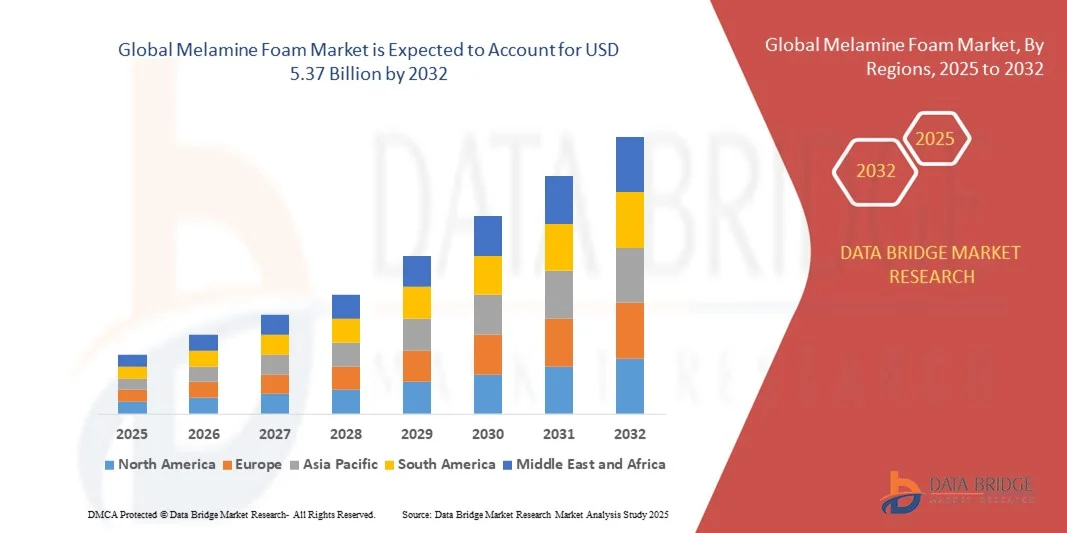
Melamine Foam Market Size
- The global melamine foam market size was valued at USD 1.68 billion in 2024 and is expected to reach USD 5.37 billion by 2032, at a CAGR of 15.60% during the forecast period
- The market growth is largely fuelled by the increasing demand for lightweight, sound-absorbing, and thermally insulating materials across various industries such as construction, automotive, and transportation
- The rising focus on energy efficiency and sustainability, along with growing adoption of eco-friendly foam materials for noise and thermal insulation applications, is driving market expansion
Melamine Foam Market Analysis
- The melamine foam market is witnessing robust growth due to its superior properties such as high temperature resistance, low density, and excellent flame retardancy, which make it ideal for a wide range of applications
- Increasing use in soundproofing, cleaning products, and industrial insulation solutions is boosting its market adoption
- North America dominated the melamine foam market with the largest revenue share of 38.74% in 2024, driven by growing demand for high-performance acoustic and thermal insulation materials across the construction, transportation, and industrial sectors
- Asia-Pacific region is expected to witness the highest growth rate in the global melamine foam market, driven by industrial expansion, government initiatives promoting energy efficiency, and increasing demand from emerging economies such as China, Japan, and India
- The Ordinary Melamine Sponge segment held the largest market revenue share in 2024, driven by its widespread use in household cleaning and commercial maintenance applications. Its cost-effectiveness, high cleaning efficiency, and ability to remove stains without chemical cleaners make it a preferred option among consumers and janitorial service providers
Report Scope and Melamine Foam Market Segmentation
|
Attributes |
Melamine Foam Key Market Insights |
|
Segments Covered |
|
|
Countries Covered |
North America
Europe
Asia-Pacific
Middle East and Africa
South America
|
|
Key Market Players |
• SINOYQX (China) |
|
Market Opportunities |
|
|
Value Added Data Infosets |
In addition to the insights on market scenarios such as market value, growth rate, segmentation, geographical coverage, and major players, the market reports curated by the Data Bridge Market Research also include import export analysis, production capacity overview, production consumption analysis, price trend analysis, climate change scenario, supply chain analysis, value chain analysis, raw material/consumables overview, vendor selection criteria, PESTLE Analysis, Porter Analysis, and regulatory framework. |
Melamine Foam Market Trends
Rising Demand For Sustainable And High-Performance Foam Solutions
- The growing focus on sustainability and eco-friendly materials is transforming the melamine foam market. Manufacturers are increasingly adopting greener production technologies to reduce carbon emissions and environmental impact while maintaining performance efficiency. Melamine foam, being lightweight, flame-resistant, and non-toxic, aligns with global sustainability standards, making it a preferred alternative to traditional foam materials in construction and industrial insulation. Its long service life and reusability make it a valuable component in circular economy initiatives
- The trend is further supported by stringent environmental regulations in key markets such as Europe and North America, where energy-efficient and recyclable materials are prioritized. Melamine foam’s ability to meet LEED certification standards and its recyclability potential have increased its demand across infrastructure and automotive sectors. In addition, rising corporate commitments toward carbon neutrality are encouraging industries to adopt sustainable insulation materials such as melamine foam
- The rising adoption of melamine foam in the packaging, aerospace, and electronics industries is also propelling market growth, as companies seek materials that combine safety, performance, and sustainability. Its versatility allows for innovative applications across sectors requiring lightweight yet durable insulation materials. Moreover, its open-cell structure and resistance to high temperatures make it ideal for complex industrial applications such as soundproofing and vibration damping
- For instance, in 2023, multiple European construction companies adopted melamine foam-based insulation systems to meet new green building energy efficiency codes, significantly reducing heat loss and overall energy consumption. This shift reflects the growing role of melamine foam in sustainable architecture and energy conservation efforts. Such trends are expected to further boost its adoption in emerging economies as sustainability standards tighten globally
- While demand for eco-friendly foam continues to rise, further market expansion depends on cost optimization, innovation in manufacturing processes, and consistent supply of raw materials to support large-scale production. Collaboration between chemical manufacturers and construction firms will be vital to streamline production efficiency and expand the reach of melamine foam-based solutions worldwide
Melamine Foam Market Dynamics
Driver
Expanding Applications In Automotive, Construction, And Transportation Industries
- The increasing use of melamine foam in the automotive and construction industries is a major driver for market growth. In the automotive sector, its superior sound absorption and thermal insulation properties make it ideal for use in vehicle interiors, engine compartments, and headliners. In construction, it is used in wall panels, ceiling tiles, and acoustic insulation to improve energy efficiency and comfort. The ability of melamine foam to meet fire safety standards without additional additives further enhances its appeal across end-use industries
- The transportation industry, including aviation and rail, is also a key consumer of melamine foam due to its lightweight and flame-retardant properties, which help reduce energy consumption and enhance passenger safety. The combination of these properties has made melamine foam a standard material for noise and thermal management. Its high dimensional stability and chemical resistance make it suitable for long-term use in harsh operating environments
- Global infrastructure development and urbanization are creating new opportunities for melamine foam adoption in building retrofitting and acoustic improvement projects. Governments promoting energy-efficient buildings and sustainable materials are also contributing to rising demand. Moreover, the trend toward electric and hybrid vehicles is expanding the use of lightweight soundproofing materials, boosting melamine foam’s importance in next-generation mobility
- For instance, in 2023, several U.S. and Japanese automakers integrated melamine foam-based insulation materials into vehicle designs to improve cabin comfort and reduce noise levels without adding significant weight. The development of customized foam structures for specific automotive parts further highlights its adaptability and commercial relevance. Such innovations are likely to reinforce its position as a key material in noise and thermal management systems
- While industrial applications continue to expand, sustained investment in R&D and advancements in foam formulation will be essential for meeting specific industry requirements and achieving broader adoption. The integration of smart materials and nanotechnology into foam manufacturing could also open new avenues for enhanced performance and cost efficiency
Restraint/Challenge
High Manufacturing Costs And Raw Material Price Volatility
- The complex manufacturing process of melamine foam and the high cost of melamine resin contribute to elevated production expenses, posing a significant challenge to market competitiveness. These costs are often passed on to consumers, making melamine foam more expensive compared to conventional insulation materials such as polyurethane or polyethylene foam. The need for specialized equipment and energy-intensive curing processes adds to the overall cost burden for producers
- Raw material price fluctuations, particularly in formaldehyde and urea derivatives, further affect profitability and production stability. Manufacturers operating in price-sensitive markets find it challenging to maintain consistent supply and pricing due to dependency on global chemical supply chains. In addition, geopolitical uncertainties and trade restrictions can lead to sudden disruptions in raw material sourcing and pricing volatility
- The energy-intensive production process of melamine foam also raises environmental and cost-related concerns, leading companies to explore alternative synthesis routes and low-emission manufacturing technologies. Limited supplier networks for key raw materials add another layer of risk to market stability. Developing localized supply chains and renewable feedstock alternatives could help mitigate these challenges over time
- For instance, in 2023, supply chain disruptions in Asia led to significant cost spikes in melamine resin, prompting several insulation manufacturers to delay production schedules or increase product prices. This situation highlighted the market’s vulnerability to global supply fluctuations and the urgent need for diversified sourcing strategies. Such volatility directly impacts the pricing structure of downstream industries relying on melamine foam
- Although innovations in raw material recovery and recycling technologies are emerging, achieving scalable, cost-efficient production remains essential for ensuring widespread adoption and maintaining long-term market growth. Strategic collaborations and investments in advanced material science could play a critical role in reducing production costs while enhancing foam performance and sustainability
Melamine Foam Market Scope
The market is segmented on the basis of product type, type, and application.
- By Product Type
On the basis of product type, the melamine foam market is segmented into Ordinary Melamine Sponge, Compressed Melamine Sponge, Melamine Sponge with Other Materials, and Melamine Foam Floor Cleaning Pads. The Ordinary Melamine Sponge segment held the largest market revenue share in 2024, driven by its widespread use in household cleaning and commercial maintenance applications. Its cost-effectiveness, high cleaning efficiency, and ability to remove stains without chemical cleaners make it a preferred option among consumers and janitorial service providers.
The Melamine Sponge with Other Materials segment is expected to witness the fastest growth rate from 2025 to 2032, driven by its enhanced durability, improved texture, and compatibility with industrial-grade cleaning applications. The combination of melamine with reinforcing materials such as polyurethane and cellulose extends the lifespan of the sponge while maintaining its superior cleaning performance, making it suitable for both residential and commercial use.
- By Type
On the basis of type, the melamine foam market is segmented into Rigid Melamine Foam, Flexible Melamine Foam, and Semi-Rigid Melamine Foam. The Flexible Melamine Foam segment accounted for the largest share in 2024, attributed to its extensive usage in acoustic insulation, soundproofing, and automotive interiors. Its lightweight, open-cell structure, and excellent thermal resistance make it a popular choice in multiple end-use industries focused on noise and energy management.
The Rigid Melamine Foam segment is expected to witness the fastest growth rate from 2025 to 2032, supported by increasing adoption in construction and transportation applications. Its superior structural strength, fire resistance, and thermal insulation capabilities make it ideal for building insulation panels, aerospace interiors, and marine applications. Growing emphasis on energy-efficient infrastructure and safety standards is expected to further fuel this segment’s demand.
- By Application
On the basis of application, the melamine foam market is segmented into Household Application and Industrial Application. The Industrial Application segment dominated the market in 2024, driven by the increasing use of melamine foam in automotive, construction, and aerospace industries. Its excellent sound absorption, fire retardancy, and lightweight characteristics make it an essential material for high-performance insulation and noise reduction systems.
The Household Application segment i is expected to witness the fastest growth rate from 2025 to 2032 due to rising demand for efficient, eco-friendly cleaning materials. Melamine foam’s unique microstructure enables deep cleaning without chemicals, making it highly desirable for everyday use in kitchens, bathrooms, and general household maintenance. The growing trend of sustainable and reusable cleaning products is further supporting its adoption in the consumer segment.
Melamine Foam Market Regional Analysis
- North America dominated the melamine foam market with the largest revenue share of 38.74% in 2024, driven by growing demand for high-performance acoustic and thermal insulation materials across the construction, transportation, and industrial sectors
- The region’s strong emphasis on energy-efficient infrastructure and sustainable materials is boosting melamine foam adoption in insulation, soundproofing, and safety applications
- Furthermore, the widespread integration of melamine foam in automotive and aerospace manufacturing, supported by stringent fire safety and environmental regulations, continues to strengthen its regional market position
U.S. Melamine Foam Market Insight
The U.S. melamine foam market held the largest revenue share in 2024 within North America, propelled by rising demand for lightweight, non-toxic, and flame-retardant insulation materials across industries. The country’s focus on sustainable building materials and acoustic management solutions has driven adoption in both residential and commercial construction. Moreover, the expanding use of melamine foam in the automotive, aerospace, and electronics sectors, combined with advancements in material innovation and manufacturing efficiency, is significantly contributing to market growth.
Europe Melamine Foam Market Insight
The Europe melamine foam market is expected to witness steady growth from 2025 to 2032, primarily driven by stringent environmental regulations and strong demand for eco-friendly insulation materials. The region’s commitment to achieving net-zero emissions and the adoption of sustainable construction standards, such as BREEAM and LEED certifications, are promoting melamine foam use in commercial and residential projects. In addition, European manufacturers are focusing on advanced processing techniques and recyclable foam variants to align with circular economy principles.
U.K. Melamine Foam Market Insight
The U.K. melamine foam market is expected to witness robust growth from 2025 to 2032, driven by increasing adoption in the building and transportation industries. The nation’s focus on energy-efficient retrofitting projects and compliance with stringent fire safety standards has accelerated the use of melamine foam insulation materials. Moreover, the growing preference for sustainable construction solutions and the integration of high-performance foams into green building projects are expected to further boost market expansion.
Germany Melamine Foam Market Insight
The Germany melamine foam market is expected to witness strong growth from 2025 to 2032, supported by technological innovation and a focus on sustainability. Germany’s thriving automotive and industrial manufacturing sectors are key contributors to melamine foam demand, given its superior sound absorption and thermal resistance properties. In addition, the increasing use of melamine foam in eco-friendly building materials, combined with advancements in production efficiency, is enhancing its adoption across both domestic and export markets.
Asia-Pacific Melamine Foam Market Insight
The Asia-Pacific melamine foam market is expected to witness the fastest growth rate from 2025 to 2032, driven by rapid urbanization, infrastructure development, and rising awareness of energy-efficient insulation materials. Countries such as China, Japan, and India are witnessing increased use of melamine foam in construction, transportation, and industrial applications. Moreover, the expansion of domestic foam manufacturing capacity, government initiatives promoting sustainable materials, and the growth of the automotive sector are contributing to the region’s rapid market expansion.
Japan Melamine Foam Market Insight
The Japan melamine foam market is expected to witness significant growth from 2025 to 2032, supported by the country’s strong focus on innovation, energy conservation, and urban development. Melamine foam is increasingly used in noise reduction panels, rail transport interiors, and eco-friendly building materials due to its lightweight and fire-resistant characteristics. In addition, Japan’s advancements in nanotechnology and smart materials are fostering the development of improved foam variants for industrial and consumer applications.
China Melamine Foam Market Insight
The China melamine foam market accounted for the largest revenue share in Asia-Pacific in 2024, attributed to its robust manufacturing ecosystem, expanding construction sector, and rising adoption of sustainable materials. The country’s growing emphasis on energy-efficient buildings and rapid industrialization have positioned melamine foam as a preferred insulation and soundproofing solution. Furthermore, the presence of leading domestic manufacturers and continuous government support for eco-friendly materials are expected to drive long-term market growth in China.
Melamine Foam Market Share
The Melamine Foam industry is primarily led by well-established companies, including:
• SINOYQX (China)
• Zhengzhou FoamTech Nano Material Co., Ltd (China)
• MNM Composites (India)
• BASF SE (Germany)
• Ecotone Systems Pvt. Ltd. (India)
• Rong Yulong Technology (China)
• Mitsui Chemicals, Inc. (Japan)
• Nissan Chemical Corporation (Japan)
• CMS Danskin (U.K.)
• Cornerstone (U.S.)
• Linyi Yingke Chemistry (China)
• Wilhams Insulation (U.K.)
• YOYBUY Ltd. (China)
• Puyang Enworld New Material Co., Ltd (China)
• Queen City Manufacturing (U.S.)
• Gujarat State Fertilizers & Chemicals Limited (India)
• Acoustafoam (U.K.)
• Borealis AG (Austria)
• Reilly Foam Corporation (U.S.)
• Clark Foam (U.S.)
Latest Developments in Global Melamine Foam Market
- In August 2021, Nissan Chemical Corporation announced its strategic decision to discontinue the production of melamine foam as part of a business realignment initiative. The development focuses on optimizing resource allocation toward high value-added and high market share products to enhance operational efficiency and profitability. By redirecting investments into more lucrative chemical segments, the company aims to strengthen its market position and improve overall financial performance. This move is expected to streamline production, reduce operational costs, and drive innovation in core business areas, positively influencing competitiveness within the global chemical market

- Interactive Data Analysis Dashboard
- Company Analysis Dashboard for high growth potential opportunities
- Research Analyst Access for customization & queries
- Competitor Analysis with Interactive dashboard
- Latest News, Updates & Trend analysis
- Harness the Power of Benchmark Analysis for Comprehensive Competitor Tracking
Global Melamine Foam Market, Supply Chain Analysis and Ecosystem Framework
To support market growth and help clients navigate the impact of geopolitical shifts, DBMR has integrated in-depth supply chain analysis into its Global Melamine Foam Market research reports. This addition empowers clients to respond effectively to global changes affecting their industries. The supply chain analysis section includes detailed insights such as Global Melamine Foam Market consumption and production by country, price trend analysis, the impact of tariffs and geopolitical developments, and import and export trends by country and HSN code. It also highlights major suppliers with data on production capacity and company profiles, as well as key importers and exporters. In addition to research, DBMR offers specialized supply chain consulting services backed by over a decade of experience, providing solutions like supplier discovery, supplier risk assessment, price trend analysis, impact evaluation of inflation and trade route changes, and comprehensive market trend analysis.
Data collection and base year analysis are done using data collection modules with large sample sizes. The stage includes obtaining market information or related data through various sources and strategies. It includes examining and planning all the data acquired from the past in advance. It likewise envelops the examination of information inconsistencies seen across different information sources. The market data is analysed and estimated using market statistical and coherent models. Also, market share analysis and key trend analysis are the major success factors in the market report. To know more, please request an analyst call or drop down your inquiry.
The key research methodology used by DBMR research team is data triangulation which involves data mining, analysis of the impact of data variables on the market and primary (industry expert) validation. Data models include Vendor Positioning Grid, Market Time Line Analysis, Market Overview and Guide, Company Positioning Grid, Patent Analysis, Pricing Analysis, Company Market Share Analysis, Standards of Measurement, Global versus Regional and Vendor Share Analysis. To know more about the research methodology, drop in an inquiry to speak to our industry experts.
Data Bridge Market Research is a leader in advanced formative research. We take pride in servicing our existing and new customers with data and analysis that match and suits their goal. The report can be customized to include price trend analysis of target brands understanding the market for additional countries (ask for the list of countries), clinical trial results data, literature review, refurbished market and product base analysis. Market analysis of target competitors can be analyzed from technology-based analysis to market portfolio strategies. We can add as many competitors that you require data about in the format and data style you are looking for. Our team of analysts can also provide you data in crude raw excel files pivot tables (Fact book) or can assist you in creating presentations from the data sets available in the report.













