


What is the Membrane Separation Technology Market Size and Overview?
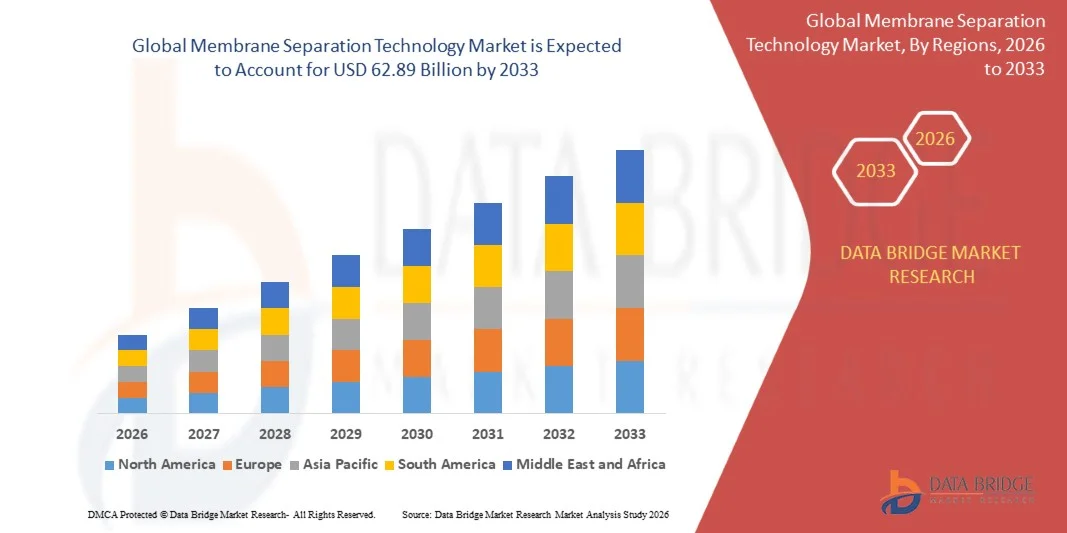
As per Data Bridge Market Research analysis, the global membrane separation technology market was valued at USD 34.49 billion in 2025 and is projected to reach USD 62.89 billion by 2033, growing at a CAGR of 7.80% from 2026 to 2033. The market is experiencing strong growth driven by increasing demand for advanced water and wastewater treatment solutions, rising industrial separation needs, and expanding applications across pharmaceuticals, food and beverage, and chemical processing industries. Growing emphasis on sustainable and energy-efficient separation processes is further accelerating adoption across both developed and emerging economies.
The rising global water scarcity crisis, combined with stringent environmental regulations on industrial effluents and discharge standards, is compelling municipalities and industries to adopt membrane-based filtration and purification systems. Technologies such as reverse osmosis, ultrafiltration, nanofiltration, and microfiltration are increasingly replacing conventional separation methods due to their higher efficiency, lower chemical usage, and ability to deliver high-purity output across critical applications.
Market Size & Forecast
- Global Market Value (2025): USD 34.49 Billion
- Expected Market Value (2033): USD 62.89 Billion
- Forecast CAGR (2026–2033): 7.80%
- Leading Region in 2025: North America
- Fastest Growing Region: Asia-Pacific
Key Market Trends & Insights
- North America dominated the membrane separation technology market with the largest revenue share of in 2025, supported by stringent environmental regulations, rising investments in water reuse infrastructure, and strong adoption across industrial and municipal water treatment facilities.
- Asia-Pacific is expected to be the fastest-growing region, recording a CAGR of from 2026 to 2033. Growth is driven by rapid industrialization, urban population growth, and increasing water scarcity challenges. Countries such as China, India, and Japan are investing heavily in desalination and wastewater treatment infrastructure to support industrial and municipal demand.
- The Polymeric Membranes segment held the largest market revenue share of approximately 71.6% in 2025 driven by their cost-effectiveness, ease of fabrication, and wide applicability across water treatment, food processing, and industrial separation systems. These membranes are extensively used due to their flexibility, high permeability, and compatibility with large-scale municipal and industrial operations.
- The Non-Polymeric Membranes segment is projected to register the fastest growth at a CAGR of 9.4% from 2026 to 2033, driven by increasing demand for high-temperature, high-pressure, and chemically resistant applications. Rising adoption in pharmaceuticals, petrochemical processing, and advanced industrial gas separation is accelerating segment expansion, particularly where long operational life and high selectivity are required.
- The Reverse Osmosis segment held the largest market revenue share of approximately 38.9% in 2025 driven by its extensive use in desalination, municipal water purification, and industrial wastewater treatment. RO systems are widely adopted due to their ability to remove dissolved salts, heavy metals, and contaminants with high efficiency in large-scale operations.
- The Ultrafiltration segment is projected to register the fastest growth at a CAGR of 8.6% from 2026 to 2033, driven by increasing adoption in biopharmaceutical processing, dairy filtration, and high-purity water production. Growing demand for membrane-based clarification in food and beverage industries and rising bioprocessing applications are further strengthening segment expansion.
- The Water and Wastewater Treatment segment held the largest market revenue share of approximately 44.3% in 2025 driven by increasing global water scarcity, strict environmental regulations, and rising investments in municipal water infrastructure. Membrane systems are widely deployed for desalination, reuse, and industrial effluent treatment across both developed and emerging economies.
- The Medical and Pharmaceutical segment is projected to register the fastest growth at a CAGR of 10.2% from 2026 to 2033, driven by rising demand for high-purity filtration in drug manufacturing, vaccine production, and biotechnology applications. Increasing focus on contamination-free processing and stringent quality standards is accelerating adoption of advanced membrane technologies in healthcare and life sciences industries.
Report Scope and Membrane Separation Technology Market Segmentation
|
Attributes |
Membrane Separation Technology Key Market Insights |
|
Segments Covered |
|
|
Countries Covered |
North America
Europe
Asia-Pacific
Middle East and Africa
South America
|
|
Key Market Players |
|
|
Market Opportunities |
|
|
Value Added Data Infosets |
In addition to the insights on market scenarios such as market value, growth rate, segmentation, geographical coverage, and major players, the market reports curated by the Data Bridge Market Research also include import export analysis, production capacity overview, production consumption analysis, price trend analysis, climate change scenario, supply chain analysis, value chain analysis, raw material/consumables overview, vendor selection criteria, PESTLE Analysis, Porter Analysis, and regulatory framework. |
What is the Key Trend in the Global Membrane Separation Technology Market?
Trend: Growth In Energy-Efficient Filtration And Advanced Separation For Water Scarcity And Industrial Purification
Increasing demand for high-performance, energy-efficient, and low-waste separation technologies across water treatment, pharmaceuticals, food processing, and chemical industries. Conventional separation methods such as thermal distillation and chemical-intensive filtration consume higher energy and generate secondary waste, encouraging industries to adopt membrane-based solutions with lower environmental impact and improved selectivity.
In municipal water treatment systems, membrane technologies are being widely deployed for desalination and wastewater reuse, such as reverse osmosis plants in regions like the Middle East and India where freshwater demand is rising rapidly. For instance, large-scale desalination facilities in Saudi Arabia and the U.A.E. increasingly rely on membrane systems to support urban water supply and industrial reuse requirements.
In industrial applications, membrane separation is being used for gas separation, protein purification, and solvent recovery, improving process efficiency and reducing operational losses. The food and beverage sector is also integrating membrane filtration for dairy processing and juice clarification to maintain product quality while minimizing thermal degradation.
The expansion of biopharmaceutical manufacturing and precision medicine is further accelerating demand for ultra-filtration and nano-filtration systems capable of high-purity separation. In addition, industrial wastewater recycling mandates in countries such as China and the European Union are driving large-scale deployment of membrane-based systems, with pilot projects in 2024 reporting water recovery efficiencies exceeding 85–90% in advanced treatment facilities.
Growing validation of hybrid membrane systems combining polymeric and ceramic materials is improving fouling resistance and operational lifespan, enabling adoption in high-contamination environments such as mining, petrochemicals, and semiconductor manufacturing.
Global Membrane Separation Technology Market Dynamics
Key Market Driver: Rising Demand For Water Recycling And Industrial Wastewater Treatment
Industries worldwide are under increasing pressure from regulatory frameworks and sustainability goals to reduce freshwater consumption and improve wastewater reuse efficiency. Rapid urbanization and industrial expansion are intensifying water stress in major economies, creating strong demand for membrane-based purification technologies capable of high recovery rates and consistent output quality.
Municipal authorities and industrial operators are increasingly investing in reverse osmosis and nanofiltration systems to support circular water management strategies. For instance, large industrial zones in China and Singapore have integrated membrane-based recycling systems to reduce freshwater dependency and support sustainable manufacturing clusters.
Similarly, the pharmaceutical and food processing industries are adopting membrane separation to ensure contamination-free production while meeting stringent quality standards. Industrial benchmarking studies indicate that advanced membrane systems can achieve water recovery efficiencies of up to 90–95% in optimized configurations, significantly improving resource utilization compared to conventional treatment methods.
Key Restraint/Challenge: Membrane Fouling And High Operational Costs
Despite strong adoption, membrane separation technologies face performance limitations due to fouling, scaling, and clogging caused by organic and inorganic contaminants. These issues reduce membrane efficiency over time and increase maintenance frequency, limiting long-term operational stability in heavily polluted feed streams.
In addition, high installation costs, periodic replacement requirements, and energy consumption for pressure-driven systems create affordability challenges for small and medium-scale industries. The need for pretreatment systems further increases overall capital expenditure, restricting adoption in price-sensitive markets.
Commercial performance evaluations indicate that membrane fouling can reduce system efficiency by 15–30% over continuous operation cycles, requiring chemical cleaning or membrane replacement to restore performance levels. This increases lifecycle costs and remains a key barrier for large-scale deployment in developing economies.
Key Market Opportunity: Expansion In Pharmaceutical, Biotechnology, And Advanced Industrial Processing
The increasing demand for high-purity separation in pharmaceutical production, biotechnology research, and specialty chemical manufacturing is creating strong growth opportunities for membrane separation technologies. Modern drug development and biologics production require ultra-clean separation processes that traditional filtration systems cannot efficiently achieve.
Pharmaceutical manufacturers are increasingly deploying ultrafiltration and microfiltration systems for vaccine production, protein purification, and sterile filtration processes. In biotechnology applications, membrane systems are being used for cell harvesting and fermentation processing to improve yield efficiency and product consistency.
In addition, advancements in nanocomposite and ceramic membrane materials are enabling higher thermal and chemical resistance, expanding applications into harsh industrial environments such as oil and gas refining and wastewater recycling in heavy industries. Pilot-scale deployments in 2025 across Europe and North America have demonstrated significant improvements in separation accuracy and operational stability, supporting broader commercialization across next-generation industrial processing systems.
How is the Global Membrane Separation Technology Market Segmented?
The market is segmented on the basis of model, type, functionality, offering, and end-use application.
• By Type Of Material
On the basis of type of material, the membrane separation technology market is segmented into Polymeric Membranes and Non-Polymeric Membranes. The Polymeric Membranes segment held the largest market revenue share of approximately 71.6% in 2025 driven by their cost-effectiveness, ease of fabrication, and wide applicability across water treatment, food processing, and industrial separation systems. These membranes are extensively used due to their flexibility, high permeability, and compatibility with large-scale municipal and industrial operations.
The Non-Polymeric Membranes segment is projected to register the fastest growth at a CAGR of 9.4% from 2026 to 2033, driven by increasing demand for high-temperature, high-pressure, and chemically resistant applications. Rising adoption in pharmaceuticals, petrochemical processing, and advanced industrial gas separation is accelerating segment expansion, particularly where long operational life and high selectivity are required.
• By Process
On the basis of process, the market is segmented into Microfiltration, Ultrafiltration, Nanofiltration, Reverse Osmosis, and Others. The Reverse Osmosis segment held the largest market revenue share of approximately 38.9% in 2025 driven by its extensive use in desalination, municipal water purification, and industrial wastewater treatment. RO systems are widely adopted due to their ability to remove dissolved salts, heavy metals, and contaminants with high efficiency in large-scale operations.
The Ultrafiltration segment is projected to register the fastest growth at a CAGR of 8.6% from 2026 to 2033, driven by increasing adoption in biopharmaceutical processing, dairy filtration, and high-purity water production. Growing demand for membrane-based clarification in food and beverage industries and rising bioprocessing applications are further strengthening segment expansion.
• By Application
On the basis of application, the market is segmented into Water and Wastewater Treatment, Food And Beverage, Medical And Pharmaceutical, Industry Processing, Industrial Gas Processing, and Others. The Water and Wastewater Treatment segment held the largest market revenue share of approximately 44.3% in 2025 driven by increasing global water scarcity, strict environmental regulations, and rising investments in municipal water infrastructure. Membrane systems are widely deployed for desalination, reuse, and industrial effluent treatment across both developed and emerging economies.
The Medical and Pharmaceutical segment is projected to register the fastest growth at a CAGR of 10.2% from 2026 to 2033, driven by rising demand for high-purity filtration in drug manufacturing, vaccine production, and biotechnology applications. Increasing focus on contamination-free processing and stringent quality standards is accelerating adoption of advanced membrane technologies in healthcare and life sciences industries.
Which Region Holds the Largest Share of the Global Membrane Separation Technology Market?
- North America dominated the membrane separation technology market with the largest revenue share of 39.8% in 2025, driven by stringent environmental regulations, rising investments in water reuse infrastructure, and strong adoption across industrial and municipal water treatment facilities
- Consumers and industries in the region highly value high-efficiency separation systems, advanced filtration performance, and integration with large-scale desalination and wastewater recycling plants
- This widespread adoption is further supported by strong regulatory frameworks from environmental agencies, high industrial water demand, and rapid technological advancements in membrane materials, establishing membrane systems as a critical solution for sustainable water management and industrial processing
U.S. Membrane Separation Technology Market Insight
The U.S. membrane separation technology market captured the largest revenue share in 2025 within North America, fueled by rising investments in water recycling infrastructure and growing adoption across pharmaceutical, food processing, and industrial wastewater treatment sectors. Utilities and industries are increasingly deploying reverse osmosis and ultrafiltration systems to meet strict discharge standards and improve water reuse efficiency. In addition, increasing concerns over water scarcity in states such as California and Texas are accelerating large-scale desalination and reuse projects. The integration of advanced membrane systems in biopharmaceutical manufacturing and semiconductor fabrication is further strengthening market expansion across high-purity applications.
Europe Membrane Separation Technology Market Insight
The Europe membrane separation technology market is expected to witness the fastest growth rate from 2026 to 2033, primarily driven by strict environmental regulations, circular economy initiatives, and rising demand for sustainable industrial processing. The region is experiencing strong adoption across wastewater recycling, food and beverage processing, and pharmaceutical manufacturing. Countries such as Germany, France, and the Netherlands are heavily investing in advanced filtration systems to reduce industrial discharge and improve water reuse efficiency. Increasing emphasis on carbon neutrality and resource optimization is further supporting the deployment of energy-efficient membrane systems.
U.K. Membrane Separation Technology Market Insight
The U.K. membrane separation technology market is expected to witness steady growth from 2026 to 2033, driven by rising water stress concerns, modernization of water utilities, and expanding pharmaceutical production. Water companies are increasingly adopting membrane-based desalination and filtration systems to improve drinking water quality and reduce dependency on traditional treatment methods. The growing focus on sustainable industrial operations and stricter environmental compliance is further encouraging adoption across food processing and chemical industries.
Germany Membrane Separation Technology Market Insight
The Germany membrane separation technology market is expected to witness strong growth from 2026 to 2033, fueled by advanced industrial infrastructure, high environmental standards, and increasing investment in water recycling technologies. German industries are actively deploying membrane systems in chemical processing, pharmaceuticals, and wastewater treatment applications. The country’s focus on energy-efficient and sustainable manufacturing practices is accelerating the adoption of advanced nanofiltration and ultrafiltration systems.
Asia-Pacific Membrane Separation Technology Market Insight
The Asia-Pacific membrane separation technology market is expected to witness the fastest growth rate from 2026 to 2033, driven by rapid industrialization, urban population growth, and increasing water scarcity challenges. Countries such as China, India, and Japan are investing heavily in desalination and wastewater treatment infrastructure to support industrial and municipal demand. Expanding food processing and pharmaceutical manufacturing industries are also contributing to rising adoption of membrane-based filtration technologies across the region.
Japan Membrane Separation Technology Market Insight
The Japan membrane separation technology market is expected to witness steady growth from 2026 to 2033 due to strong technological adoption, limited freshwater resources, and high demand for precision filtration systems. The country is increasingly using membrane technologies in semiconductor manufacturing, beverage processing, and wastewater recycling. Advanced research in membrane materials and high-efficiency separation systems is further supporting market development in industrial and municipal applications.
China Membrane Separation Technology Market Insight
The China membrane separation technology market accounted for the largest market revenue share in Asia-Pacific in 2025, attributed to rapid industrial expansion, large-scale urban water treatment projects, and strong government initiatives promoting water reuse and pollution control. China is extensively deploying membrane systems in desalination plants, industrial wastewater treatment facilities, and food processing industries. Growing investment in smart water infrastructure and environmental sustainability projects continues to drive large-scale adoption across the country.
Which are the Top Companies in the Global Membrane Separation Technology Market?
The Membrane Separation Technology industry is primarily led by well-established companies, including:
• Merck KGaA (Germany)
• DuPont (U.S.)
• TORAY INDUSTRIES, INC. (Japan)
• NITTO DENKO CORPORATION (Japan)
• Pentair (U.S.)
• Koch Separation Solutions (U.S.)
• Asahi Kasei Corporation (Japan)
• SUEZ (France)
• Koch Membrane Systems, Inc. (U.S.)
• General Electric (U.S.)
• Danaher (U.S.)
• NX Filtration BV (Netherlands)
• AXEON Water Technologies (U.S.)
• GEA Group Aktiengesellschaft (Germany)
• Corning Incorporated (U.S.)
• APPLIED MEMBRANES, INC. (U.S.)
• Culligan (U.S.)
• Pall Corporation (U.S.)
• LANXESS (Germany)
• 3M (U.S.)
• Other Companies (Various)
What are Latest Developments in the Global Membrane Separation Technology Market?
- In January 2026, Toray Industries, Inc. introduced a high-efficiency separation membrane module designed to enhance biopharmaceutical manufacturing processes by improving filtration precision and operational stability. The development focuses on increasing facility utilization rates and boosting overall production yields through advanced membrane performance. It also helps reduce energy consumption and process downtime in large-scale bioprocessing systems. This innovation is expected to lower production costs for manufacturers while improving product consistency and scalability, thereby strengthening adoption of advanced membrane technologies in the biopharma sector
- In March 2025, Memsift Innovations and Murugappa Group launched GOSEP ultrafiltration membranes as part of a strategic product development initiative targeting water treatment and industrial filtration applications. These membranes are designed to improve contaminant removal efficiency while ensuring higher throughput in purification systems. The solution supports sustainable water management practices by reducing chemical usage and operational waste. It also enhances industrial wastewater treatment performance, which is expected to drive adoption across municipal and industrial sectors, supporting market growth for eco-friendly filtration technologies
- In January 2025, Arkema and OOYOO LTD. entered into a memorandum of understanding (MOU) to jointly develop advanced gas separation membrane technology. The collaboration aims to integrate Arkema’s material science expertise with OOYOO’s membrane innovation capabilities to enhance gas separation efficiency. The development is expected to improve energy efficiency and selectivity in industrial gas processing applications. It also focuses on enabling more cost-effective and scalable separation solutions, which is likely to accelerate commercialization of next-generation membrane technologies across oil & gas, chemical, and industrial gas markets

- Interactive Data Analysis Dashboard
- Company Analysis Dashboard for high growth potential opportunities
- Research Analyst Access for customization & queries
- Competitor Analysis with Interactive dashboard
- Latest News, Updates & Trend analysis
- Harness the Power of Benchmark Analysis for Comprehensive Competitor Tracking
Global Membrane Separation Technology Market, Supply Chain Analysis and Ecosystem Framework
To support market growth and help clients navigate the impact of geopolitical shifts, DBMR has integrated in-depth supply chain analysis into its Global Membrane Separation Technology Market research reports. This addition empowers clients to respond effectively to global changes affecting their industries. The supply chain analysis section includes detailed insights such as Global Membrane Separation Technology Market consumption and production by country, price trend analysis, the impact of tariffs and geopolitical developments, and import and export trends by country and HSN code. It also highlights major suppliers with data on production capacity and company profiles, as well as key importers and exporters. In addition to research, DBMR offers specialized supply chain consulting services backed by over a decade of experience, providing solutions like supplier discovery, supplier risk assessment, price trend analysis, impact evaluation of inflation and trade route changes, and comprehensive market trend analysis.
Data collection and base year analysis are done using data collection modules with large sample sizes. The stage includes obtaining market information or related data through various sources and strategies. It includes examining and planning all the data acquired from the past in advance. It likewise envelops the examination of information inconsistencies seen across different information sources. The market data is analysed and estimated using market statistical and coherent models. Also, market share analysis and key trend analysis are the major success factors in the market report. To know more, please request an analyst call or drop down your inquiry.
The key research methodology used by DBMR research team is data triangulation which involves data mining, analysis of the impact of data variables on the market and primary (industry expert) validation. Data models include Vendor Positioning Grid, Market Time Line Analysis, Market Overview and Guide, Company Positioning Grid, Patent Analysis, Pricing Analysis, Company Market Share Analysis, Standards of Measurement, Global versus Regional and Vendor Share Analysis. To know more about the research methodology, drop in an inquiry to speak to our industry experts.
Data Bridge Market Research is a leader in advanced formative research. We take pride in servicing our existing and new customers with data and analysis that match and suits their goal. The report can be customized to include price trend analysis of target brands understanding the market for additional countries (ask for the list of countries), clinical trial results data, literature review, refurbished market and product base analysis. Market analysis of target competitors can be analyzed from technology-based analysis to market portfolio strategies. We can add as many competitors that you require data about in the format and data style you are looking for. Our team of analysts can also provide you data in crude raw excel files pivot tables (Fact book) or can assist you in creating presentations from the data sets available in the report.













