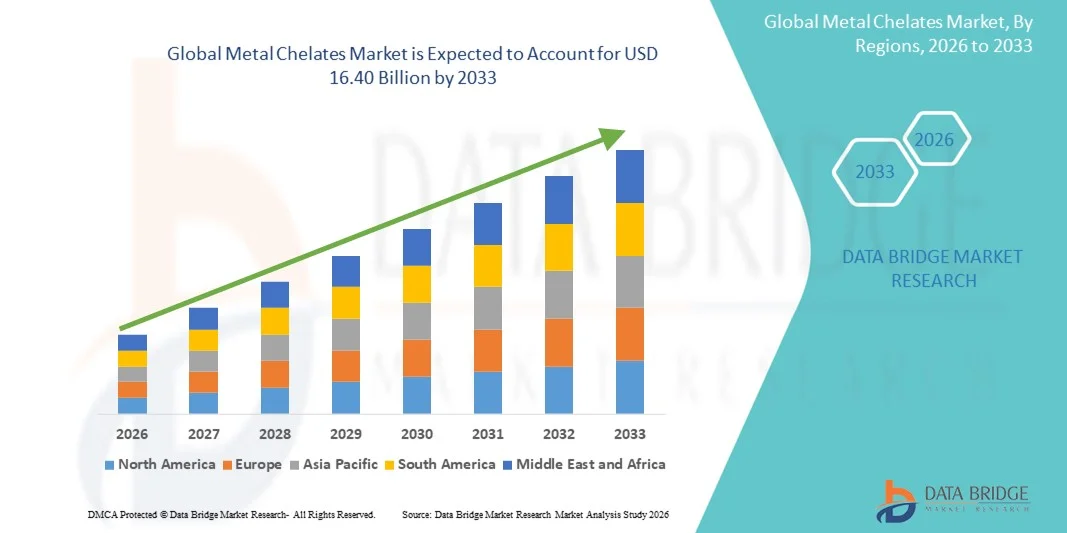
Metal Chelates Market Size
- The global metal chelates market size was valued at USD 6.50 billion in 2025 and is expected to reach USD 16.40 billion by 2033, at a CAGR of 12.27% during the forecast period
- The market growth is largely fuelled by the increasing adoption of micronutrient fertilizers in agriculture to enhance crop yield and quality
- Rising demand for fortified food products and dietary supplements is further supporting the growth of metal chelates in the food and pharmaceutical industries
Metal Chelates Market Analysis
- The market is witnessing significant innovation in chelating agents to improve stability, solubility, and bioavailability of minerals in both agriculture and industrial applications
- Increasing investment by manufacturers in research and development for customized and eco-friendly chelates is enhancing market penetration and application diversity
- North America dominated the metal chelates market with the largest revenue share in 2025, driven by the growing adoption of precision agriculture, advanced farming practices, and increasing awareness about micronutrient deficiencies in crops
- Asia-Pacific region is expected to witness the highest growth rate in the global metal chelates market, driven by rapid agricultural modernization, rising demand for fortified crops, expanding adoption of foliar and soil-applied chelated nutrients, and increasing investment in advanced farming technologies
- The micronutrients segment held the largest market revenue share in 2025, driven by the growing awareness of deficiencies in essential trace elements such as iron, zinc, and manganese, which are critical for improving crop quality and yield. Micronutrient chelates offer enhanced bioavailability and stability, making them highly effective for targeted nutrient management
Report Scope and Metal Chelates Market Segmentation
|
Attributes |
Metal Chelates Key Market Insights |
|
Segments Covered |
|
|
Countries Covered |
North America
Europe
Asia-Pacific
Middle East and Africa
South America
|
|
Key Market Players |
• BASF SE (Germany) |
|
Market Opportunities |
|
|
Value Added Data Infosets |
In addition to the insights on market scenarios such as market value, growth rate, segmentation, geographical coverage, and major players, the market reports curated by the Data Bridge Market Research also include import export analysis, production capacity overview, production consumption analysis, price trend analysis, climate change scenario, supply chain analysis, value chain analysis, raw material/consumables overview, vendor selection criteria, PESTLE Analysis, Porter Analysis, and regulatory framework. |
Metal Chelates Market Trends
Rise of Chelated Micronutrients in Agriculture
- The growing adoption of metal chelates is transforming the agriculture and food industries by enabling improved nutrient absorption and bioavailability. Chelated formulations provide essential micronutrients such as iron, zinc, and manganese in a stable and easily assimilable form, resulting in healthier crops and enhanced yields. This trend is further supported by advancements in formulation technology that improve solubility, shelf life, and compatibility with fertilizers and foliar sprays
- Increasing demand for fortified foods, nutraceuticals, and functional beverages is accelerating the use of chelated minerals. These compounds ensure consistent nutrient delivery, improve product quality, and support compliance with dietary and regulatory standards. Manufacturers are also leveraging chelated minerals to develop innovative products that meet growing consumer expectations for health and wellness
- The versatility and solubility of chelated compounds are making them attractive for both foliar application and soil supplementation, allowing farmers and manufacturers to optimize nutrient management efficiently. Enhanced stability and reduced leaching of nutrients in chelated forms further increase efficiency, reduce waste, and promote environmentally sustainable agriculture
- For instance, in 2023, several large-scale farms in the U.S. and Europe reported improved crop quality and reduced nutrient deficiencies after adopting chelated micronutrients in combination with precision farming techniques. These implementations helped optimize input costs, improve soil health, and increase crop market value
- While chelated micronutrients are boosting market growth, their impact depends on continuous innovation, regulatory compliance, and cost optimization. Manufacturers must focus on product diversification, eco-friendly chelates, and tailored solutions to fully capitalize on growing demand, while also educating farmers about proper usage and integration
Metal Chelates Market Dynamics
Driver
Rising Awareness of Micronutrient Deficiencies and Focus on Sustainable Agriculture
- Increasing awareness of soil nutrient depletion and micronutrient deficiencies is driving farmers to adopt metal chelates as a solution to enhance crop productivity and quality. Essential minerals delivered in chelated form are less prone to precipitation and loss, ensuring effective nutrient uptake. This reduces the risk of crop nutrient imbalances and supports sustainable agricultural practices
- Governments and agricultural agencies are promoting the use of micronutrients to improve food security and crop quality, further encouraging adoption. Supportive policies, subsidies, and farmer training programs are enhancing market penetration and promoting the adoption of efficient nutrient management techniques
- The growing trend of precision farming and integrated nutrient management is further enhancing the preference for chelated minerals, as they allow targeted, efficient, and environmentally sustainable fertilization. Smart farming tools and data-driven nutrient application are increasing operational efficiency and reducing the environmental footprint of agriculture
- For instance, in 2022, several European and North American farms reported increased crop yields and reduced micronutrient deficiencies after integrating chelated fertilizers into their precision agriculture programs. These farms also observed improved soil fertility and long-term productivity benefits, creating a positive feedback loop for continued chelate adoption
- While awareness and regulatory support are driving market growth, continuous education, affordability, and supply chain optimization remain critical to ensure sustained adoption. Companies must invest in distribution networks, technical support, and farmer awareness campaigns to strengthen market presence
Restraint/Challenge
High Cost of Chelated Products and Limited Accessibility in Developing Regions
- The higher price point of chelated fertilizers compared with conventional mineral salts limits adoption, particularly among smallholder farmers in developing regions. High production costs, complex manufacturing processes, and import dependencies contribute to elevated pricing, restricting widespread usage
- In remote areas, limited access to quality products and distribution channels further restricts market penetration, resulting in reliance on traditional fertilizers with lower efficiency. Weak supply chain infrastructure and logistical challenges exacerbate the problem, leaving farmers with fewer options for optimal crop nutrition
- Lack of awareness and technical expertise in using chelated compounds effectively can lead to underutilization, reducing the potential benefits of these products. Farmers may apply incorrect dosages, miss optimal timing, or fail to integrate chelates with other nutrient management practices, limiting yield improvements
- For instance, in 2023, reports from Sub-Saharan Africa and parts of Southeast Asia highlighted that many farmers continued using conventional mineral fertilizers due to higher costs and supply constraints, despite proven benefits of chelated micronutrients. Limited education and availability of extension services hinder adoption of advanced nutrient solutions
- While product innovation continues, addressing affordability, accessibility, and farmer education is essential. Stakeholders must focus on scalable, cost-effective, locally tailored, and environmentally sustainable chelated solutions to unlock long-term market potential and enhance global agricultural productivity
Metal Chelates Market Scope
The market is segmented on the basis of type, mode of application, and crop type.
- By Type
On the basis of type, the metal chelates market is segmented into primary nutrients, secondary nutrients, micronutrients, and other nutrients. The micronutrients segment held the largest market revenue share in 2025, driven by the growing awareness of deficiencies in essential trace elements such as iron, zinc, and manganese, which are critical for improving crop quality and yield. Micronutrient chelates offer enhanced bioavailability and stability, making them highly effective for targeted nutrient management.
The primary nutrients segment is expected to witness the fastest growth rate from 2026 to 2033, driven by increasing adoption of chelated nitrogen, phosphorus, and potassium compounds for soil and foliar supplementation. These chelates improve nutrient absorption efficiency, reduce leaching losses, and support sustainable agricultural practices, making them highly preferred among large-scale and precision farming operations.
- By Mode of Application
On the basis of mode of application, the market is segmented into soil, foliar, and fertigation. The foliar application segment held the largest market share in 2025, due to its ability to deliver nutrients directly to plant leaves, ensuring rapid absorption and immediate correction of deficiencies. Foliar chelates are particularly popular in high-value crops and regions practicing precision agriculture.
The fertigation segment is projected to witness the fastest growth from 2026 to 2033, fueled by the increasing use of irrigation systems for efficient nutrient delivery. Fertigation allows uniform distribution of chelated minerals, reduces wastage, and supports integrated nutrient management, driving adoption among modern farms globally.
- By Crop Type
On the basis of crop type, the market is segmented into cereals and grains, oilseeds and pulses, fruits and vegetables, and other crops. The fruits and vegetables segment accounted for the largest revenue share in 2025, attributed to the high sensitivity of these crops to micronutrient deficiencies and the increasing focus on improving yield and quality for fresh produce markets.
The cereals and grains segment is expected to witness the fastest growth from 2026 to 2033, driven by the rising demand for staple food crops, enhanced crop nutrition programs, and precision agriculture practices that leverage chelated fertilizers for improved nutrient efficiency and soil health.
Metal Chelates Market Regional Analysis
- North America dominated the metal chelates market with the largest revenue share in 2025, driven by the growing adoption of precision agriculture, advanced farming practices, and increasing awareness about micronutrient deficiencies in crops
- Farmers and agribusinesses in the region value the efficiency, improved nutrient uptake, and enhanced crop quality provided by chelated fertilizers, which are compatible with both soil and foliar applications
- High investments in agricultural R&D, government support, and technologically advanced farming systems are further accelerating the adoption of metal chelates across cereals, fruits, vegetables, and oilseed crops
U.S. Metal Chelates Market Insight
The U.S. metal chelates market captured the largest revenue share in 2025 within North America, fueled by the adoption of advanced nutrient management practices and precision farming technologies. Growers are increasingly integrating chelated micronutrients into soil, foliar, and fertigation programs to boost crop productivity and quality. Supportive policies, subsidies for micronutrient application, and growing awareness about crop fortification further strengthen market growth in the country.
Europe Metal Chelates Market Insight
The Europe metal chelates market is expected to witness the fastest growth rate from 2026 to 2033, primarily driven by stringent agricultural quality standards and increasing focus on sustainable farming. Farmers are adopting chelated fertilizers to improve nutrient use efficiency, reduce environmental impact, and meet regulatory requirements. Growth is particularly significant across cereals, fruits, vegetables, and high-value crops, supported by modern farming infrastructure and increasing awareness of soil nutrient management.
U.K. Metal Chelates Market Insight
The U.K. metal chelates market is expected to witness a robust growth rate from 2026 to 2033, driven by the emphasis on precision agriculture, sustainable fertilization practices, and enhanced crop quality. Adoption of soil and foliar chelates is rising due to the demand for improved yield, nutrient-rich produce, and compliance with food safety standards. The country’s strong agricultural research ecosystem and technology adoption are expected to continue stimulating market growth.
Germany Metal Chelates Market Insight
The Germany metal chelates market is projected to grow rapidly from 2026 to 2033, fueled by increasing awareness of soil micronutrient deficiencies and adoption of advanced nutrient management strategies. The use of chelated fertilizers in cereals, oilseeds, and vegetables is becoming more prevalent, supported by government programs promoting sustainable agriculture. Integration with precision farming systems and focus on efficient nutrient delivery further boost market demand.
Asia-Pacific Metal Chelates Market Insight
The Asia-Pacific metal chelates market is expected to witness the highest growth rate from 2026 to 2033, driven by increasing adoption of modern farming practices, rising population, and growing demand for higher crop yields. Countries such as India, China, and Japan are investing in precision agriculture and nutrient management programs. The rising awareness of micronutrient deficiencies and government initiatives promoting fortified crops are propelling the adoption of chelated fertilizers across cereals, fruits, vegetables, and pulses.
Japan Metal Chelates Market Insight
The Japan metal chelates market is expected to witness strong growth from 2026 to 2033, due to high adoption of technologically advanced farming systems and emphasis on crop quality. Farmers are increasingly integrating chelated micronutrients in soil and foliar applications to enhance nutrient uptake and optimize yields. In addition, aging farm populations are favoring easier-to-use, efficient fertilization solutions to maintain productivity.
China Metal Chelates Market Insight
The China metal chelates market accounted for the largest revenue share in Asia-Pacific in 2025, attributed to the rapid modernization of agriculture, growing population, and high focus on crop fortification. Chelated fertilizers are widely adopted for cereals, vegetables, fruits, and oilseeds to improve nutrient availability and crop quality. Government support for micronutrient programs, expansion of precision farming, and the availability of affordable chelated products are key factors propelling the market in China.
Metal Chelates Market Share
The Metal Chelates industry is primarily led by well-established companies, including:
• BASF SE (Germany)
• Akzo Nobel N.V. (Netherlands)
• Syngenta AG (Switzerland)
• Nufarm (Australia)
• Haifa Group (Israel)
• AVA Chemicals Private Limited (India)
• M&M Industries (India)
• Qingyuan Mutual Bio Techniques Co., Ltd. (China)
• Shanghai Joint Hope International Trade Co., Ltd. (China)
• Micromix Plant Health Ltd (U.K.)
• Farmtech Agriland Corp. (U.S.)
• Gujarat State Fertilizer & Chemicals Limited (GSFC) (India)
• Aris Agro Limited (India)
• Valagro SpA (Italy)
• Cheminova A/S (Denmark)
• Van Iperen International (Netherlands)
• PROTEX INTERNATIONAL (U.S.)
• Deretil Agronutritional (Spain)
• Dow (U.S.)
• NIPPON SHOKUBAI CO., LTD (Japan)
• Innospec (U.K.)
• Jungbunzlauer Suisse AG (Switzerland)
• Kemira (Finland)
• ADOB (U.S.)
• Anil Bioplus Limited (India)
• Novus International (U.S.)
Latest Developments in Global Metal Chelates Market
- In January 2023, Nouryon completed the acquisition of ADOB, a prominent supplier of chelated micronutrients, foliar products, and specialty agricultural solutions in Poland. This strategic move allowed Nouryon to broaden its crop nutrition portfolio, enhance its innovative offerings, and strengthen its presence in the European market. The acquisition is expected to improve product availability, support advanced nutrient solutions, and positively impact market growth by catering to a wider customer base
- In March 2022, Haifa Group acquired Horticoop Andina, a wholesaler specializing in agricultural nutritional products in Quito, Ecuador. Through this acquisition, Haifa expanded its operations across Ecuador and the surrounding Latin American markets, consolidating its position as an international leader in advanced plant nutrition. The move enhanced Haifa’s distribution network, increased market penetration, and reinforced its reputation for delivering high-quality crop nutrition solutions

- Interactive Data Analysis Dashboard
- Company Analysis Dashboard for high growth potential opportunities
- Research Analyst Access for customization & queries
- Competitor Analysis with Interactive dashboard
- Latest News, Updates & Trend analysis
- Harness the Power of Benchmark Analysis for Comprehensive Competitor Tracking
Data collection and base year analysis are done using data collection modules with large sample sizes. The stage includes obtaining market information or related data through various sources and strategies. It includes examining and planning all the data acquired from the past in advance. It likewise envelops the examination of information inconsistencies seen across different information sources. The market data is analysed and estimated using market statistical and coherent models. Also, market share analysis and key trend analysis are the major success factors in the market report. To know more, please request an analyst call or drop down your inquiry.
The key research methodology used by DBMR research team is data triangulation which involves data mining, analysis of the impact of data variables on the market and primary (industry expert) validation. Data models include Vendor Positioning Grid, Market Time Line Analysis, Market Overview and Guide, Company Positioning Grid, Patent Analysis, Pricing Analysis, Company Market Share Analysis, Standards of Measurement, Global versus Regional and Vendor Share Analysis. To know more about the research methodology, drop in an inquiry to speak to our industry experts.
Data Bridge Market Research is a leader in advanced formative research. We take pride in servicing our existing and new customers with data and analysis that match and suits their goal. The report can be customized to include price trend analysis of target brands understanding the market for additional countries (ask for the list of countries), clinical trial results data, literature review, refurbished market and product base analysis. Market analysis of target competitors can be analyzed from technology-based analysis to market portfolio strategies. We can add as many competitors that you require data about in the format and data style you are looking for. Our team of analysts can also provide you data in crude raw excel files pivot tables (Fact book) or can assist you in creating presentations from the data sets available in the report.