


Metal Trauma Implants Market Size
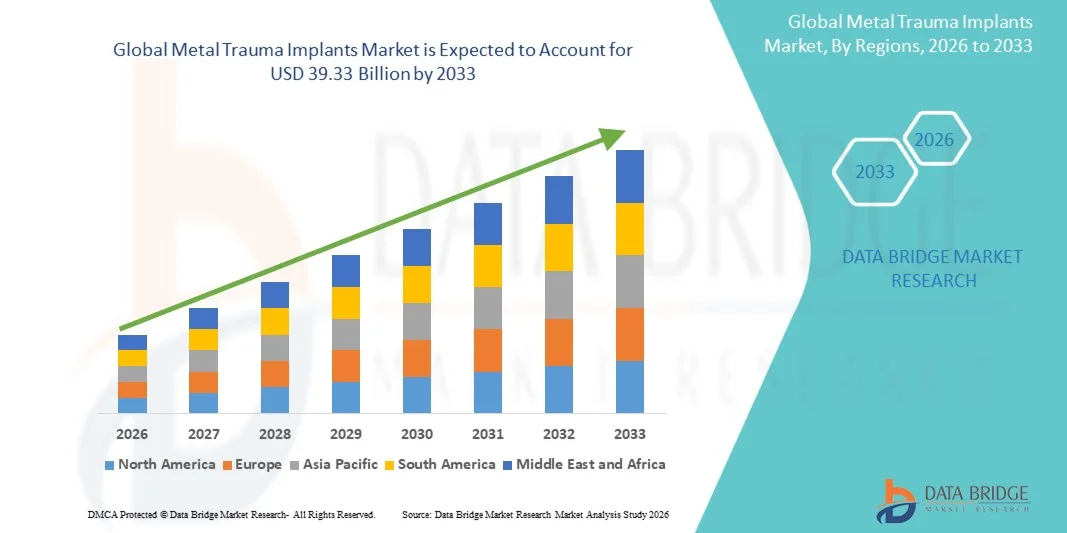
- The global metal trauma implants market size was valued at USD 18.35 billion in 2025 and is expected to reach USD 39.33 billion by 2033, at a CAGR of 10.00% during the forecast period
- The market growth is primarily driven by the rising incidence of road accidents, sports injuries, and age-related fractures, along with the increasing prevalence of osteoporosis and other bone-related disorders, which are significantly boosting the demand for metal trauma fixation devices across healthcare systems
- Furthermore, continuous advancements in biomaterials, including lightweight titanium and stainless-steel implants, along with improved surgical techniques and growing adoption of minimally invasive orthopedic procedures, are enhancing patient outcomes and accelerating the uptake of metal trauma implants, thereby supporting strong market expansion
Metal Trauma Implants Market Analysis
- Metal trauma implants, including plates, screws, rods, and pins, are critical orthopedic devices used for internal fixation of fractured bones, widely applied in emergency trauma care, reconstructive surgeries, and post-accident orthopedic treatments due to their high strength, biocompatibility, and ability to support proper bone healing
- The escalating demand for metal trauma implants is primarily driven by the rising number of road traffic accidents, sports-related injuries, and osteoporosis-driven fractures, along with increasing geriatric population globally, which is significantly boosting the need for effective and durable orthopedic fixation solutions
- North America dominated the metal trauma implants market with the largest revenue share of 38.6% in 2025, supported by advanced healthcare infrastructure, high surgical volumes, and strong adoption of innovative orthopedic technologies, with the U.S. witnessing substantial growth in trauma fixation procedures driven by continuous product innovations and established medical device manufacturers
- Asia-Pacific is expected to be the fastest growing region in the metal trauma implants market during the forecast period due to rapidly expanding healthcare infrastructure, increasing trauma cases, improving access to orthopedic care, and rising medical tourism in countries such as India and China
- Metal plates segment dominated the metal trauma implants market with a market share of 44.8% in 2025, attributed to their superior rigidity, versatility across multiple fracture types, and widespread clinical preference for achieving stable anatomical fixation in complex trauma cases
Report Scope and Metal Trauma Implants Market Segmentation
|
Attributes |
Metal Trauma Implants Key Market Insights |
|
Segments Covered |
|
|
Countries Covered |
North America
Europe
Asia-Pacific
Middle East and Africa
South America
|
|
Key Market Players |
|
|
Market Opportunities |
|
|
Value Added Data Infosets |
In addition to the insights on market scenarios such as market value, growth rate, segmentation, geographical coverage, and major players, the market reports curated by the Data Bridge Market Research also include in-depth expert analysis, patient epidemiology, pipeline analysis, pricing analysis, and regulatory framework |
Metal Trauma Implants Market Trends
“Advancements in Patient-Specific 3D-Printed and Precision Fixation Systems”
- A significant and accelerating trend in the global metal trauma implants market is the growing adoption of patient-specific 3D-printed implants and digitally guided fixation systems, which is improving surgical precision and enhancing anatomical fit in complex fracture management
- For instance, Stryker’s customized 3D-printed titanium solutions are increasingly used for complex reconstructive trauma cases, enabling better alignment and faster surgical planning. Similarly, Zimmer Biomet offers advanced pre-contoured plating systems designed for improved intraoperative efficiency
- 3D printing and digital modeling technologies enable the creation of anatomically accurate implants tailored to individual patients, improving load distribution and reducing implant failure risk while supporting faster post-operative recovery
- The integration of pre-operative planning software with imaging modalities such as CT scans is allowing surgeons to simulate procedures in advance, resulting in more accurate implant positioning and reduced operating time
- This shift toward personalized and digitally engineered trauma implants is reshaping surgical expectations, as companies such as DePuy Synthes are increasingly focusing on anatomically optimized plating systems and advanced fixation technologies
- The demand for patient-specific and precision-engineered metal trauma implants is rising rapidly across hospitals and trauma centers, as healthcare providers increasingly prioritize improved outcomes and reduced revision surgeries
- In addition, the use of minimally invasive trauma fixation techniques is gaining traction, supported by advanced instrumentation systems that reduce tissue damage and promote faster patient recovery
Metal Trauma Implants Market Dynamics
Driver
“Rising Trauma Incidence and Expanding Orthopedic Surgical Volumes”
- The increasing prevalence of road accidents, sports injuries, and osteoporosis-related fractures, coupled with a growing aging population, is a significant driver for the heightened demand for metal trauma implants globally
- For instance, in May 2025, orthopedic hospitals across Europe reported rising adoption of advanced locking plate systems to manage complex multi-fragment fractures, improving surgical success rates and recovery outcomes
- As trauma burden continues to rise worldwide, metal implants provide essential structural support for bone stabilization, enabling effective healing in severe fracture cases that cannot be treated conservatively
- Furthermore, the expansion of emergency trauma care infrastructure and increasing access to orthopedic surgeries in developing regions are significantly contributing to higher implant utilization rates
- The increasing preference for minimally invasive fixation procedures and faster post-surgical rehabilitation is further accelerating the adoption of advanced metal trauma implant systems in both public and private healthcare settings
- The growing availability of advanced imaging technologies such as intraoperative CT and fluoroscopy is further enhancing surgical accuracy, thereby increasing reliance on metal trauma fixation devices
- Rising healthcare expenditure and government investments in trauma care centers are also supporting wider accessibility and adoption of advanced orthopedic implant solutions
Restraint/Challenge
“Implant Failure Risks and Stringent Regulatory Approval Requirements”
- Concerns related to implant-related complications such as infection, loosening, and mechanical failure pose a significant challenge to broader adoption of metal trauma implants in clinical practice
- For instance, reported cases of hardware failure in high-load fracture fixation have led to increased scrutiny of implant durability and long-term performance in orthopedic procedures
- Addressing these risks requires continuous improvement in biomaterials, surface coatings, and biomechanical design to enhance implant longevity and reduce post-surgical complications
- Furthermore, stringent regulatory approval processes from health authorities such as the FDA and CE marking requirements in Europe often delay product launches and increase development costs for manufacturers
- While innovation in titanium alloys and bio-compatible stainless steel is improving safety outcomes, the high cost of compliance and clinical validation remains a barrier for new market entrants
- Overcoming these challenges through enhanced material engineering, stronger clinical evidence generation, and streamlined regulatory pathways will be critical for sustained market growth
- In addition, variability in reimbursement policies across different countries limits patient access to advanced trauma implants, particularly in price-sensitive markets
- Moreover, the shortage of skilled orthopedic trauma surgeons in developing regions further restricts the widespread adoption of advanced fixation technologies
Metal Trauma Implants Market Scope
The market is segmented on the basis of type, application, and end-user.
- By Type
On the basis of type, the global metal trauma implants market is segmented into metal plates, metal screws, pins and wires, and others. The metal plates segment dominated the market with the largest market revenue share of 44.8% in 2025, driven by their superior mechanical stability, broad applicability across complex fracture types, and strong clinical preference in orthopedic trauma surgeries. Metal plates are widely used in open reduction and internal fixation procedures due to their ability to maintain rigid alignment of fractured bone segments, ensuring proper healing. Their versatility across upper limb, lower limb, and craniofacial fractures further strengthens their dominance. In addition, continuous innovations in locking compression plates and anatomically contoured designs are enhancing surgical precision and reducing complication rates, further supporting segment growth.
The metal screws segment is expected to witness the fastest growth rate of 8.9% from 2026 to 2033, fueled by increasing use in minimally invasive fixation procedures and combination therapies with plates and rods. Metal screws are essential for providing compression and stabilization in fracture repair, particularly in small bone and joint-related injuries. Their growing use in arthroscopic and percutaneous surgeries is accelerating demand. In addition, advancements in bio-compatible titanium screws and improved thread designs are enhancing fixation strength and reducing surgical failure risks, contributing to strong market expansion.
- By Application
On the basis of application, the global metal trauma implants market is segmented into reconstructive joint replacements, spinal implants, dental implants, and others. The reconstructive joint replacements segment dominated the market with the largest revenue share of 41.6% in 2025, driven by the rising prevalence of severe trauma cases, degenerative bone disorders, and post-accident reconstructive surgeries. This segment benefits from high surgical volumes, particularly in elderly populations suffering from fractures and joint damage. Increasing adoption of advanced fixation systems in hip, knee, and shoulder reconstruction procedures further strengthens its dominance. Moreover, continuous improvements in implant materials and surgical techniques are enhancing patient mobility and long-term outcomes, supporting sustained demand.
The spinal implants segment is expected to witness the fastest growth rate of 9.3% from 2026 to 2033, driven by rising spinal injuries, degenerative disc diseases, and trauma-induced vertebral fractures. Increasing demand for minimally invasive spinal fixation procedures is significantly boosting adoption. Technological advancements such as modular spinal fixation systems and improved titanium alloy implants are enhancing surgical precision and recovery outcomes. In addition, the growing aging population and increasing incidence of osteoporosis-related spinal fractures are further accelerating segment growth.
- By End-user
On the basis of end-user, the global metal trauma implants market is segmented into hospitals, orthopedic clinics, ambulatory surgical centers, and others. The hospitals segment dominated the market with the largest revenue share of 58.4% in 2025, driven by the high volume of trauma surgeries performed in hospital settings and the availability of advanced surgical infrastructure. Hospitals serve as primary centers for emergency trauma care, enabling immediate access to orthopedic surgeons and advanced imaging systems. The presence of specialized trauma units and multidisciplinary care teams further supports dominance. In addition, increasing hospital admissions due to road accidents and sports injuries is significantly contributing to higher implant utilization rates.
The ambulatory surgical centers segment is expected to witness the fastest growth rate of 10.2% from 2026 to 2033, fueled by the growing shift toward outpatient surgical procedures and cost-effective treatment options. ASCs offer shorter hospital stays, reduced healthcare costs, and faster patient turnover, making them increasingly attractive for elective and minor trauma procedures. Advancements in minimally invasive surgical techniques are enabling more procedures to be safely performed in outpatient settings. In addition, rising healthcare infrastructure development in emerging economies is supporting the expansion of ambulatory surgical centers, driving strong segment growth.
Metal Trauma Implants Market Regional Analysis
- North America dominated the metal trauma implants market with the largest revenue share of 38.6% in 2025, supported by advanced healthcare infrastructure, high surgical volumes, and strong adoption of innovative orthopedic technologies
- Patients and healthcare providers in the region highly value the availability of advanced surgical techniques, biocompatible implant materials, and minimally invasive fixation systems that ensure faster recovery and improved clinical outcomes
- This widespread adoption is further supported by high healthcare expenditure, strong presence of leading medical device manufacturers, and increasing preference for technologically advanced orthopedic solutions, establishing metal trauma implants as a standard of care in trauma and reconstructive surgeries
U.S. Metal Trauma Implants Market Insight
The U.S. metal trauma implants market captured the largest revenue share of 79% in 2025 within North America, driven by a high volume of road accidents, sports injuries, and a well-established orthopedic surgical infrastructure. Patients and healthcare providers in the region highly prioritize advanced trauma fixation systems, including locking plates, screws, and minimally invasive implant technologies that ensure faster recovery and improved clinical outcomes. The strong presence of leading medical device manufacturers and continuous product innovation further accelerates adoption. Moreover, the increasing integration of advanced imaging, robotics-assisted surgeries, and biocompatible titanium implants is significantly contributing to market expansion.
Europe Metal Trauma Implants Market Insight
The Europe metal trauma implants market is projected to expand at a substantial CAGR throughout the forecast period, primarily driven by rising geriatric population, increasing fracture cases, and strong demand for advanced orthopedic care. The region benefits from well-developed healthcare systems and widespread access to trauma and reconstructive surgeries. European healthcare providers are increasingly adopting minimally invasive fixation techniques and anatomically contoured implant systems to improve patient outcomes. In addition, stringent regulatory standards ensure high-quality implant usage, further supporting steady market growth across both public and private hospitals.
U.K. Metal Trauma Implants Market Insight
The U.K. metal trauma implants market is anticipated to grow at a noteworthy CAGR during the forecast period, driven by increasing sports-related injuries, road accidents, and rising demand for advanced orthopedic procedures. The country’s strong public healthcare system supports widespread access to trauma care and surgical interventions. Growing adoption of locking plate systems and titanium-based implants is enhancing surgical precision and recovery rates. Furthermore, increasing investment in hospital infrastructure and orthopedic specialization is contributing to sustained market expansion.
Germany Metal Trauma Implants Market Insight
The Germany metal trauma implants market is expected to expand at a considerable CAGR during the forecast period, fueled by high technological adoption in healthcare and strong emphasis on precision-driven orthopedic solutions. Germany’s advanced hospital infrastructure supports widespread use of innovative fixation systems, particularly in complex fracture management. There is a growing preference for bio-compatible and long-lasting implant materials that align with strict clinical standards. Moreover, integration of digital surgical planning and minimally invasive techniques is increasingly shaping the adoption of metal trauma implants in both public and private healthcare facilities.
Asia-Pacific Metal Trauma Implants Market Insight
The Asia-Pacific metal trauma implants market is poised to grow at the fastest CAGR of 9.8% during the forecast period of 2026 to 2033, driven by rising road accidents, expanding healthcare infrastructure, and increasing access to orthopedic care in emerging economies such as China, India, and Southeast Asia. The region’s growing population and improving surgical capabilities are significantly boosting implant demand. Governments are investing heavily in trauma care centers and hospital modernization, further accelerating adoption. In addition, increasing affordability of orthopedic implants and growing medical tourism are supporting rapid market expansion across the region.
Japan Metal Trauma Implants Market Insight
The Japan metal trauma implants market is gaining momentum due to its aging population, high healthcare standards, and strong demand for advanced orthopedic solutions. The country places significant emphasis on precision-based surgical care, leading to increased adoption of anatomically designed implants and minimally invasive fixation systems. Integration of robotics-assisted surgery and advanced imaging technologies is further enhancing clinical outcomes. Moreover, rising cases of osteoporosis-related fractures among the elderly population are significantly contributing to sustained market growth.
India Metal Trauma Implants Market Insight
The India metal trauma implants market accounted for the largest market revenue share in Asia Pacific in 2025, attributed to rapid urbanization, increasing road accidents, and expanding access to advanced orthopedic care. India is witnessing strong growth in trauma surgeries due to rising healthcare awareness and improving hospital infrastructure. The availability of cost-effective implants and growing presence of domestic manufacturers are key factors supporting adoption. In addition, government initiatives to strengthen trauma care networks and the expansion of private hospitals are significantly driving market penetration across urban and semi-urban regions.
Metal Trauma Implants Market Share
The Metal Trauma Implants industry is primarily led by well-established companies, including:
- Stryker (U.S.)
- Johnson & Johnson Services, Inc. (U.S.)
- Zimmer Biomet. (U.S.)
- Smith & Nephew plc (U.K.)
- Medtronic (Ireland)
- B. Braun SE Germany)
- Orthofix Medical Inc. (U.S.)
- Globus Medical, Inc. (U.S.)
- Arthrex, Inc. (U.S.)
- CONMED Corporation (U.S.)
- Integra LifeSciences Holdings Corporation (U.S.)
- Acumed LLC (U.S.)
- Medartis AG (Switzerland)
- aap Implantate AG (Germany)
- Smiths Group plc (U.K.)
- Wright Medical Group N.V. (U.S.)
- MicroPort Scientific Corporation (China)
- LimaCorporate S.p.A. (Italy)
- NuVasive, Inc. (U.S.)
What are the Recent Developments in Global Metal Trauma Implants Market?
- In December 2025, Zimmer Biomet expanded its trauma and extremities portfolio with new foot and ankle fixation systems, including advanced plating and trauma nail solutions for complex fracture management. The launch strengthens its presence in metal trauma implants by improving surgical precision and expanding options for complex lower-limb injuries
- In October 2025, Zimmer Biomet introduced the Gorilla Pilon Fusion Plating System and Phantom TTC Trauma Nail for complex ankle and hindfoot trauma treatment. These innovations are designed to enhance fixation strength in severe fractures and improve surgical outcomes in high-risk orthopedic trauma cases. The products reflect growing demand for advanced metal plating systems in lower-extremity trauma care
- In September 2025, Medtronic launched a minimally invasive craniofacial trauma fixation kit integrating resorbable screws and plates. The system improves surgical precision and reduces operating time in facial and trauma reconstruction procedures. It reflects the trend toward hybrid fixation solutions combining metal implants with bioresorbable technologies
- In March 2025, Stryker showcased next-generation orthopedic trauma and spine solutions, including advancements in robotic-assisted and implant-based surgical systems at AAOS 2025. The company highlighted innovations across trauma fixation platforms, improving accuracy and outcomes in fracture management. These developments support increasing adoption of digitally assisted metal implant procedures
- In January 2025, Stryker announced the divestiture of its U.S. spinal implants business while continuing to focus on high-growth trauma and extremities implant segments. This strategic move allows the company to strengthen its focus on core orthopedic trauma technologies, including metal plates, screws, and fixation systems. It reflects ongoing restructuring within the global orthopedic implant industry

- Interactive Data Analysis Dashboard
- Company Analysis Dashboard for high growth potential opportunities
- Research Analyst Access for customization & queries
- Competitor Analysis with Interactive dashboard
- Latest News, Updates & Trend analysis
- Harness the Power of Benchmark Analysis for Comprehensive Competitor Tracking
Data collection and base year analysis are done using data collection modules with large sample sizes. The stage includes obtaining market information or related data through various sources and strategies. It includes examining and planning all the data acquired from the past in advance. It likewise envelops the examination of information inconsistencies seen across different information sources. The market data is analysed and estimated using market statistical and coherent models. Also, market share analysis and key trend analysis are the major success factors in the market report. To know more, please request an analyst call or drop down your inquiry.
The key research methodology used by DBMR research team is data triangulation which involves data mining, analysis of the impact of data variables on the market and primary (industry expert) validation. Data models include Vendor Positioning Grid, Market Time Line Analysis, Market Overview and Guide, Company Positioning Grid, Patent Analysis, Pricing Analysis, Company Market Share Analysis, Standards of Measurement, Global versus Regional and Vendor Share Analysis. To know more about the research methodology, drop in an inquiry to speak to our industry experts.
Data Bridge Market Research is a leader in advanced formative research. We take pride in servicing our existing and new customers with data and analysis that match and suits their goal. The report can be customized to include price trend analysis of target brands understanding the market for additional countries (ask for the list of countries), clinical trial results data, literature review, refurbished market and product base analysis. Market analysis of target competitors can be analyzed from technology-based analysis to market portfolio strategies. We can add as many competitors that you require data about in the format and data style you are looking for. Our team of analysts can also provide you data in crude raw excel files pivot tables (Fact book) or can assist you in creating presentations from the data sets available in the report.













