What is the Methane Reduction Feed Additives Market Size and Overview?
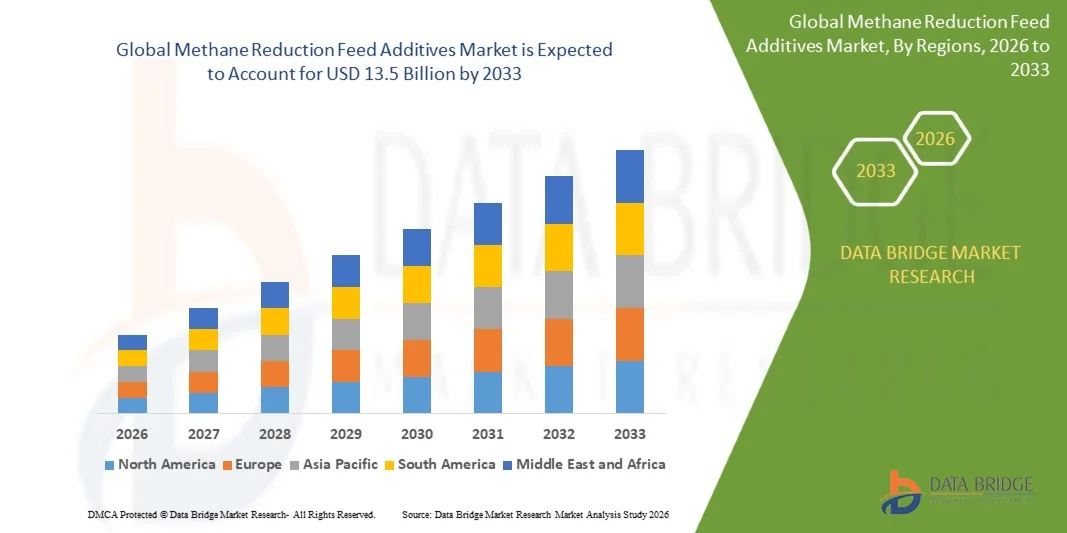
As per Data Bridge Market Research Analysis the methane reduction feed additives market was valued at USD 3.6 billion in 2025 and is projected to reach USD 13.5 billion by 2033, growing at a CAGR of 6.2% from 2026 to 2033. The market is witnessing steady growth driven by increasing pressure to reduce greenhouse gas emissions from livestock, growing adoption of sustainable animal nutrition practices, and continuous innovation in feed additive technologies. Rising global commitments to climate targets, coupled with stricter environmental regulations and expanding carbon reduction initiatives, are encouraging livestock producers, feed manufacturers, and dairy companies to incorporate methane-reducing feed additives into animal diets.
Advanced solutions such as 3-Nitrooxypropanol (3-NOP), seaweed-based additives, and precision microbial formulations are increasingly replacing conventional feed supplements by delivering measurable methane reduction while improving feed efficiency, animal productivity, and overall farm sustainability.
Market Size & Forecast
- Global Market Value (2025): USD 3.6 billion
- Expected Market Value (2033): USD 13.5 billion
- Forecast CAGR (2026–2033): 6.2%
What are the Major Takeaways of Methane Reduction Feed Additives Market?
- North America dominated the global methane reduction feed additives market with the largest revenue share of 39.7% in 2025, supported by early commercialization of
- 3-Nitrooxypropanol (3-NOP), favourable regulatory approvals, and strong adoption of sustainable livestock farming practices.
- Asia-Pacific is expected to be the fastest-growing region at a CAGR of 8.9% from 2026 to 2033, fuelled by expanding dairy and beef production, increasing government initiatives to reduce agricultural greenhouse gas emissions, and growing investments in advanced animal nutrition solutions.
- The 3-nitrooxypropanol (3-NOP) segment led the market with a 36.91% share in 2025, driven by its proven methane reduction performance, increasing commercial availability, and regulatory acceptance across major livestock-producing countries.
- The seaweed-based feed additives segment is projected to be the fastest-growing product type, registering a CAGR of 10.8%, owing to rising commercial trials, expanding research activities, and strong methane mitigation potential.
- The dairy cattle segment dominated the livestock category with a 44.72% revenue share in 2025, supported by the large global dairy herd, increasing sustainability commitments from dairy processors, and wider adoption of methane mitigation technologies.
- Commercial livestock farms accounted for 52.45% of the market share in 2025, driven by increasing adoption of methane-reducing feed additives to improve feed efficiency, meet environmental regulations, and support carbon reduction initiatives.
- The natural feed additives segment is expected to be the fastest-growing source category, registering a CAGR of 9.9%, driven by growing demand for clean-label animal nutrition, consumer preference for sustainable livestock products, and increasing commercialization of plant- and seaweed-derived feed additives.
Report Scope and Methane Reduction Feed Additives Market Segmentation
|
Attributes |
Methane Reduction Feed Additives Market Key Segments |
|
Segments Covered |
|
|
Countries Covered |
North America
Europe
Asia-Pacific
Middle East and Africa
South America
|
|
Key Market Players |
|
|
Market Opportunities |
|
|
Value Added Data Infosets |
In addition to the insights on market scenarios such as market value, growth rate, segmentation, geographical coverage, and major players, the market reports curated by the Data Bridge Market Research also include import export analysis, production capacity overview, production consumption analysis, price trend analysis, climate change scenario, supply chain analysis, value chain analysis, raw material/consumables overview, vendor selection criteria, PESTLE Analysis, Porter Analysis, and regulatory framework. |
What is the Key Trend in the Methane Reduction Feed Additives Market?
Trend: Rising Adoption of Sustainable Livestock Nutrition Solutions
Livestock producers are increasingly adopting methane reduction feed additives as part of sustainable nutrition strategies to reduce enteric methane emissions while improving feed efficiency and animal productivity. Advanced additives such as 3-Nitrooxypropanol (3-NOP), seaweed-derived ingredients, essential oils, and probiotic formulations are gaining commercial acceptance due to their proven ability to lower methane emissions without compromising animal performance. In addition, precision livestock farming technologies and digital feed management systems are enabling producers to optimize additive dosage, monitor animal health, and comply with evolving environmental sustainability standards.
Methane Reduction Feed Additives Market Dynamics
Key Market Driver: Stringent Climate Regulations and Growing Focus on Sustainable Livestock Farming
Increasing global efforts to reduce greenhouse gas emissions from agriculture are significantly driving demand for methane reduction feed additives. Governments, environmental agencies, dairy processors, and livestock producers are implementing sustainability initiatives aimed at lowering enteric methane emissions while maintaining farm productivity. Regulatory approvals for innovative methane inhibitors, corporate net-zero commitments, and expanding carbon reduction programs are accelerating the adoption of advanced feed additives across the dairy and beef industries. These solutions not only support environmental compliance but also improve feed conversion efficiency and enhance overall farm profitability.
Key Restraint/Challenge: High Cost and Limited Commercial Availability of Advanced Methane-Reducing Feed Additives
The high cost of advanced methane-reducing feed additives and their limited availability in developing regions remain key challenges for market growth. Products such as 3-Nitrooxypropanol (3-NOP) and seaweed-based additives require substantial investment in R&D, regulatory approvals, and production. In addition, low farmer awareness and uncertain return on investment continue to limit adoption among small and medium-sized livestock producers.
Key Market Opportunity: Expansion of Carbon Credit Programs and Commercialization of Next-Generation Methane Reduction Technologies
Growing carbon credit programs and sustainability initiatives are creating significant opportunities for the methane reduction feed additives market. Increasing demand for low-emission livestock production, along with the commercialization of next-generation solutions such as seaweed-based additives and precision microbial technologies, is expected to drive market growth, particularly across Asia-Pacific, Latin America, and the Middle East.
How is the Methane Reduction Feed Additives Market Segmented?
The methane reduction feed additives market is segmented on the basis of product type, livestock type, production system, source, form, mode of action, distribution channel, application, end user, and support & services.
- By Product Type
On the basis of product type, the global methane reduction feed additives market is segmented into 3-nitrooxypropanol (3-NOP), nitrate-based additives, seaweed-based additives, essential oils & plant extracts, probiotics & prebiotics, enzymes, organic acids, and other feed additives. The 3-nitrooxypropanol (3-NOP) segment dominated the market with a 36.91% share in 2025 due to its scientifically validated methane reduction efficacy, increasing regulatory approvals, and growing commercial adoption in dairy and beef cattle production. The widespread availability of products such as Bovaer, coupled with increasing sustainability commitments from livestock producers, dairy processors, and food companies, has accelerated the adoption of 3-NOP-based feed additives. In addition, its ability to significantly reduce enteric methane emissions while maintaining animal productivity and feed efficiency further strengthens the segment's leading position in the global market.
The seaweed-based additives segment is expected to witness the fastest CAGR of 10.8% from 2026 to 2033, driven by increasing investments in sustainable livestock nutrition, expanding commercialization of Asparagopsis-based feed additives, and rising demand for natural methane mitigation solutions. Growing research activities, favorable environmental policies, and increasing consumer preference for low-carbon animal products are encouraging feed manufacturers and livestock producers to adopt seaweed-derived additives, supporting rapid segment growth during the forecast period.
- By Livestock Type
On the basis of livestock type, the global methane reduction feed additives market is segmented into dairy cattle, beef cattle, sheep & goats, buffaloes, and other ruminants. The dairy cattle segment dominated the market with a 44.72% share in 2025 due to the large global dairy herd, increasing adoption of methane mitigation technologies, and growing sustainability commitments from dairy processors and retailers. Dairy producers are increasingly incorporating methane reduction feed additives to improve feed conversion efficiency, reduce greenhouse gas emissions, and comply with evolving environmental regulations. Furthermore, the commercialization of innovative products such as 3-nitrooxypropanol (3-NOP) and increasing investments in sustainable dairy farming continue to reinforce the dominance of this segment in the global market.
The beef cattle segment is expected to witness the fastest CAGR of 9.1% from 2026 to 2033, driven by the growing global demand for sustainable beef production and increasing government initiatives to reduce methane emissions from beef farming. Rising adoption of precision livestock nutrition, expansion of carbon reduction programs, and increasing commercialization of natural feed additives, including seaweed-based products and essential oil formulations, are further accelerating the adoption of methane reduction feed additives across commercial beef production systems.
- By Production System
On the basis of production system, the global methane reduction feed additives market is segmented into intensive farming, semi-intensive farming, and extensive grazing systems. The intensive farming segment dominated the market with a 53.28% share in 2025 due to its higher adoption of scientifically formulated feed additives, controlled feeding practices, and increasing focus on improving feed efficiency while reducing greenhouse gas emissions. Large-scale dairy and beef farms operating under intensive production systems are increasingly implementing methane reduction technologies to comply with environmental regulations, achieve sustainability targets, and enhance livestock productivity. In addition, the availability of precision feeding systems and advanced nutrition management practices continues to strengthen the dominance of this segment.
The semi-intensive farming segment is expected to witness the fastest CAGR of 8.8% from 2026 to 2033, driven by the gradual modernization of livestock production in emerging economies and increasing awareness of sustainable animal nutrition. Growing government support for climate-smart agriculture, rising adoption of commercial feed additives, and expanding dairy and beef production across Asia-Pacific, Latin America, and Africa are encouraging farmers to integrate methane reduction feed additives into semi-intensive production systems, thereby accelerating segment growth during the forecast period.
- By Source
On the basis of source, the global methane reduction feed additives market is segmented into natural and synthetic. The synthetic segment dominated the market with a 58.73% share in 2025 due to the widespread commercial adoption of scientifically validated methane inhibitors such as 3-nitrooxypropanol (3-NOP) and nitrate-based additives. These products offer consistent performance, proven efficacy in reducing enteric methane emissions, and have gained regulatory approvals in several key livestock-producing regions. In addition, increasing investments in research and development, along with growing demand from commercial dairy and beef producers for reliable methane mitigation solutions, continue to reinforce the dominance of the synthetic segment.
The natural segment is expected to witness the fastest CAGR of 9.9% from 2026 to 2033, driven by rising demand for sustainable and clean-label livestock nutrition solutions. Increasing commercialization of seaweed-based additives, essential oils, plant extracts, probiotics, and other naturally derived feed ingredients, coupled with growing consumer preference for environmentally friendly animal products and supportive government initiatives promoting sustainable agriculture, is expected to accelerate the adoption of natural methane reduction feed additives during the forecast period.
- By Form
On the basis of form, the global methane reduction feed additives market is segmented into dry and liquid. The dry segment dominated the market with a 67.41% share in 2025 due to its longer shelf life, ease of storage and transportation, compatibility with compound feed manufacturing, and widespread use in commercial livestock operations. Dry feed additives also offer better stability and simplified handling, making them the preferred choice among feed manufacturers and large-scale dairy and beef producers.
The liquid segment is expected to witness the fastest CAGR of 8.5% from 2026 to 2033, driven by increasing adoption in precision feeding systems, improved mixing efficiency, and growing demand for customized livestock nutrition solutions across modern farming operations.
- By Mode of Action
On the basis of mode of action, the global methane reduction feed additives market is segmented into methanogenesis inhibitors, rumen microbiome modifiers, fermentation enhancers, and enzyme-based solutions. The methanogenesis inhibitors segment dominated the market with a 42.18% share in 2025 due to their proven effectiveness in directly reducing enteric methane emissions and the increasing commercial adoption of products such as 3-nitrooxypropanol (3-NOP). Growing regulatory approvals, rising investments in sustainable livestock farming, and increasing demand for scientifically validated methane mitigation solutions continue to strengthen the dominance of this segment.
The rumen microbiome modifiers segment is expected to witness the fastest CAGR of 9.4% from 2026 to 2033, driven by increasing research on precision animal nutrition, growing adoption of probiotics and microbial technologies, and rising demand for natural solutions that improve rumen health, enhance feed efficiency, and reduce methane emissions.
- By Distribution Channel
On the basis of distribution channel, the global methane reduction feed additives market is segmented into direct sales, feed manufacturers, distributors & dealers, and online sales. The direct sales segment dominated the market with a 46.35% share in 2025 due to strong partnerships between feed additive manufacturers, commercial livestock farms, and integrated dairy and beef producers. Direct sales provide technical support, customized feed solutions, and long-term supply agreements, making them the preferred distribution channel for large-scale livestock operations.
The feed manufacturers segment is expected to witness the fastest CAGR of 9.2% from 2026 to 2033, driven by the increasing incorporation of methane reduction additives into compound feed formulations, rising demand for sustainable animal nutrition, and expanding collaborations between feed producers and additive manufacturers to develop innovative, low-emission livestock feed solutions.
- By Application
On the basis of application, the global methane reduction feed additives market is segmented into methane emission reduction, feed efficiency improvement, animal health & performance, and sustainable livestock farming. The methane emission reduction segment dominated the market with a 48.62% share in 2025 due to increasing global initiatives to reduce greenhouse gas emissions, stringent environmental regulations, and the growing adoption of scientifically proven feed additives across commercial dairy and beef farms. Rising corporate sustainability commitments and carbon reduction targets are further supporting the dominance of this segment.
The feed efficiency improvement segment is expected to witness the fastest CAGR of 9.0% from 2026 to 2033, driven by increasing demand for improved feed conversion ratios, lower production costs, and enhanced livestock productivity. Growing awareness among livestock producers regarding the economic benefits of methane-reducing feed additives, along with advancements in precision nutrition technologies, is expected to accelerate the growth of this segment during the forecast period.
- By End User
On the basis of end user, the global methane reduction feed additives market is segmented into commercial livestock farms, dairy farms, beef producers, feed manufacturers, and research institutions & universities. The commercial livestock farms segment dominated the market with a 52.38% share in 2025 due to the large-scale adoption of methane reduction feed additives to improve feed efficiency, enhance animal productivity, and comply with environmental sustainability standards. Increasing investments in precision livestock farming, carbon reduction initiatives, and advanced feed management practices continue to strengthen the dominance of this segment.
The feed manufacturers segment is expected to witness the fastest CAGR of 9.3% from 2026 to 2033, driven by the growing integration of methane-reducing ingredients into commercial feed formulations, rising demand for sustainable animal nutrition products, and increasing collaborations with livestock producers to develop innovative feed solutions that support both productivity and environmental goals.
- By Support & Services
On the basis of support & services, the global methane reduction feed additives market is segmented into technical consultation, feed formulation support, product testing & validation, and training & advisory services. The feed formulation support segment dominated the market with a 38.76% share in 2025 due to the increasing demand for customized feed formulations that optimize methane reduction while maintaining animal health and productivity. Growing collaboration between feed additive manufacturers, nutritionists, and commercial livestock producers has further strengthened the adoption of formulation support services across the industry.
The technical consultation segment is expected to witness the fastest CAGR of 8.9% from 2026 to 2033, driven by the rising need for expert guidance on additive selection, regulatory compliance, methane mitigation strategies, and precision nutrition practices. Increasing adoption of sustainable livestock farming and expanding commercialization of advanced feed additives are expected to accelerate demand for technical consulting services during the forecast period.
Which Region Holds the Largest Share of the Methane Reduction Feed Additives Market?
North America dominated the methane reduction feed additives market and accounted for the largest revenue share of 39.7% in 2025, supported by early commercialization of methane-reducing technologies, favorable regulatory approvals, and strong adoption of sustainable livestock production practices. The region benefits from increasing investments in animal nutrition research, growing implementation of carbon reduction initiatives, and the presence of leading feed additive manufacturers. Rising demand for scientifically validated products such as 3-Nitrooxypropanol (3-NOP), coupled with expanding sustainability commitments from dairy and beef producers, continues to strengthen North America's leadership position in the global market.
U.S. Methane Reduction Feed Additives Market Insight
The U.S. methane reduction feed additives market is witnessing strong growth due to increasing government support for greenhouse gas reduction, rising adoption of sustainable livestock farming practices, and growing commercialization of innovative feed additives. The approval of advanced methane inhibitors and increasing investments by dairy and beef producers to improve feed efficiency and environmental performance are driving market expansion. Furthermore, strong industry collaboration among feed manufacturers, livestock producers, and research organizations continues to accelerate product adoption across the country.
Europe Methane Reduction Feed Additives Market Insight
The Europe methane reduction feed additives market is experiencing significant growth due to stringent environmental regulations, ambitious climate targets, and increasing adoption of sustainable livestock nutrition solutions. The region has been at the forefront of commercializing innovative methane-reducing feed additives, supported by strong research capabilities and favorable regulatory frameworks. Growing investments in carbon-neutral dairy and beef production, along with increasing collaboration between feed manufacturers and livestock producers, continue to support regional market growth.
Germany Methane Reduction Feed Additives Market Insight
The Germany methane reduction feed additives market is expanding steadily due to the country's strong focus on sustainable agriculture, advanced animal nutrition research, and climate-friendly livestock production. Dairy and beef producers are increasingly adopting methane reduction technologies to improve environmental performance while maintaining animal productivity. In addition, growing investments in precision livestock farming and government initiatives promoting greenhouse gas reduction are further supporting market growth in Germany.
Asia-Pacific Methane Reduction Feed Additives Market Insight
The Asia-Pacific methane reduction feed additives market is expected to witness the fastest growth during the forecast period, driven by expanding dairy and beef industries, increasing livestock populations, and growing awareness regarding sustainable animal farming. Countries such as China, India, Australia, and New Zealand are investing in advanced feed technologies to improve productivity while reducing methane emissions. Rising government support for climate-smart agriculture and increasing demand for high-quality livestock products are further accelerating regional market expansion.
Japan Methane Reduction Feed Additives Market Insight
The Japan methane reduction feed additives market is witnessing consistent growth due to increasing investments in advanced livestock nutrition, environmental sustainability, and agricultural innovation. Livestock producers are adopting methane reduction feed additives to improve feed efficiency and support the country's carbon neutrality objectives. Furthermore, continuous research on microbial and natural feed additives, along with increasing collaboration between industry and academic institutions, is contributing to market growth.
China Methane Reduction Feed Additives Market Insight
The China methane reduction feed additives market is growing rapidly, driven by the country's large livestock population, increasing government focus on reducing agricultural greenhouse gas emissions, and rising demand for sustainable animal nutrition solutions. Growing adoption of commercial feed additives, expanding dairy and beef production, and increasing investments in precision livestock farming are significantly boosting market demand. In addition, favorable policy initiatives and continuous advancements in feed technology are positioning China as one of the fastest-growing markets for methane reduction feed additives globally.
Which are the Top Companies in Methane Reduction Feed Additives Market?
The methane reduction feed additives industry is primarily led by well-established companies, including:
- DSM-Firmenich AG (Switzerland)
- Elanco Animal Health Incorporated (U.S.)
- Cargill, Incorporated (U.S.)
- Archer Daniels Midland Company (U.S.)
- BASF SE (Germany)
- Evonik Industries AG (Germany)
- Kemin Industries, Inc. (U.S.)
- Novonesis A/S (Denmark)
- Alltech, Inc. (U.S.)
- Nutreco N.V. (Netherlands)
- CH4 Global, Inc. (U.S.)
- Symbrosia, Inc. (U.S.)
- Mootral SA (Switzerland)
- FutureFeed Pty Ltd. (Australia)
- Rumin8 Ltd. (Australia)
- Blue Ocean Barns, Inc. (U.S.)
- Volta Greentech AB (Sweden)
- Agolin SA (Switzerland)
- Lallemand Animal Nutrition (Canada)
- Adisseo France SAS (France)
- Trouw Nutrition (Netherlands)
- Phibro Animal Health Corporation (U.S.)
- Delacon Biotechnik GmbH (Austria)
- BIOMIN Holding GmbH (Austria)
- Hansen Holding A/S (Denmark)
- Beneo GmbH (Germany)
- ForFarmers N.V. (Netherlands)
- Kent Nutrition Group, Inc. (U.S.)
- De Heus Animal Nutrition B.V. (Netherlands)
What are Latest Developments in Methane Reduction Feed Additives Market?
- In May 2024, dsm-firmenich announced that the U.S. Food and Drug Administration (FDA) completed its review of Bovaer (3-Nitrooxypropanol), enabling its commercial launch in the U.S. through its strategic partner Elanco Animal Health. The approval expanded Bovaer’s availability across North America, strengthening dsm-firmenich’s leadership in methane-reducing feed additives and accelerating the adoption of sustainable livestock farming solutions.
- In May 2024, Elanco Animal Health Incorporated commercially launched Bovaer in the United States following U.S. FDA review and approval through its strategic partnership with dsm-firmenich. The launch expanded access to methane-reducing feed technology for U.S. dairy producers and supported the livestock industry's sustainability goals.
- In February 2024, CH4 Global welcomed the U.S. FDA's regulatory reforms for novel animal feed additives, paving the way for commercialization of its Methane Tamer™ seaweed-based feed supplement in the U.S. market. The development strengthened the company's position in natural methane reduction technologies.
- In September 2022, Rumin8 Ltd. secured a major funding round to accelerate the commercialization of its synthetic seaweed-based methane reduction technology for cattle. The investment supported product development, manufacturing scale-up, and expansion of commercial trials across global livestock markets.
- In July 2021, Symbrosia, Inc. expanded commercial pilot programs for SeaGraze, its seaweed-based cattle feed additive, through collaborations with dairy producers in the United States. The initiative advanced on-farm validation of methane reduction technology while supporting the commercialization of sustainable livestock feed solutions.

- Interactive Data Analysis Dashboard
- Company Analysis Dashboard for high growth potential opportunities
- Research Analyst Access for customization & queries
- Competitor Analysis with Interactive dashboard
- Latest News, Updates & Trend analysis
- Harness the Power of Benchmark Analysis for Comprehensive Competitor Tracking
Data collection and base year analysis are done using data collection modules with large sample sizes. The stage includes obtaining market information or related data through various sources and strategies. It includes examining and planning all the data acquired from the past in advance. It likewise envelops the examination of information inconsistencies seen across different information sources. The market data is analysed and estimated using market statistical and coherent models. Also, market share analysis and key trend analysis are the major success factors in the market report. To know more, please request an analyst call or drop down your inquiry.
The key research methodology used by DBMR research team is data triangulation which involves data mining, analysis of the impact of data variables on the market and primary (industry expert) validation. Data models include Vendor Positioning Grid, Market Time Line Analysis, Market Overview and Guide, Company Positioning Grid, Patent Analysis, Pricing Analysis, Company Market Share Analysis, Standards of Measurement, Global versus Regional and Vendor Share Analysis. To know more about the research methodology, drop in an inquiry to speak to our industry experts.
Data Bridge Market Research is a leader in advanced formative research. We take pride in servicing our existing and new customers with data and analysis that match and suits their goal. The report can be customized to include price trend analysis of target brands understanding the market for additional countries (ask for the list of countries), clinical trial results data, literature review, refurbished market and product base analysis. Market analysis of target competitors can be analyzed from technology-based analysis to market portfolio strategies. We can add as many competitors that you require data about in the format and data style you are looking for. Our team of analysts can also provide you data in crude raw excel files pivot tables (Fact book) or can assist you in creating presentations from the data sets available in the report.