


What is the Methanol Engines Market Size and Overview?
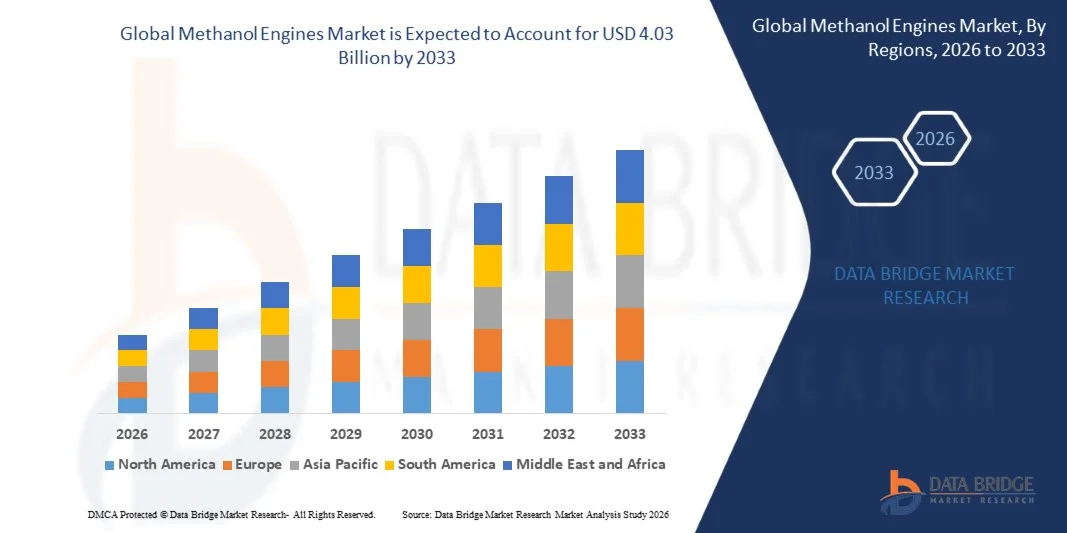
As per Data Bridge Market Research Analysis the Methanol Engines Market was valued at USD 0.75 billion in 2025 and is projected to reach USD 4.03 billion by 2033, growing at a CAGR of 23.40% from 2026 to 2033. Methanol is gaining attention as an alternative transportation fuel because it can reduce particulate emissions, is comparatively easier to store and transport than hydrogen, and can be utilized in specially designed or modified internal combustion engines with relatively limited infrastructure changes.
The market is witnessing rapid expansion as governments and international regulatory bodies tighten emission standards across transportation and maritime sectors, encouraging operators to evaluate cleaner fuel technologies such as methanol-powered engines. Advancements in dual-fuel and flexible-fuel engine technologies are further supporting commercialization across marine, power generation, and heavy-duty vehicle applications. The rising global focus on carbon neutrality and stringent emission reduction targets is accelerating the adoption of methanol engines across shipping and industrial sectors.
Key Market Trends & Insights
- North America held the leading position in the methanol engines market in 2025, benefiting from strong early adoption of clean fuel technologies, advanced engine manufacturing capabilities, and increasing pilot projects in marine and freight transportation.
- Asia-Pacific is expected to be the fastest-growing region, aided by rapid expansion of shipping activities, strong government-backed methanol fuel programs, and increasing adoption of methanol-fueled vehicles in countries such as China and Japan.
- The Dual-Fuel Engines segment accounted for the largest share in 2025, fueled by its flexibility to operate on methanol-diesel or methanol-gasoline blends, enabling easier integration into existing engine platforms.
- Spark Ignition Engines are expected to witness the fastest growth during the forecast period, influenced by increasing adoption in light commercial vehicles and distributed power generation systems.
- The Marine application represented the largest application segment in 2025, underpinned by strong decarbonization initiatives in global shipping and increasing deployment of methanol-fueled vessels.
- The IMO's revised 2023 GHG Strategy, aiming to reduce the carbon intensity of international shipping by at least 40% by 2030 while pursuing net-zero greenhouse gas emissions by or around 2050, is accelerating maritime adoption.
- Engine retrofit capability is building momentum, with demonstration projects highlighting the technical viability of methanol conversions at the deep-sea end of the market.
- Expansion of renewable methanol production facilities and associated fuel supply infrastructure is expected to improve fuel accessibility and encourage wider commercial deployment of methanol-powered engines.
Market Size & Forecast
- Global Market Value (2025): USD 0.75 Billion
- Expected Market Value (2033): USD 4.03 Billion
- Forecast CAGR (2026–2033): 23.40%
- Leading Region in 2025: North America
- Fastest Growing Region: Asia-Pacific
Report Scope and Methanol Engines Market Segmentation
|
Attributes |
Methanol Engines Key Market Insights |
|
Segments Covered |
|
|
Countries Covered |
North America
Europe
Asia-Pacific
Middle East and Africa
South America
|
|
Key Market Players |
|
|
Market Opportunities |
|
|
Value Added Data Infosets |
In addition to the market insights such as market value, growth rate, market segments, geographical coverage, market players, and market scenario, the market report curated by the Data Bridge Market Research team includes in-depth expert analysis, import/export analysis, pricing analysis, production consumption analysis, and pestle analysis. |
What is the Key Trend in the Methanol Engines Market?
Trend: Rising Demand for Dual-Fuel and Flexible-Fuel Engines
The Dual-Fuel Engines segment accounted for the largest share in 2025, fueled by its flexibility to operate on methanol-diesel or methanol-gasoline blends, enabling easier integration into existing engine platforms. These systems are widely adopted in marine propulsion and heavy-duty transport due to their improved emission performance and fuel adaptability. The increasing pressure on shipowners to operate vessels with lower emissions while maintaining long-distance operations and fuel efficiency is pushing manufacturers to develop methanol engines that enable stable operation, fuel flexibility, and compliance with evolving environmental standards.
Methanol Engines Market Dynamics
Key Market Driver: Stringent Emission Regulations and Decarbonization Targets
The primary driver of the methanol engines market is the increasing regulatory pressure to reduce emissions in the shipping and transportation sectors. The International Maritime Organization's (IMO) revised 2023 GHG Strategy aims to reduce the carbon intensity of international shipping by at least 40% by 2030, while pursuing net-zero greenhouse gas emissions by or around 2050. Methanol offers significant advantages as a clean fuel, including lower particulate emissions, easier storage compared to hydrogen, and compatibility with existing internal combustion engine platforms. By 2026, a substantial number of methanol-capable vessels are on order globally, underscoring the pace of maritime adoption.
Key Restraint/Challenge: Regulatory Uncertainty and High Conversion Costs
A significant challenge facing the methanol engines market is the regulatory uncertainty delaying large-scale engine retrofit decisions. The longer conventionally fuelled vessels remain in service, the greater the pressure will be to retrofit them later to meet emissions targets, potentially compressing demand into a narrower and more costly timeframe. Additionally, the high cost of converting existing engines to methanol-capable systems, coupled with the limited availability of green methanol bunkering infrastructure in many ports, poses challenges to widespread adoption.
Key Market Opportunity: Engine Retrofitting and Aftermarket Services
The retrofit segment is expected to witness significant growth as the existing fleet remains central to global trade, and the ability to convert vessels efficiently will be critical to meeting decarbonisation targets. OEM announcements have strengthened the case for methanol and ethanol conversions, with successful demonstrations across various engine types. Bridge retrofits, including engine upgrades, propulsion optimisation, and control system improvements, are reducing emissions in the near term and preparing vessels for future fuel conversion.
How is the Methanol Engines Market Segmented?
The methanol engines market is segmented based on engine type, application, end-user, and fuel blend.
- By Engine Type
On the basis of engine type, the Methanol Engines Market is segmented into spark ignition engines, compression ignition engines, and dual-fuel engines. The Dual-Fuel Engines segment accounted for the largest share in 2025, fueled by its flexibility to operate on methanol-diesel or methanol-gasoline blends, enabling easier integration into existing engine platforms. These systems are widely adopted in marine propulsion and heavy-duty transport due to their improved emission performance and fuel adaptability. Spark Ignition Engines are expected to witness the fastest growth during the forecast period, influenced by increasing adoption in light commercial vehicles and distributed power generation systems. Rising demand for cleaner combustion and compatibility with methanol-gasoline blends is accelerating segment expansion. Compression ignition engines continue to hold significant market share, particularly in heavy-duty and industrial applications where high efficiency and torque are required. The development of advanced fuel injection systems and engine control technologies is further enhancing the performance and reliability of methanol engines across all engine types. The growing availability of methanol-capable engine designs from leading manufacturers is supporting market expansion across diverse applications.
- By Application
On the basis of application, the Methanol Engines Market is segmented into automotive, marine, power generation, industrial, and others. The Marine application represented the largest segment in 2025, underpinned by strong decarbonization initiatives in global shipping and increasing deployment of methanol-fueled vessels. Major shipping operators are integrating methanol dual-fuel engines into newbuild vessels, supporting the transition toward cleaner marine fuels. The automotive segment is experiencing steady growth, influenced by increasing adoption of methanol-fueled vehicles in countries such as China and Japan, where government-backed methanol fuel programs are gaining momentum. Power generation applications are emerging as a significant growth area, with methanol engines being deployed for distributed power generation and backup power systems. Industrial applications, including mining, construction, and agricultural equipment, are also adopting methanol engines to reduce emissions and comply with increasingly stringent environmental regulations. The versatility of methanol as a fuel and the availability of flexible-fuel engine platforms are expanding the application scope of methanol engines across multiple end-use sectors.
- By End-User
On the basis of end-user, the Methanol Engines Market is segmented into OEMs and aftermarket. The OEM segment dominates the market, encouraged by increasing newbuild vessel orders incorporating methanol dual-fuel engines and growing production of methanol-fueled vehicles. Major engine manufacturers are expanding their methanol-capable engine portfolios to meet rising demand from shipowners and fleet operators. The aftermarket segment is expected to witness significant growth, driven by increasing demand for engine retrofitting solutions for existing vessels. Aftermarket services, including maintenance, repair, and upgrade solutions, are also gaining traction as operators seek to extend the lifespan and improve the performance of their existing engine assets.
- By Fuel Blend:
On the basis of fuel blend, the Methanol Engines Market is segmented into pure methanol, methanol-gasoline blends, and methanol-diesel blends. Methanol-diesel blends hold the largest market share, favored by their widespread adoption in marine and heavy-duty transport applications where diesel engines are predominant. The flexibility to operate on methanol-diesel blends enables easier integration into existing engine platforms and provides operators with fuel choice and operational flexibility. Methanol-gasoline blends are gaining traction in automotive applications, particularly in light commercial vehicles where spark ignition engines are commonly used. Pure methanol applications are emerging in specialized sectors such as marine propulsion and power generation, where dedicated methanol engines offer maximum emission reduction benefits. Demonstration projects have showcased the viability of pure methanol operation in marine engines. The growing availability of green methanol and improving bunkering infrastructure are expected to encourage increased adoption of pure methanol and higher-blend ratios in the coming years.
Which Region Holds the Largest Share of the Methanol Engines Market?
North America Methanol Engines Market Insight
North America held the leading position in the methanol engines market in 2025, benefiting from strong early adoption of clean fuel technologies, advanced engine manufacturing capabilities, and increasing pilot projects in marine and freight transportation. The region also benefits from supportive emission reduction policies and growing investments in alternative fuel infrastructure. The United States is at the forefront of methanol engine development, with key players such as Cummins Inc. and Caterpillar Inc. headquartered in the country. The region's strong regulatory framework, including stringent emission standards and incentives for clean fuel adoption, is driving demand for methanol engines across marine, automotive, and power generation applications. Growing investments in green methanol production and bunkering infrastructure along major shipping routes are further supporting market expansion in North America.
Europe Methanol Engines Market Insight
Europe is expected to account for a significant share of the Methanol Engines Market. The region benefits from strong regulatory frameworks, stringent emission reduction targets, and high adoption of alternative fuel technologies. Key players such as Everllence (Germany), Wärtsilä Corporation (Finland), and Rolls-Royce (United Kingdom) are headquartered in Europe, supporting regional market growth. The European Union's ambitious decarbonization targets and the implementation of the FuelEU Maritime regulation are driving demand for methanol engines in the shipping sector. Demonstration projects and engine tests have represented important developments for the region. The region is also witnessing growing investments in green methanol production facilities and bunkering infrastructure, supporting the adoption of methanol as a marine fuel.
Asia-Pacific Methanol Engines Market Insight
Asia-Pacific is expected to be the fastest-growing region in the methanol engines market, aided by rapid expansion of shipping activities, strong government-backed methanol fuel programs, and increasing adoption of methanol-fueled vehicles in countries such as China and Japan. The region is also experiencing rising investments in green methanol production and industrial decarbonization initiatives. China is emerging as a key player, with significant investments in methanol fuel production and vehicle deployment. The Chinese government's support for methanol as an alternative fuel is driving demand for methanol engines across automotive and industrial applications. Japan is also witnessing growing adoption of methanol-fueled vehicles and marine engines, supported by government initiatives promoting low-carbon technologies. South Korea, with its strong shipbuilding industry, is a significant market for methanol marine engines, with HD Hyundai and other local manufacturers developing methanol-capable engine platforms.
Latin America Methanol Engines Market Insight
Latin America represents an emerging market for methanol engines, with growing demand influenced by increasing investments in renewable energy, government incentives for clean fuel adoption, and the region's abundant methanol production capacity. Brazil, with its established ethanol and methanol production infrastructure, is leading the region's methanol engine market. Industry trials have demonstrated that ethanol can be blended with methanol and marine diesel without significant impacts on engine performance. Countries such as Brazil and Argentina are witnessing significant investments in methanol production facilities and alternative fuel infrastructure, supported by policies promoting sustainable transportation and reducing emissions. The region's expanding agricultural and mining sectors are also creating demand for methanol engines in industrial and power generation applications. However, market growth is currently constrained by limited consumer awareness, higher vehicle costs compared to traditional vehicles, and fragmented regulatory frameworks.
Middle East & Africa Methanol Engines Market Insight
The Middle East and Africa region represents a nascent market for methanol engines, with demand primarily concentrated in the GCC countries and South Africa. Governments across the region are increasing investments in alternative fuel technologies and renewable energy to reduce carbon emissions and diversify their economies. The UAE is investing in clean fuel technologies and sustainable shipping solutions, while Saudi Arabia is expanding its methanol production capacity as part of its Vision 2030 initiative. South Africa is gradually adopting methanol engines to support the growing demand for cleaner transportation solutions. Increasing investments from global engine manufacturers and fuel technology providers are improving technology availability across major urban centers. However, relatively low adoption of alternative fuels, limited bunkering infrastructure, and high costs continue to restrain market growth.
Which are the Top Companies in Methanol Engines Market?
The Methanol Engines industry is primarily led by well-established companies, including:
- Everllence (formerly MAN Energy Solutions) (Germany)
- Wärtsilä Corporation (Finland)
- Rolls-Royce plc (United Kingdom)
- Cummins Inc. (U.S.)
- Volvo Group (Sweden)
- Scania AB (Sweden)
- Yanmar Holdings Co., Ltd. (Japan)
- Anglo Belgian Corporation (Belgium)
- Caterpillar Inc. (U.S.)
- HD Hyundai (South Korea)
- Mitsubishi Heavy Industries, Ltd. (Japan)
- Kawasaki Heavy Industries, Ltd. (Japan)
- Hyundai Heavy Industries Co., Ltd. (South Korea)
- Doosan Engine Co., Ltd. (South Korea)
- Weichai Power Co., Ltd. (China)
- CSSC Power Group (China)
- WinGD (China)
- Yuchai Group (China)
- Ningbo C.S.I. Power & Machinery Group (China)
- Bharat Heavy Electricals Limited (India)
What are Latest Developments in Methanol Engines Market?
- In November 2025, CM Energy officially launched its green methanol project and obtained ISCC EU certification, marking the official entry of its green methanol into the EU market. The project's first phase has an annual production capacity of 20,000 to 30,000 tons, with deliveries scheduled to begin in December 2025.
- In October 2025, Everllence announced the completion of the world's first conversion of an Everllence B&W S90 two-stroke engine to dual-fuel methanol running, following successful sea-trials of COSCO SHIPPING LINES' 20,000+ TEU container vessel, 'COSCO SHIPPING LIBRA'. The vessel's 11S90ME-C engine was retrofitted to an 11S90ME-LGIM unit. As part of the process, Everllence commissioned a dedicated 4S90 testbed engine in Japan in early 2025.
- In October 2025, Rolls-Royce successfully tested the world's first high-speed marine engine powered exclusively by methanol on its test bench in Friedrichshafen, Germany. The milestone was achieved through the meOHmare research project, bringing together Rolls-Royce, injection system specialist Woodward L'Orange, and the WTZ Roßlau technology and research centre. The engine is positioned for operators of ferries, yachts, and supply vessels seeking to reduce their carbon footprint.
- In September 2025, Everllence was awarded a contract by Qingdao Beihai Shipyard (China) for the supply of 10 methanol-fueled marine engines. These engines will be installed on 325,000 DWT large ore carriers being built for Shandong Shipping (China) and Bohai Ocean Shipping (China). These vessels are expected to be chartered to Vale S.A. (Brazil) for iron ore transportation between Brazil and China.
- In August 2025, Everllence partnered with ship after-sales service provider Meyer Re to advance methanol retrofit solutions for the shipping sector. The deal will focus on retrofitting Everllence's four-stroke engines and vessels to run on methanol. Together, they aim to create a roadmap for methanol adoption, covering vessel modifications, fuelling infrastructure and industry safety standards.
- In July 2025, Everllence received its first order for dual-fuel methanol engines for a superyacht under construction by an undisclosed European shipbuilder. The firm will deliver two dual-fuel methanol engines, fuel systems and gensets, with deliveries scheduled for July 2027. Growing interest for dual-fuel methanol engines is being seen across cruise ships, tugs, ferries, and superyachts.
- In June 2025, initial green methanol production began at Toyo Engineering India's 10 TPD green methanol plant at NTPC's Vindhyachal Super Thermal Power Station in Madhya Pradesh. The facility produces methanol using carbon dioxide captured from flue gases and green hydrogen generated through water electrolysis, marking India's first successful demonstration of methanol production.

- Interactive Data Analysis Dashboard
- Company Analysis Dashboard for high growth potential opportunities
- Research Analyst Access for customization & queries
- Competitor Analysis with Interactive dashboard
- Latest News, Updates & Trend analysis
- Harness the Power of Benchmark Analysis for Comprehensive Competitor Tracking
Data collection and base year analysis are done using data collection modules with large sample sizes. The stage includes obtaining market information or related data through various sources and strategies. It includes examining and planning all the data acquired from the past in advance. It likewise envelops the examination of information inconsistencies seen across different information sources. The market data is analysed and estimated using market statistical and coherent models. Also, market share analysis and key trend analysis are the major success factors in the market report. To know more, please request an analyst call or drop down your inquiry.
The key research methodology used by DBMR research team is data triangulation which involves data mining, analysis of the impact of data variables on the market and primary (industry expert) validation. Data models include Vendor Positioning Grid, Market Time Line Analysis, Market Overview and Guide, Company Positioning Grid, Patent Analysis, Pricing Analysis, Company Market Share Analysis, Standards of Measurement, Global versus Regional and Vendor Share Analysis. To know more about the research methodology, drop in an inquiry to speak to our industry experts.
Data Bridge Market Research is a leader in advanced formative research. We take pride in servicing our existing and new customers with data and analysis that match and suits their goal. The report can be customized to include price trend analysis of target brands understanding the market for additional countries (ask for the list of countries), clinical trial results data, literature review, refurbished market and product base analysis. Market analysis of target competitors can be analyzed from technology-based analysis to market portfolio strategies. We can add as many competitors that you require data about in the format and data style you are looking for. Our team of analysts can also provide you data in crude raw excel files pivot tables (Fact book) or can assist you in creating presentations from the data sets available in the report.













