


Micellar Casein Market Overview
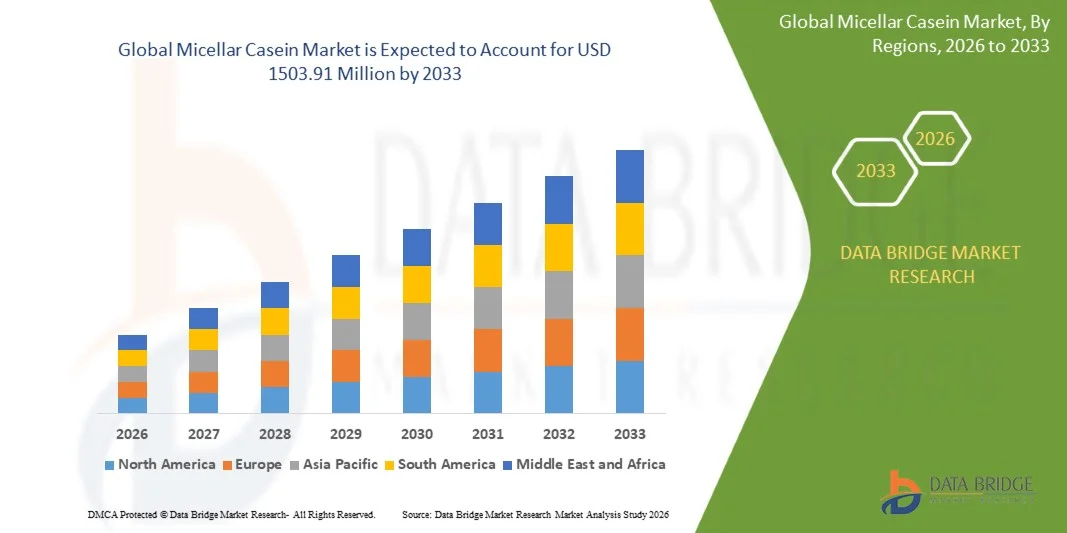
The Micellar Casein Market was valued at USD 940.02 Million in 2025 and is projected to reach USD 1503.91 Million by 2033, growing at a CAGR of 6.05% from 2026 to 2033. The market is experiencing consistent growth driven by rising demand for high-protein dietary supplements, increasing consumer preference for slow-digesting protein sources, and expanding applications in sports nutrition, clinical nutrition, and functional foods. Growing health and fitness awareness, along with the rising adoption of protein-enriched diets across global populations, is further supporting market expansion.
The increasing global focus on health, wellness, and preventive nutrition, combined with rapid growth in fitness-oriented lifestyles, is driving strong adoption of micellar casein-based products. Its sustained amino acid release profile makes it highly suitable for muscle recovery and weight management applications, especially among athletes and active consumers. In addition, expanding availability through e-commerce platforms, continuous product innovation in flavored protein powders, and growing use in medical and elderly nutrition formulations are further accelerating global market growth.
Key Market Trends & Insights
- North America dominated the Micellar Casein Market with the largest revenue share of 48.5% in 2025, supported by high consumer awareness of sports nutrition, strong penetration of protein-based dietary supplements, and well-established fitness and wellness culture
- The micellar casein concentrates segment led the market with a 61.5% share in 2025, driven by its cost-effectiveness and broad utilization across dietary supplements, sports nutrition products, and functional food applications
- Asia-Pacific is expected to be the fastest-growing region at a CAGR of 6.4% from 2026 to 2033, fueled by rising disposable incomes, increasing urbanization, and growing awareness of protein-based nutrition
- Clinical nutrition is the fastest-growing application type, projected to register a CAGR of 10.4% from 2026 to 2033, supported by rising demand for specialized nutritional solutions for aging populations and patients requiring long-term nutritional support
- The 1kg to 2kg segment dominated the packaging size category with a 41.4% revenue share in 2025, led by its balance between affordability, convenience, and long-term usage requirements
- Vanilla micellar casein accounted for 38.7% of the market in 2025, preferred by its widespread consumer acceptance and versatility across sports nutrition, meal replacement products, and protein beverages
- The keto friendly supplements segment is the fastest-growing allergens category, with a CAGR of 10.1% from 2026 to 2033, driven by the expanding popularity of ketogenic diets among health-conscious consumers
Market Size & Forecast
- Global Market Value (2025): USD 02 Million
- Expected Market Value (2033): USD 1503.91 Million
- Forecast CAGR (2026–2033): 6.05%
- Leading Region in 2025: North America
- Fastest Growing Region: Asia-Pacific
Report Scope and Micellar Casein Market Segmentation
|
Attributes |
Micellar Casein Key Market Insights |
|
Segments Covered |
|
|
Countries Covered |
North America · U.S. · Canada · Mexico Europe · Germany · France · U.K. · Netherlands · Switzerland · Belgium · Russia · Italy · Spain · Turkey · Rest of Europe Asia-Pacific · China · Japan · India · South Korea · Singapore · Malaysia · Australia · Thailand · Indonesia · Philippines · Rest of Asia-Pacific Middle East and Africa · Saudi Arabia · U.A.E. · South Africa · Egypt · Israel · Rest of Middle East and Africa South America · Brazil · Argentina · Rest of South America |
|
Key Market Players |
· Milk Specialties Global (U.S.) · Arla Foods Ingredients Group P/S (Denmark) · U.S. Dairy Export Council (U.S.) · Leprino Foods Company (U.S.) · ProteinCo. (U.S.) · Idaho Milk Products (U.S.) · Nutrimed Healthcare (India) · AMCO Proteins (U.S.) · Informa PLC (U.K.) · LACTALIS Ingredients (France) · Hoogwegt (Netherlands) · Glanbia plc (Ireland) · Ingredia (France) · NUTREND D. S. (Czech Republic) · FrieslandCampina (Netherlands) · Fonterra Co-operative Group Limited (New Zealand) · Noumi Limited (Australia) · NEW CULTURE (U.S.) · MEGGLE GmbH & Co. KG (Germany) |
|
Market Opportunities |
· Expansion in Clinical and Elderly Nutrition Applications · Growth of Premium Sports Nutrition and Protein Supplements Segment · Rising Demand from E-Commerce and Direct-to-Consumer Protein Brands |
|
Value Added Data Infosets |
In addition to the insights on market scenarios such as market value, growth rate, segmentation, geographical coverage, and major players, the market reports curated by the Data Bridge Market Research also include in-depth expert analysis, pricing analysis, brand share analysis, consumer survey, demography analysis, supply chain analysis, value chain analysis, raw material/consumables overview, vendor selection criteria, PESTLE Analysis, Porter Analysis, and regulatory framework. |
Micellar Casein Market Trends
Trend: Rising Demand for Slow-Digesting Protein in Sports and Clinical Nutrition
The Micellar Casein market is witnessing strong demand for slow-digesting protein ingredients due to their sustained amino acid release profile, which supports muscle recovery, satiety, and long-duration nutrition delivery. This trend is particularly strong across sports nutrition, weight management, and clinical dietary applications, where protein timing and absorption rate are critical. Increasing consumer preference for high-performance nutritional supplements is driving adoption in protein powders, meal replacements, and functional foods.
Companies such as Arla Foods Ingredients Group P/S are actively promoting micellar casein-based solutions such as Lacprodan MicelPure, which is widely used in clinical nutrition formulations to support protein intake in patient care and recovery applications.
Micellar Casein Market Dynamics
Key Market Driver: Increasing Health and Fitness Awareness
Rising global awareness of health, fitness, and preventive nutrition is significantly driving demand for micellar casein-based products. Consumers are increasingly adopting high-protein diets to support muscle growth, weight management, and overall wellness, boosting consumption of slow-release protein supplements. Growth in gym participation and sports nutrition usage is further strengthening market expansion across developed and emerging economies.
Brands such as Glanbia plc through Optimum Nutrition and other sports nutrition portfolios are widely using micellar casein in protein powders designed for overnight recovery and sustained protein intake.
Key Restraint/Challenge: High Production Cost and Limited Consumer Awareness
High production and purification costs associated with micellar casein extraction and processing remain a key challenge for market growth, limiting affordability in price-sensitive regions. In addition, limited consumer awareness compared to whey protein restricts wider adoption in mainstream nutrition segments. Complex manufacturing processes and stringent quality requirements further increase product costs and slow large-scale penetration.
Despite strong dairy protein production capabilities from companies such as FrieslandCampina and Fonterra Co-operative Group Limited, cost barriers continue to impact pricing competitiveness in mass-market applications.
Key Market Opportunity: Expansion in Clinical and Elderly Nutrition Applications
Growing demand for specialized nutrition in aging populations and clinical care settings presents a major opportunity for micellar casein manufacturers. Its slow digestion and sustained protein release make it highly suitable for medical nutrition, sarcopenia prevention, and long-term recovery diets. Increasing healthcare expenditure and rising prevalence of chronic conditions are supporting adoption in hospital nutrition formulations.
Organizations such as Nutricia (Danone) and Arla Foods Ingredients are actively incorporating micellar casein into medical nutrition solutions designed for elderly care and patient recovery programs across global healthcare systems.
Micellar Casein Market Scope
The micellar casein market is segmented on the basis of flavor, product type, application, allergens, end user, packaging size, and distribution channel.
- By Flavor
On the basis of flavor, the Micellar Casein Market is segmented into Vanilla Micellar Casein, Chocolate Honeycomb Micellar Casein, Raw/Natural Micellar Casein, Chocolate Micellar Casein, and Others. The Vanilla Micellar Casein segment dominated the market with the largest share of 38.7% in 2025, driven by its widespread consumer acceptance and versatility across sports nutrition, meal replacement products, and protein beverages. Vanilla remains the preferred flavor among fitness enthusiasts due to its compatibility with various formulations and ingredients. Manufacturers increasingly incorporate vanilla-flavored micellar casein into ready-to-mix powders and nutritional supplements to enhance consumer appeal. Its strong presence across retail and e-commerce channels further supports demand growth. Continuous product launches and premium flavor innovations reinforce the segment’s leading position.
The Chocolate Honeycomb Micellar Casein segment is projected to register the fastest growth at a CAGR of 8.9% from 2026 to 2033, driven by rising consumer demand for indulgent yet functional nutrition products. Manufacturers are increasingly introducing unique flavor combinations to differentiate their offerings in the competitive protein supplement market. The segment benefits from growing interest among younger consumers seeking enhanced taste experiences without compromising nutritional value. Expanding availability in specialty nutrition stores and online platforms is further accelerating adoption. Increasing investments in flavor innovation and premium protein formulations continue to support rapid segment expansion.
- By Product Type
On the basis of product type, the Micellar Casein Market is segmented into Micellar Casein Concentrates and Micellar Casein Isolates. The Micellar Casein Concentrates segment dominated the market with a share of 61.5% in 2025, supported by its cost-effectiveness and broad utilization across dietary supplements, sports nutrition products, and functional food applications. Concentrates retain valuable milk nutrients while delivering sustained amino acid release, making them highly preferred among consumers seeking prolonged muscle recovery benefits. Their relatively lower production costs encourage widespread adoption among manufacturers. Strong demand from fitness and wellness sectors further strengthens market penetration. Consistent product utilization across multiple nutrition categories supports segment dominance.
The Micellar Casein Isolates segment is projected to register the fastest growth at a CAGR of 9.8% from 2026 to 2033, driven by increasing demand for high-purity protein ingredients with reduced fat and lactose content. Consumers are increasingly prioritizing clean-label and premium nutritional products that provide superior protein concentration. Growing adoption among professional athletes and clinical nutrition users is contributing significantly to demand. Technological advancements in protein filtration and purification processes are improving product quality and availability. Rising investments in advanced nutritional formulations continue to accelerate segment growth.
- By Application
On the basis of application, the Micellar Casein Market is segmented into Dairy Beverages and Products, Bakery, Supplements, Nutritional Beverages, Clinical Nutrition, Meat Product, Nutritional Powders and Bars Protein Fortification, Dairy Beverages, Infant Nutrition, Cheese, Coffee, and Others. The Supplements segment dominated the market with the largest share of 34.8% in 2025, driven by growing consumer focus on muscle recovery, weight management, and long-lasting protein intake. Micellar casein is extensively utilized in protein powders and sports nutrition products due to its slow digestion characteristics. Increasing gym participation and fitness awareness are supporting consistent demand worldwide. Manufacturers continue to expand supplement portfolios featuring micellar casein as a premium protein source. Strong consumer preference for performance-oriented nutrition products reinforces segment leadership.
The Clinical Nutrition segment is projected to register the fastest growth at a CAGR of 10.4% from 2026 to 2033, driven by rising demand for specialized nutritional solutions for aging populations and patients requiring long-term nutritional support. Healthcare providers increasingly incorporate high-quality proteins into medical nutrition formulations to support recovery and muscle maintenance. Growing prevalence of chronic diseases and malnutrition-related conditions is creating substantial demand for clinical nutrition products. Advancements in medical dietary formulations are enhancing product effectiveness and adoption. Expanding healthcare expenditure across developed and emerging economies further supports growth.
- By Allergens
On the basis of allergens, the Micellar Casein Market is segmented into Dairy Free Diet, Gluten-Free Diet, Low Carb Diet, High Protein Diet, Keto Friendly Supplements, Vegetarian Diet, and Vegan Diet. The High Protein Diet segment dominated the market with a share of 32.9% in 2025, supported by increasing consumer preference for protein-rich diets aimed at fitness improvement, muscle development, and weight management. Micellar casein is widely recognized for its prolonged amino acid release profile, making it highly suitable for high-protein nutritional plans. Rising participation in sports and wellness activities continues to strengthen demand. Product manufacturers actively market micellar casein as a premium protein ingredient for daily nutrition. Growing awareness of protein consumption benefits further reinforces segment growth.
The Keto Friendly Supplements segment is projected to register the fastest growth at a CAGR of 10.1% from 2026 to 2033, driven by the expanding popularity of ketogenic diets among health-conscious consumers. Micellar casein aligns well with keto nutritional requirements due to its high protein and relatively low carbohydrate profile. Increasing demand for specialized dietary supplements is encouraging manufacturers to introduce keto-focused formulations. Social media influence and growing awareness regarding low-carbohydrate lifestyles are accelerating product adoption. Continuous innovation in ketogenic nutrition products supports strong future growth prospects.
- By End User
On the basis of end user, the Micellar Casein Market is segmented into Online Stores, Supermarkets, Specialized Stores, Sports Stores, Grocery Stores, Hypermarket, Supermarket, and Others. The Online Stores segment dominated the market with the largest share of 36.2% in 2025, driven by growing digital commerce penetration and consumer preference for convenient purchasing options. Online platforms offer extensive product variety, competitive pricing, and direct access to premium nutrition brands. Consumers increasingly rely on e-commerce channels to compare nutritional products and access detailed product information. Subscription-based supplement purchasing models further contribute to demand growth. Strong expansion of digital retail ecosystems continues to strengthen segment leadership.
The Sports Stores segment is projected to register the fastest growth at a CAGR of 9.6% from 2026 to 2033, driven by increasing demand for specialized nutrition products among athletes, bodybuilders, and fitness enthusiasts. Sports retailers provide expert guidance and access to performance-focused nutritional solutions, supporting consumer confidence. Expanding fitness culture across emerging economies is contributing significantly to sales growth. Manufacturers are strengthening partnerships with sports retail chains to improve product visibility. Rising demand for premium sports nutrition products continues to accelerate segment expansion.
- By Packaging Size
On the basis of packaging size, the Micellar Casein Market is segmented into 0.5kg to 1kg, 1kg to 2kg, 2kg to 4kg, 1 to10 Sachets, 4kg, and Above. The 1kg to 2kg segment dominated the market with a share of 41.4% in 2025, supported by its balance between affordability, convenience, and long-term usage requirements. This packaging format is widely preferred by regular supplement consumers seeking economical purchasing options without excessive bulk. Manufacturers frequently launch flagship products in this category due to strong consumer demand. The segment benefits from broad availability across online and offline retail channels. Consistent consumption patterns among fitness-focused consumers reinforce its market leadership.
The 4kg and Above segment is projected to register the fastest growth at a CAGR of 9.2% from 2026 to 2033, driven by increasing adoption among professional athletes, fitness centers, and heavy supplement users. Bulk packaging provides cost advantages and supports long-term consumption requirements. Rising awareness regarding value-based purchasing is encouraging consumers to shift toward larger pack sizes. Expanding demand from commercial fitness facilities and sports organizations is further supporting growth. Improved packaging technologies are enhancing product shelf life and convenience.
- By Distribution Channel
On the basis of distribution channel, the Micellar Casein Market is segmented into Business to Business and Business to Consumers. The Business to Consumers (B2C) segment dominated the market with the largest share of 68.3% in 2025, driven by strong retail demand for sports nutrition, dietary supplements, and functional food products. Direct consumer purchasing through online stores, supermarkets, and specialty nutrition retailers remains the primary sales channel for micellar casein products. Increasing health awareness and fitness participation continue to support consumer demand. Manufacturers are investing heavily in branding, digital marketing, and direct-to-consumer strategies to strengthen market presence. The broad accessibility of products across retail channels reinforces segment dominance.
The Business to Business (B2B) segment is projected to register the fastest growth at a CAGR of 8.7% from 2026 to 2033, driven by increasing utilization of micellar casein as a functional ingredient in food processing, clinical nutrition, and sports nutrition manufacturing. Food and beverage companies are incorporating high-quality protein ingredients into a wider range of products to meet evolving consumer preferences. Rising demand for protein fortification across multiple industries is creating substantial opportunities for ingredient suppliers. Strategic partnerships between protein manufacturers and food producers are expanding market reach. Growing industrial-scale application of micellar casein continues to support robust segment growth.
Micellar Casein Market Regional Analysis
North America dominated the micellar casein market and accounted for the largest revenue share of 48.5% in 2025, driven by high consumer awareness of sports nutrition, strong penetration of protein-based dietary supplements, and well-established fitness and wellness culture. The region benefits from a mature retail ecosystem, widespread availability of premium protein products, and strong adoption of clean-label nutritional ingredients. Consumers increasingly prefer slow-digesting proteins such as micellar casein for muscle recovery and weight management. In addition, the presence of leading nutrition brands and advanced product innovation capabilities continues to reinforce North America’s leadership position in the global market. Growing demand for functional foods and protein-enriched beverages further supports sustained regional expansion.
U.S. Micellar Casein Market Insight
The U.S. Micellar Casein market is witnessing strong growth driven by rising participation in fitness activities, increasing demand for high-protein diets, and expanding consumption of sports nutrition supplements. Consumers are actively shifting toward slow-release protein sources to support overnight muscle recovery and long-duration satiety. The country’s advanced retail infrastructure, strong e-commerce penetration, and widespread availability of international supplement brands are accelerating product adoption. In addition, continuous innovation in flavored protein powders and clinical nutrition applications is further strengthening market growth across the U.S.
Canada Micellar Casein Market Insight
The Canada Micellar Casein market is experiencing steady growth supported by increasing health consciousness and rising adoption of protein-rich dietary supplements among urban populations. Growing interest in active lifestyles and fitness programs is boosting demand for premium protein products across sports stores and online channels. The country’s strong regulatory framework for nutritional products ensures high product quality and consumer trust. In addition, expanding availability of clean-label and lactose-reduced protein formulations is further contributing to market growth in Canada.
Europe Micellar Casein Market Insight
The Europe Micellar Casein market is expanding steadily due to rising demand for functional nutrition, strong fitness culture, and increasing adoption of high-protein dietary products. Consumers across the region are increasingly incorporating slow-digesting proteins into daily diets for weight management and muscle maintenance. The region benefits from well-developed dairy processing industries and strong presence of nutritional supplement manufacturers. In addition, growing preference for natural and minimally processed protein ingredients is supporting sustained market growth. Increasing innovation in sports nutrition and clinical dietary applications continues to strengthen regional demand.
U.K. Micellar Casein Market Insight
The U.K. Micellar Casein market is growing steadily, driven by rising fitness awareness, strong gym culture, and increasing demand for protein supplements among young adults. Consumers are increasingly adopting micellar casein for nighttime protein intake and sustained amino acid release. The country’s well-developed e-commerce ecosystem and strong presence of sports nutrition brands are supporting product accessibility. In addition, rising focus on healthy aging and weight management is further contributing to market expansion in the U.K.
Germany Micellar Casein Market Insight
The Germany Micellar Casein market is expanding due to strong demand for high-quality protein ingredients, increasing health and wellness awareness, and growing preference for functional dairy-based nutrition. Consumers are focusing on clean-label, high-protein diets supported by scientifically backed nutritional benefits. The country’s advanced dairy processing industry and strong regulatory standards ensure high product quality and safety. In addition, rising adoption of sports nutrition and clinical dietary supplements is further accelerating market growth in Germany.
Asia-Pacific Micellar Casein Market Insight
The Asia-Pacific Micellar Casein market is expected to register the fastest growth with a CAGR of 6.4% from 2026 to 2033, driven by rising disposable incomes, increasing urbanization, and growing awareness of protein-based nutrition. Expanding fitness culture, especially among young consumers, is significantly boosting demand for sports nutrition and dietary supplements. The region is also witnessing rapid growth in e-commerce platforms, making premium protein products more accessible. In addition, increasing adoption of Western dietary habits and rising investments in health and wellness products are further accelerating regional market expansion.
Japan Micellar Casein Market Insight
The Japan Micellar Casein market is witnessing steady growth supported by strong health consciousness, aging population trends, and increasing demand for clinical nutrition products. Consumers are increasingly adopting high-quality protein supplements for muscle maintenance and healthy aging. The country’s advanced food processing industry and strong focus on functional foods are supporting product innovation. In addition, rising demand for convenient nutritional beverages and protein-enriched diets is further strengthening market growth in Japan.
China Micellar Casein Market Insight
The China Micellar Casein market is growing rapidly due to increasing fitness participation, expanding middle-class population, and rising demand for protein-rich dietary supplements. Consumers are becoming more health-conscious, driving strong adoption of sports nutrition and functional food products. The country’s robust e-commerce ecosystem and strong domestic supplement manufacturing base are enabling wide product availability. In addition, increasing influence of social media fitness trends and growing awareness of protein supplementation benefits are further driving market growth in China.
Micellar Casein Market Share
The micellar casein industry is primarily led by well-established companies, including:
- Milk Specialties Global (U.S.)
- Arla Foods Ingredients Group P/S (Denmark)
- S. Dairy Export Council (U.S.)
- Leprino Foods Company (U.S.)
- (U.S.)
- Idaho Milk Products (U.S.)
- Nutrimed Healthcare (India)
- AMCO Proteins (U.S.)
- Informa PLC (U.K.)
- LACTALIS Ingredients (France)
- Hoogwegt (Netherlands)
- Glanbia plc (Ireland)
- Ingredia (France)
- NUTREND D. S. (Czech Republic)
- FrieslandCampina (Netherlands)
- Fonterra Co-operative Group Limited (New Zealand)
- Noumi Limited (Australia)
- NEW CULTURE (U.S.)
- MEGGLE GmbH & Co. KG (Germany)
Latest Developments in Micellar Casein Market
- In February 2026, Glanbia Nutritionals reported strong volume growth in its dairy nutrition segment driven by rising demand for advanced protein ingredients including micellar casein. This development highlights accelerating demand for high-value dairy proteins across sports nutrition and functional food applications. The growth reflects a clear market shift toward premium, slow-digesting proteins used for muscle recovery and sustained nutrition. It also strengthens Glanbia’s competitive positioning in the global protein ingredients ecosystem, reinforcing its influence in formulation-driven nutrition markets
- In January 2026, FrieslandCampina completed a large-scale consolidation within its European dairy ingredients operations, strengthening its supply chain for high-purity milk proteins including micellar casein. This structural development enhances production efficiency and improves scalability of micellar casein supply across Europe. It supports stronger integration of dairy protein processing networks, reducing fragmentation in ingredient sourcing. The consolidation is expected to improve global export competitiveness and ensure more stable availability for sports nutrition and clinical nutrition manufacturers
- In November 2025, Arla Foods Ingredients launched Lacprodan MicelPure Medical, a specialized micellar casein isolate designed for clinical nutrition applications. This product expansion strengthens the role of micellar casein in hospital nutrition and medical dietary formulations. It improves product functionality through better solubility, neutral taste, and high protein density suitable for patient recovery needs. The launch reinforces the transition of micellar casein from sports nutrition into high-value clinical and therapeutic nutrition segments
- In May 2025, Arla Foods Ingredients expanded its distribution network through a strategic partnership to increase availability of native protein solutions across Oceania and Asia-Pacific markets. This expansion improves regional accessibility of micellar casein ingredients for sports nutrition and functional food manufacturers. It enhances supply chain reach in fast-growing protein consumption markets, supporting stronger penetration in emerging economies. The development also accelerates commercialization of premium dairy proteins in new geographic regions with rising fitness and health awareness
- In March 2025, Fonterra advanced its high-value dairy protein strategy by expanding production capabilities for milk protein ingredients including micellar casein through facility upgrades in New Zealand. This expansion increases global supply reliability for dairy protein ingredients and strengthens upstream processing capacity. It supports growing demand from global nutrition brands requiring consistent, high-quality protein inputs. The move also enhances Fonterra’s position in premium dairy ingredient markets while reducing exposure to commodity milk price volatility

- Interactive Data Analysis Dashboard
- Company Analysis Dashboard for high growth potential opportunities
- Research Analyst Access for customization & queries
- Competitor Analysis with Interactive dashboard
- Latest News, Updates & Trend analysis
- Harness the Power of Benchmark Analysis for Comprehensive Competitor Tracking
Global Micellar Casein Market, Supply Chain Analysis and Ecosystem Framework
To support market growth and help clients navigate the impact of geopolitical shifts, DBMR has integrated in-depth supply chain analysis into its Global Micellar Casein Market research reports. This addition empowers clients to respond effectively to global changes affecting their industries. The supply chain analysis section includes detailed insights such as Global Micellar Casein Market consumption and production by country, price trend analysis, the impact of tariffs and geopolitical developments, and import and export trends by country and HSN code. It also highlights major suppliers with data on production capacity and company profiles, as well as key importers and exporters. In addition to research, DBMR offers specialized supply chain consulting services backed by over a decade of experience, providing solutions like supplier discovery, supplier risk assessment, price trend analysis, impact evaluation of inflation and trade route changes, and comprehensive market trend analysis.
Data collection and base year analysis are done using data collection modules with large sample sizes. The stage includes obtaining market information or related data through various sources and strategies. It includes examining and planning all the data acquired from the past in advance. It likewise envelops the examination of information inconsistencies seen across different information sources. The market data is analysed and estimated using market statistical and coherent models. Also, market share analysis and key trend analysis are the major success factors in the market report. To know more, please request an analyst call or drop down your inquiry.
The key research methodology used by DBMR research team is data triangulation which involves data mining, analysis of the impact of data variables on the market and primary (industry expert) validation. Data models include Vendor Positioning Grid, Market Time Line Analysis, Market Overview and Guide, Company Positioning Grid, Patent Analysis, Pricing Analysis, Company Market Share Analysis, Standards of Measurement, Global versus Regional and Vendor Share Analysis. To know more about the research methodology, drop in an inquiry to speak to our industry experts.
Data Bridge Market Research is a leader in advanced formative research. We take pride in servicing our existing and new customers with data and analysis that match and suits their goal. The report can be customized to include price trend analysis of target brands understanding the market for additional countries (ask for the list of countries), clinical trial results data, literature review, refurbished market and product base analysis. Market analysis of target competitors can be analyzed from technology-based analysis to market portfolio strategies. We can add as many competitors that you require data about in the format and data style you are looking for. Our team of analysts can also provide you data in crude raw excel files pivot tables (Fact book) or can assist you in creating presentations from the data sets available in the report.













