


What is the Micro and Nano Programmable Logic Controller (PLC) Market Size and Growth Rate?
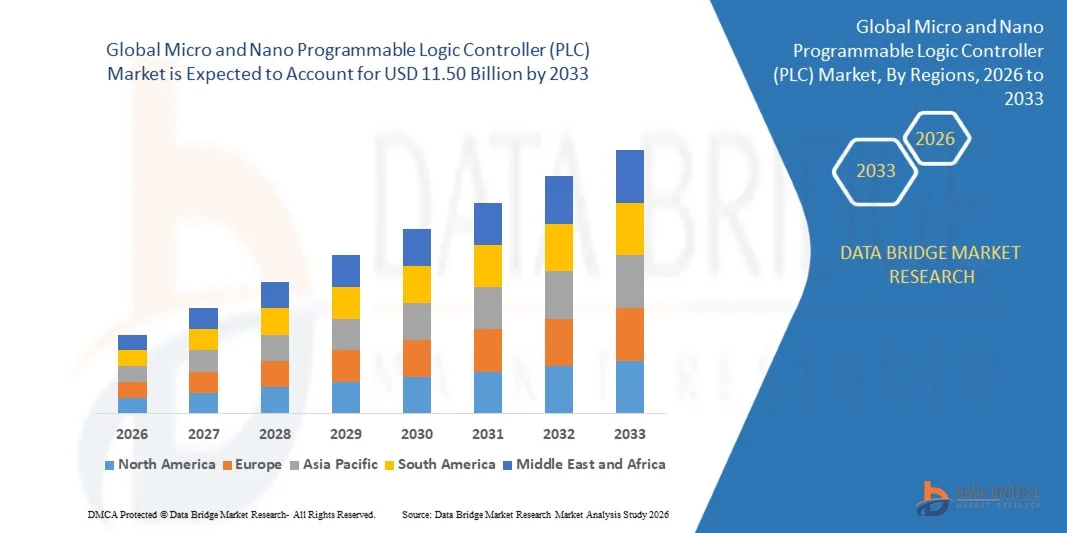
- As per Data Bridge Market Research analysis, the micro and nano programmable logic controller (PLC) market was valued at USD 6.45 billion in 2025 and is projected to reach USD 11.50 billion by 2033, growing at a CAGR of 7.50% from 2026 to 2033.
- The market is experiencing consistent growth driven by rising industrial automation, increasing adoption of compact and cost-effective control systems, growing demand for smart manufacturing solutions, and expanding applications across automotive, food and beverage, pharmaceuticals, energy, and building automation.
- The increasing adoption of Industry 4.0 technologies, combined with the growing need for flexible, space-efficient, and energy-efficient automation systems, is compelling manufacturers, system integrators, and industrial facilities to deploy micro and nano PLCs. Compact PLCs are increasingly replacing conventional control systems in small-scale and decentralized automation applications, offering cost-effective, reliable, and programmable solutions for machine control, process automation, and smart manufacturing.
Market Size & Forecast
- Global Market Value (2025): USD 6.45 Billion
- Expected Market Value (2033): USD 11.50 Billion
- Forecast CAGR (2026–2033): 7.50%
- Leading Region in 2025: North America
- Fastest Growing Region: Asia Pacific
What are the Major Takeaways of the Micro and Nano Programmable Logic Controller (PLC) Market?
- North America dominated the micro and nano programmable logic controller (PLC) market with the largest revenue share of 37.02% in 2025, supported by advanced manufacturing infrastructure, high adoption of industrial automation, and strong investments in smart manufacturing and Industry 4.0 technologies.
- Asia-Pacific is expected to be the fastest-growing region at a CAGR of 7.80% from 2026 to 2033, fueled by rapid industrialization, increasing factory automation, and rising adoption of compact PLCs across manufacturing and automotive industries.
- The micro PLC segment led the market with a 61.23% share in 2025, driven by its broad deployment across machine automation, manufacturing equipment, building automation, and process-control applications.
- Nano PLC are the fastest-growing type, projected to register a CAGR of 7.91%, reflecting the surge in demand for extremely compact and economical automation controllers.
- The hardware segment dominated the offering type category with a 69.38% revenue share in 2025, led by the essential role of PLC processors, I/O modules, communication interfaces, power supplies, and related components in automation systems.
- Fixed PLC accounted for 65.89% of the market share in 2025, preferred by manufacturers and machine builders for simple, standardized, and space-efficient automation applications.
- The home and building automation industry segment is the fastest-growing industry, with a CAGR of 8.69%, driven by increasing adoption of smart buildings and automated energy-management systems.
Report Scope and Micro and Nano Programmable Logic Controller (PLC) Market Segmentation
|
Attributes |
Micro and Nano Programmable Logic Controller (PLC) Key Market Insights |
|
Segments Covered |
|
|
Countries Covered |
North America
Europe
Asia-Pacific
Middle East and Africa
South America
|
|
Key Market Players |
|
|
Market Opportunities |
|
|
Value Added Data Infosets |
In addition to the market insights such as market value, growth rate, market segments, geographical coverage, market players, and market scenario, the market report curated by the Data Bridge Market Research team includes in-depth expert analysis, import/export analysis, pricing analysis, production consumption analysis, and pestle analysis. |
What is the Key Trend in the Micro and Nano Programmable Logic Controller (PLC) Market?
- Micro and nano PLCs are increasingly evolving toward connected, compact, and cybersecurity-enabled controllers, allowing small machines and building systems to integrate Ethernet, web visualization, scalable I/O, and secure communications without the complexity of larger PLC platforms.
- For instance, in September 2025, Rockwell Automation’s Micro800 family offered compact controllers with embedded Ethernet, serial connectivity, data logging, and expandable I/O, highlighting the increasing integration of networking and digital capabilities into small PLC platforms.
- Integrated connectivity enables micro and nano PLCs to exchange operational data with HMIs, sensors, cloud platforms, and industrial networks, supporting decentralized automation and real-time monitoring.
- Machine builders are increasingly adopting compact PLCs for standalone machines and remote automation where limited installation space, flexible communications, and simple commissioning are important requirements.
- For instance, in November 2024, Beckhoff expanded its CX7000 compact controller series with the CX7291 and CX7293, adding BACnet/IP and PROFINET RT connectivity for applications including HVAC, lighting, security, and fire-alarm systems. The controllers retain an extremely compact 71 × 100 × 73 mm footprint, demonstrating the integration of advanced networking into small controllers.
- As manufacturers increasingly demand compact controllers that combine connectivity, scalability, cybersecurity, and simplified engineering, the shift toward smart and connected micro and nano PLCs is expected to accelerate, reinforcing their role in decentralized industrial and building automation.
What are the Key Drivers of the Micro and Nano Programmable Logic Controller (PLC) Market?
- The rapid expansion of industrial automation and smart manufacturing is increasing demand for compact PLCs capable of controlling machines, production equipment, and decentralized processes while supporting flexible communications and scalable
- For instance, in March 2026, Siemens introduced LOGO! 9 with up to 800 function blocks and expanded capacity of up to 64 digital inputs, 60 digital outputs, 16 analog inputs, and 16 analog outputs, demonstrating how demand for more capable compact controllers is expanding micro-PLC applications in machine and building automation.
- Automotive, food and beverage, packaging, building automation, and machine-building companies are integrating micro and nano PLCs to reduce panel space, simplify control architectures, and improve machine-level automation.
- For instance, in October 2025, Rockwell Automation launched FactoryTalk Design Workbench, a free engineering software specifically designed for Micro800 controllers, providing a unified environment for programming, configuration, and troubleshooting. The launch supports compact automation systems in packaging, water and wastewater, agriculture, and material handling, demonstrating growing demand for efficient micro-PLC-based machine automation.
- With manufacturers increasingly prioritizing flexible, space-efficient, and digitally connected automation solutions, demand for micro and nano PLCs will continue expanding across decentralized machine control and smart manufacturing applications.
Which Factors are Challenging the Growth of the Micro and Nano Programmable Logic Controller (PLC) Market?
- Increasing connectivity of micro and nano PLCs to industrial networks creates greater cybersecurity exposure, requiring manufacturers to invest in secure communications, network segmentation, authentication, firmware updates, and vulnerability management.
- For instance, in January 2024, Control Design reported that PLCs were among the industrial automation products most affected by semiconductor shortages, with some PLC components experiencing extended lead times and forcing system integrators to choose between costly redesigns and project delays
- These cybersecurity requirements can increase system complexity and maintenance costs, particularly for smaller manufacturers and facilities with limited industrial cybersecurity expertise.
- The growing cybersecurity requirements associated with connected PLC deployments continue to challenge adoption, particularly among small and medium-sized manufacturers that lack dedicated OT security resources. As micro and nano PLCs become increasingly networked, organizations must balance compact automation, remote connectivity, and operational efficiency with the additional costs and technical requirements of securing industrial control environments.
- Limited processing capacity and scalability can constrain micro and nano PLC deployment in increasingly complex automation environments, as manufacturers may need to migrate to larger PLCs or industrial PCs when applications require greater I/O density, advanced analytics, or sophisticated control functions.
- For instance, in December 2024, CISA, FBI, NSA, and international partners issued a joint advisory after cyber actors exploited Unitronics Vision Series PLCs, highlighting the security risks associated with internet-connected PLCs and the additional cybersecurity requirements that can constrain deployment.
- These limitations can make micro and nano PLCs less suitable for highly complex production environments, requiring manufacturers to balance their lower cost and compact footprint against performance, scalability, and future expansion requirements.
How is the Micro and Nano Programmable Logic Controller (PLC) Market Segmented?
The micro and nano programmable logic controller (PLC) market is segmented on the basis of type, offering, architecture, and industry.
- By Type
On the basis of type, the micro and nano PLC market is segmented into micro PLC and nano PLC. The micro PLC segment dominated the market with a 61.23% share in 2025, supported by its broad deployment across machine automation, manufacturing equipment, building automation, and process-control applications. Micro PLCs provide greater processing capacity and I/O flexibility than nano PLCs while retaining a compact footprint. Their ability to integrate communication interfaces, expansion modules, and programming functions makes them suitable for a wide range of industrial applications. Demand is further supported by the increasing automation of small and medium-sized machines and production lines. Micro PLCs also offer a balance between affordability, functionality, and scalability for manufacturers.
The nano PLC segment is projected to register the fastest growth at a CAGR of 7.91% through 2033, driven by increasing demand for extremely compact and economical automation controllers. Nano PLCs are particularly suitable for simple machine-control applications where limited I/O and processing requirements are sufficient. Their small physical footprint enables manufacturers to reduce control-panel space and installation requirements. Growing adoption in building automation, lighting control, HVAC systems, small conveyors, and standalone machines is creating additional demand. The increasing deployment of decentralized automation is also encouraging the use of small controllers closer to individual machines and devices.
- By Offering
On the basis of offering, the market is segmented into hardware, software, and services. The hardware segment dominated the market with a 69.38% share in 2025, owing to the essential role of PLC processors, I/O modules, communication interfaces, power supplies, and related components in automation systems. Hardware represents the core physical infrastructure required to implement micro and nano PLC-based control systems. Increasing investments in factory automation and machine modernization are directly supporting hardware demand. Replacement of aging control equipment is also generating recurring opportunities for PLC hardware suppliers. Manufacturers are increasingly introducing compact controllers with integrated communication, cybersecurity, and expanded I/O capabilities.
The software segment is expected to witness the fastest growth at a CAGR of 7.87% through 2033, driven by increasing demand for advanced programming, visualization, diagnostics, and data-management capabilities. Modern PLC software enables engineers to configure controllers, monitor equipment, troubleshoot faults, and optimize machine performance. Integration with industrial communication networks and digital manufacturing platforms is further increasing the importance of software. Cloud connectivity and remote monitoring are also encouraging greater use of software-based PLC management tools. Artificial intelligence and data analytics are creating opportunities for more intelligent control and predictive maintenance functions.
- By Architecture
On the basis of architecture, the market is segmented into fixed PLC and modular PLC. The fixed PLC segment dominated the market with a 65.89% share in 2025, primarily because of its compact design, lower cost, and suitability for straightforward automation applications. Fixed PLCs integrate the processor and a predefined number of I/O points within a single unit, reducing installation complexity. They are widely deployed in small machines, packaging equipment, conveyor systems, lighting controls, and building automation. Their simplified configuration allows manufacturers and system integrators to reduce engineering and commissioning time. Fixed PLCs are particularly attractive for applications where I/O requirements remain relatively stable throughout the equipment lifecycle.
The modular PLC segment is projected to experience the fastest growth at a CAGR of 8.12% through 2033, supported by rising demand for flexible and scalable automation architectures. Modular PLCs allow users to add or modify I/O modules according to changing application requirements. This flexibility is particularly valuable for manufacturers expanding production capacity or introducing new machine functions. Modular architectures can also accommodate specialized communication, analog, motion-control, and safety modules. Increasing adoption of smart manufacturing is encouraging manufacturers to deploy systems that can evolve with changing production requirements. The ability to expand functionality without completely replacing the controller is further improving the long-term value proposition of modular PLCs.
- By Industry
On the basis of industry, the market is segmented into automotive industry, chemicals and fertilizers industry, food and beverages industry, home and building automation industry, metals and mining industry, oil and gas, pharmaceutical industry, pulp and paper industry, power, and water and wastewater industry. The automotive industry dominated the market with 32% share in 2025, supported by extensive automation across vehicle assembly, material handling, welding, painting, inspection, and component manufacturing. Automotive manufacturers increasingly use compact PLCs for machine-level control and production-line automation. The expansion of electric vehicle and battery manufacturing is creating additional automation requirements across assembly and testing processes. Increasing investments in smart factories are also encouraging the integration of PLCs with sensors, robotics, HMIs, and industrial networks.
The home and building automation industry is projected to witness the fastest growth at a CAGR of 8.63% from 2026 to 2023, driven by increasing adoption of smart buildings and automated energy-management systems. Micro and nano PLCs can control HVAC, lighting, ventilation, access systems, pumps, and other building equipment within compact automation architectures. Growing emphasis on energy efficiency is encouraging building owners to adopt automated systems capable of monitoring and optimizing energy consumption. The expansion of smart commercial buildings is further increasing demand for connected and remotely manageable control systems. Integration with Ethernet, building-management systems, sensors, and IoT technologies is broadening the application potential of compact PLCs.
Which Region Holds the Largest Share of the Micro and Nano Programmable Logic Controller (PLC) Market?
- North America dominated the micro and nano programmable logic controller (PLC) market with the largest revenue share of 37.02% in 2025, supported by advanced manufacturing infrastructure, high adoption of industrial automation, and strong investments in smart manufacturing and Industry 4.0 technologies.
- The region also benefits from strong demand across automotive, food and beverage, pharmaceutical, and building automation applications, alongside increasing investments in smart manufacturing and Industry 4.0 technologies. The presence of leading PLC manufacturers and continued modernization of industrial control systems further strengthens North America’s leadership position in the global market
U.S. Micro and Nano Programmable Logic Controller (PLC) Market Insight
The U.S. micro and nano programmable logic controller (PLC) market is witnessing strong growth due to rising investments in industrial automation, smart manufacturing, and advanced control technologies. The country’s mature manufacturing ecosystem, along with increasing adoption of compact, connected, and intelligent PLC systems, is driving demand across automotive, food and beverage, pharmaceutical, and building automation applications. In addition, growing emphasis on Industry 4.0, operational efficiency, and real-time process monitoring is accelerating PLC adoption among manufacturers and industrial facilities.
Asia-Pacific Micro and Nano Programmable Logic Controller (PLC) Market Insight
The Asia-Pacific micro and nano programmable logic controller (PLC) market is expected to witness rapid growth, driven by expanding manufacturing activities, industrialization, and rising investments in factory automation across countries such as China, Japan, and India. Growing adoption of smart manufacturing technologies, increasing demand for compact automation solutions, and modernization of industrial facilities are supporting regional market expansion. Additionally, the growing presence of automotive, electronics, food processing, and machinery manufacturing industries is accelerating PLC adoption across the region.
Japan Micro and Nano Programmable Logic Controller (PLC) Market Insight
The Japan micro and nano programmable logic controller (PLC) market is witnessing consistent growth due to rising investments in factory automation, robotics, and advanced manufacturing technologies. Automotive manufacturers, electronics companies, and industrial machinery producers are increasingly adopting compact PLC systems for machine control, production-line automation, and process monitoring. Moreover, increasing integration of connected automation, smart manufacturing, and energy-efficient control technologies, along with Japan’s strong industrial automation ecosystem, is further contributing to market growth.
China Micro and Nano Programmable Logic Controller (PLC) Market Insight
The China micro and nano programmable logic controller (PLC) market is growing rapidly, driven by expanding manufacturing capacity, industrial automation, and increasing government focus on smart factories and digital transformation. Growing adoption of connected and intelligent PLC platforms across automotive, electronics, machinery, food and beverage, and building automation applications is significantly boosting market demand. In addition, rising investments in industrial modernization, increasing automation of production processes, and rapid development of advanced manufacturing technologies are positioning China as one of the fastest-growing markets for micro and nano PLCs globally.
U.K. Micro and Nano Programmable Logic Controller (PLC) Market Insight
The U.K. micro and nano programmable logic controller (PLC) market is experiencing steady growth, supported by rising adoption of industrial automation, smart manufacturing, and building automation technologies. Increasing investments in modernizing manufacturing facilities and growing demand for compact, flexible, and cost-effective control solutions are contributing to market growth. Furthermore, integration of industrial connectivity, remote monitoring, and intelligent automation technologies is improving operational efficiency, positioning the U.K. as an important market for micro and nano PLC solutions.
Germany Micro and Nano Programmable Logic Controller (PLC) Market Insight
The Germany micro and nano programmable logic controller (PLC) market is expanding steadily due to the country’s strong manufacturing base, advanced industrial automation capabilities, and increasing adoption of Industry 4.0 technologies. Automotive companies, machinery manufacturers, and industrial facilities are increasingly utilizing compact PLCs for machine control, production automation, and process monitoring activities. Continuous advancements in connected automation, industrial communication, and intelligent control technologies, along with strong emphasis on manufacturing efficiency and digitalization, are further driving market growth in Germany.
Which are the Top Companies in Micro and Nano Programmable Logic Controller (PLC) Market?
The micro and nano programmable logic controller (PLC) industry is primarily led by well-established companies, including:
- Siemens AG (Germany)
- Mitsubishi Electric Corporation (Japan)
- Beckhoff Automation GmbH & Co KG (Germany)
- Panasonic Industry Co., Ltd. (Japan)
- Rockwell Automation, Inc. (U.S.)
- KEYENCE CORPORATION (Japan)
- Fuji Electric Co., Ltd. (Japan)
- IDEC Corporation (Japan)
- Delta Electronics, Inc. (Taiwan)
- Schneider Electric (France)
- LS ELECTRIC Co., Ltd. (South Korea)
- WAGO GmbH & Co. KG (Germany)
- Phoenix Contact GmbH & Co. KG (Germany)
- OMRON Corporation (Japan)
- Yokogawa Electric Corporation (Japan)
- Emerson Electric Co. (U.S.)
- Honeywell International Inc. (U.S.)
- ABB (Switzerland)
- Bosch Rexroth AG (Germany)
- Eaton Corporation plc (Ireland)
What are Latest Developments in Micro and Nano Programmable Logic Controller (PLC) Market?
- In October 2025, Rockwell Automation announced the launch of FactoryTalk Design Workbench, a free design software specifically developed for micro control systems. Version 1 supports Micro800 controllers and provides a unified environment for programming, configuration, and troubleshooting. The software is designed for manufacturers and machine builders working with compact, standalone automation systems and supports multiple devices simultaneously. The development strengthens Rockwell Automation’s micro-PLC ecosystem by simplifying engineering workflows and improving the management of compact automation applications.
- In November 2024, Beckhoff expanded its CX7000 Embedded PC series with new compact controllers supporting BACnet/IP and PROFINET RT. The new CX7291 and CX7293 devices were designed for small-controller applications, including HVAC, lighting, security, and fire-alarm systems. The controllers combine compact form factors with PC-based control and scalable I/O capabilities, enabling automation solutions where limited installation space is important. The expansion demonstrates continued development of compact control platforms for building and industrial automation.
- In August 2023, Siemens announced upgrades across its SIMATIC S7 programmable logic controller family, highlighting continued development of modern PLC technologies for industrial automation. The company described ongoing enhancements to the S7 portfolio as part of its efforts to address evolving automation requirements. The developments included advances across the SIMATIC controller ecosystem and reflected the increasing integration of connectivity, performance, and digitalization into PLC-based automation. This supported the broader shift toward more capable and connected compact and industrial control systems.
- In February 2022, Omron highlighted the integration of MQTT and secure communication capabilities across its Sysmac controller portfolio, including the NX1P series. MQTT function blocks enabled controllers to communicate with connected systems, while secure sockets using TLS supported protected communications on NX1P controllers. These capabilities strengthened the connectivity of compact PLC platforms and supported their use in increasingly connected industrial automation environments. The development reflects the growing importance of IIoT communication and cybersecurity in PLC-based control systems.
- In August 2021, Siemens marked the tenth anniversary of the SIMATIC S7-1200, highlighting the platform’s role in redefining compact PLCs and machine automation. Siemens noted that the S7-1200 introduced a new approach to compact PLC technology by combining the controller with the TIA Portal engineering environment. The platform was developed to support machine automation while providing a future-oriented architecture for industrial applications. The milestone demonstrated the sustained adoption and evolution of compact PLC technology within modern automation systems.

- Interactive Data Analysis Dashboard
- Company Analysis Dashboard for high growth potential opportunities
- Research Analyst Access for customization & queries
- Competitor Analysis with Interactive dashboard
- Latest News, Updates & Trend analysis
- Harness the Power of Benchmark Analysis for Comprehensive Competitor Tracking
Data collection and base year analysis are done using data collection modules with large sample sizes. The stage includes obtaining market information or related data through various sources and strategies. It includes examining and planning all the data acquired from the past in advance. It likewise envelops the examination of information inconsistencies seen across different information sources. The market data is analysed and estimated using market statistical and coherent models. Also, market share analysis and key trend analysis are the major success factors in the market report. To know more, please request an analyst call or drop down your inquiry.
The key research methodology used by DBMR research team is data triangulation which involves data mining, analysis of the impact of data variables on the market and primary (industry expert) validation. Data models include Vendor Positioning Grid, Market Time Line Analysis, Market Overview and Guide, Company Positioning Grid, Patent Analysis, Pricing Analysis, Company Market Share Analysis, Standards of Measurement, Global versus Regional and Vendor Share Analysis. To know more about the research methodology, drop in an inquiry to speak to our industry experts.
Data Bridge Market Research is a leader in advanced formative research. We take pride in servicing our existing and new customers with data and analysis that match and suits their goal. The report can be customized to include price trend analysis of target brands understanding the market for additional countries (ask for the list of countries), clinical trial results data, literature review, refurbished market and product base analysis. Market analysis of target competitors can be analyzed from technology-based analysis to market portfolio strategies. We can add as many competitors that you require data about in the format and data style you are looking for. Our team of analysts can also provide you data in crude raw excel files pivot tables (Fact book) or can assist you in creating presentations from the data sets available in the report.













